In this article
- Why can a page rank on Google and never be mentioned by ChatGPT?
- What does the research say about the overlap?
- Does low overlap mean ChatGPT ignores Google?
- How do the engines differ?
- What does the gap look like on a real site?
- Which gap costs you more: the ranking or the mention?
- How do you diagnose your own gap? The Rank–Mention matrix
- Why does a page that ranks go unnamed? 7 checks
- What makes an assistant name a business that does not rank top 10?
- How do you measure the gap in 30 minutes?
- How do you close the gap?
- What should you not conclude from this?
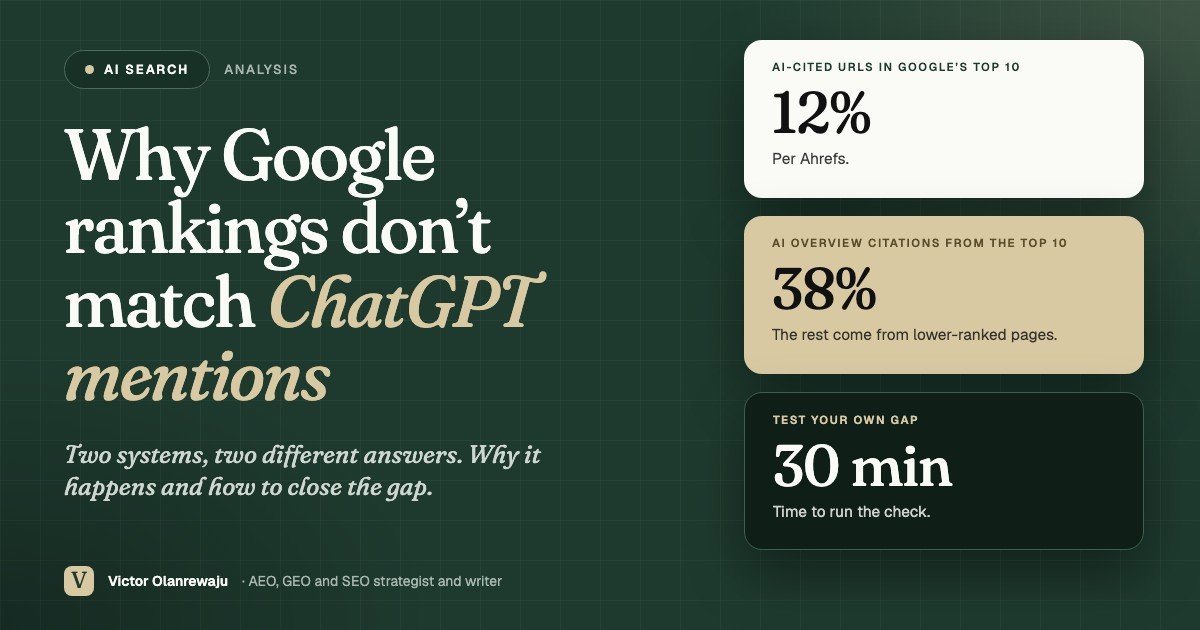
In short: A Google ranking and a ChatGPT mention are different results from different systems, so they often disagree. In Ahrefs’ study of 15,000 long-tail prompts, only about 12% of the URLs cited by ChatGPT, Gemini and Copilot ranked in Google’s top 10 for the original prompt. Google’s own AI Overviews now take about 38% of their citations from the top 10, down from about 76% a year earlier. The systems retrieve differently: an assistant fans one question out into many searches, then decides which businesses to name, not just which pages to list. I have seen both gaps on live sites, including a Lagos eyewear store that ranked 4th and 5th on Google and was ChatGPT’s first pick in 5 of 6 answers. Below: why it happens, how the engines differ, a four-box matrix to diagnose your own gap, seven reasons a ranking page goes unnamed, and a 30-minute test.
12%
of AI-cited URLs that ranked in Google’s top 10 for the original prompt (Ahrefs, 15,000 prompts)
76% to 38%
share of Google AI Overview citations taken from the top 10, July 2025 to March 2026 (Ahrefs)
8% vs 15%
share of visits that clicked a result link with and without a Google AI summary (Pew, March 2025)
4.4x
modeled value of an AI search visitor against an organic one (Semrush)
If you are on page one of Google and ChatGPT has never named you, nothing is broken. It also is not a coincidence, and it is not fixed by more of the same SEO. Teams that report on rankings alone are watching one ledger while buyers increasingly use another. This guide explains the gap with sources, shows how the major engines differ, gives you a way to diagnose it and a test to measure it, and ends with a 90-day plan. It builds on my guides to AI citation versus AI recommendation and how SEO, AEO and GEO fit together. Figures are as of October 2026, and every study is labeled with its date, method and limits.
Why can a page rank on Google and never be mentioned by ChatGPT?
Because ranking and being named answer two different questions. Google ranks pages for a query. An assistant writes an answer, and for a buying question it often chooses a short list of businesses. Five differences explain most of the gap:
- The assistant searches more than once. Google’s documentation says its AI features may “issue multiple related searches across subtopics and data sources.” Ahrefs describes the same behavior as query fan-out and uses it to explain why AI citations rarely match the ranking for the original prompt. A page can be absent from the results for your exact words and present in the results for a related sub-question.
- The assistant selects facts, not just pages. A page needs to hold something an answer can use: a price range, a delivery time, who something is for. A page can rank on authority and say nothing quotable.
- The assistant names businesses. For a buying question the answer is often a short list. Being one of the pages Google ranks does not put you on that list.
- Access is controlled separately. To appear in ChatGPT’s search features, OpenAI’s crawler OAI-SearchBot has to be allowed in. OpenAI’s documentation says sites that block it will not be shown in ChatGPT search answers, though they can still appear as navigational links. A Google ranking tells you nothing about whether that door is open.
- The answers are not stable. SparkToro’s study found that asking the same question repeatedly returns different brand lists. A single ChatGPT result is a sample, not a rank.
What does query fan-out look like?
Here is an illustration of how one buyer prompt can become several searches. The sub-searches are invented to show the mechanism, not taken from a real log. Notice that your page might win on one of them without ranking for the sentence the buyer typed.
Sub-search 1
accountants for small businesses in Lagos
Who exists and where. Firm pages, directories and local results.
Sub-search 2
how much does an accountant cost for a small business in Nigeria
A page that states prices plainly can be picked here, even if it never ranked for the original sentence.
Where a specific page can win
Sub-search 3
is it worth hiring an accountant or using software
Comparison and advice content.
Sub-search 4
reviews and complaints about local accounting firms
Third-party mentions, review sites and forums.
What does the research say about the overlap?
Four studies matter, and they measure different things, so read the limits as carefully as the headline.
| Study | Sample and method | Finding | Limits the authors give |
|---|---|---|---|
| Ahrefs, Aug 11, 2025: AI-cited URLs against Google’s top 10 | 15,000 long-tail queries run through Ahrefs Brand Radar on Google, Bing, ChatGPT, Gemini, Copilot and Perplexity; citations cross-checked with rankings | About 12% of URLs cited by ChatGPT, Gemini and Copilot ranked in Google’s top 10 for the original prompt. By assistant: Perplexity 28.6%, Gemini 8.6%, Copilot 8.2%, ChatGPT 8.0% (in-text) and 6.1% (references) | Data collected in early July 2025 and may have changed. Long-tail prompts only. Measures rank for the original prompt, not for the related searches an assistant also runs |
| Ahrefs, Jul 21, 2025: Google AI Overviews | 1.9 million citations from 1 million AI Overviews, top three citations per response | 76.1% of cited pages ranked in the top 10, 9.5% at 11 to 100 and 14.4% beyond the top 100 | Ahrefs calls the link between rank and citation “positive yet moderate” and says other factors, such as freshness, also play a part |
| Ahrefs, Mar 2, 2026: the update | 863,000 keyword results and 4 million AI Overview URLs | The top-10 share fell to 37.9%, with 31.2% from positions 11 to 100 and 31.0% from beyond the top 100. Ahrefs links the shift to Gemini 3 powering AI Overviews from January 2026 and to more reliance on fan-out searches | Ahrefs improved its citation parsing between the two studies, so the 76% and 38% are not an exact like-for-like comparison |
| SparkToro and Gumshoe.ai: how stable are AI answers? | 2,961 responses from 600 volunteers asking a dozen questions across ChatGPT, Claude and Google’s AI tools | Asked the same question repeatedly, the tools almost never returned the same list of brands, in the same order, of the same length | Not peer reviewed, and the authors say neither is a data scientist |
AI-cited URLs that rank in Google’s top 10 for the original prompt, by assistant (%)
Does low overlap mean ChatGPT ignores Google?
No, and this is the most common misreading. The Ahrefs figure measures where a cited URL ranks for the original prompt. An assistant also runs related searches, and the cited page may rank well for one of those. So “only 12% rank in the top 10” does not prove that the other 88% rank nowhere. It proves that your position for the question as the buyer typed it is a weak predictor of whether you are cited. The same logic explains Google’s own shift from 76% to 38%: the model pulls from more searches than the one on the screen.
It also does not mean rankings are worthless. Google says a page must be indexed and eligible to show in Search with a snippet to appear as a supporting link in AI Overviews or AI Mode, and that there are “no additional requirements” beyond that. In Ahrefs’ March 2026 data, 37.9% of citations still came from the top 10. Ranking is a way in. It is not the whole door. See Google Search Central: AI features and your website.
Where Google AI Overview citations rank on Google, March 2026 (%)
How do the engines differ?
“AI search” is several products with different habits. The overlap with Google varies a lot, and so does the crawler you must let in.
| Engine | Overlap with Google’s top 10 | What controls access | What to remember |
|---|---|---|---|
| Google AI Overviews and AI Mode | 37.9% of citations (Ahrefs, March 2026) | The page must be indexed and eligible to show with a snippet | Closest to classic SEO, but over 60% of citations came from outside the top 10 |
| ChatGPT search | 8.0% in-text, 6.1% references (Ahrefs, July 2025 data) | OAI-SearchBot. Blocking it keeps you out of ChatGPT search answers. OpenAI says changes can take about 24 hours | The least tied to Google rank in the study, so specific, quotable pages matter most |
| Perplexity | 28.6% (Ahrefs, July 2025 data) | PerplexityBot | The most similar to Google here, so classic SEO carries furthest |
| Gemini | 8.6% | See my crawler guide | Low overlap despite being a Google product, which shows how much fan-out changes retrieval |
| Copilot | 8.2% | See my crawler guide | Measured against both Google and Bing, overlap was about 10% to 11% |
| Claude | Not covered by these studies | Claude-SearchBot, covered in my crawler guide | Test it separately. In my Lens & Co data it was the only engine connected, so it needs its own checks |
The practical reading: do not optimize for “AI” as one thing. If your buyers use Perplexity, rank-led SEO takes you much further. If they use ChatGPT, a page that states the answer plainly, on a site the crawler can read, matters more than your position on the exact query.
What does the gap look like on a real site?
Two of my client cases show it from opposite sides. In both, the queries are not word-for-word the same on Google and in ChatGPT, so treat them as illustrations, not a controlled test.
Case 1: ranked 4th and 5th on Google, ChatGPT’s first pick
Lens & Co by Tiara is a young Lagos eyewear store whose content began going live on September 27, 2026. By October 10, 2026, four Google searches I tracked had it on page one of Google Nigeria, but not at the top: 5th, 4th, 5th and 4th. The same site was listed first in 5 of 6 ChatGPT answers and named in all 6 Google AI Overviews, first in 4 of them. The full evidence is in the Lens & Co case study.
| Where | What I checked | Result for the store |
|---|---|---|
| Google, signed out, Nigeria | Four tracked searches, such as “screen glasses in Lagos” | 4th or 5th organic result on each, plus a local listing at 5.0 stars from 63 reviews |
| ChatGPT, signed in | Six buyer questions: best stores, original not fake, prescription, nationwide delivery, best online stores in Lagos, eye strain | Listed first in 5; second, behind an eye clinic, in 1 |
| Google AI Overviews, signed in, Lagos | Six searches | Named in 6, first in 4, with its own pages as source cards in 5 |
Why would a store at 4th and 5th beat the sites above it in the answers? I cannot prove the cause, but the evidence points one way. ChatGPT repeated facts from the store’s own pages almost word for word: delivery in 24 to 48 hours in Lagos and 3 to 7 business days elsewhere, a virtual try-on, prescription lenses through partner opticians. Each page was built to answer one buyer question. Pages built that way hand an assistant something to quote.
Case 2: first on Google, but not first in the answer
LAGE Lightings, a Lagos luxury lighting brand, shows the reverse. On October 12, 2026, in a signed-in Google search with the location set to Lagos, the first organic result for “where to buy droplights in Lagos” was the store’s droplights page. Google’s AI Overview above it still led with markets in Alaba. Separately, in July 2026 ChatGPT listed the brand seventh for luxury chandeliers in Lagos, and by October it was the first of five picks. The products and queries differ, so this is not a clean comparison, but the pattern is the same: a Google position did not decide the order of the answer. Details are in the LAGE Lightings case study.
What did Claude read instead?
For Lens & Co, AmasoAI recorded which sites Claude consulted across its checks between September 29 and October 10, 2026. Marketplaces dominated, and the store already appeared ahead of its closest brand rival. That is the other half of the gap: you are not only competing for a ranking, you are competing with whatever the assistant chooses to read.
Sites Claude consulted for the tracked questions, Sep 29 to Oct 10, 2026 (times)
Which gap costs you more: the ranking or the mention?
Both, but in different ways, and the data shows why neither ledger can be ignored. Think of two ledgers. The clicks ledger is Google: still the bulk of the traffic, but each result earns fewer clicks when an AI summary appears. The shortlist ledger is the assistants: small in referral traffic, but they decide which businesses a buyer considers.
- Fewer clicks when a summary appears. Pew Research Center tracked 900 US adults in March 2025: users clicked a traditional result link in 8% of visits when a Google AI summary appeared, against 15% when it did not, and clicked a source inside the summary in 1% of visits. Ahrefs’ February 4, 2026 update, on 300,000 keywords, found a 58% lower average click-through rate for the top result when an AI Overview was present (correlational, desktop). SparkToro reported that 68.01% of US Google searches in January to April 2026 ended without a click. See Pew, Ahrefs and SparkToro.
- AI referrals are small but growing fast. Similarweb counted over 1.13 billion AI referral visits to the top 1,000 websites in June 2025, up 357% on June 2024, with ChatGPT responsible for more than 80% of them. Google sent about 191 billion referrals in the same month, so AI referrals were roughly 0.6% of that by my arithmetic. See Similarweb.
- The visitors who do arrive may be worth more. Semrush’s AI search study estimated an AI search visitor at 4.4 times the value of an organic one by conversion rate, but states that its projections are extrapolations. See Semrush.
Monthly referral visits to the top 1,000 websites, June 2025 (billions)
What this means for the gap: rankings still bring most of today’s clicks, so do not abandon them. But the mention decides whether you are on the shortlist, and visitors arriving from an answer have already seen your name. A business that is strong in only one ledger is leaving money on the table. For the full statistics and caveats, see AI search statistics for 2026.
How do you diagnose your own gap? The Rank–Mention matrix
This is the working model I use with clients. It is my own framework, not a published standard, and the causes are hypotheses to test. For each buyer question that matters to you, place yourself in one of four boxes by asking two things: do I rank in Google’s top 10, and does an assistant name my business?
| Named by the assistant | Not named | |
|---|---|---|
| Ranks on Google (top 10) | 1. Aligned. Protect it. Re-test monthly and keep facts current. | 2. Ranked but unnamed. The usual cause is that the page is findable but not quotable, the facts differ between sites, or the crawler door is closed. Check robots.txt for OAI-SearchBot first, then rewrite the page to answer the question in its first lines. |
| Does not rank | 3. Named without ranking. Often earned through other pages, mentions elsewhere or sub-question results. Do not celebrate yet: add the page that makes it repeatable, and start ranking so you own both channels. | 4. Invisible. Start with one page per buyer question, consistent facts everywhere and a few independent mentions. |
Most businesses I audit have a mix, and the useful finding is which questions fall in box 2, because those are the cheapest wins: the page already ranks, so the audience and authority exist. Box 3 is the most dangerous to misread, because a lucky mention feels like success and disappears when the answer changes.
Why does a page that ranks go unnamed? 7 checks
When a question lands in box 2, I run these seven checks in order. It is a practitioner’s checklist from my own audits, not a study, and each one is quick to test.
| Check | How to test it | Typical fix |
|---|---|---|
| 1. The crawler is blocked | Open yourdomain.com/robots.txt and look for rules covering OAI-SearchBot, PerplexityBot and Claude-SearchBot. Check your firewall and CDN settings too | Allow the search crawlers. OpenAI says changes can take about 24 hours |
| 2. The answer is not in the first lines | Read the first 100 words. Do they answer the buyer’s question in plain words? | Lead with the answer, the price or the condition, then explain |
| 3. The facts are vague | Search the page for numbers, times, places and conditions | Add specifics an answer can quote: ranges, timings, who it is for |
| 4. The facts conflict across the web | Compare name, address, phone and description on your site, Google Business Profile and social profiles | Make them identical everywhere |
| 5. A competitor’s page answers the sub-question better | Search two or three related questions and see who ranks and what they state | Write the page that answers the specific sub-question, not a general one |
| 6. Few independent mentions | Search your brand name and category. Do other sites, videos or lists mention you? | Earn mentions through guest pieces, expert quotes, lists and podcasts |
| 7. The page is stale | Check dates, prices and any claims that have changed | Update and show the date you reviewed it |
What does a rewrite look like?
Here is an illustration of checks 2 and 3 with placeholder facts. It is example wording, not a real client page.
| Before: findable, not quotable | After: findable and quotable |
|---|---|
| “Welcome to our accounting practice. We are passionate about helping local businesses grow with tailored solutions. Contact us to find out more.” | “We prepare VAT returns and annual accounts for small businesses in Lagos. Fees start from [your price] a month, and most returns are filed within [your timeframe]. We work with [who it suits]. Here is what is included and what is not.” |
The second version states who, what, how much and how long. An assistant can lift any of those facts into an answer. The first gives it nothing to lift.
What makes an assistant name a business that does not rank top 10?
I would not claim a single cause, but four signals recur in the data and in my cases:
- Independent mentions of the brand. In Ahrefs’ study of 75,000 brands (December 12, 2025, brands with Domain Rating above 40, across ChatGPT, AI Mode and AI Overviews), YouTube mentions showed the strongest correlation with AI visibility, at about 0.74, and branded web mentions followed at 0.66 to 0.71. Domain Rating (0.27 to 0.33) and backlinks correlated far more weakly. The authors stress that correlation is not causation, and the sample is larger, more established brands than most small businesses. Read it in full at Ahrefs: brand visibility in AI.
- Quotable, specific facts on the page. Prices, times, who it is for, how it works. The Lens & Co pages were quoted back almost verbatim.
- Consistent facts across the web. In one Lens & Co answer, ChatGPT placed the store in Ojodu; in the others it said Ogba. A single consistent address, phone number and description on every profile removes that uncertainty.
- Access. The crawler must be allowed in. My guide to AI crawlers and robots.txt lists which bots to allow.
What tracks AI visibility most closely: correlation with brand mentions in AI answers (upper end of each reported range)
How do you measure the gap in 30 minutes?
You need a spreadsheet, a logged-out browser window and ten buyer questions. This is a shortened version of my repeatable test for what ChatGPT says about your business.
- Write ten questions a buyer would really type, one per row: “best [what you sell] in [city],” “is [your category] genuine,” “who delivers [product] to [city].”
- Record your Google position. Search each in a signed-out window with the country set to your market. Note your organic position, whether an AI Overview appears and whether it names you.
- Ask ChatGPT, Gemini, Claude and Perplexity the same ten questions. Note whether you are named, where you are in the list and which sources are shown.
- Repeat each question three times on different days. SparkToro’s study shows single answers are unreliable, so judge the pattern, not one screenshot.
- Place each question in the matrix above and score it.
| Question | AI Overview | ChatGPT | Gemini | Claude | Perplexity | Box | |
|---|---|---|---|---|---|---|---|
| Question 1 | position | named? | 1st, 2nd, cited, absent | same | same | same | 1 to 4 |
| Question 2 |
How do you score it?
Use two rates and one gap. These are my working definitions, not an industry standard.
- Top-10 rate: the share of your questions where you rank in Google’s top 10.
- Mention rate: the share of questions where an assistant names you in at least two of your three runs.
- Gap: top-10 rate minus mention rate. A large positive gap means many box 2 questions: you rank but are not named. A negative gap means box 3: you are named without ranking.
Illustration with invented numbers: you rank in the top 10 for 7 of 10 questions (70%) but are named in 3 of 10 (30%). The gap is 40 points, so start with the seven checks on the questions where you rank but are not named. If instead you rank for 2 and are named for 5, the gap is minus 30 points: you are being named on the strength of other pages or mentions, and the priority is to build the pages that make it repeatable.
A few caveats. Signed-in accounts can be personalized, so use a logged-out window where you can. Ten questions are a snapshot, not the whole market. And a tool that automates this is only as good as its sampling, a point I make in my AmasoAI review.
Which tools can automate the test?
If you already pay for Ahrefs or Semrush, start with the AI features you own. Ahrefs Brand Radar covers Google AI Overviews, ChatGPT, Perplexity, Copilot, Gemini and Claude. Semrush’s AI Visibility Toolkit starts from $99 a month per domain as an add-on to a paid plan. AmasoAI is a WordPress plugin with a free plan and paid plans from $6.99 a month, which I compare in my review. On Google’s side, Google says traffic from its AI features is counted in the Web search type of Search Console’s Performance report, and in Google Analytics 4 you can look for an AI assistant channel in your traffic acquisition report. Whatever you use, keep a manual check as your control.
If you sell software, the layer-by-layer version of this advice is in SEO vs AEO vs GEO for B2B SaaS.
How do you close the gap?
- Open the door. Allow OAI-SearchBot, Claude-SearchBot, PerplexityBot and Googlebot in robots.txt, and check your host’s firewall and CDN are not blocking them.
- Write one page for each buyer question, answer-first. The first lines should state the answer in plain words, with the price, time or condition an assistant can quote. My guide to how to get cited by ChatGPT shows the structure.
- Make every fact match everywhere. Name, address, phone, opening hours and one-line description should be identical on your site, Google Business Profile and social profiles.
- Earn independent mentions. Guest articles, expert quotes, lists and podcasts in your niche. Do not buy placement and present it as editorial.
- Add structured data only where it is true and useful. Google says it is not required for AI features, but accurate markup helps machines read the page. See my guide to schema markup for AEO and GEO.
- Re-test monthly and track direction. Judge by the share of questions where you are named across several runs, not by any one position.
What does a 90-day plan look like?
| Window | Focus | Output |
|---|---|---|
| Days 1 to 14 | Diagnose | Ten buyer questions tested, matrix filled in, top-10 rate, mention rate and gap calculated. Robots.txt and firewall checked |
| Days 15 to 45 | Fix the box 2 pages | The pages that rank but go unnamed rewritten answer-first, with facts made consistent across your profiles |
| Days 46 to 75 | Build for boxes 3 and 4 | One new page per unanswered buyer question, plus two or three independent mentions pursued |
| Days 76 to 90 | Re-test | The same ten questions run three times on different days, compared with the baseline |
On timing, Lens & Co’s first ChatGPT captures came about two weeks after content started going live, and LAGE Lightings moved from seventh to first over about three months. Those are two examples, not a promise. Nobody can guarantee a position in an AI answer.
Fixing a box 2 page usually needs a writer with specific skills. I list them, with a hiring scorecard, in who can write content that gets cited by ChatGPT, Gemini and Perplexity.
What should you not conclude from this?
- “SEO is dead.” No. Google says a page must be indexed and snippet-eligible to be a supporting link in its AI features, and in Ahrefs’ latest data more than a third of AI Overview citations still come from the top 10. Rankings are still the base layer for Google and a route to Perplexity.
- “Rankings do not matter for AI.” Also no. They matter less than most people assume for ChatGPT and more than zero for others. Treat them as one signal among several.
- “One ChatGPT screenshot proves we are fine.” It does not, because the answers vary run to run.
- “Ahrefs’ 12% is a law.” It is one study of long-tail prompts with data from July 2025, and it measures rank for the original prompt only.
- “My evidence proves a method.” Two client cases do not make a study. Mine are small, early, partly signed in and partly my own work. Use them as worked examples and run the test on your own questions.
If you want a map of your own gap, I run this exact test as part of a free AI visibility audit. See the pricing page for what happens after: foundation builds start at $390 one-time and growth retainers at $290 a month. Or tell me what you want to be found for.
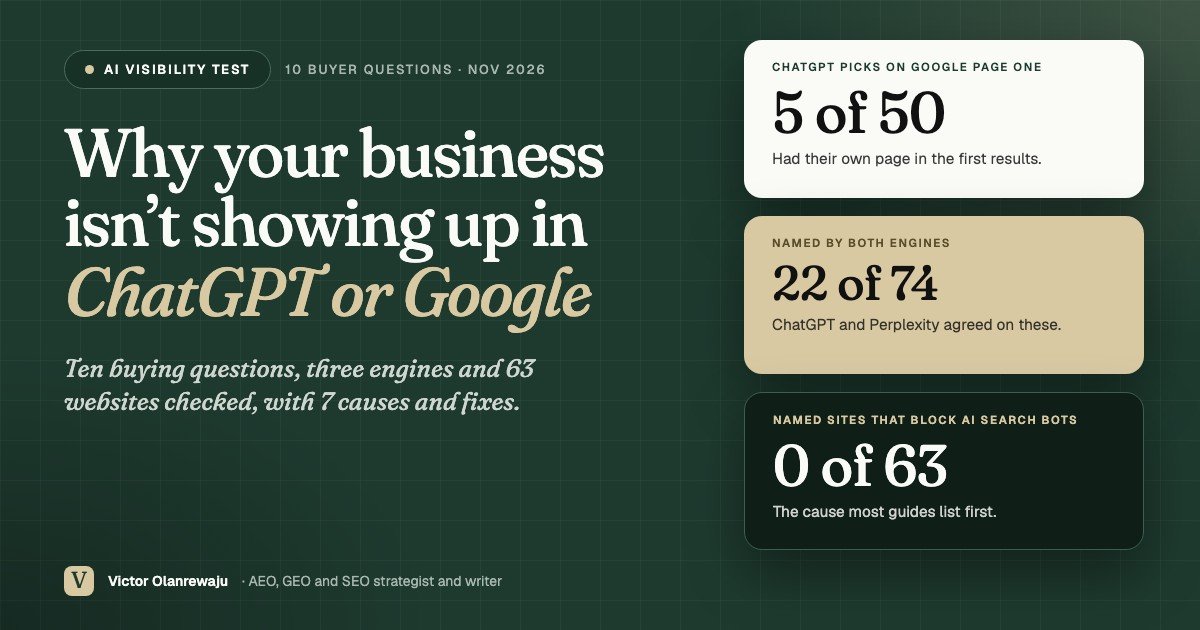
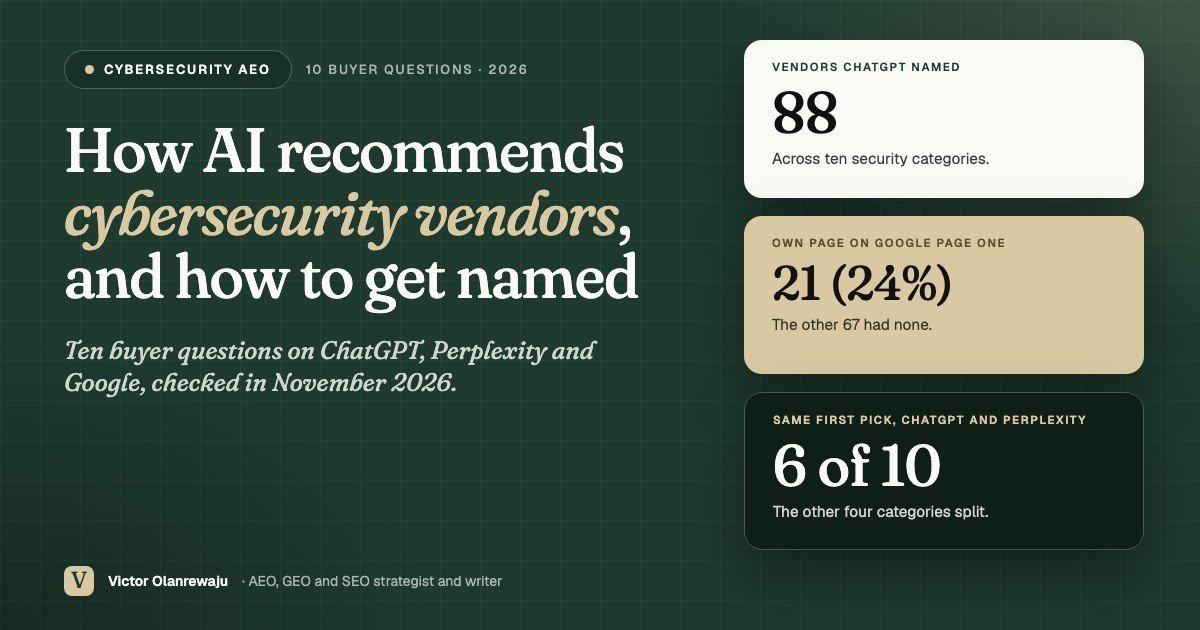
Keep reading: To see the gap between ranking and being named, read why your business isn’t showing up in ChatGPT or Google. In that test, ChatGPT named 50 businesses and only 5 had their own page on Google’s first page. For software buyers, I ran ten “best software” questions through ChatGPT in how SaaS products get named in ChatGPT’s best-software answers. For a security buyer’s version of this, I tested ten vendor questions in how AI recommends cybersecurity vendors. For retail and e-commerce, the Black Friday plan is in how to get products recommended by ChatGPT, Gemini and Perplexity. For regulated finance brands, see why NerdWallet gets cited instead of your fintech.
Frequently asked questions
Why do I rank on Google but not get mentioned by ChatGPT?
Because they are different systems. Google ranks pages for one query. ChatGPT runs several related searches, then chooses which businesses to name. In Ahrefs’ study of 15,000 prompts, only about 12% of URLs cited by ChatGPT, Gemini and Copilot ranked in Google’s top 10 for the original prompt. Common causes are a page that is findable but not quotable, facts that differ across sites, and OAI-SearchBot being blocked.
Do I need to rank on Google to be mentioned by ChatGPT?
Not necessarily. In Ahrefs’ August 2025 data only 8.0% of ChatGPT in-text citations and 6.1% of its references ranked in Google’s top 10 for the original prompt. A Lagos store I worked with ranked 4th and 5th on Google and was listed first by ChatGPT in 5 of 6 answers. Ranking still helps, especially for Google AI Overviews and Perplexity, but it is not the gate.
How many Google AI Overview citations come from the top 10?
About 38%. Ahrefs found 37.9% in March 2026 across 863,000 keyword results and 4 million AI Overview URLs, against about 76% in July 2025. Ahrefs improved its citation parsing between the two studies, so the figures are not an exact comparison.
Why would ChatGPT cite a page that does not rank?
The cited page may rank for a related search that ChatGPT ran as part of query fan-out, or it may hold a clear fact the answer needs. Ahrefs’ figure measures rank for the original prompt only, so a low overlap does not mean the other pages rank nowhere.
Which crawler lets ChatGPT search show my site?
OAI-SearchBot. OpenAI says it is used to surface websites in ChatGPT’s search features, and that sites blocking it will not be shown in ChatGPT search answers, though they can still appear as navigational links. OpenAI says robots.txt changes can take about 24 hours to take effect.
Is Perplexity more like Google than ChatGPT is?
In Ahrefs’ August 2025 data, yes. 28.6% of Perplexity’s cited URLs ranked in Google’s top 10 for the original prompt, against 8.0% for ChatGPT in-text citations and 8.6% for Gemini. Classic SEO therefore carries further for Perplexity than for ChatGPT.
What is the Rank–Mention matrix?
It is my four-box diagnostic. For each buyer question you ask whether you rank in Google’s top 10 and whether an assistant names you. The boxes are aligned, ranked but unnamed, named without ranking, and invisible. It is my own working model, not a published standard.
How do I check whether I am mentioned by AI assistants?
Write ten questions a buyer would type, search them on Google in a signed-out window, then ask ChatGPT, Gemini, Claude and Perplexity the same questions. Record your Google position, whether you are named and where, and repeat on three different days, because answers vary between runs.
Do backlinks help me get mentioned by AI?
Less than most people assume. In Ahrefs’ study of 75,000 brands, branded web mentions (0.66 to 0.71) and YouTube mentions (about 0.74) correlated with AI visibility far more strongly than Domain Rating (0.27 to 0.33), and backlinks correlated weakly. It is correlation, not proof of cause, and the sample was larger brands.
Is SEO still worth doing if AI answers differ from Google rankings?
Yes. Google says a page must be indexed and eligible to show with a snippet to be a supporting link in AI Overviews and AI Mode, and more than a third of AI Overview citations still come from the top 10. Google also still sends far more referral traffic than AI assistants: about 191 billion against about 1.13 billion in June 2025 on Similarweb’s data. SEO is the base layer, and AEO and GEO add the work of being quotable and named.
Are visitors from AI assistants worth more?
Possibly. Semrush’s study estimated an AI search visitor at 4.4 times the value of an organic visitor by conversion rate, but it states that its projections are extrapolations. Measure conversion by source on your own site before budgeting on that number.
How long does it take to close the gap?
It varies and cannot be guaranteed. Lens & Co by Tiara was listed first by ChatGPT in 5 of 6 answers about two weeks after its content started going live. LAGE Lightings moved from seventh to first in ChatGPT over about three months. Treat both as examples, not forecasts.
Can you check my own Google and ChatGPT gap?
Yes. Vatam starts with a free AI visibility audit, which includes this test. Its published prices, in US dollars, are foundation builds from $390 one-time and growth retainers from $290 a month, with each scope agreed in writing before work starts.