In this article
- Why security buyers ask AI first, and why it matters to your pipeline
- The test: 10 security buying questions on ChatGPT, Perplexity and Google
- What a security buyer actually sees
- 7 findings that should change your plan
- 3 questions for your next leadership meeting
- What decision makers ask AI, and what vendors should publish in return
- How an AI shortlist forms
- Open the door first: your firewall may be hiding you from AI
- The security vendor trust stack
- A 10-step plan to get your security product named
- 4 page templates security buyers read
- The 12-prompt test: see where you stand today
- Where I come in
- How I checked, and the limits
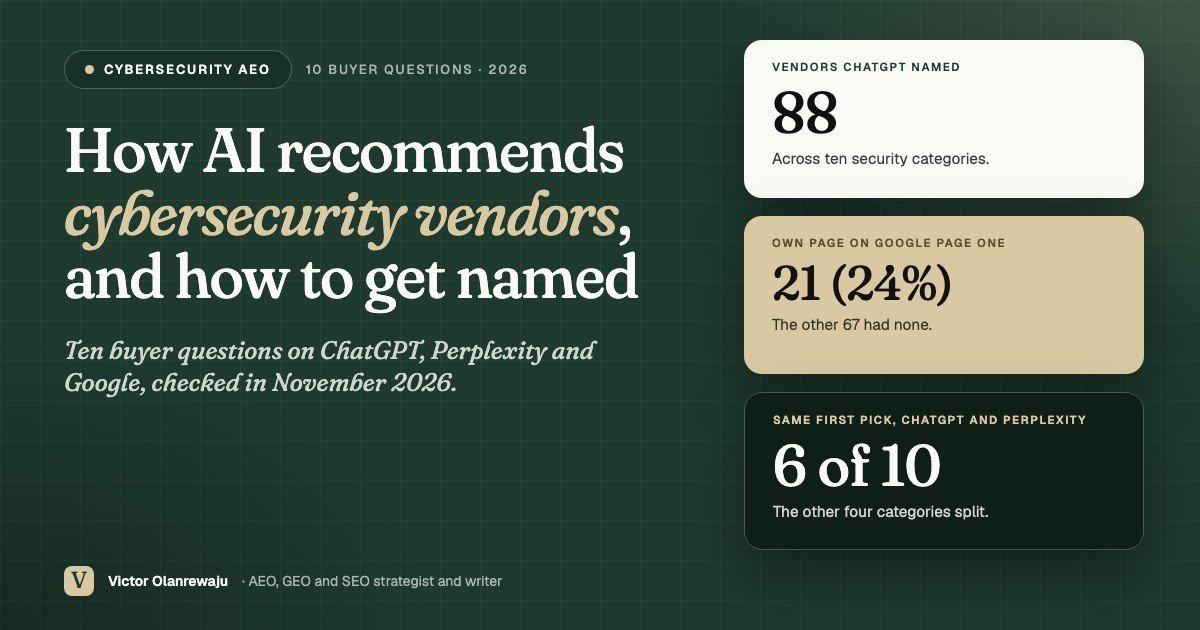
In short: AI engines are building cybersecurity shortlists before your sales team ever hears about the deal, and Google rank does not decide who gets named. On November 4, 2026, I asked ChatGPT and Perplexity ten security buying questions, from EDR to SOC 2 automation, and ran the same ten searches on Google. ChatGPT named 88 vendors. Only 21 of them (24%) had their own page on Google’s first page. ChatGPT and Perplexity agreed on the first pick in 6 of 10 categories and split in the other four. Here is the pattern in my data: the engines agreed in categories with one or two clear leaders, and split in the rest. To get named, you need three things: pages that say who you are best for, proof a skeptical CISO can verify, and crawlers allowed in. Below you get the data, six screenshots, a ten-step plan and a 12-prompt test.
21 of 88
Vendors ChatGPT named that had their own page on Google page one
6 of 10
Categories where ChatGPT and Perplexity agreed on the first pick
0 of 94
Perplexity citations that went to Gartner or Reddit
$4.99M
Average cost of a data breach, a record high (IBM, 2026)
I typed one question into ChatGPT: “best SIEM software in the US.” It named ten vendors. Microsoft Sentinel came first. Splunk and CrowdStrike followed. Then I asked Claude the same thing, and it put Splunk first. Google’s AI Overview agreed with Claude. Perplexity sided with ChatGPT. Four engines gave two different winners. And none of them asked for a demo, a form or an email address. They simply told me who to call.
That moment now decides deals. G2 surveyed 1,076 software buyers in March 2026. Half of them (51%) start with an AI chatbot. Even more telling, 69% ended up buying from a different vendor than the one they first planned to buy. So the shortlist forms before anyone visits your site. In security, the stakes are heavier still. IBM puts the average data breach at $4.99 million, a record high. Verizon says 31% of breaches now begin with a software vulnerability. Gartner expects about $244 billion in security spending this year. In short, buyers have the money and the fear. They ask AI first, and they act on what it says.
So I tested it properly. I asked ChatGPT and Perplexity ten questions that security teams type every week. Then I ran the same ten searches on Google. The result is uncomfortable. ChatGPT named 88 vendors, yet only 21 had their own page on Google’s first page. Microsoft appeared in six of the ten answers. And in four categories, the two engines could not agree on who comes first. Ranking on Google, it turns out, does not put you on the shortlist. Something else does. This article shows you what it is.
This article is for the people who sign off on security budgets and security growth: founders, CMOs, heads of demand generation, and the CISOs who want to understand how their shortlists are being shaped. It will show you what the engines say, where they get it, and what to publish so your product gets named. You will get:
- The data: ten categories, 88 named vendors, two AI engines and Google side by side.
- The screenshots: what a buyer actually sees in ChatGPT, Perplexity, Claude and Google.
- Seven findings: including which sources each engine trusts, and one surprise about vendor-written roundups.
- The access check: why your CDN or firewall may be hiding you from AI.
- The plan: ten steps, a trust stack, four page templates and a 12-prompt test.
If you want the plan first, jump to it. Otherwise, start with the test.
Why security buyers ask AI first, and why it matters to your pipeline
Three forces are pushing in the same direction. First, buying is moving to chatbots. Second, security is among the sectors where AI already sends the most visits. Third, security buyers verify before they trust, and AI shortlists shape who gets verified.
| Finding | Number | Why it matters to a security vendor |
|---|---|---|
| B2B software buyers who start research with an AI chatbot (G2, March 2026) | 51%, up from 29% in 2025 | The shortlist forms before your website is visited. |
| Buyers who chose a different vendor than planned (G2) | 69% | An AI answer can pull a deal away from the vendor on the original list. |
| AI referrals as a share of traffic, IT sector (Conductor) | 2.80%, the highest of 10 industries; ChatGPT drives 88.5% | Technology buyers already click through from AI, mostly from ChatGPT. |
| Average cost of a data breach (IBM and Ponemon, 2026) | $4.99M, up 12%, a record high | Buyers are anxious, so they compare carefully and ask many questions. |
| Breaches that begin with a software vulnerability (Verizon, 2026) | 31%; ransomware in 48% of breaches | Vulnerability, EDR and email buyers have urgent, specific needs. |
| Worldwide information security spending in 2026 (Gartner) | About $244 billion | The prize is large, and the competition for each shortlist is intense. |
Read those together. Security buyers are afraid, well funded and early adopters of AI. That is the ideal audience for an engine that answers “who should I buy?” in ten seconds. Sources for each number: G2, Conductor, IBM, Verizon and Gartner. For wider context, see my AI search statistics.
The test: 10 security buying questions on ChatGPT, Perplexity and Google
I picked ten categories that security teams buy every year. Each is a question a real buyer would type. For ChatGPT and Perplexity, I added “in the US” so the answers would not default to my location in Kigali. For Google, I ran the same words with US settings and personalization off. Then I recorded three things. First, which vendors ChatGPT named, in order. Second, which vendor Perplexity led with. Third, which of ChatGPT’s vendors had their own website among Google’s page-one organic results. Reviews, forums and analyst pages did not count as a vendor’s own page.
| Buyer question | ChatGPT first | Perplexity first | Vendors named | Own page on Google p1 |
|---|---|---|---|---|
| Endpoint protection for small business | Bitdefender GravityZone | Microsoft Defender for Business | 8 | 2: Huntress, SentinelOne |
| SIEM software | Microsoft Sentinel | Microsoft Sentinel | 10 | 2: Palo Alto Networks, Wazuh |
| Penetration testing companies | Bishop Fox | NetSPI | 10 | 1: Synack |
| Managed detection and response | Sophos MDR | CrowdStrike | 10 | 3: SentinelOne, Rapid7, Huntress |
| Vulnerability management | Tenable | Tenable | 8 | 0 |
| Identity and access management | Microsoft Entra ID | Microsoft Entra ID | 6 | 0 |
| Email security | Proofpoint | Microsoft Defender for Office 365 | 10 | 3: Proofpoint, IRONSCALES, Barracuda |
| SOC 2 compliance automation | Vanta | Vanta | 6 | 1: Vanta |
| Security awareness training | KnowBe4 | KnowBe4 | 10 | 4: Proofpoint, SoSafe, Huntress, KnowBe4 |
| Cloud security posture management | Wiz | Wiz | 10 | 5: Orca, SentinelOne, Palo Alto, Sysdig, Wiz |
| Total | Same first pick in 6 of 10 | 88 | 21 (24%) | |
Share of ChatGPT’s named vendors with their own page on Google page one (%)
What a security buyer actually sees
Numbers help. Screenshots show the experience. Start with ChatGPT. Here is the answer to “best endpoint protection software for small business in the US.” Notice the structure. It opens with one recommendation. It ranks eight products. And each product gets a short “best for” tag, four bullets and a link.
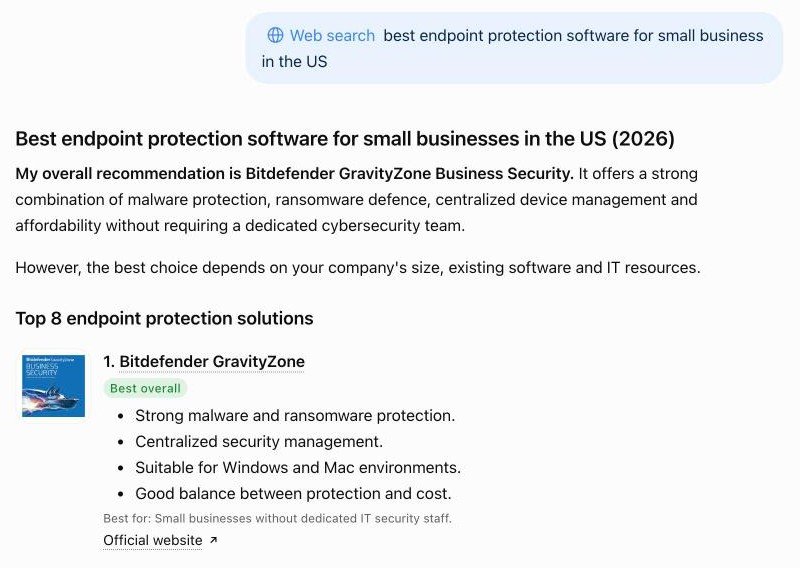
Then comes the part most marketers have not seen. ChatGPT did not stop at the list. It added a short intake form at the bottom of the answer, with four questions: how large is the business, which devices need protection, what is the monthly budget per device, and does the company have an IT or security team. It even pre-selected likely answers.
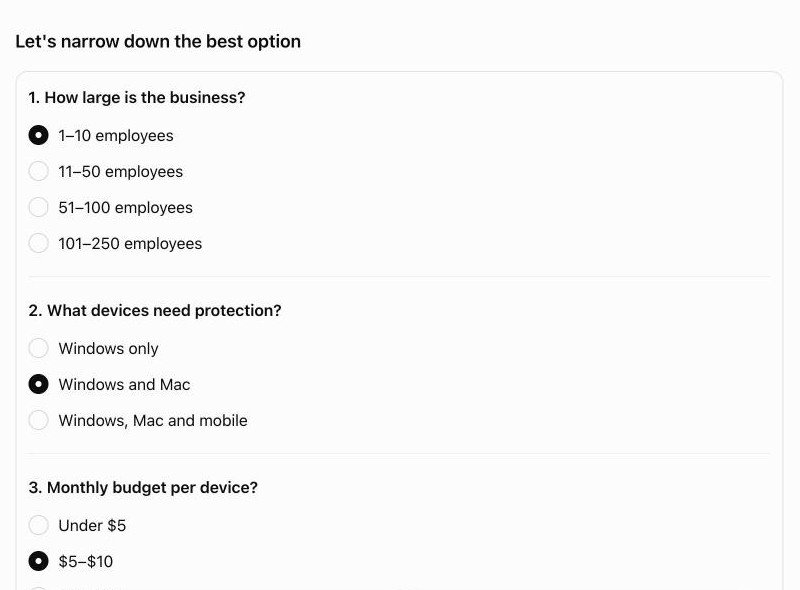
That intake form is a warning and a gift. It is a warning because ChatGPT now qualifies the buyer on your behalf: size, devices, budget, team. If your pages never mention those four things, the AI has nothing to match you against. It is a gift because you now know what to publish. State who you are for, in those exact terms.
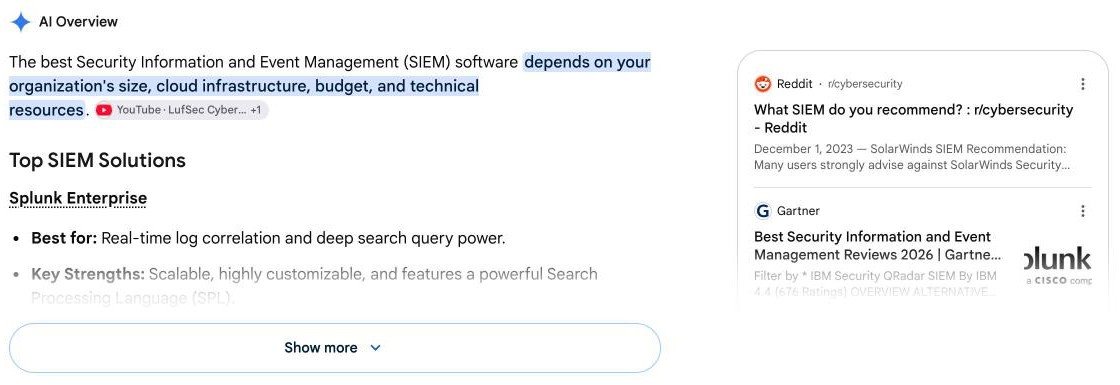
Now compare Google. For “best SIEM software,” Google put an AI Overview on top. It led with Splunk Enterprise. Next to it, it showed a Reddit thread and a Gartner page.
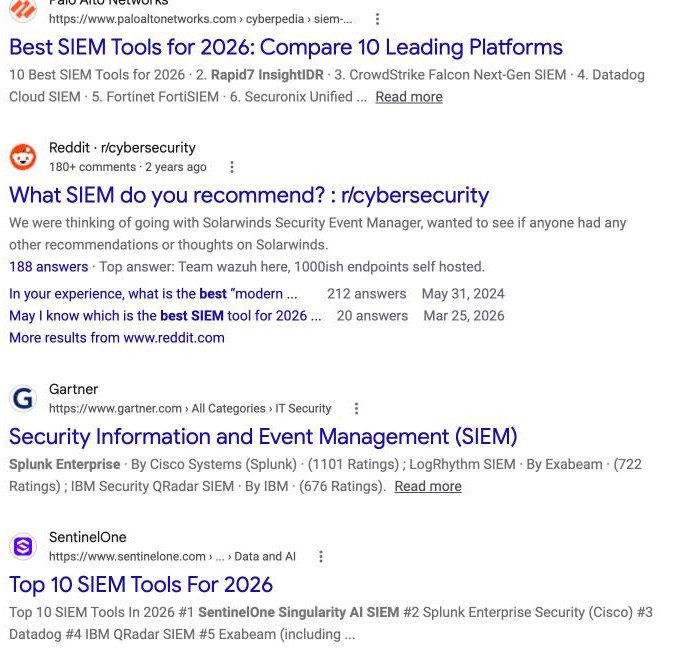
Scroll down and the classic results tell a similar story. The first result was a “best SIEM tools” roundup written by a vendor, Palo Alto Networks. After it came Reddit, Gartner, and another vendor roundup, this one from SentinelOne.
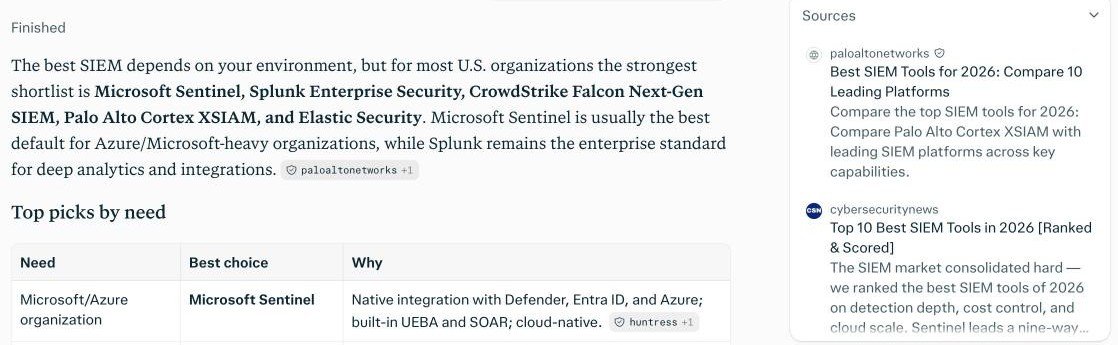
Perplexity gave a third answer. It led with Microsoft Sentinel, like ChatGPT, and it showed its sources in a panel on the right. Ten sources were cited. Four of them were vendor-written “top 10” pages, from Palo Alto Networks, Huntress, ManageEngine and SentinelOne.
Claude took a fourth path. It searched the web, then led with Splunk. Its stated reason was analyst recognition: Splunk “was named a Leader in the 2025 Gartner Magic Quadrant for SIEM.” And many of the pages it cited were the vendors’ own announcements of that result, from Splunk, Google Cloud, Exabeam and Gurucul.
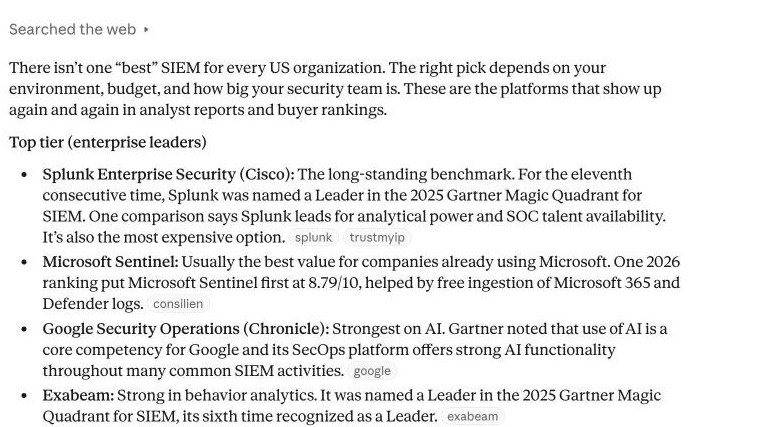
| Engine | First vendor named for “best SIEM” | What it leaned on |
|---|---|---|
| ChatGPT | Microsoft Sentinel | No source names shown in the answer |
| Perplexity | Microsoft Sentinel | 10 sources, 4 of them vendor-written roundups |
| Claude | Splunk Enterprise Security | 7 sources, including vendor pages about the 2025 Gartner Magic Quadrant |
| Google AI Overview | Splunk Enterprise | A YouTube video, with Reddit and Gartner in side cards |
Four engines gave two different leaders. That is the whole story in one table. A buyer who asks one engine sees one world. A buyer who asks two sees a conflict.
7 findings that should change your plan
1. Google rank does not decide who gets named
Only 21 of the 88 vendors ChatGPT named (24%) had their own page on Google’s first page. In vulnerability management and identity, the number was zero. Okta, CrowdStrike, Qualys and Tenable were all named by AI without a page of their own on page one for that search. So you can rank and not be named. You can also be named without ranking. The two systems pull from different shelves.
2. Engines agree on market leaders and split in crowded markets
ChatGPT and Perplexity gave the same first pick in six categories: SIEM, vulnerability management, identity, SOC 2 automation, awareness training and cloud posture. In four they split: endpoint protection, penetration testing, MDR and email security. Notice the pattern. The six agreement categories have a clear category leader or two. The four split categories are crowded, and many vendors look alike. In a crowded market, small signals decide, and different engines weigh them differently. That is where an unknown vendor has the best chance to win a spot.
3. Suites win by repetition
Microsoft appeared in six of ChatGPT’s ten answers: Defender for Business, Sentinel, Defender Vulnerability Management, Entra ID, Defender for Office 365 and Defender for Cloud. CrowdStrike appeared in five. Rapid7 and Huntress each appeared in four. SentinelOne appeared in three. A vendor with a product in many categories gets many chances to be named, and each mention reinforces the others. If you sell several products, link them clearly and publish the same facts, in the same words, for each.
4. Each engine trusts a different shelf
| Engine | What showed up most |
|---|---|
| Google page one (81 results) | Gartner Peer Insights on 8 of 10 searches. Reddit on 9 of 10. SentinelOne’s own roundups on 6 of 10. |
| Perplexity (94 cited sources) | Small review and roundup sites. Guideflow on 5 answers, Expert Insights on 4, Huntress on 4. Gartner and Reddit: none. |
| ChatGPT (source names visible in 4 of 10 answers) | CIOPages (MDR), Expert Insights (vulnerability management and IAM), SoftwareCompare.net (SOC 2). |
| Claude (SIEM only) | Vendor pages about Gartner Magic Quadrant results, plus Consilien, TrustMyIP and Capterra. |
This matters more than any single ranking. If you invest only in Google, you miss Perplexity’s small roundup sites. If you invest only in analyst relations, you miss Reddit. Spread your proof across the shelves each engine reads.
5. Vendor-written roundups are everywhere, and they are a risk
SentinelOne’s own “best of” pages held page-one slots on six of the ten Google searches. Palo Alto Networks, Huntress, Orca, Rapid7, Synack and Defendify did the same in their categories. And Perplexity cited them. It is a smart tactic: the buyer asked for the best, and the vendor wrote the list. But it has limits. ChatGPT named SentinelOne in only three categories, and it never named several vendors that rank well on Google, such as Exabeam, Sublime Security, Defendify and Scytale. A roundup that puts your product first and gives no honest trade-offs may win a Google slot and still lose the buyer’s trust. If you publish one, disclose your interest, name rivals fairly and date every fact.
6. ChatGPT is turning answers into intake forms
The endpoint answer ended with a four-question form: company size, devices, budget per device, and IT team. Buyers will increasingly answer those questions and get a narrower list. So your pages should say, in plain words, which company size you serve, which platforms you support, what you cost per seat or per device, and whether you need an in-house team to run the product. Vague “for every business” positioning gets filtered out.
7. Ranking is not recommendation
Several vendors earned Google page-one slots for their roundups and were still not named by ChatGPT. That echoes my findings on AI citation versus AI recommendation. Being cited is one thing. Being recommended is another. Citations come from pages that answer the question. Recommendations come from consensus: many sources that agree you belong on the list.
3 questions for your next leadership meeting
If you run a security company, take these three questions to your leadership team this week. They take an hour to answer, and they will tell you whether AI is helping your pipeline or quietly draining it.
| Question | How to answer it | Red flag |
|---|---|---|
| 1. Are we named when a buyer asks AI for our category? | Run the 12-prompt test below, three times, on ChatGPT, Perplexity, Claude and Google. | You are missing from every run, or only named when the buyer types your brand. |
| 2. Does what AI says about us match the product today? | Read each answer line by line against your current pricing, features and certifications. | Old prices, retired products, wrong integrations or a missing certification. |
| 3. Who owns this? | Name one person across product marketing, SEO and PR, with a monthly report. | Nobody owns it, so everyone assumes someone else does. |
Then do a back-of-envelope check on what silence costs you. Multiply four numbers: the qualified opportunities you expect this quarter, the share of those buyers who start in an AI chatbot, the share of those chats where you are not named, and your average contract value. G2’s survey puts the first-step share at 51% for software buyers overall. Your own mix will differ, so use your own sales data. If the product of those numbers makes you wince, you have found your budget line.
Want this run on your product? Tell me your category and your top three rivals. My free audit shows what ChatGPT, Gemini and Perplexity say about you today, scores you out of 100 and lists your top fixes. No payment details, and the report arrives within one business day.
What decision makers ask AI, and what vendors should publish in return
Security buyers do not ask “what is the best product.” They ask narrower, riskier questions. Here are the questions I would expect a CISO, a head of IT or a founder to type, and the page that should answer each one.
| Buyer question | What the AI looks for | What you publish |
|---|---|---|
| “Best [category] for a [size] company” | A named fit, with price and team assumptions | A “best for” line and a plan table, in plain HTML |
| “[You] vs [rival]” | A fair table of price, coverage and limits | A comparison page with sources and a “not for” row |
| “Is [you] SOC 2 or ISO 27001 certified” | A page that states it, with a date and an auditor | A trust page with reports, scope and dates |
| “[You] pricing” | Plan names, prices and limits | A pricing page without a “contact us” wall |
| “How do I switch from [rival] to [you]” | A migration guide with time and cost | A switching page with steps and a checklist |
| “[You] problems” or “[you] false positives” | Honest limits and community threads | A known-limits page, and replies in the forums |
| “What happened in [breach] and what should we do” | A fast, sourced, dated explainer | An incident explainer with an update log |
Notice the last row. Breaches drive searches, and most vendors publish nothing within the first day. I used the same approach in my Binance hack study. A short, sourced explainer with timestamps and an update log gets quoted when no one else has published.
How an AI shortlist forms
Put the findings together and a pattern appears. The buyer asks. The engine reads a footprint of public sources. It weighs fit, recognition, proof and consensus. Then it names a few products and asks the buyer to narrow.

Every box in that flow is something you can influence. The question is shaped by your content. The sources are shaped by your PR, reviews and pages. The weights are shaped by your proof. And the final answer is shaped by how clearly you state who you serve.
Open the door first: your firewall may be hiding you from AI
Here is a risk unique to security companies. You probably sit behind a content delivery network and a web application firewall. That is good practice. But it can also block the bots that feed AI search. On July 1, 2025, Cloudflare changed its default so that AI crawlers are blocked unless a site owner allows them, and every new domain is asked at sign-up whether to allow them. Other providers have their own bot rules. If your marketing site has a strict bot policy, check it.
The good news is that Google needs nothing special. Google says on its AI features page that “there are no additional requirements to appear in AI Overviews or AI Mode.” The other engines use search bots you can allow separately from the bots that collect training data.
| Engine | Bot | What it does | Your move |
|---|---|---|---|
| ChatGPT | OAI-SearchBot | Surfaces sites in ChatGPT search | Allow it. Sites that opt out do not appear in ChatGPT search answers. |
| ChatGPT | GPTBot | Collects content that may train models | Your choice. It is separate from search. |
| Claude | Claude-SearchBot | Indexes content for search results | Allow it. Blocking may reduce visibility. |
| Claude | Claude-User | Fetches pages when a user asks | Allow it for visibility in those answers. |
| Perplexity | PerplexityBot | Surfaces and links sites in results | Allow it, and allow its published IP ranges. |
Test with your own tools. Request a key product page as each bot and confirm it returns the full page, not a challenge screen. For setup details, read my AI crawler guide. Bot facts come from OpenAI, Anthropic and Perplexity.
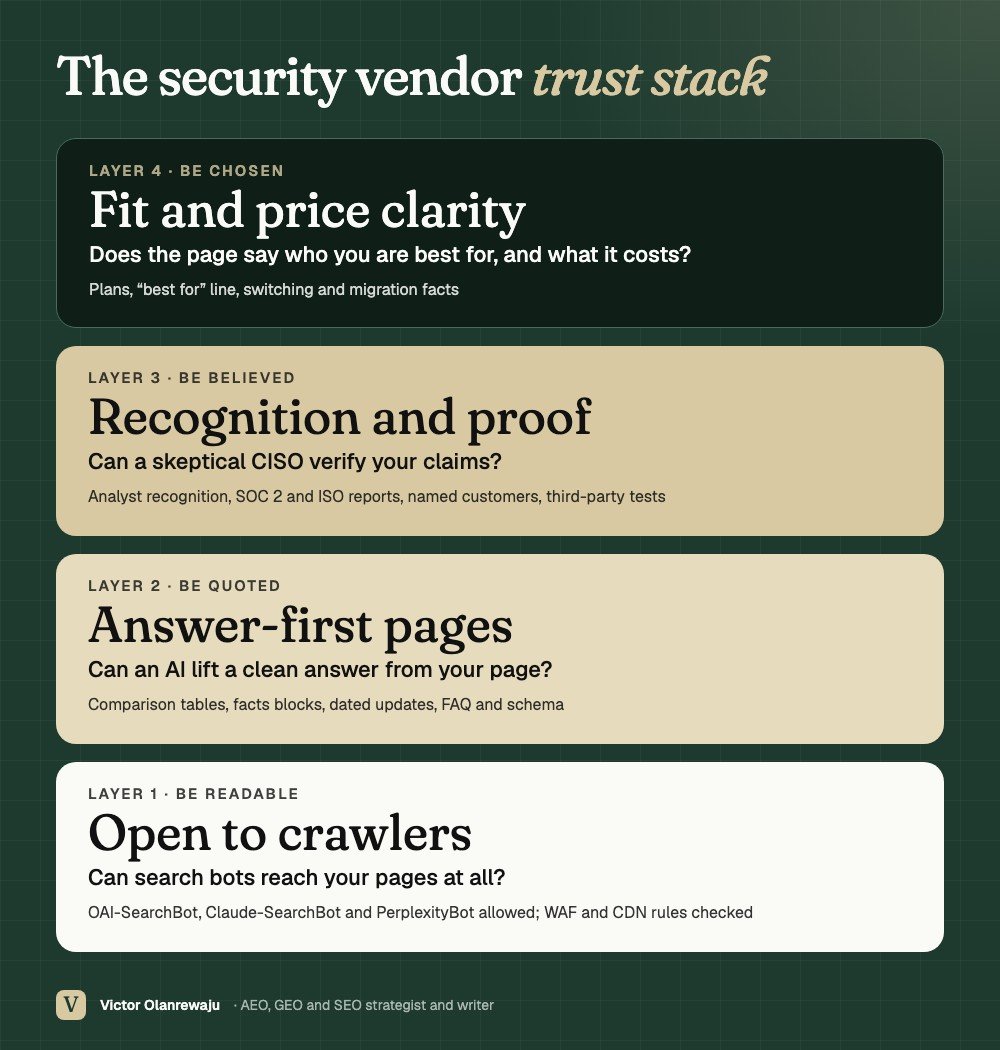
The security vendor trust stack
Security is a trust business. So the order of work matters. Start at the bottom, because nothing above it works if the engines cannot read you.
A 10-step plan to get your security product named
Steps 1 to 4 build the base. Steps 5 to 8 win the shortlist. Steps 9 and 10 keep you honest and current.
| Step | What to do | Why | Effort |
|---|---|---|---|
| 1. Check crawler access | Allow OAI-SearchBot, Claude-SearchBot and PerplexityBot. Test key pages through your CDN and firewall. | Engines cannot name what they cannot fetch. | Half a day |
| 2. Write a “best for” line | “[Product] is best for [size] teams that need [job] and have [team].” Use the same words everywhere. | ChatGPT’s endpoint answer put a “best for” line on each product. | 2 hours |
| 3. Publish plain-HTML pricing | Plans, per-seat or per-device prices, limits, and a “last checked” date. Avoid “contact us” as the only answer. | The endpoint answer asked buyers for a budget per device. | 1 day |
| 4. Build a trust page | List SOC 2 and ISO 27001 status, report dates and scope, named customers, and third-party test results. | Security buyers verify before they shortlist. | 2 to 3 days |
| 5. Write honest “best of” and “vs” pages | One per buying question. Name rivals, state criteria, add a “not for” row, and disclose that you make one of the products. | Vendor-written roundups held page-one slots in most of the ten categories I checked. | 1 week for the first three |
| 6. Publish your analyst recognition clearly | If you are in a recognized report, write a page that says so, with the date and the report name. Link to the source. | Claude led with vendors that had a Gartner Magic Quadrant announcement. | 1 day |
| 7. Win the roundups engines read | List the roundups that rank for your queries. Check what each says about you. Send editors accurate facts and a test account. | Perplexity cited small review sites, not the big ones. | 1 day, then monthly |
| 8. Join the forum conversation | Answer questions in security communities as a named employee, with disclosure. Never post fake reviews. | Reddit was on 9 of 10 Google page ones. | 2 hours a week |
| 9. Publish fast, sourced incident explainers | When a breach hits your category, publish a dated explainer with an update log within hours. | Breach searches spike, and few vendors publish. | Ongoing |
| 10. Test monthly | Run a fixed 20-prompt panel on ChatGPT, Perplexity, Claude, Gemini and Google. Log mentions, position and sources. | Answers vary by engine and by day. | Half a day a month |
For schema, add Organization sitewide and Article and FAQPage on guides, matched to the visible page. My schema guide shows safe patterns. And keep one rule above all: claim only what you can prove. “Stops all ransomware” is a claim that a CISO, a journalist or an AI engine can check and quote against you.
4 page templates security buyers read
Template 1: the “best for” comparison page
| Section | What goes in it |
|---|---|
| Verdict | Two sentences: who each option suits, and the date you last checked. |
| Summary table | Three to six options with price, best for, not for, and deployment model. Include rivals. |
| How we chose | Your criteria, and a line that you make one of the products. |
| Fit by company size | Small team, mid-size, enterprise. This answers the intake questions. |
| Limits and sources | Known trade-offs and a link for every claim. |
| FAQ | Five buyer questions with FAQPage schema. |
Template 2: the trust page
| Section | What goes in it |
|---|---|
| Certifications | SOC 2 Type, ISO 27001, others, with scope and report dates. |
| Independent proof | Analyst recognition and third-party tests, each linked to the source. |
| Security practices | Encryption, access control, incident response and disclosure policy, in plain words. |
| Customers | Named logos or case studies, with permission and dates. |
| Contact | A real security contact and a vulnerability disclosure path. |
Template 3: the “versus” page
| Section | What goes in it |
|---|---|
| Verdict | Who should pick you and who should pick the rival. |
| Side-by-side table | Price, coverage, integrations, support, limits. Cite the rival’s own pricing page. |
| Switching guide | Migration steps, time and cost. |
| Honest limits | Where the rival is stronger. |
Template 4: the incident explainer
| Section | What goes in it |
|---|---|
| Answer first | What happened, in two sentences, with the time of your last check. |
| Timeline | A dated list of events with a source for each. |
| What to do now | Three to five steps for a security team. |
| Update log | Every change, with a timestamp. |
The 12-prompt test: see where you stand today
Run each prompt on ChatGPT with web search on, then on Perplexity, Claude and Google. Run it three times, because answers vary. Record whether you are named, your position, what the engine says and which sources it shows.
| Type | Prompt | What to record |
|---|---|---|
| Best of | “Best [category] software in the US” | Are you named? In what position? |
| Best of | “Best [category] for a [size] company” | Who is first, and what “best for” tag? |
| Best of | “Best [category] for [industry or compliance need]” | Does it name you for your niche? |
| Comparison | “[You] vs [rival]” | Are the facts right? What is missing? |
| Comparison | “[Rival] alternatives” | Do you appear on the list? |
| Trust | “Is [you] SOC 2 certified” and “Is [you] secure” | Does it cite your trust page? |
| Pricing | “[You] pricing” and “[You] cost per user” | Is it current? Which page does it cite? |
| Integration | “Does [you] integrate with [Microsoft 365, AWS, Okta]” | Is the answer right? |
| Switching | “How to migrate from [rival] to [you]” | Does your migration page appear? |
| Problems | “[You] problems” and “[You] false positives” | What do sources say? Can you respond? |
| Analyst | “Is [you] in the Gartner Magic Quadrant for [category]” | Does it state your recognition correctly? |
| Incident | “What should we do after [recent breach in your category]” | Is your explainer cited? |
If you want it automated, see my AI visibility tools review. For the manual method, read how to check what ChatGPT says about your business. And for the same method in another category, see my SaaS “best software” test and the fintech study.
Where I come in
I have spent six years writing for crypto and finance outlets, where a wrong fact costs readers money. Now I test what AI engines say about brands. For a security company, the work looks like this:
| Option | Price | What you get |
|---|---|---|
| Free AI visibility audit | Free | A score out of 100, your top fixes, and what ChatGPT, Gemini and Perplexity say about you |
| Manual AI visibility report | $120 | 25 prompts tested across five engines, with a written summary. The 12-prompt test above is the base. |
| Answer-first article | $80 each | 800 to 1,200 words, sourced, with an FAQ and schema |
| Standard foundation build | $850 | Up to 30 pages, an internal linking plan, five answer-first pages written for you and review request set-up, in about 3 to 4 weeks |
| Growth retainer | $650 per month | A 25-prompt panel across five engines with two competitors compared, four pages or articles and a monthly report |
I cannot promise a ranking or an AI citation. I can promise a clear fix list, sourced data and honest reporting. Prices come from my pricing page, checked November 4, 2026.
Start with the free audit. It takes no payment details, and you get a plain-English report by email within one business day. Tell me your product and your buyer, and I will tell you which searches to test first.
Run the free AI visibility audit
Contact me, or see my pages on AEO and GEO.
How I checked, and the limits
- One snapshot. I ran ten ChatGPT prompts, ten Perplexity prompts and ten Google searches on November 4, 2026. Answers vary run to run and by user. Google varies by day and location.
- Claude and Google AI Overview on one question only. I tested them on SIEM. Do not read their SIEM results as their behavior across all ten categories.
- Personalization. ChatGPT and Claude were signed in to my accounts and Perplexity to a free account. I added “in the US” to each prompt, yet account memory may have shaped some answers.
- Wording. The Google searches used the same words as the prompts, without “in the US,” with US settings applied.
- “Own page” is my judgment. A vendor counted only when its own domain appeared in the page-one organic results. Reddit, Gartner, review sites and videos did not count. Vendor-written roundups did count as the vendor’s own page.
- “First” means first named. ChatGPT lists vendors in an order, and Perplexity opens with a summary sentence. Neither always calls one vendor the winner. For Perplexity, I used the first vendor named in the opening answer.
- Sources are partly visible. ChatGPT showed source names in four of ten answers. I counted Perplexity’s source panel for all ten, which gave 94 citations.
- The intake form. I saw ChatGPT’s four-question form in the endpoint answer. I did not check the other nine.
- Third-party data has its own limits. Conductor covers US enterprise sites. G2 surveyed buyers who chose to respond. IBM, Verizon and Gartner figures are read from their own pages. Check the originals before you reuse a number.
Related reading: SEO, AEO and GEO explained and why AI engines rarely cite CoinGecko.
Frequently asked questions
How do I get my cybersecurity product recommended by ChatGPT?
Publish pages that state who you are best for, what you cost and how you compare. Add a trust page with certifications and proof. Allow OAI-SearchBot through your firewall. In my November 4, 2026 test, only 21 of the 88 vendors ChatGPT named had their own page on Google page one, so Google rank alone does not decide it.
Why does ChatGPT recommend my competitor and not us?
Usually because the competitor is named across more sources that agree. In my test, Microsoft appeared in six of ten ChatGPT answers and CrowdStrike in five. Check which roundups, review sites and forums name your rival, then fix your own pages and coverage in those places.
Do ChatGPT, Perplexity and Claude recommend the same security vendors?
Often not. ChatGPT and Perplexity gave the same first pick in 6 of 10 categories and split in 4. For SIEM, ChatGPT and Perplexity led with Microsoft Sentinel, while Claude and Google’s AI Overview led with Splunk.
Does ranking on Google get a security vendor named by AI?
Not by itself. Several vendors with page-one roundups, such as Exabeam, Sublime Security and Defendify, were not named by ChatGPT in their categories. Meanwhile, large vendors like Okta and Tenable were named without a page of their own on page one.
Which sources do AI engines use for security software?
They differ. Google page one carried Gartner Peer Insights on 8 of 10 searches and Reddit on 9 of 10. Perplexity cited small review and roundup sites such as Guideflow and Expert Insights, and none of its 94 citations went to Gartner or Reddit. Claude cited vendor pages about Gartner Magic Quadrant results.
Should security vendors publish their own “best of” roundups?
Yes, if they are honest. Vendor roundups held page-one slots in many categories I checked, and Perplexity cited several. Disclose that you make one of the products, name rivals fairly, state criteria and date every fact. A one-sided list can win a ranking and lose trust.
Does Gartner recognition help AI visibility?
It appeared to help in my Claude SIEM test. Claude led with Splunk, citing its Gartner Magic Quadrant Leader status, and cited Splunk, Google Cloud, Exabeam and Gurucul pages about the 2025 report. If you have recognition, state it clearly on your own site, with the date, report name and a source link.
Can my firewall or CDN block AI crawlers?
Yes. On July 1, 2025, Cloudflare changed its default so AI crawlers are blocked unless a site owner allows them, and new domains are asked at sign-up. Check your bot rules and test key pages as OAI-SearchBot, Claude-SearchBot and PerplexityBot.
Which AI crawlers should a security vendor allow?
Allow the search bots: OAI-SearchBot for ChatGPT search, Claude-SearchBot and Claude-User for Claude, and PerplexityBot for Perplexity. Training bots such as GPTBot and ClaudeBot are separate decisions. Google needs nothing special for AI Overviews.
How many B2B software buyers use AI to research vendors?
G2’s March 2026 survey of 1,076 B2B software buyers found 51% start research with an AI chatbot, up from 29% in its 2025 report, and 69% chose a different vendor than they planned.
How much traffic does AI send to security and IT sites?
More than to most industries. Conductor measured AI referrals at 2.80% of IT-sector traffic, the highest of 10 industries, and ChatGPT drove 88.5% of them. It is still a minority of visits, but it shapes the shortlist before the visit.
What should a security comparison page include?
A two-sentence verdict, a summary table with price, best-for, not-for and deployment model, fit by company size, your criteria, honest limits, a source for each claim, and a dated update log. Disclose that you make one of the products.
How do I fix wrong information about my product in AI answers?
Find which page the engine cites, then correct the source. Fix your own pages first, then ask roundup sites to correct errors. Re-test after a few weeks, because engines update at different speeds.
How often should I test what AI says about my security product?
Run a fixed 20-prompt panel monthly, and weekly around launches, analyst reports or incidents in your category. Log your position and sources each time on ChatGPT, Perplexity, Claude and Google.
Can you audit my security company’s AI visibility?
Yes. Start with the free AI visibility audit, or order the $120 manual report that tests 25 prompts across five engines. For a full build, the Standard foundation package is $850.