In this article
- Why a miss costs you customers now
- The test: 10 buying questions, 3 engines, 63 websites
- One question, three winners
- What the test showed
- The 7 causes, ranked by how often I would expect them
- Which cause is yours? A decision table
- What it costs to fix
- How long it takes
- The 30-minute test
- Where I come in
- Every answer I recorded
- How I checked, and the limits
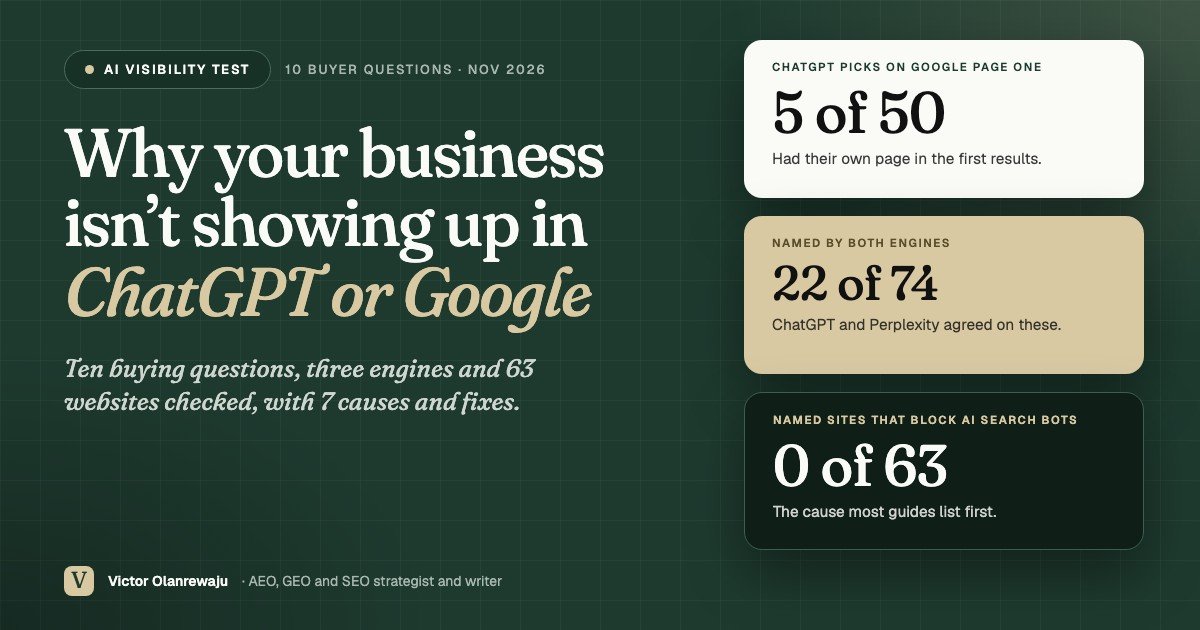
In short: Most businesses are missing from ChatGPT and Google for one of 7 reasons. Other sites do not list or review them. No page answers the exact question. AI cannot tell which business they are. Their pages say nothing quotable. Google has not indexed them. Basic tags are missing. Or crawlers are blocked. I tested 10 buying questions on ChatGPT, Perplexity and Google on November 5, 2026. Only 5 of the 50 businesses ChatGPT named had their own page on Google page one. Blocked crawlers explained none of the 63 named sites I could check. Below you get each cause, the fix, the cost, the timeline and a 30-minute test.
5 of 50
Businesses ChatGPT named that had their own page on Google page one
22 of 74
Businesses named by both ChatGPT and Perplexity
0 of 63
Named websites that blocked AI search bots
45%
US consumers who used AI tools for local business recommendations in the past year, up from 6% (BrightLocal, 2026)
I asked ChatGPT one question: “Who is the best family dentist in Austin, TX?” It named four practices, then asked me a question of its own. I asked Perplexity. It named six. Then I searched Google, and its AI Overview led with a third practice. Three engines gave three different winners.
Here is the part that should worry any owner. None of ChatGPT’s four dentists had their own page on Google’s first page. That page held Yelp, Reddit, a newspaper list, two directories and the sites of three other practices. ChatGPT named its four dentists anyway.
So what decides who gets named? And if your business is missing, what should you fix first?
Most advice on this is vague. “Build authority.” “Add schema.” “Optimize for AI.” None of it tells you which problem you have. So I ran a fresh test. I asked ChatGPT and Perplexity 10 buying questions, from dentists and plumbers to bookkeepers and HR firms. I checked Google for each one. Then I opened 63 of the websites the AI named and looked for what they had in common.
The result surprised me. Some causes that guides list first explained nothing in my sample. Another cause explained most of what I saw, and it has little to do with your own website. You will find it at cause 1.
Below you get the 7 causes, ranked by how often I would expect each to explain a miss. Each one has a fix, a cost and a timeline. At the end, a 30-minute test shows which cause is yours.
Why a miss costs you customers now
Your customers already ask AI who to hire. BrightLocal’s 2026 survey of 1,002 US adults found that 45% had used AI tools for local business recommendations in the past 12 months, up from 6% a year earlier. ChatGPT led at 31%. Among people who use AI this way, 63% trust its recommendations.
Meanwhile, AI answers keep readers on the results page. Pew Research tracked 900 US adults in March 2025. They clicked a regular result link on 8% of visits that showed an AI summary, compared with 15% of visits without one. Only 1% clicked a link inside the summary. In short, buyers see names, not links. If you are not named, you are not on the list.
There is good news too. Google’s own guide says there are “no additional requirements to appear in AI Overviews or AI Mode.” A page only has to be indexed and eligible to show with a snippet. That also means no secret trick exists, so the fix is a set of ordinary jobs done well.
The test: 10 buying questions, 3 engines, 63 websites
I chose 10 questions that real buyers type. Five name a city (Austin, Texas) and five ask for a US-wide service. I ran each one in ChatGPT with web search on and in Perplexity. I also ran the same words in Google with US settings. Perplexity’s free allowance ran out after nine searches, so I could not run the HR question there.
Next, I looked up the website of every business the two engines named. After that, I read the raw page of each site, plus its robots.txt file. Here is what each engine named.
| Buying question | ChatGPT named | Perplexity named | Named by both |
|---|---|---|---|
| Best family dentist, Austin | 4 | 6 | 3 |
| Best plumber for a water heater replacement, Austin | 3 | 5 | 0 |
| Best CPA for a small business, Austin | 4 | 6 | 0 |
| Best roofing company, Austin | 4 | 5 | 3 |
| Best HVAC company for AC repair, Austin | 5 | 6 | 0 |
| Best bookkeeping service, US | 7 | 6 | 6 |
| Best managed IT provider, US | 7 | 6 | 5 |
| Best web design agency, US | 5 | 6 | 1 |
| Best virtual assistant company, US | 5 | 6 | 4 |
| Best HR consulting firm, US | 6 | not run | not run |
The totals: ChatGPT named 50 businesses. Perplexity named 52 across its nine answers. Across those nine questions, the two engines named 74 different businesses, and only 22 of them (30%) appeared in both lists. That number is small because the engines also disagree on who to put first.
| Buying question | ChatGPT named first | Perplexity named first | Google AI Overview named first |
|---|---|---|---|
| Family dentist | Blunn Creek Family Dentistry | ATX Family Dental | Forest Family Dentistry |
| Plumber | ABC Home & Commercial Services | Radiant Plumbing, Air Conditioning & Electrical | A&T Service Plumbing |
| CPA | Austin Tax Advisors | Insogna CPA | Jonathan Wyman, CPA, LLC |
| Roofing | Kidd Roofing | Kidd Roofing | Kidd Roofing |
| HVAC | Radiant Plumbing, Air Conditioning & Electrical | The Coolest LLC | The Coolest, LLC |
| Bookkeeping | Bookkeeper360 | QuickBooks Live | Bench |
| Managed IT | Ntiva | Ntiva | Dataprise |
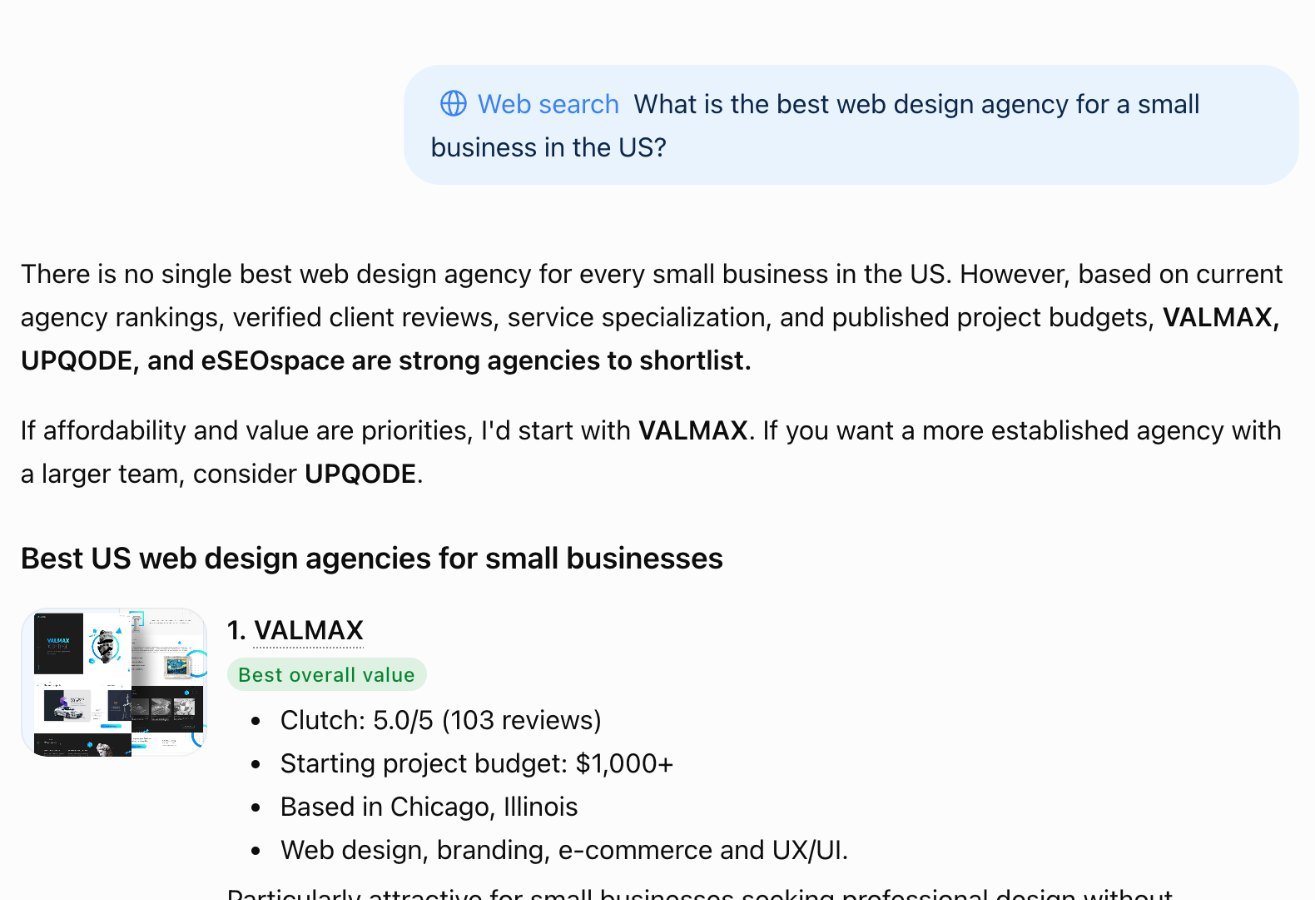
| Web design | VALMAX | SmartSites | The Business Toolkit |
| Virtual assistants | Time Etc | Time Etc | ClearDesk |
| HR consulting | Insperity | not run | Bambee |
All three engines named the same business first on only 1 of 9 questions: roofing. ChatGPT and Perplexity matched on 3. I read Google’s AI Overview for the table above and the screenshots below, but I did not count its names in the overlap totals.
One question, three winners
The dentist question shows the pattern best. Look at what each engine did with the same words.

First, ChatGPT. It said there was no single best dentist, then ranked four practices with a rating and a short reason for each.

Next, Perplexity. It led with a different practice, then put six in a table with review counts and cited two roundup sites.
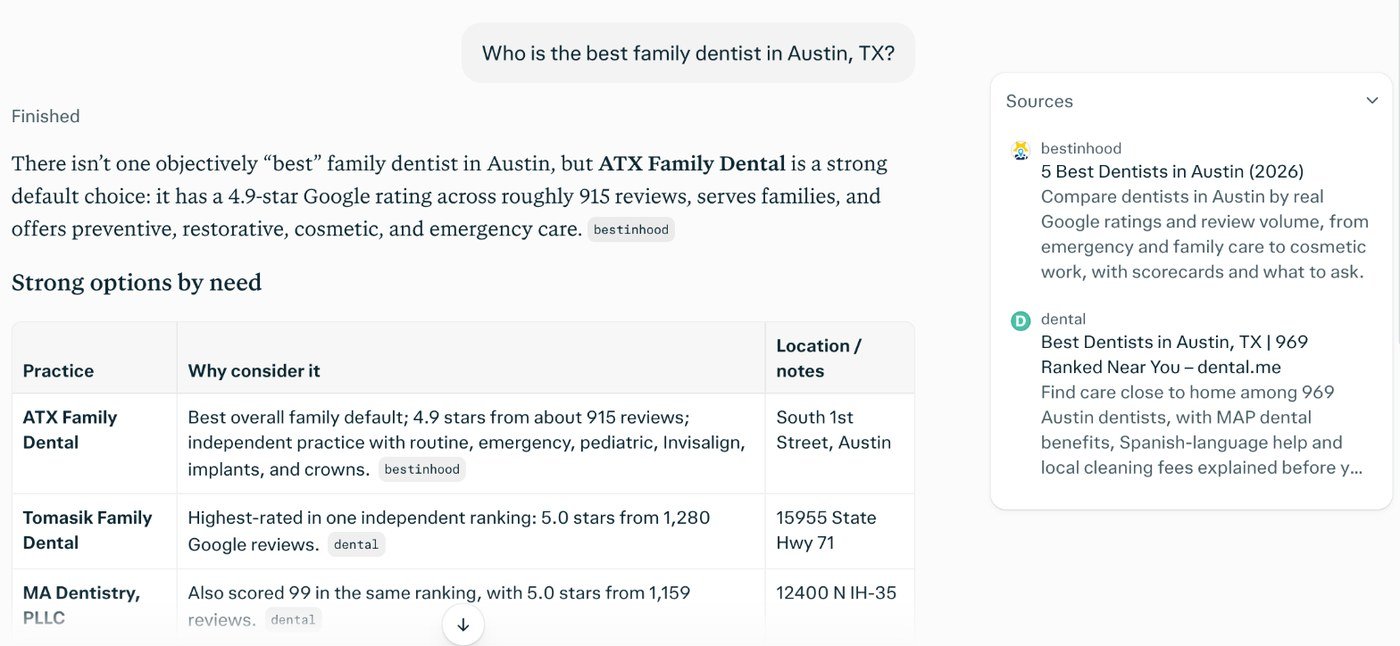
Finally, Google. Its AI Overview opened with Forest Family Dentistry, and the panel beside it showed Yelp and two practice sites.

So three engines produced three winners. That is why “optimize for ChatGPT” is not one job. It is several, and the causes below map to them.
What the test showed
1. ChatGPT named businesses that Google’s first page did not show. Only 5 of the 50 businesses ChatGPT named (10%) had their own page on Google page one. For Perplexity the figure was 7 of 52 (13%). In my earlier tests the share was higher: 29% for SaaS tools and 24% for security vendors. Service businesses depend on Google page one even less.
Share of named businesses that had their own page on Google page one (%)
2. The engines disagree, most of all for local businesses. For the five Austin questions, only 6 of 42 named businesses (14%) appeared in both engines’ lists. For the four US-wide questions, 16 of 32 (50%) did. In other words, a national software or service brand has a better chance of consistent mentions than a local shop.
Share of named businesses that both ChatGPT and Perplexity named (%)
3. Google’s first page was a directory shelf. Reddit appeared on page one for all 10 searches. Yelp appeared on all 5 Austin searches. Google also showed an AI Overview on all 10. Across the 40 organic results I read for the Austin searches, only 16 (40%) were a business’s own site. The rest were directories, forums, media lists and review sites.
4. ChatGPT questioned the buyer back. Eight of the 10 ChatGPT answers ended with a question or a form. Six of those asked about the buyer’s need. For the dentist, it asked whether I wanted care for young children or adults.

The roofing answer went further. It ended with a three-question form: type of work, property type and main priority, with a “Find the best match” button.

Two other answers, for IT and virtual assistants, asked whether I was a customer or researching competitors. That came from my account’s memory, so I do not count it as a buyer question. I mention it in the limits below.
So the engines act like a salesperson. They shortlist, then qualify. Pages that answer those follow-up questions give them something to quote.
That raises the real question. If rank on Google does not decide the shortlist, what does? To find out, I opened 63 of the named websites and checked them one by one. The answer is in the causes below.
The 7 causes, ranked by how often I would expect them
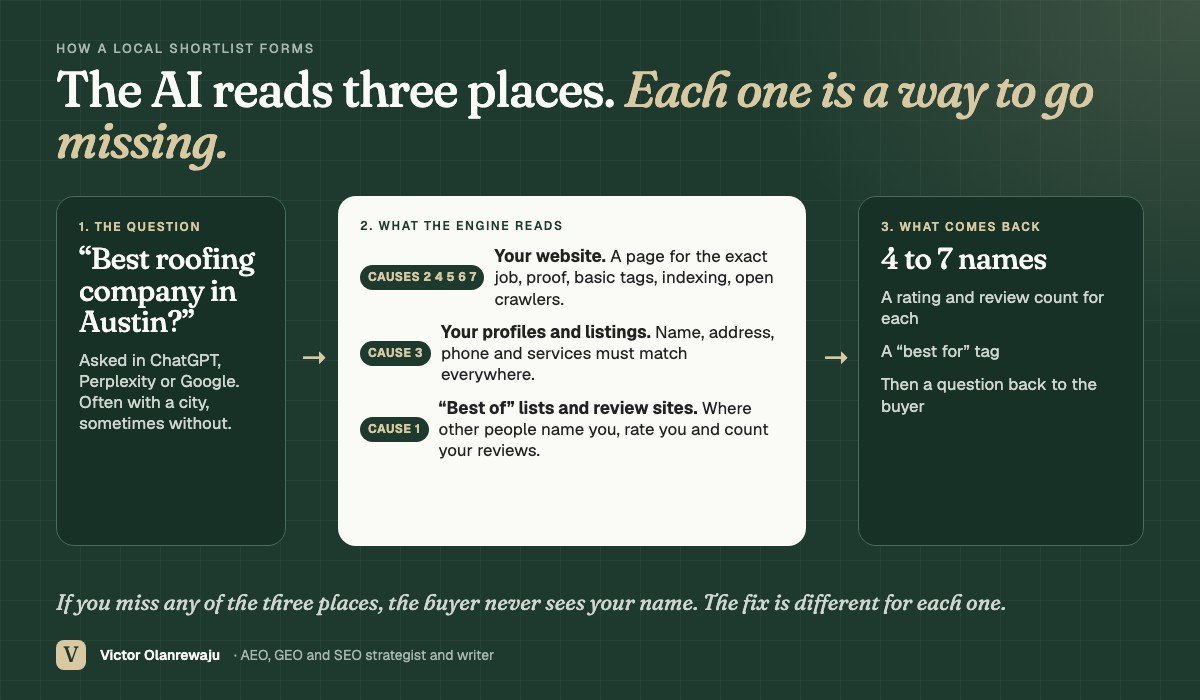
I ranked these using my test data, Google’s and OpenAI’s own documents, and my earlier studies. The ranking is my judgment, not a measured frequency. First, the map: it shows where a business can go missing.
Cause 1: Other sites do not list or review you
What I saw. The answers leaned on ratings, review counts and “best of” pages. ChatGPT’s dentist answer cited DentistsRanked. Its plumbing and HVAC answers cited ContractorsRanked. Its web design and virtual assistant answers cited Clutch, and its bookkeeping answer cited NerdWallet. Perplexity quoted review counts such as 937, 700 and 4,049 for its HVAC picks. At the same time, only 10% of ChatGPT’s picks had their own page on Google page one. So the engines were not reading the winners’ own pages to build the shortlist.
Official sources agree. Google says local prominence comes from information such as “how many websites link to your business and how many reviews you have” (Business Profile help). BrightLocal notes that AI answers may draw on reviews, directories, business websites and social media.
The fix. Open the answer, click the source chips and write down which list sites repeat. Then earn a place there. Ask happy customers for Google reviews. Apply to the industry directories that keep appearing. Pitch the local paper and trade sites that publish “best of” lists. Do not buy reviews or paid placements that pretend to be rankings.
Cost and time. Often free, plus your time. Expect weeks to months.
Cause 2: No page answers the exact question
What I saw. ChatGPT asked buyers “tank or tankless?” and “residential or commercial?” Those are the questions a good page answers. In my Kigali audit, 5 of 11 AI answers cited a business’s own site, mostly for specific questions. Broad questions cited directories instead. In this test, 9 of the 12 plumbing and HVAC sites I could read linked from the homepage to a page about the exact job. That was common among named businesses, so it did not separate winners from the rest. Still, the three that lacked such a link were named anyway, which suggests other signals, such as reviews, carried them (see cause 1).
The fix. Write one page per job a buyer asks about. Open with a two-sentence answer. Then cover the follow-up questions: which type, which size, which price range, which area, how fast. The Lens & Co case shows what plain facts can do. Delivery windows, a price floor and lens measurements were repeated closely in AI answers.
Cost and time. $0 if you write it. $80 per article if you hire me. Allow about 2 weeks before you test.
Cause 3: AI cannot tell which business you are
What I saw. The same business showed up under two names. ChatGPT listed “Tech Ridge Dental” at 12400 N. IH-35. Perplexity listed “MA Dentistry, PLLC” at 12400 N IH-35. The practice’s own site says Tech Ridge Dental, at 12400 N. Interstate 35, Ste A131. It looks like one practice with two names. Likewise, ChatGPT named Integris and Perplexity named TechMD. The TechMD website now redirects to Integris, so I treated them as one company. I counted each pair once. One more case: I could not match one of ChatGPT’s four roofing picks to any website with an Austin phone number. Location is blurry too. Google’s AI Overview led its Austin CPA answer with a firm listed in Katy, Texas, and Perplexity named the same firm.
The fix. Use one business name, one address and one phone number on your site, your Google Business Profile and every directory. If you rebranded, say so on your site and update old listings. Google also advises checking that Business Profile information is up to date. Add LocalBusiness structured data that matches what visitors see.
Cost and time. Free if you do it. $180 if I do the Business Profile and directory clean-up. Days to weeks, because directories update slowly.
Cause 4: Your pages say nothing quotable
What I saw. Buyers care about price, speed and proof, and ChatGPT’s roofing form lists those priorities. Yet only 10 of the 32 named local sites I could read (31%) had a price or cost link on the homepage. Among the 31 national sites, 21 did (68%).
The fix. Say what you do, who it is for, what it costs, how long it takes and why you can be trusted. Add a price range or a starting price. Name your people and your licenses. Show real photos, real numbers and real results. Google’s guidance is to create “helpful, reliable, people-first content.” A page of general claims gives an engine nothing to repeat.
Cost and time. Your time, or $80 per article. Plan on 2 to 4 weeks for a first round.
Cause 5: Google or Bing has not indexed you
What I saw. None of the 63 named sites carried a noindex tag. That is no surprise, because established businesses rarely have this problem. New sites and relaunches do. Google says a page “must be indexed and eligible to be shown in Google Search with a snippet,” and it adds that indexing is not guaranteed.
The fix. Verify your site in Google Search Console. Submit your sitemap. Inspect your key pages and request indexing. Check that no page carries a noindex tag. Then do the same in Bing Webmaster Tools.
Cost and time. Free. Days to weeks.
Cause 6: Basic page signals are missing
What I saw. The 63 named sites had the basics. In the raw HTML, 90% had a meta description and 94% had at least one H1. Another 83% carried business schema such as Organization or LocalBusiness. By contrast, my Kigali audit found 9 of 20 sites with no meta description and 8 of 20 with no H1. So basics look like table stakes in the markets I tested. Fix them, but do not expect them to be your main problem.
What the 63 AI-named websites had in the raw HTML of their homepages (%)
One caution on llms.txt. Twenty-eight of the 63 sites had one, and many look generated by an SEO plugin. I cannot show that it helped. Google says you do not need “new machine readable files, AI text files, or markup” to appear in its AI features. I cover this in my llms.txt guide.
The fix. Give every key page a unique title, a meta description, one clear H1 and matching schema. Keep structured data identical to the visible text.
Cost and time. Free with an SEO plugin. $220 for my schema pack. One to two days.
Cause 7: Crawlers are blocked
What I saw. This is the cause most guides list first. In my sample it explained nothing. None of the 63 named sites blocked an AI search bot in robots.txt, and none blocked a training bot. The same was true of the 20 Kigali sites. Even so, the risk is real. OpenAI says that “sites that are opted out of OAI-SearchBot will not be shown in ChatGPT search answers.” Perplexity recommends allowing PerplexityBot. And since July 1, 2025, Cloudflare blocks AI crawlers by default unless the owner allows them.
One more note. Fourteen of the 77 sites refused or failed my plain request: ten returned 403, two returned 202 with no page, one returned 404 and one would not connect. That does not prove they block AI crawlers, because firewalls treat bots differently. Still, it is why you should test your own site.
The fix. Open yourdomain.com/robots.txt. Look for “Disallow: /” under any bot. Then check your firewall or CDN bot settings. Allow OAI-SearchBot, PerplexityBot and Claude-SearchBot. Training bots such as GPTBot are a separate decision. My robots.txt guide has examples.
Cost and time. Free. OpenAI says it can take about 24 hours for its systems to adjust after a robots.txt update.
Which cause is yours? A decision table
Match what you see to the likely cause. Then start with the fix in the last column.
| What you see | Likely cause | Start here |
|---|---|---|
| Competitors appear with ratings and review counts. You do not appear at all. | 1: not listed or reviewed elsewhere | Click their source chips. Get listed there. Ask for reviews. |
| You show up for your brand name, but not for “best [service] in [city].” | 1 or 2 | Write a page for the exact job, then earn mentions. |
| AI gives the wrong address, merges you with another business, or lists an old name. | 3: identity mismatch | Match your name, address and phone everywhere. |
| AI names you last, or describes you in vague terms. | 4: nothing quotable | Add price, proof and a clear “best for” line. |
| Your site is new, or you relaunched it. Nothing appears anywhere. | 5: not indexed | Search Console and Bing: sitemap, then request indexing. |
| Your pages have no meta description, no H1 or no schema. | 6: weak basics | Fix titles, descriptions and headings first. |
| robots.txt says “Disallow: /”, or your firewall shows a bot challenge. | 7: blocked crawlers | Allow the search bots. Test again in 24 hours. |
What it costs to fix
Most fixes cost time, not money. The table shows what you can do yourself and what I charge. These are the prices on my pricing page on November 5, 2026.
| Fix | Do it yourself | If you hire me |
|---|---|---|
| Allow search crawlers (cause 7) | Free, about 10 minutes | Included in the Essentials build, $390 |
| Get indexed (cause 5) | Free: Search Console and Bing Webmaster Tools | Crawl and indexation fixes, included in Essentials |
| Basic tags and schema (cause 6) | Free with an SEO plugin | Schema markup pack, $220 for up to 10 templates |
| Match your identity everywhere (cause 3) | Free: your Business Profile and listings | Business Profile and directory clean-up, $180 |
| Write answer pages (causes 2 and 4) | Free: your time | Answer-first article, $80 each |
| Earn reviews and listings (cause 1) | Free to low: ask customers, apply to lists | Review request system, $160. Digital PR outreach round, from $220. |
| Find out which cause is yours | The 30-minute test below | Free audit, or a manual report of 25 prompts across five engines, $120 |
For a bigger job, my Standard build costs $850 and covers up to 30 pages, five answer-first pages and an internal linking plan. My Growth retainer costs $650 a month. For comparison, one vendor price guide quotes $2,000 to $10,000 a month for mid-market AEO and GEO retainers, and $500 to $2,500 a month for productized packages. That same guide gives different ranges in different sections, and agency blog figures are not contracts. Treat them as a rough guide, and ask any vendor to list deliverables.
How long it takes
Nobody can promise a date. Here is what the evidence supports.
| Fix | How fast, and the evidence |
|---|---|
| Allow OAI-SearchBot | About 24 hours for OpenAI’s systems to adjust after a robots.txt change (OpenAI). |
| Get indexed | Not promised. Google says indexing and serving are not guaranteed. In my experience, days to weeks. |
| New answer pages | In one case, Lens & Co, pages went live September 27, 2026. By October 10 to 12, ChatGPT named the store in 6 of 6 buyer questions and first in 5. That is one store and single runs. |
| Ranking on Google | Slow. In Ahrefs’ data, 6.11% of 2 million new pages (1.74% in a 1 million page sample) reached Google’s top 10 within a year. |
| Reviews and mentions | Weeks to months. This is my estimate, not a measured figure. |
Because AI answers change run to run, test the same questions every month and log the result. One good answer is not a trend.
The 30-minute test
Run this before you spend a dollar. It shows which cause is yours.
- Write 10 questions (5 minutes). Use real buyer wording: “Who is the best [service] in [city]?”, “Best [service] for [type of customer],” “How much does [service] cost in [city]?” and “[Service] for [specific problem].”
- Run each one (10 minutes). Use ChatGPT with web search on, Perplexity and Google. Use a private window where you can, and add the city if you are local.
- Log the result (5 minutes). Copy the table below into a sheet.
- Click the sources (5 minutes). Write down which list and review sites repeat. Those are your cause 1 targets.
- Check the basics (5 minutes). Open your robots.txt file. Inspect your key page in Search Console. Compare your Business Profile with your website. Search your own site for a page about the job.
| Question | Engine | Were you named? Where? | Who was named instead, and which sources showed |
|---|---|---|---|
| Best roofing company in Austin | ChatGPT | No | Kidd Roofing and KangaRoof. Ranking sites and Google. |
For a deeper version, see my guide to checking what ChatGPT says about your business and my post on why Google rankings do not match ChatGPT mentions.
Where I come in
I spent six years writing for crypto and finance outlets, where a wrong fact costs readers money. Now I test what AI engines say about brands and publish the data. If you want a second pair of eyes, the free audit scans your site, scores it out of 100, lists your top fixes and checks what ChatGPT, Gemini and Perplexity say about you. I cannot promise a ranking or a citation. I can promise a clear fix list, sourced data and honest reporting.
Run the free AI visibility audit
Contact me, or see my pages on AEO and GEO.
Every answer I recorded
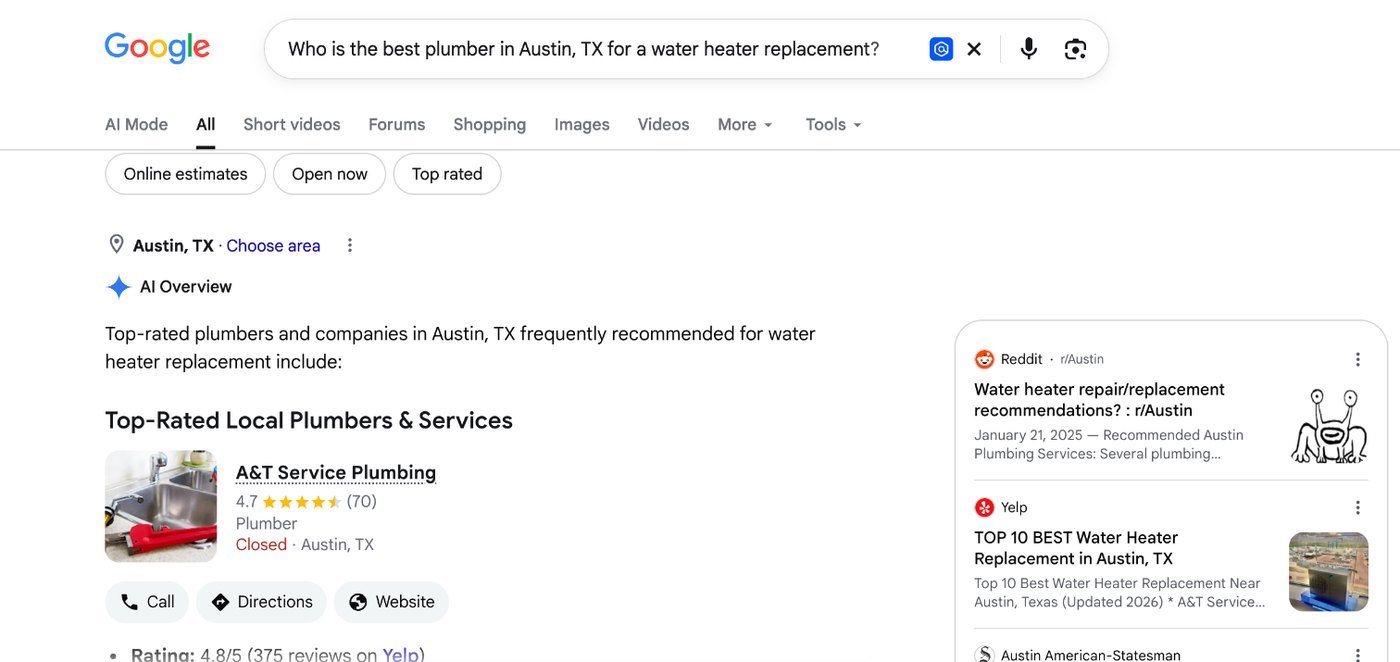
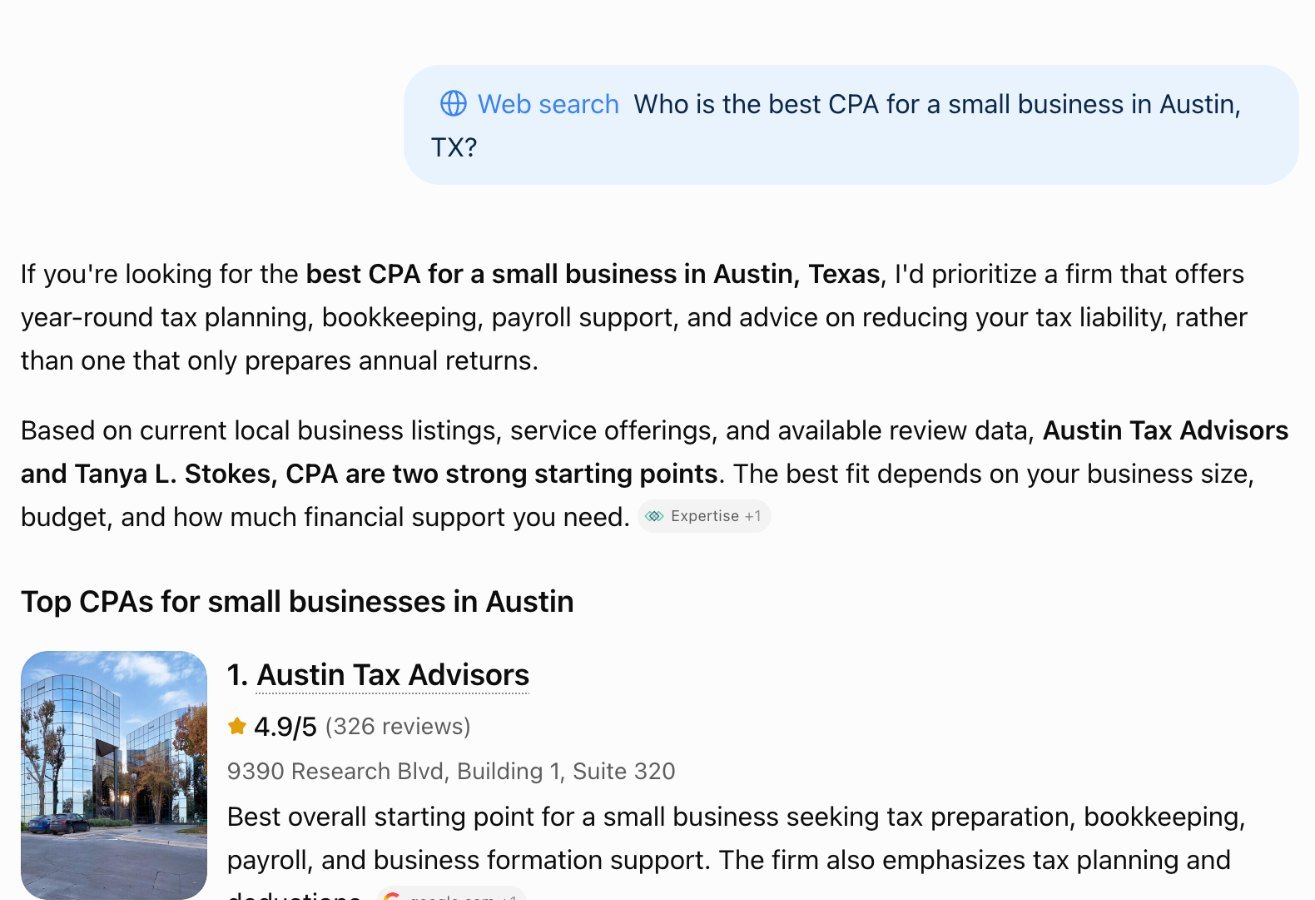
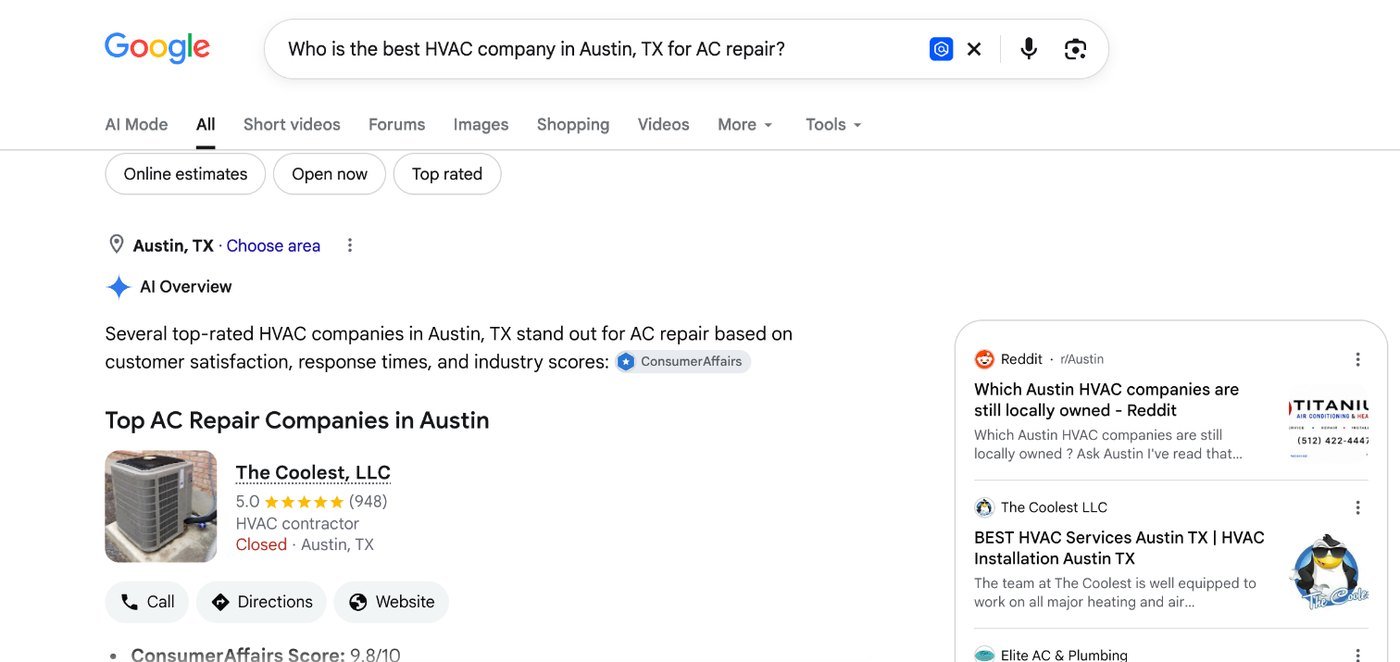
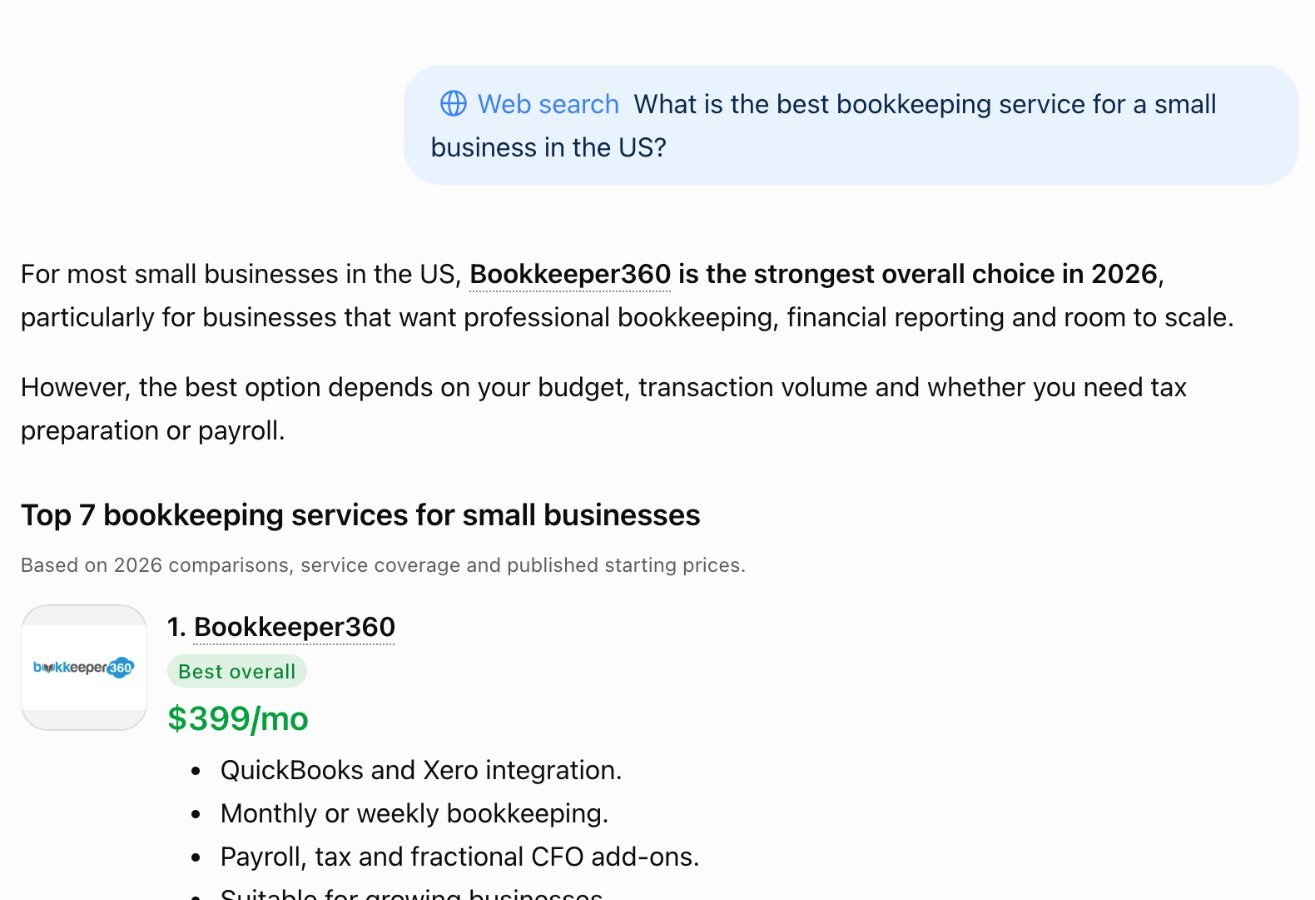
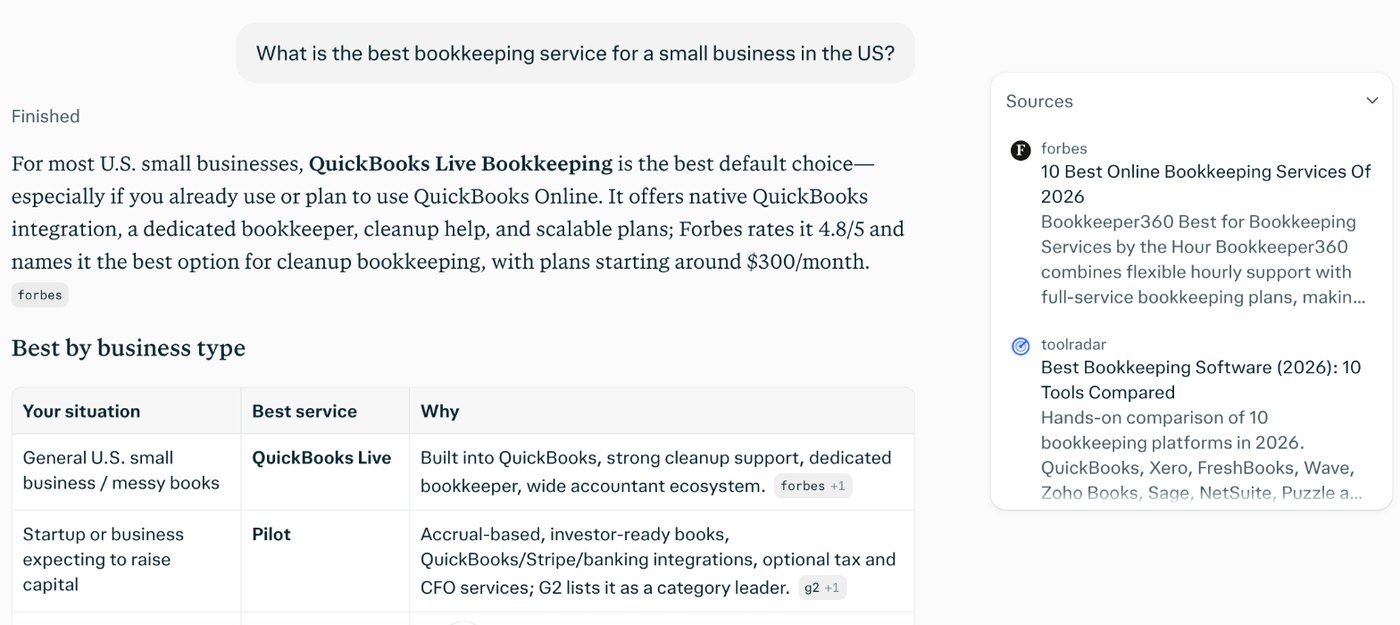
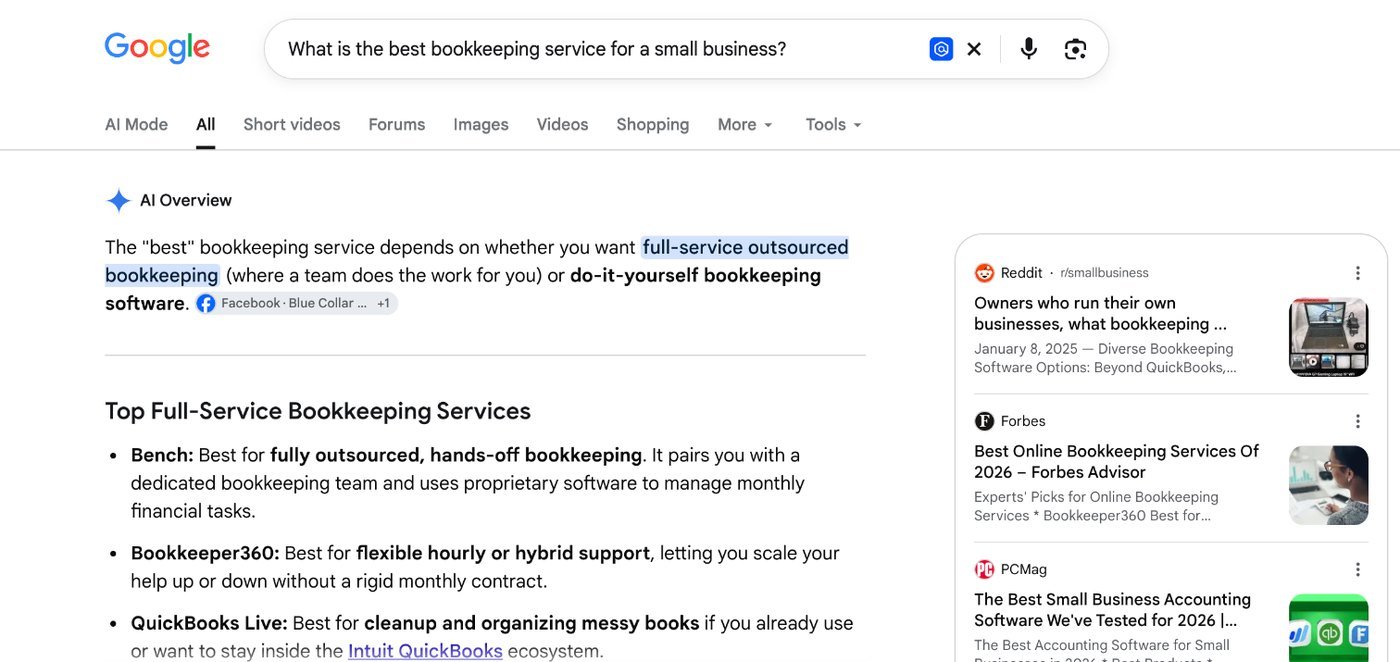
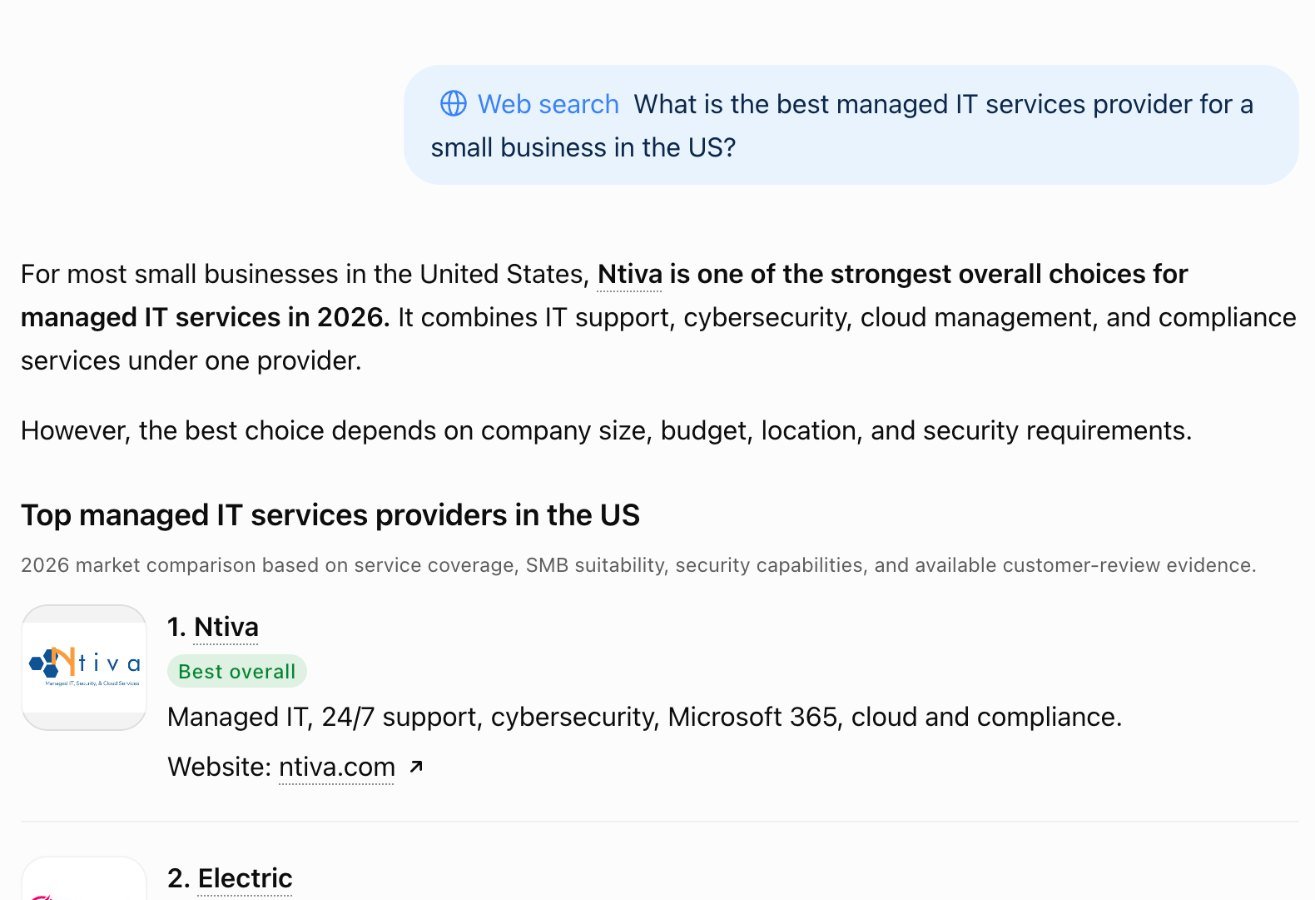
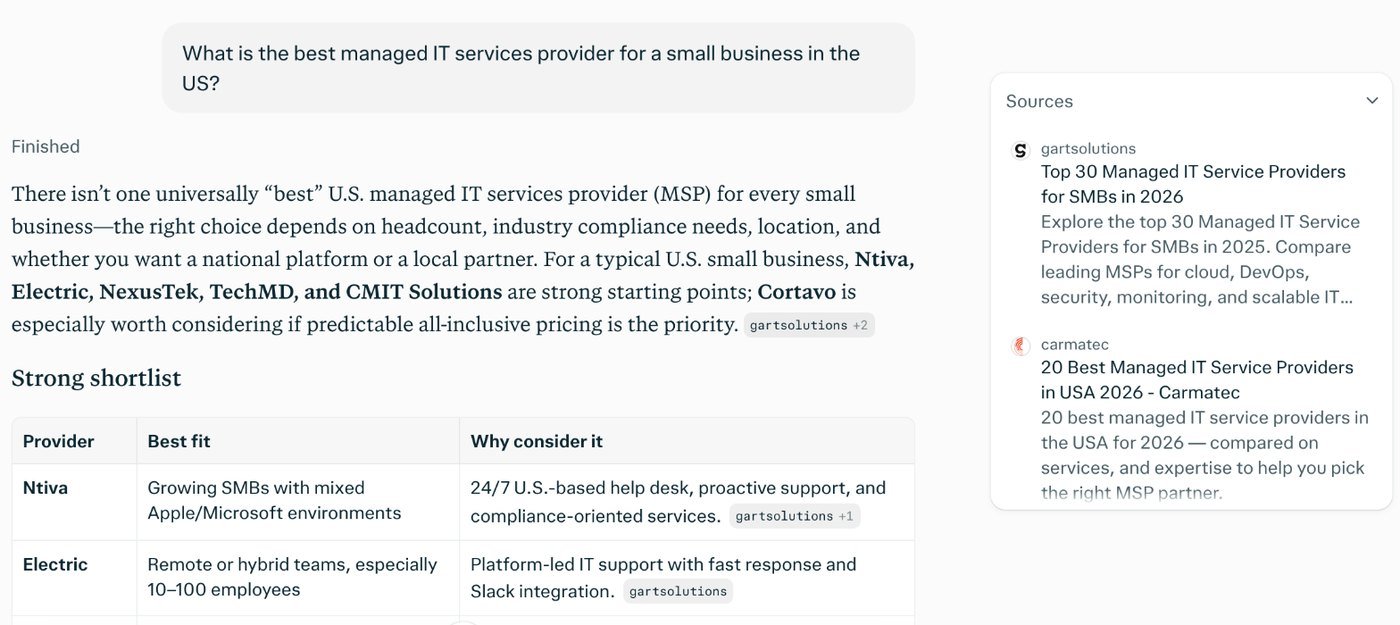
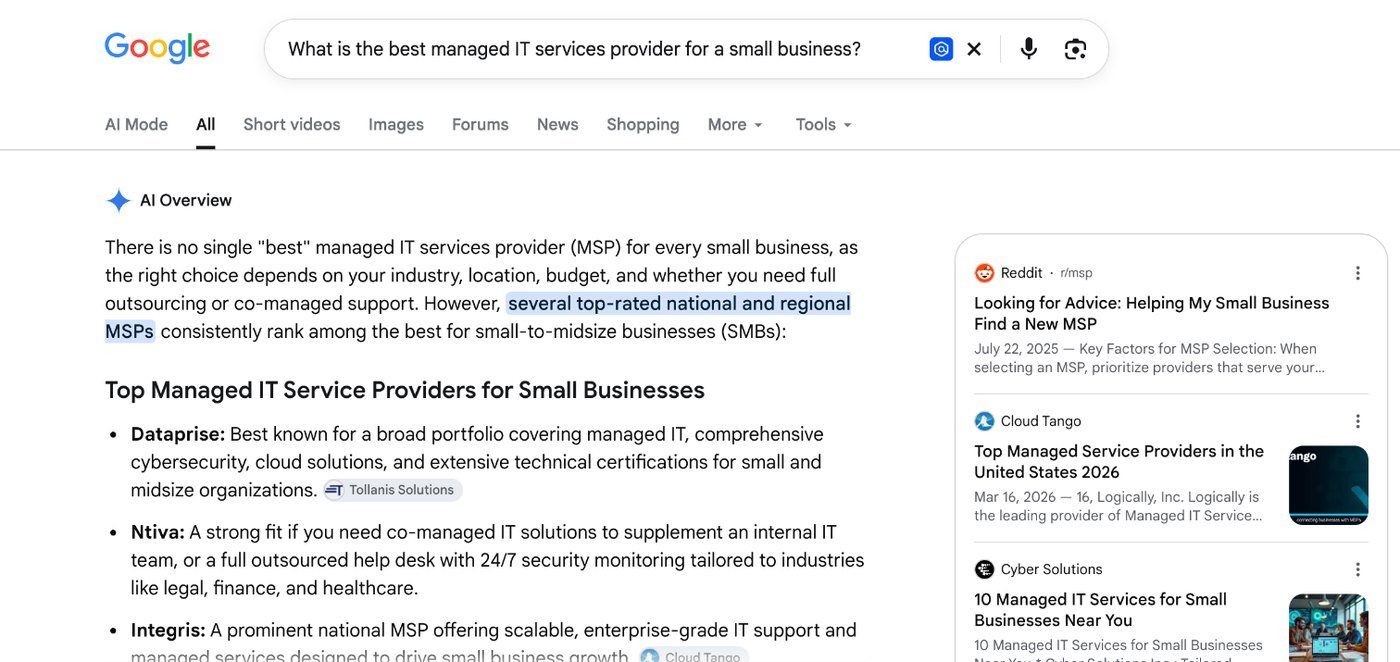
You should not have to take my word for the numbers. Below is the top of every answer I recorded: ChatGPT, Perplexity and Google, for each of the 10 questions. The family dentist screenshots are in full above. Open a question to see its three screens.
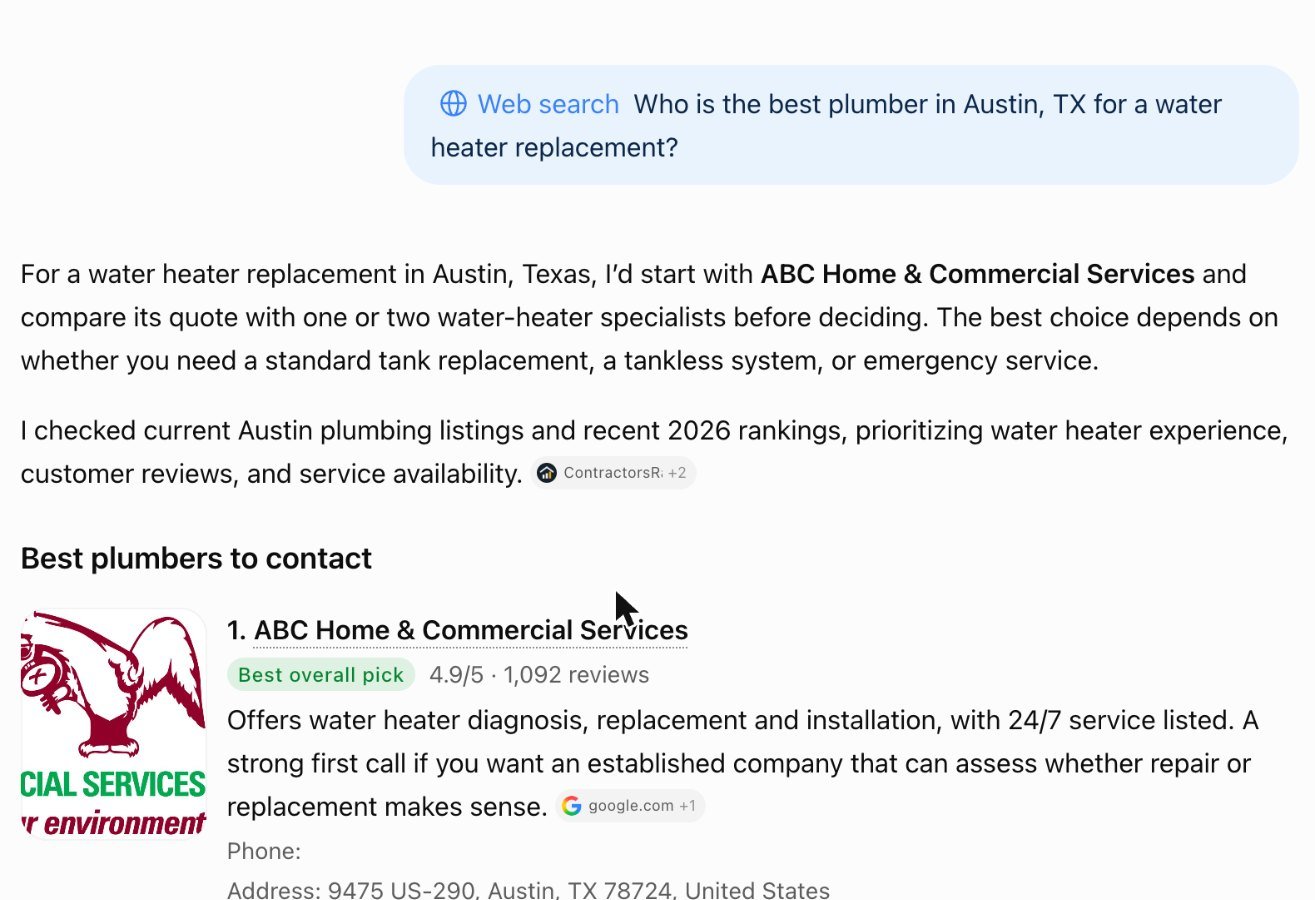
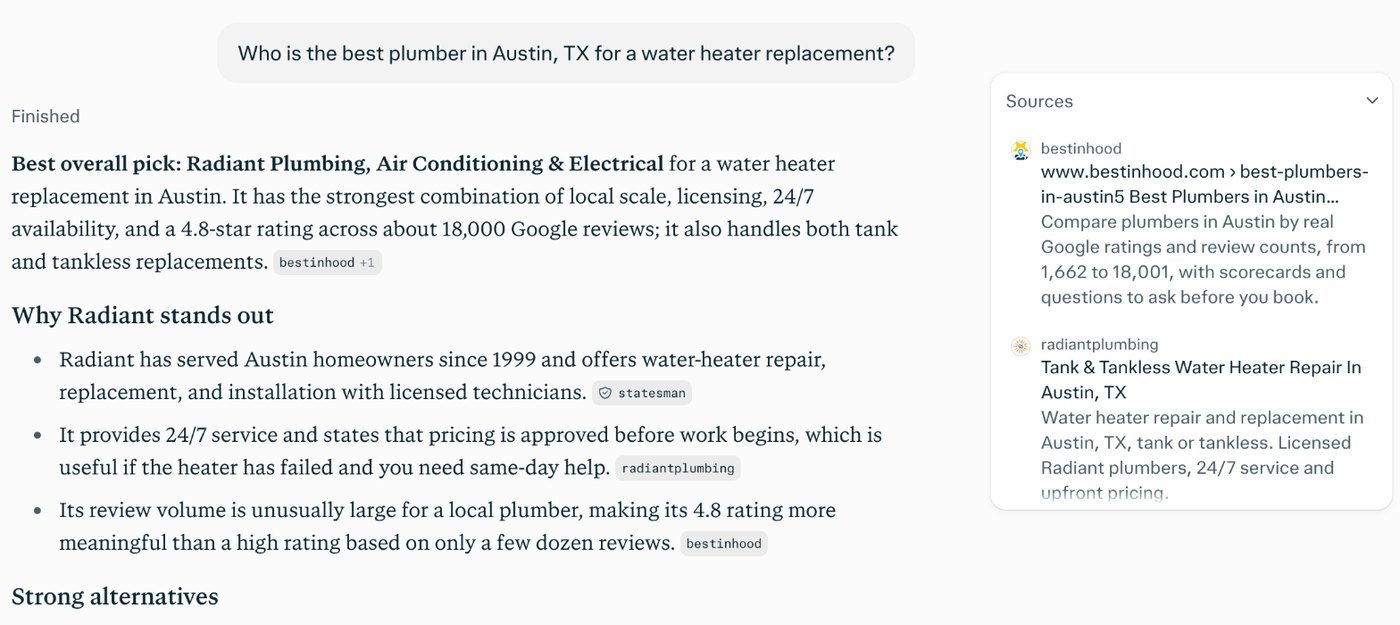
Best plumber for a water heater replacement, Austin
Best CPA for a small business, Austin
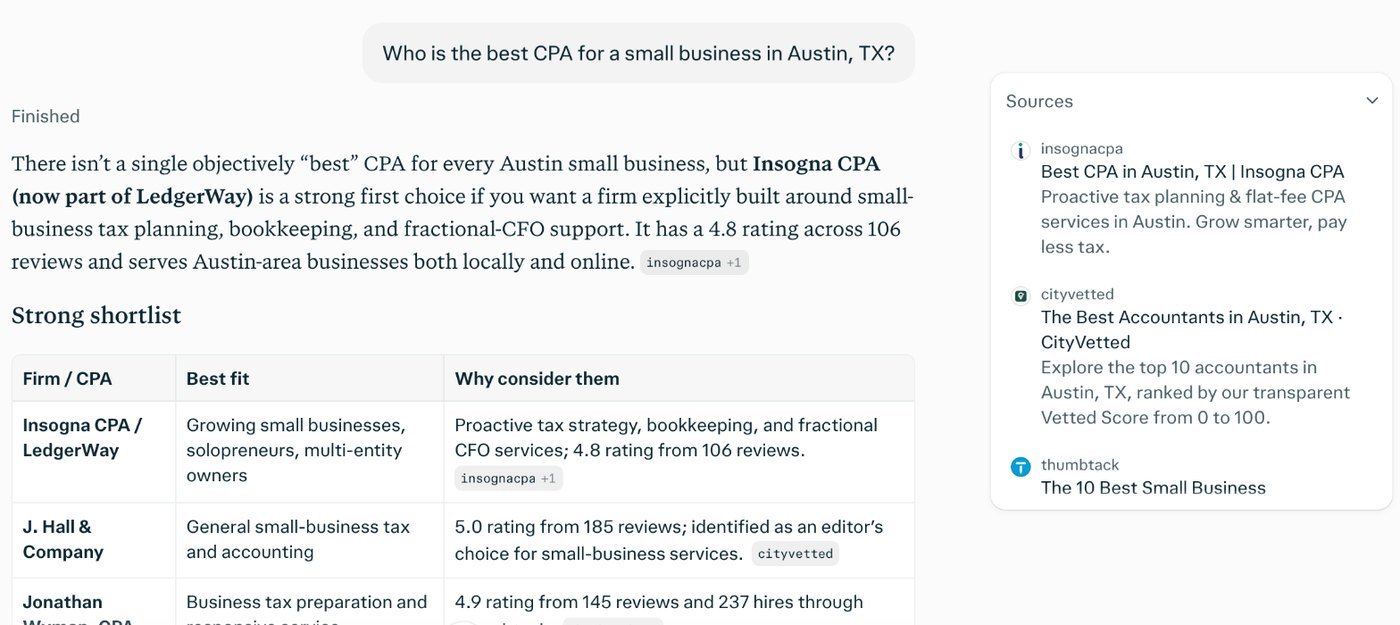
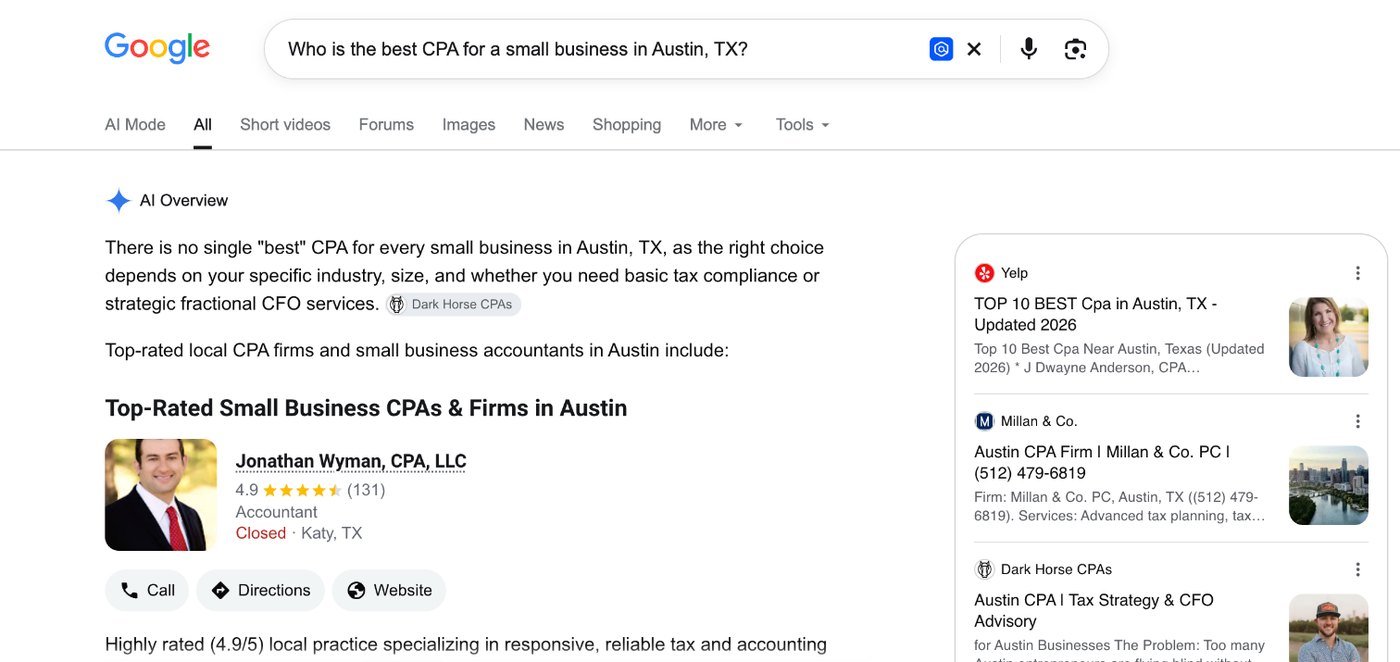
Best roofing company, Austin
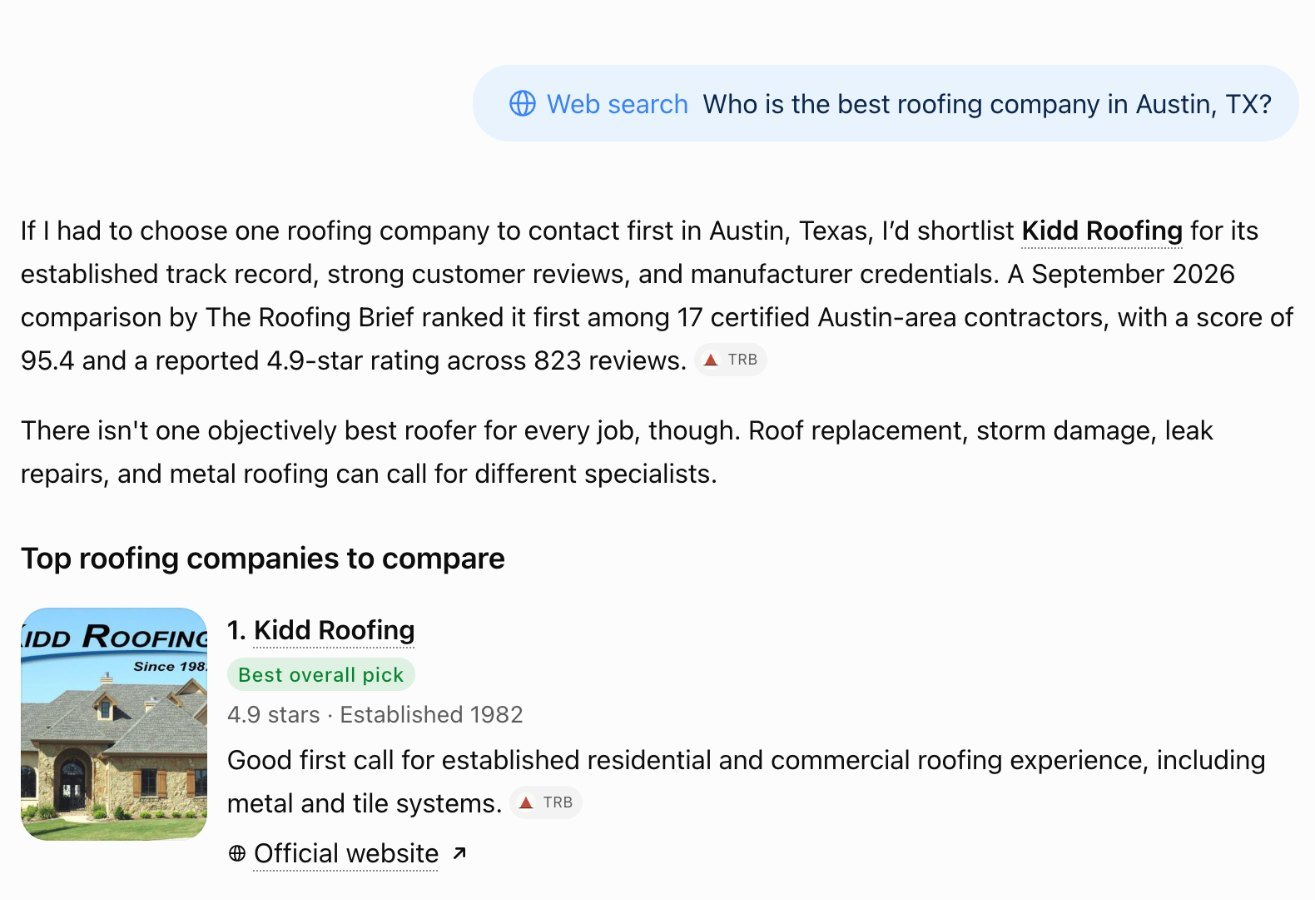
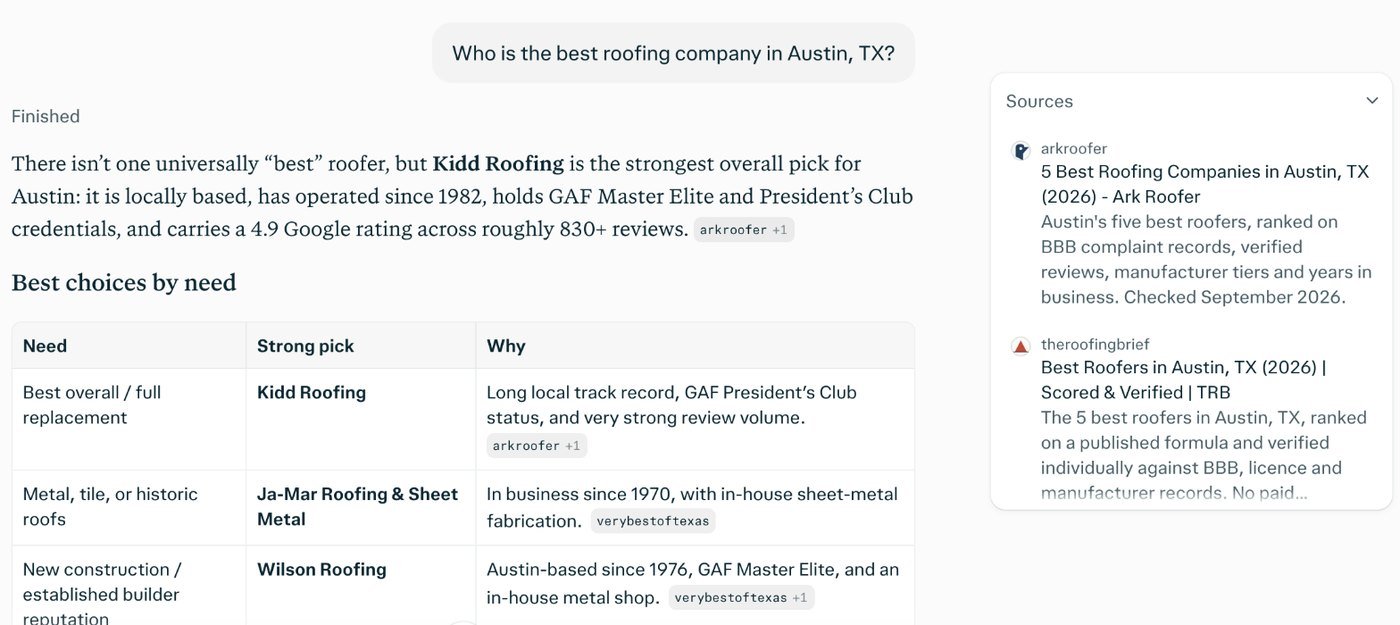
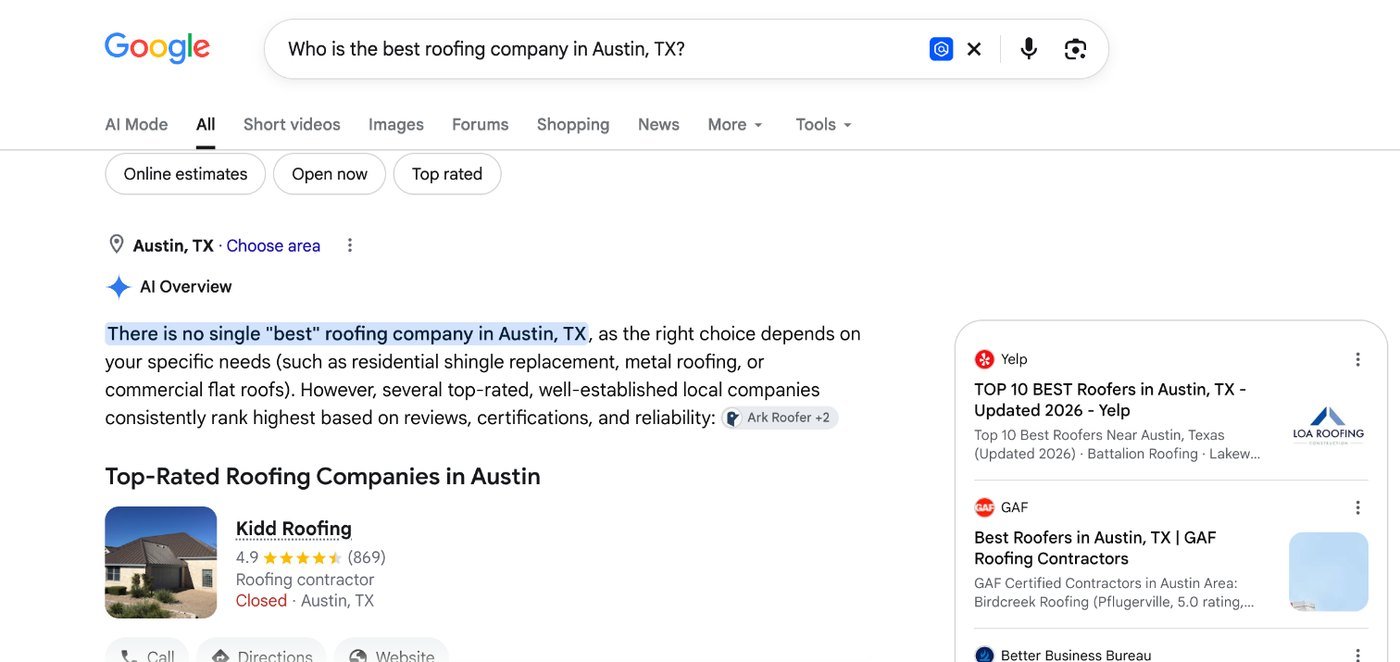
Best HVAC company for AC repair, Austin

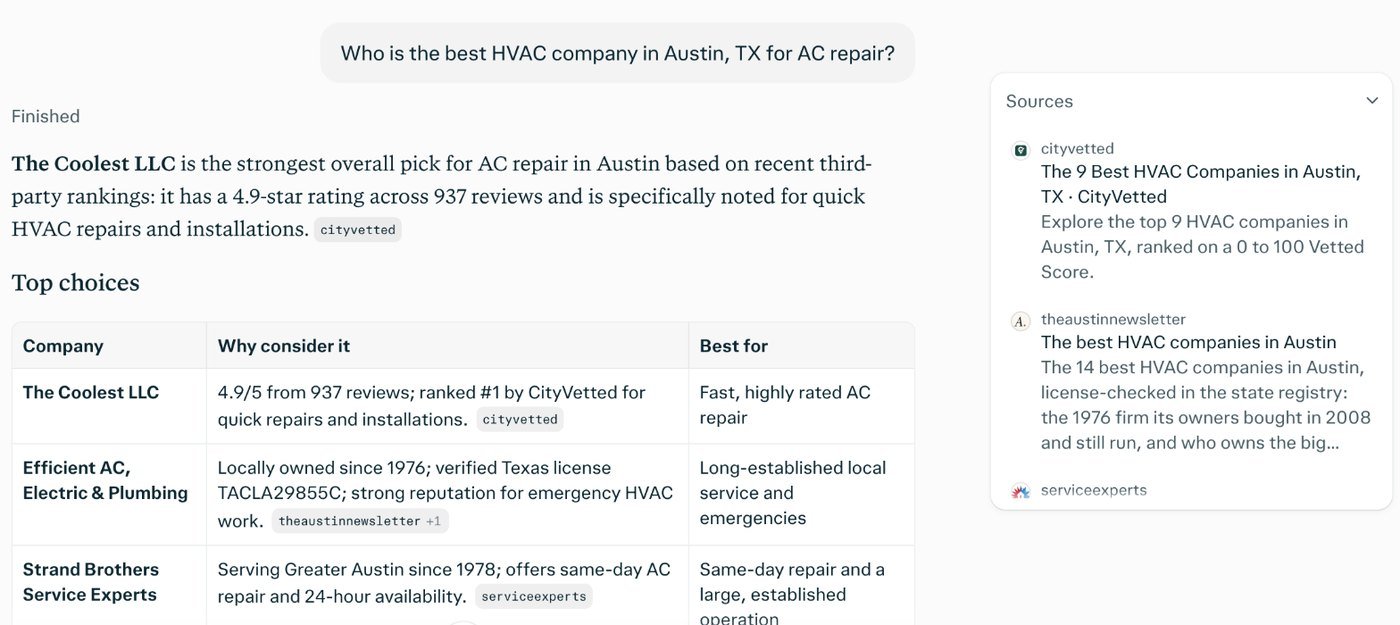
Best bookkeeping service, US
Best managed IT provider, US
Best web design agency, US
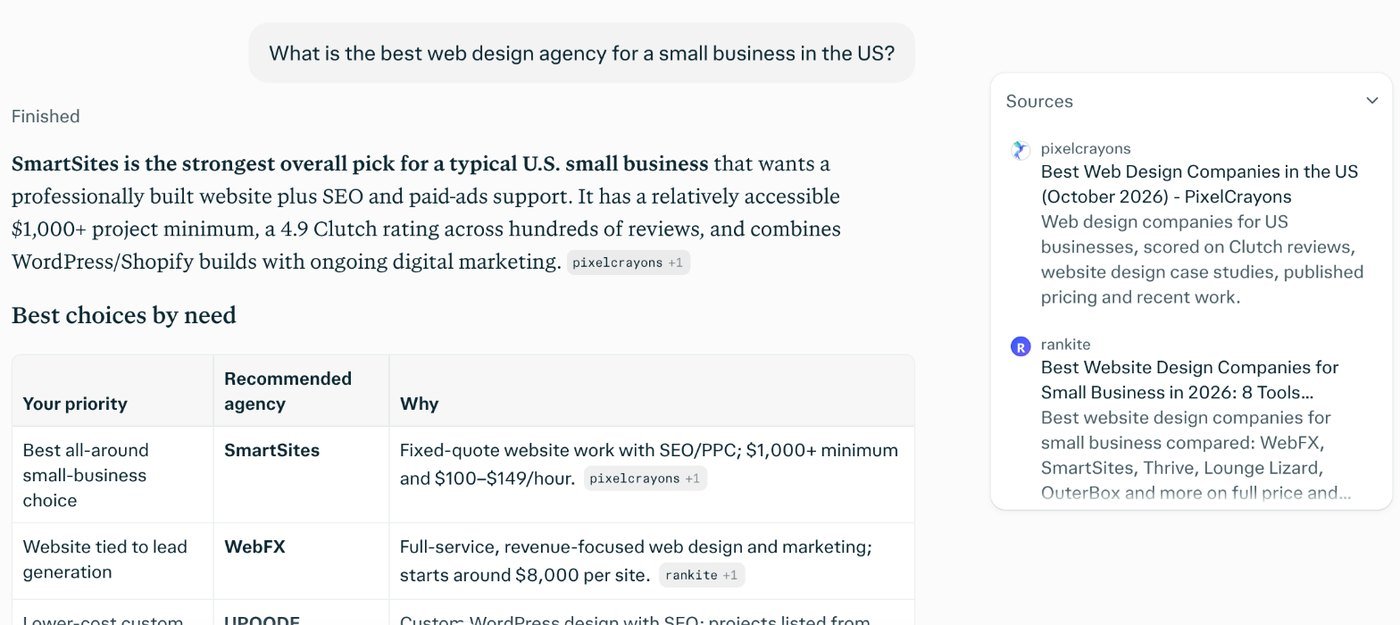
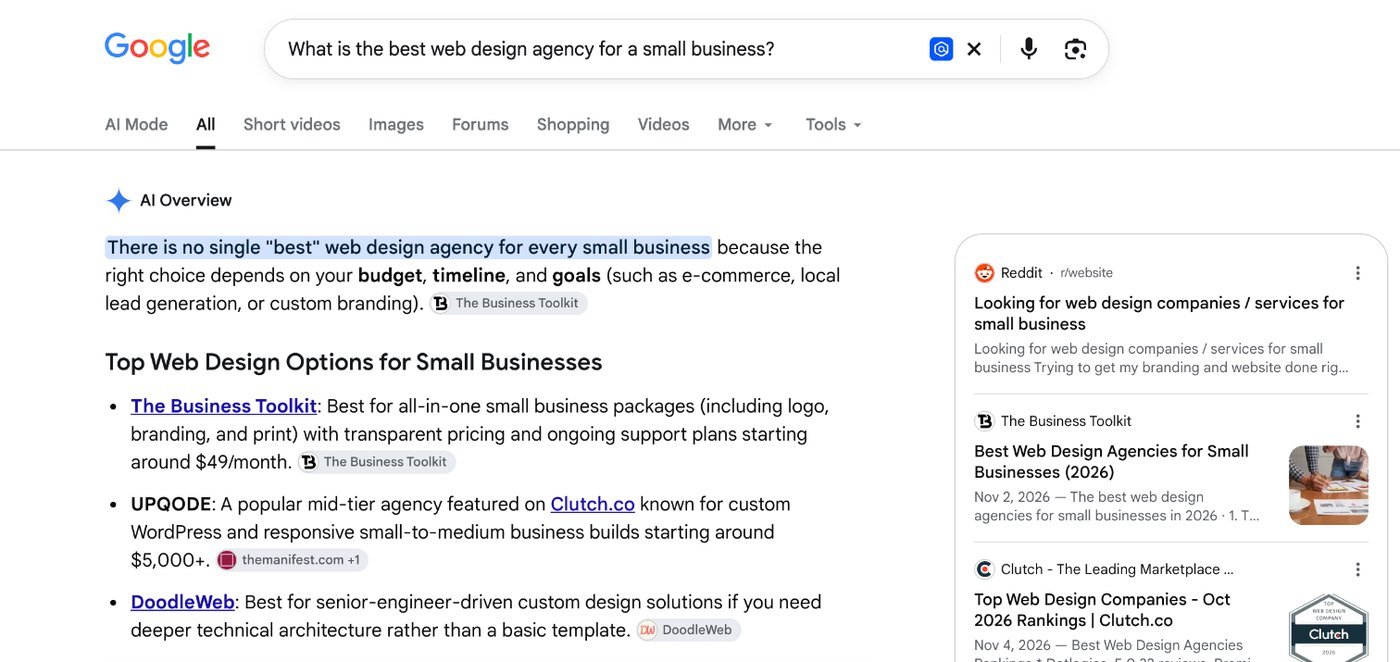
Best virtual assistant company, US
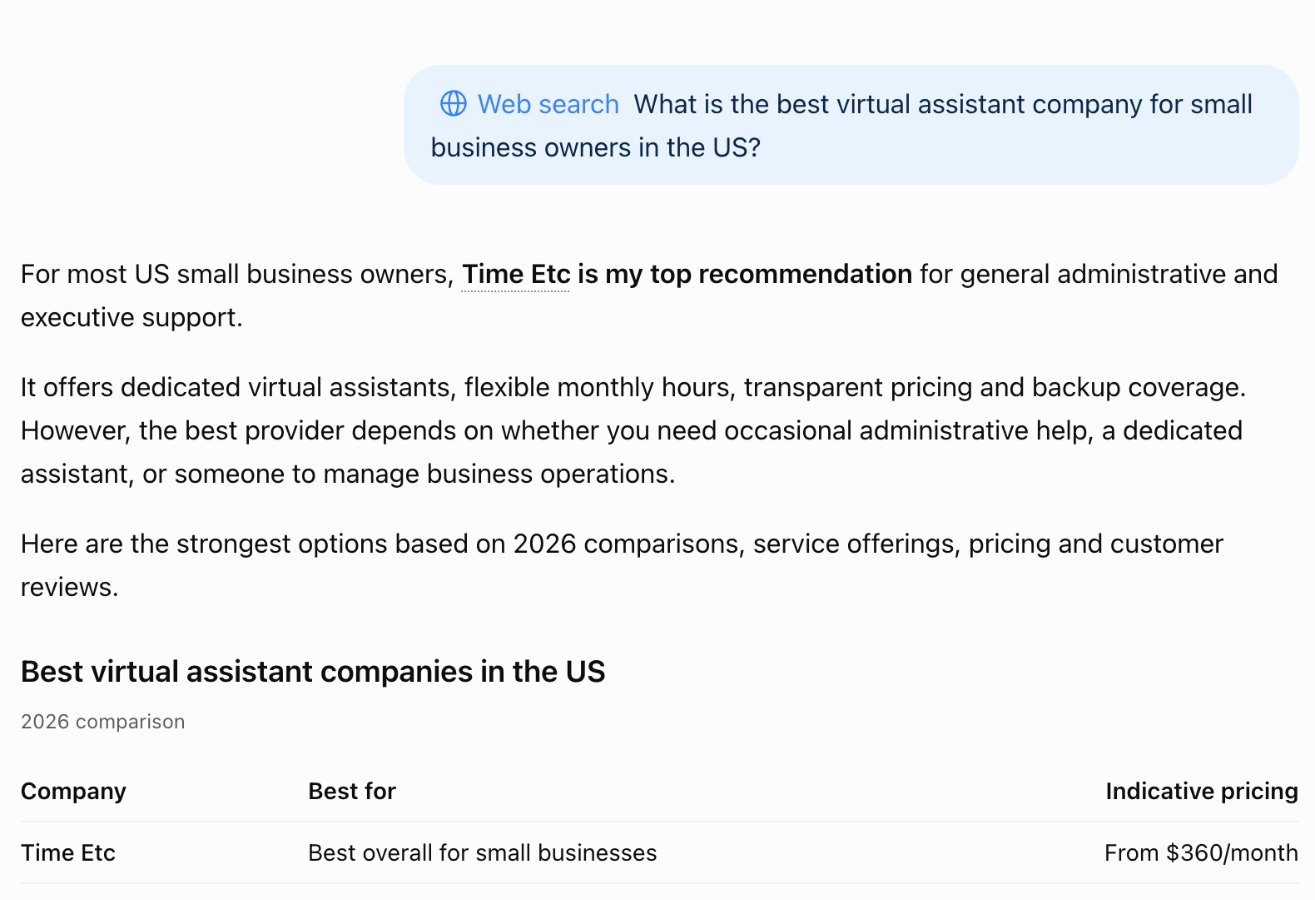
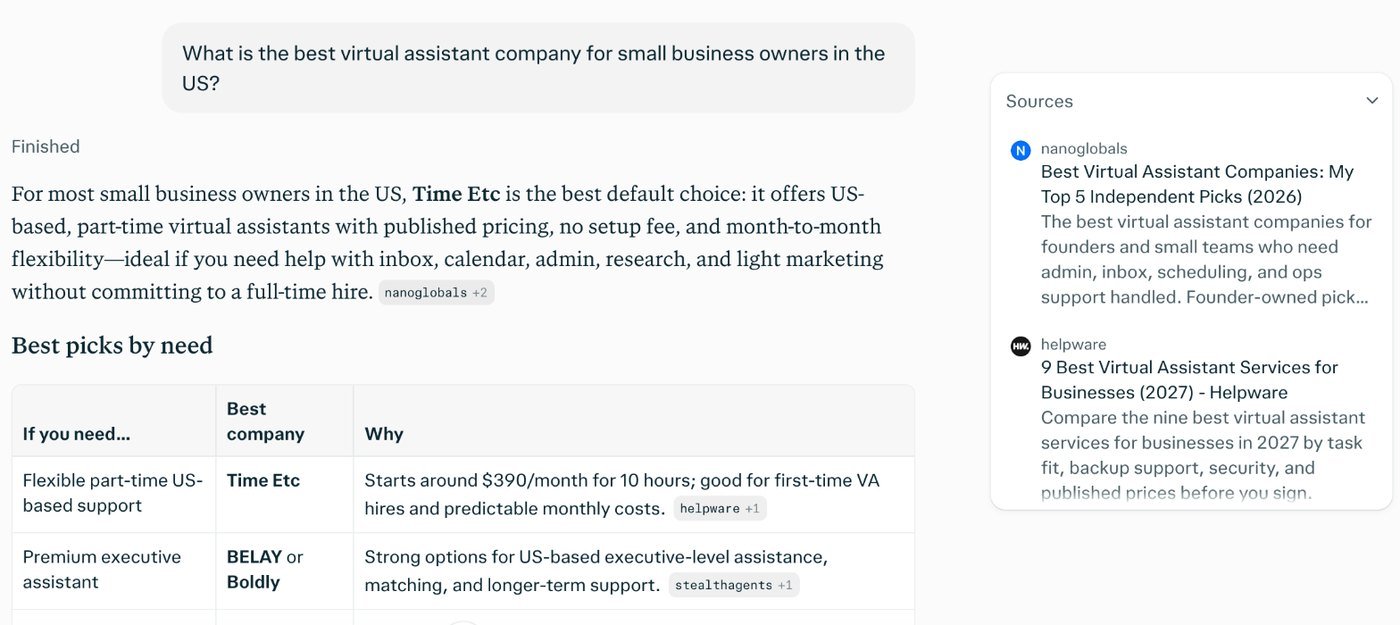
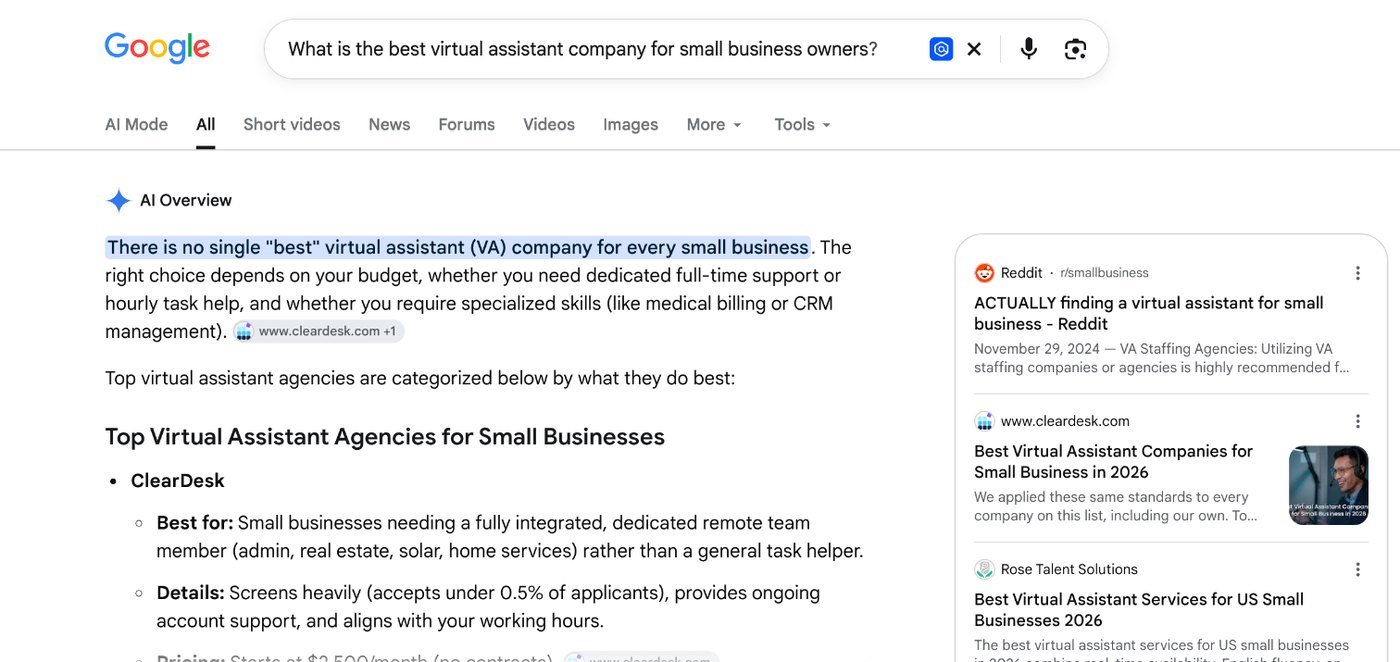
Best HR consulting firm, US

Perplexity: not run. Its free search limit ran out after nine searches.
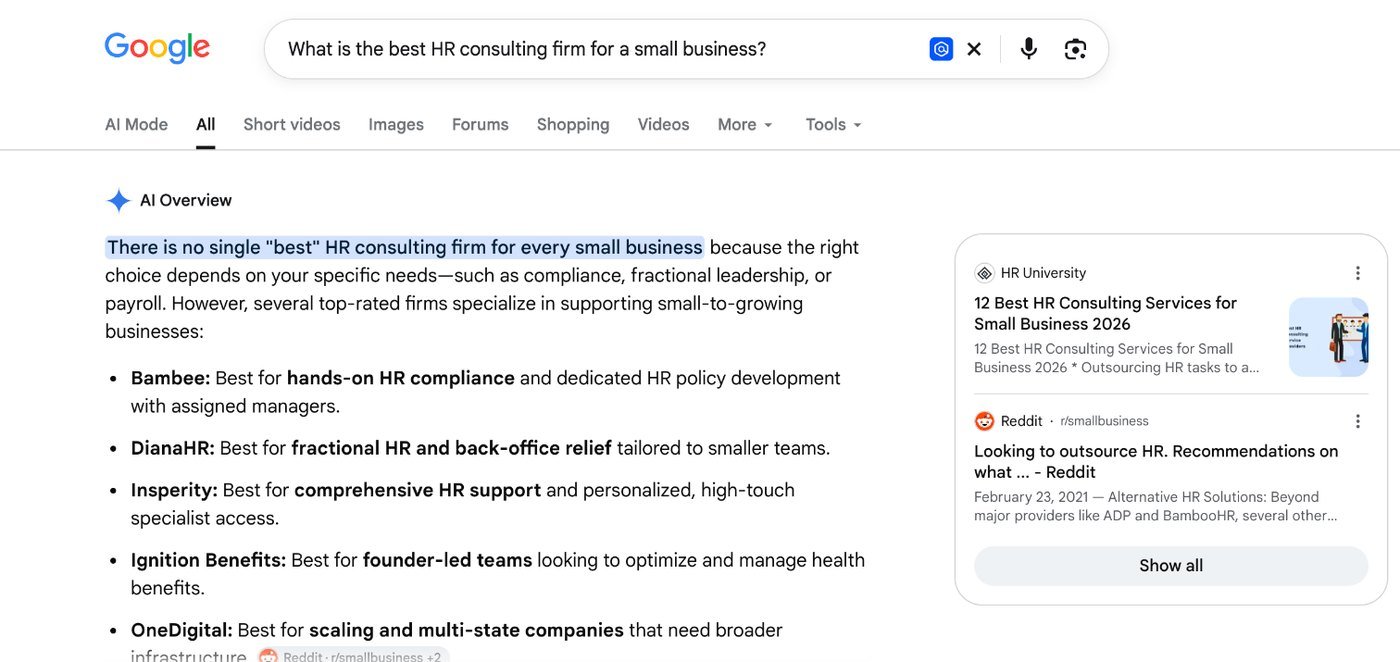
How I checked, and the limits
- One snapshot. I ran all searches on November 5, 2026. Answers vary run to run and by user. Google varies by day and location.
- Accounts. ChatGPT was on a free plan, signed in, with web search on. Perplexity was on a free plan, signed in. Account memory shaped the end of some ChatGPT answers: the IT, virtual assistant and web design answers asked whether I was a customer or a competitor researcher. It may also have shaped other details.
- Perplexity gave two answers to the plumber question. I ran it twice because my first read missed names. Cold Is On The Right led the first answer and Radiant led the second. I used the second. I also counted businesses named in the text of Perplexity’s answers, not only in its tables.
- Perplexity stopped at nine. Its free search limit ran out, so I did not run the HR question there. I did not work around the limit.
- Wording. Austin questions named the city. The US-wide questions ended “in the US” on ChatGPT and Perplexity, and had no location words on Google.
- Google. I read the first 8 organic results of each search with US settings and personalization off. “Own page” means the business’s own domain appeared among them. Directories, forums, media lists and review sites did not count.
- Matching names to websites. I matched each named business to a website, then checked the page. Of 82 listings, 64 were verified, 16 were likely matches and 2 had no match. I counted a business once when two listings pointed to the same domain.
- The website audit. I fetched each homepage and robots.txt once, with a plain, honest user agent. I read raw HTML only, so content that JavaScript adds was invisible. Fourteen of 77 sites refused or failed, and I left them out. I did not retry or work around a refusal.
- “First named” means the first business in the answer or the first row of Perplexity’s table.
- Source chips are partial. ChatGPT showed source names on some paragraphs and not others.
- Small samples. These are 10 questions and 63 sites, not a random sample. The audit shows what named sites have. It does not prove what caused a mention. The ranking of causes is my judgment.
- Outside data. I read BrightLocal, Pew, Ahrefs and the Google and OpenAI pages on their own sites. The price guide is a vendor’s blog post. Check the originals before you reuse a number.
Related reading: AI citation vs AI recommendation, how to get cited by ChatGPT and SEO, AEO and GEO explained.
Frequently asked questions
Why isn’t my business showing up in ChatGPT?
Usually for one of 7 reasons: other sites do not list or review you, no page answers the exact question, AI cannot tell which business you are, your pages say nothing quotable, Google or Bing has not indexed you, basic page tags are missing, or crawlers are blocked. In my November 5, 2026 test, only 5 of 50 businesses ChatGPT named had their own page on Google page one, and none of 63 named sites blocked AI search bots.
Why does ChatGPT recommend my competitor and not me?
Most likely your competitor is listed and reviewed on the sites ChatGPT reads. Its answers quoted ratings and review counts and cited ranking sites such as DentistsRanked, ContractorsRanked and Clutch. Click the source chips in the answer to see where your rival appears, then earn a place there.
Do I need to rank on Google to appear in ChatGPT?
Not necessarily. Only 10% of the businesses ChatGPT named in my test had their own page on Google page one. To appear in Google’s own AI Overviews, though, a page must be indexed and eligible to show with a snippet.
How long does it take to show up after I fix things?
It depends on the fix. OpenAI says its systems take about 24 hours to adjust after a robots.txt change. One store I worked on was named in 6 of 6 ChatGPT answers about two weeks after its pages went live. Google rankings are slower: Ahrefs found 6.11% of 2 million new pages reached the top 10 within a year. Nobody can promise a date.
How much does it cost to fix?
Most fixes cost time, and doing them yourself can be free. My published prices run from $80 for an answer-first article and $180 for a Business Profile and directory clean-up, to $390 to $1,590 for one-time builds and $290 to $1,250 a month for retainers. One vendor guide quotes $2,000 to $10,000 a month for mid-market agency retainers.
Do I need llms.txt or special schema to be recommended?
No. Google says there are no additional requirements and that you do not need new machine readable files, AI text files or special schema to appear in its AI features. In my audit, 28 of 63 named sites had an llms.txt file, but many looked plugin-generated and I cannot show they helped. Keep any structured data accurate.
Should I block AI crawlers?
Not if you want to be recommended. OpenAI says sites opted out of OAI-SearchBot will not be shown in ChatGPT search answers. Training bots such as GPTBot are a separate choice. None of the 63 named sites in my audit blocked an AI search bot.
Do reviews matter for AI recommendations?
In the answers I read, yes. ChatGPT and Perplexity both quoted star ratings and review counts for local businesses, such as 937 and 4,049 reviews for HVAC firms. BrightLocal also notes that AI answers may draw on reviews, directories, business websites and social media.
Why do ChatGPT, Perplexity and Google name different businesses?
They read different sources and weigh them differently. In my test, only 22 of 74 businesses (30%) were named by both ChatGPT and Perplexity, and the two shared the same first pick in 3 of 9 questions. For the Austin questions, the overlap was 6 of 42.
Does this apply to every industry?
I tested 10 types: dentists, plumbers, CPAs, roofers, HVAC, bookkeeping, managed IT, web design, virtual assistants and HR consulting. US-wide services agreed more across engines (16 of 32) than local ones (6 of 40). Your industry may differ, so run the 30-minute test.
Can anyone guarantee that AI will recommend my business?
No. Answers vary run to run and by user, and nobody controls the sources engines read. Be wary of a guarantee. A good provider gives you a fix list, sourced data, a testing plan and honest reporting.
How do I check what ChatGPT says about my business?
Write 10 buyer questions, run them in ChatGPT with web search on, in Perplexity and in Google, and log whether you are named, in what position and with which sources. The 30-minute test above gives the steps, and my guide to checking ChatGPT has templates.
What should I fix first?
Start with the free checks: your robots.txt file, Search Console indexing and a Business Profile that matches your website. Then write one page for your main job and ask happy customers for reviews. Those steps cover causes 7, 5, 3, 2 and 1.
Can you check my business for me?
Yes. The free AI visibility audit scores your site out of 100 and shows what ChatGPT, Gemini and Perplexity say about you. A manual report of 25 prompts across five engines costs $120.