In this article
- Why does the terminology matter?
- What is SEO, in depth?
- What is AEO (answer engine optimization), in depth?
- What is GEO (generative engine optimization), in depth?
- How do SEO, AEO and GEO compare?
- What does the data say about why all three matter?
- Which should you do first? A decision framework
- What does a 12-month roadmap look like?
- What myths should you ignore?
- What does the evidence from my own work look like?
- Glossary
- Where to go next
- What should you ask a provider who sells SEO, AEO or GEO?
- Sources
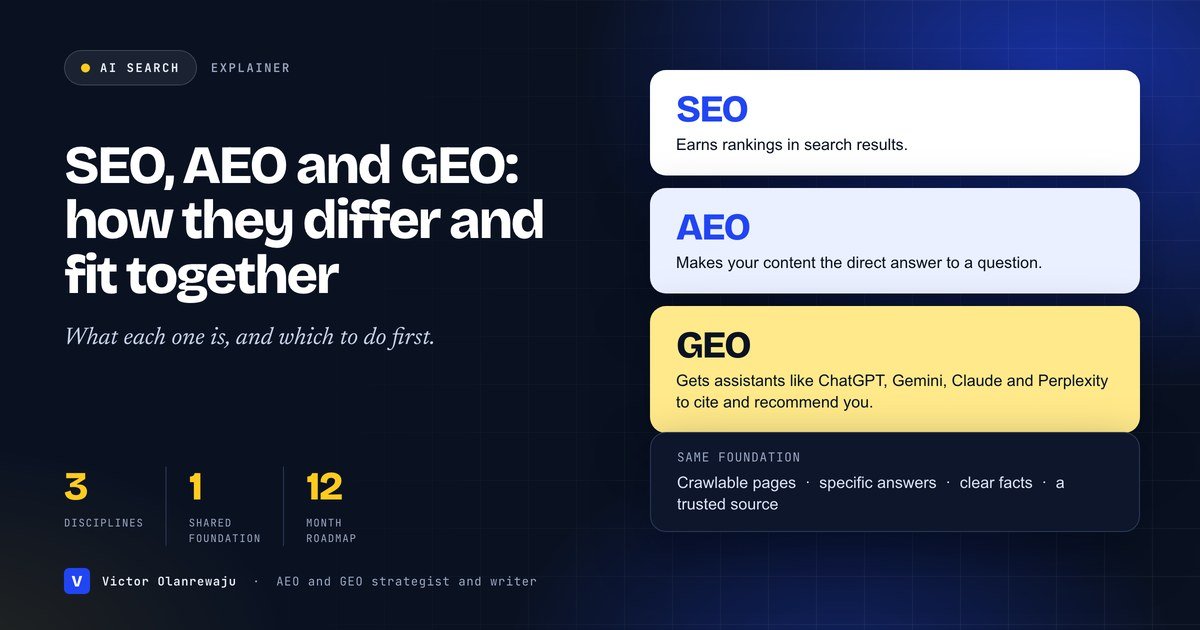
In short: SEO (search engine optimization) earns rankings. AEO (answer engine optimization) makes your content the direct answer to a question. GEO (generative engine optimization) gets AI assistants such as ChatGPT, Gemini, Claude and Perplexity to cite and recommend you. All three rest on the same foundations: pages that can be crawled and indexed, specific answers to real questions, clear facts and a source people can trust. Buyers now use Google and AI assistants to decide who to contact, so a business needs all three, in the right order. Google’s own documentation says its AI features need no special optimization beyond SEO fundamentals, which is why the order matters.
The three acronyms are often presented as rivals, or as a replacement cycle in which each new one makes the last obsolete. That framing sells conferences and confuses buyers. In practice they are three views of one job: being easy to find, easy to understand and easy to trust, for people and for machines. This guide defines each, shows where they overlap and where they diverge, gives you the evidence, and ends with a framework for deciding what to do first. If you want the numbers before the theory, read AI search statistics for 2026.
Why does the terminology matter?
Terminology matters because each term points at a different surface where a buyer meets your business, and each surface rewards different work. A hotel might rank fifth for “boutique hotel Kigali” (an SEO result), supply the sentence in a featured snippet answering “is there airport pickup in Kigali” (an AEO result) and be named first by ChatGPT when someone asks for the best place to stay near the airport (a GEO result). Each result needs its own page, check and measure. Treating them as one undifferentiated “SEO” hides gaps, and treating them as three separate projects wastes effort.
What is SEO, in depth?
Search engine optimization is the discipline of deciding which searches a business should win, fixing what stops its site ranking for them, and building the content and authority to get there. Its output is a place on a results page. Its test is commercial: do the people who find you become enquiries and customers?
The technical layer
Search engines must be able to find, fetch and understand your pages. Google’s documentation covers the basics:
- Sitemaps. A sitemap tells search engines which pages you think are important and helps them crawl more efficiently. Google says that if your pages are properly linked it can usually discover most of your site, that a sitemap does not guarantee crawling or indexing, and that you might need one if your site is large or new with few external links. It describes a site as small at about 500 pages or fewer. If you use WordPress, your CMS has likely already made one available.
- Robots.txt. A robots.txt file manages crawler traffic and is not a mechanism for keeping a page out of Google. A page blocked by robots.txt can still appear in results, without a description, if other pages point to it. To keep a page out of Google, use noindex or password protection.
- Titles and descriptions. Google’s guidance on meta descriptions and snippets says to create unique descriptions for each page, because identical descriptions across a site are not helpful when individual pages appear in results, and that descriptions made of keyword strings are less likely to be shown.
- Page experience. Google’s core ranking systems look to reward content that provides a good page experience, across many aspects, not one or two.
The content layer
Google’s guidance on helpful, reliable, people-first content is the clearest statement of what a ranking page looks like. It asks whether content provides original information, reporting, research or analysis, a substantial and complete description of the topic, and insight beyond the obvious. It warns against search-engine-first content: content primarily made to attract visits from search engines, extensive automation to produce content on many topics, mainly summarising what others say without adding value, and writing to a particular word count because you have heard Google prefers it.
The authority layer
Authority comes from being referenced by others. The sustainable ways to earn it are original research, useful tools and expert commentary promoted through digital PR. The unsustainable way is buying links, which Google lists under link spam. I cover the competitive extreme of this work in my crypto SEO guide, and the service is described on my SEO strategist page.
What is AEO (answer engine optimization), in depth?
An answer engine is anywhere a question gets a direct response instead of a list of ten links. That includes Google’s featured snippets, the People Also Ask box, voice assistants and the AI summaries Google shows in AI Overviews and AI Mode. AEO is the practice of writing and structuring content so those systems can lift a clear, correct answer from it and credit you.
The anatomy of an answer-first page
- A heading that matches the question as people ask it.
- A direct answer in the first 40 to 60 words beneath it.
- Specifics that can be checked: numbers, dates, names, conditions.
- A named author and a visible updated date.
- A short FAQ for the follow-up questions.
- Structured data that matches the visible text, where it genuinely fits.
What Google says about AEO surfaces
Google’s documentation on AI features and your website, last updated in December 2025, says the best practices for SEO remain relevant for AI Overviews and AI Mode, that there are no additional requirements to appear in them and no other special optimizations necessary. To be shown as a supporting link, a page must be indexed and eligible to be shown in Google Search with a snippet. It also says you do not need to create new machine-readable files, AI text files or markup to appear in these features, and that there is no special schema.org structured data you need to add. Indexing and serving are never guaranteed.
One practical wrinkle: Google limits FAQ rich results to well-known, authoritative government and health websites. I still write FAQs because they match how people ask follow-up questions, and I still mark them up because it makes the questions and answers unambiguous, but I never promise a rich result from them. My AEO strategist page shows how I apply this for clients.
What is GEO (generative engine optimization), in depth?
Generative engines are AI assistants that answer by synthesising information from several sources. GEO is the practice of making a business easy for them to find, trust, cite and recommend. Two outcomes matter and they are different: a citation, where the assistant uses your page as a source, and a recommendation, where it names your business as the answer. I explain the difference in AI citation versus AI recommendation.
The research
The term was introduced in a 2023 paper, GEO: Generative Engine Optimization, by Aggarwal and colleagues. The authors built a benchmark of diverse user queries called GEO-bench, with relevant web sources to answer them, and tested optimization methods for content creators. They reported that GEO can boost visibility in generative engine responses by up to 40%, and that the efficacy of the strategies varies across domains, underscoring the need for domain-specific methods. Two cautions apply. It is an academic study of specific methods in a controlled setting, not a promise about any one business. And the domain finding is the more useful half: test in your own market instead of copying a generic checklist.
The practice
For a business, GEO has five working parts, which I walk through in how to get cited by ChatGPT:
- Access. The right crawlers can read your site. See AI crawlers and robots.txt.
- Pages. A specific, answer-first page for each buyer question.
- Entity. Your name, offer, location and contact details are consistent everywhere, including structured data.
- Sources. Accurate mentions on the third-party sites assistants rely on.
- Measurement. A monthly test across assistants. See how to check what ChatGPT says about your business.
How do SEO, AEO and GEO compare?
| SEO | AEO | GEO | |
|---|---|---|---|
| Goal | Rank for the searches buyers make | Be the direct answer | Be cited and recommended by AI assistants |
| Where it shows up | Search results pages | Featured snippets, People Also Ask, AI Overviews, voice | ChatGPT, Gemini, Claude, Perplexity, AI Mode |
| Main inputs | Technical health, content, links | Answer-first pages, FAQs, structured data | Crawler access, entity consistency, third-party mentions, reviews |
| Typical query | “boutique hotel Kigali” | “is there airport pickup in Kigali” | “best place to stay near Kigali airport” |
| Time to show effect | Weeks for technical fixes, months for competitive queries | Weeks to months after pages are indexed | Weeks to a few months in my client cases, but variable |
| How I measure it | Rankings, organic visits, leads | Snippet and answer presence, enquiries from answer pages | Monthly panel of buyer questions, AI referral traffic, enquiry source |
What does the data say about why all three matter?
The full figures, with their methods and limits, are in AI search statistics for 2026. The headlines, each from a primary source:
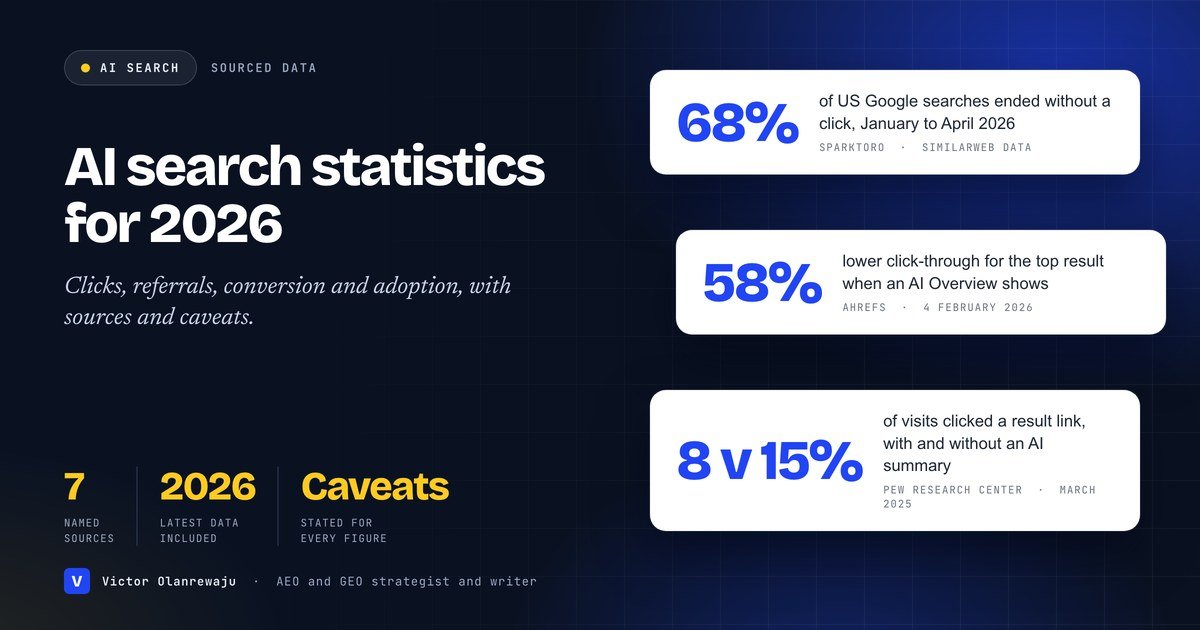
- Pew Research Center’s analysis of 900 US adults’ browsing in March 2025 found users who saw a Google AI summary clicked a traditional result in 8% of visits, against 15% for users who did not, and very rarely clicked the sources cited inside the summary. See the Pew analysis.
- Ahrefs found an AI Overview correlates with a 58% lower average click-through rate for the top-ranking page (update of 4 February 2026, 300,000 keywords).
- SparkToro, using Similarweb panel data, reports 68.01% of US Google searches in January to April 2026 ended without a click.
- Similarweb counted over 1.13 billion AI referral visits to the top 1,000 sites in June 2025, up 357% year on year, with ChatGPT more than 80%. Google sent about 191 billion referrals that month.
- Semrush’s modelled study estimates an AI search visitor is worth 4.4 times an organic visitor by conversion rate, with the caveat that its projections are extrapolations.
The reading I take from them: fewer clicks per search, a very large audience asking assistants, small but fast-growing referral traffic, and probably more valuable visits. Visibility inside the answer is now part of pipeline.
Which should you do first? A decision framework
Because the three share foundations, the order is rarely controversial. What changes by business type is the emphasis.
| Your situation | Start with | Then |
|---|---|---|
| New site, few external links | Technical SEO: crawlable, indexed, sitemap, clear structure | Answer-first pages for your ten most valuable questions |
| Established site, flat traffic | Audit content against Google’s helpful-content questions; fix thin or duplicate pages | Add AEO structure to the pages that already rank |
| Local business (hotel, restaurant, clinic) | Business Profile, consistent entity, specific pages for visitor questions | GEO testing; reviews and listings |
| E-commerce | Category pages and guides, one page per search | Structured data and GEO testing on “best” queries |
| B2B service or agency | Named-expert content and case studies | Third-party mentions and original research |
| Crypto and finance | Trust: sourcing, authorship, accuracy standards | Original data, then AI visibility |
What does a 12-month roadmap look like?
- Months 1 to 2: foundation. Crawl, indexing, speed, titles, descriptions, robots.txt and firewall checks, Search Console set up. Baseline test of what assistants say.
- Months 2 to 4: answer pages. Map 20 buyer questions to 20 pages, publish the top ten, add FAQs and author bylines.
- Months 3 to 5: entity. Consistent facts across site, structured data and profiles; complete Business Profile; request genuine reviews.
- Months 4 to 8: authority. One original research piece, promoted; accurate listings and mentions on the sources assistants cite.
- Months 6 to 12: compound. Refresh what moved, publish the next batch, repeat the monthly test and tie results to enquiries.
What myths should you ignore?
- “GEO replaces SEO.” Google says SEO fundamentals remain relevant to AI features, and a page that is not indexed cannot be a supporting link.
- “You need llms.txt to be cited.” Google says no special files are needed for its features. Others have published no commitment either way. See the llms.txt guide.
- “Schema guarantees AI citations.” Google says there is no special structured data to add for its AI features. Schema clarifies content and entity. See schema markup for AI search.
- “Rank first and you will be cited.” Not automatically. A page that ranks may never be named, and a page that does not rank may still be cited.
- “AI content at scale is a shortcut.” Google’s spam policy on scaled content abuse targets many pages generated primarily to manipulate rankings, however created.
- “Anyone can guarantee a mention.” No. Answers vary between runs, users and models.
What does the evidence from my own work look like?
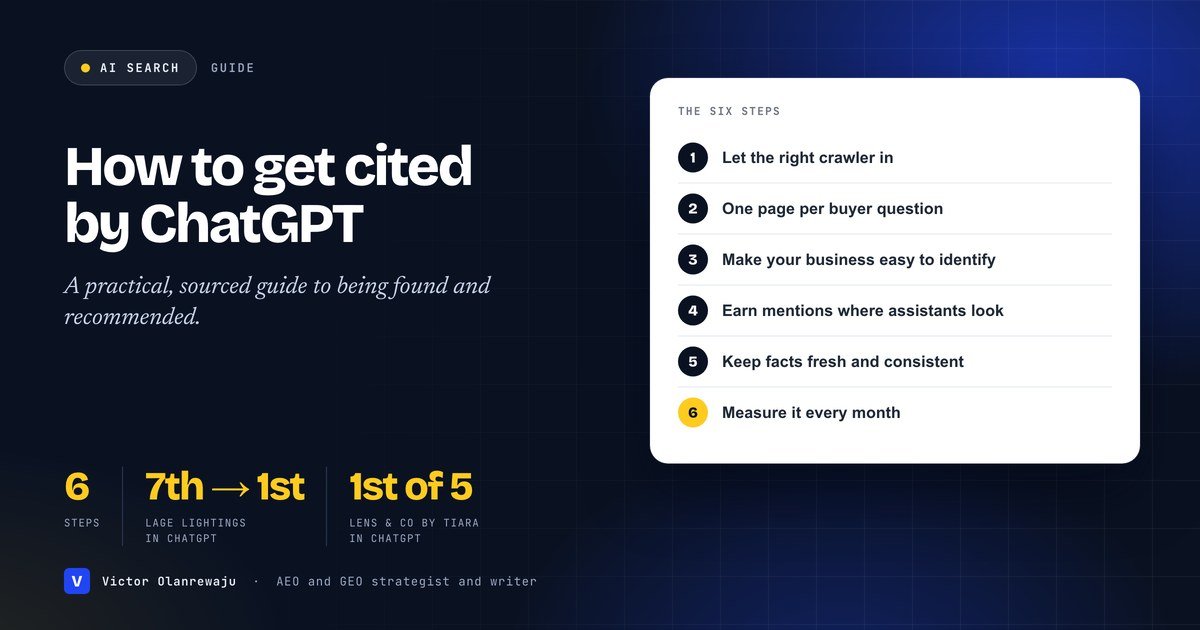
- LAGE Lightings: ChatGPT moved it from seventh in July 2026 to the first of five picks in October; Gemini and Claude also name it first; sessions rose 233% year on year; the co-founder reports inquiries from top architects and some of the biggest deals the business has closed. See the case study.
- Lens & Co by Tiara: page one of Google Nigeria for all four tracked searches and ChatGPT’s first of five stores within weeks of publishing. See the case study.
- CCN: coverage of the MANTRA (OM) collapse held the number one Google position for months and was cited by AI models.
- Kigali research: only 5 of 11 AI answers cited a business’s own website. See the research.
Glossary
- Answer engine
- Any system that responds to a question with a direct answer: snippets, voice assistants, AI Overviews, chat assistants.
- Citation
- An assistant uses your page as a source, usually with a link.
- Recommendation
- An assistant names your business as an answer, often in a ranked list.
- Entity
- A uniquely identifiable thing, such as a person, business or place, that machines can recognise across sources.
- Query fan-out
- Google’s term for issuing multiple related searches across subtopics and data sources to build an AI response.
- E-E-A-T
- Experience, expertise, authoritativeness and trustworthiness, the mix of factors Google says its systems use to identify helpful content. Google says trust is the most important.
Where to go next
If you remember one thing, make it this: fix the foundation, write specific answer-first pages, make your entity unambiguous and measure monthly. The practical steps are in how to get cited by ChatGPT. If you want a specialist to do it, see my services and pricing.
What should you ask a provider who sells SEO, AEO or GEO?
The market is full of confident claims. These questions separate substance from salesmanship:
- “What will you measure before you start?” A credible answer includes a baseline: rankings, assistant answers, traffic, enquiries.
- “What do you guarantee?” Be wary of any guarantee of a ranking or an AI mention. No one outside the platforms controls them.
- “Can you show a comparable result with sources?” Ask for dated figures and what the limits are.
- “Who writes the content, and who checks the claims?” You want named experts, not anonymous mass production. Google’s spam policy on scaled content abuse is a good reference point.
- “How do you get links?” If the answer involves buying them, walk away.
- “How will you report?” The same measures every month, including the unflattering ones, tied to leads and revenue.
Those are the standards I hold myself to, and they are why my published offers start with a free audit and fixed scopes. See pricing.
Sources
- Google Search Central: AI features and your website
- Google Search Central: creating helpful, reliable, people-first content
- Google Search Central: learn about sitemaps
- Google Search Central: introduction to robots.txt
- Google Search Central: meta descriptions and snippets
- Google Search Central: spam policies
- Aggarwal et al., GEO: Generative Engine Optimization (arXiv, 2023)
- Pew Research Center: Google users are less likely to click on links when an AI summary appears
Frequently asked questions
What is the difference between SEO and AEO?
SEO earns a ranking on a results page. AEO earns the direct answer to a question, in a featured snippet, a People Also Ask box, an AI Overview or a voice result. AEO is built on SEO foundations and adds answer-first writing, FAQs and structured data.
What is the difference between AEO and GEO?
AEO focuses on being the direct answer in search features. GEO focuses on being cited and recommended inside AI assistant answers such as ChatGPT, Gemini, Claude and Perplexity. They share the same foundations, so they are best run together.
Does Google require special optimization for AI Overviews?
No. Google's documentation says the best practices for SEO remain relevant for AI Overviews and AI Mode, with no additional requirements and no special optimizations necessary. A page must be indexed and eligible to be shown in Search with a snippet.
Which should I do first, SEO, AEO or GEO?
Start with the shared foundation: crawlable, indexed, fast pages with unique titles and descriptions. Then write answer-first pages for your most valuable buyer questions, make your entity consistent, and measure monthly what assistants say about you.
Can anyone guarantee a ChatGPT or Google AI mention?
No. Rankings and AI answers are controlled by the platforms and they change between runs, users and models. A credible strategist guarantees a measured baseline, the work and the reporting, not a placement.