In this article
- What the data says about AI shopping this Black Friday
- How an AI shopping answer is built, according to OpenAI’s own help page
- How ChatGPT, Gemini and Perplexity choose products
- A 29-day plan from October 29 to Black Friday
- The fix list, in order of impact
- Your AI shopping readiness scorecard
- Short on time? What can realistically be done before November 27
- If you’re starting from zero: no store, no stock, no sales yet
- What if you sell on Amazon, eBay, Etsy or Walmart?
- The 12-prompt test: see where AI puts you today
- 7 mistakes that keep products off AI shortlists
- What to do next
- How I checked, and the limits
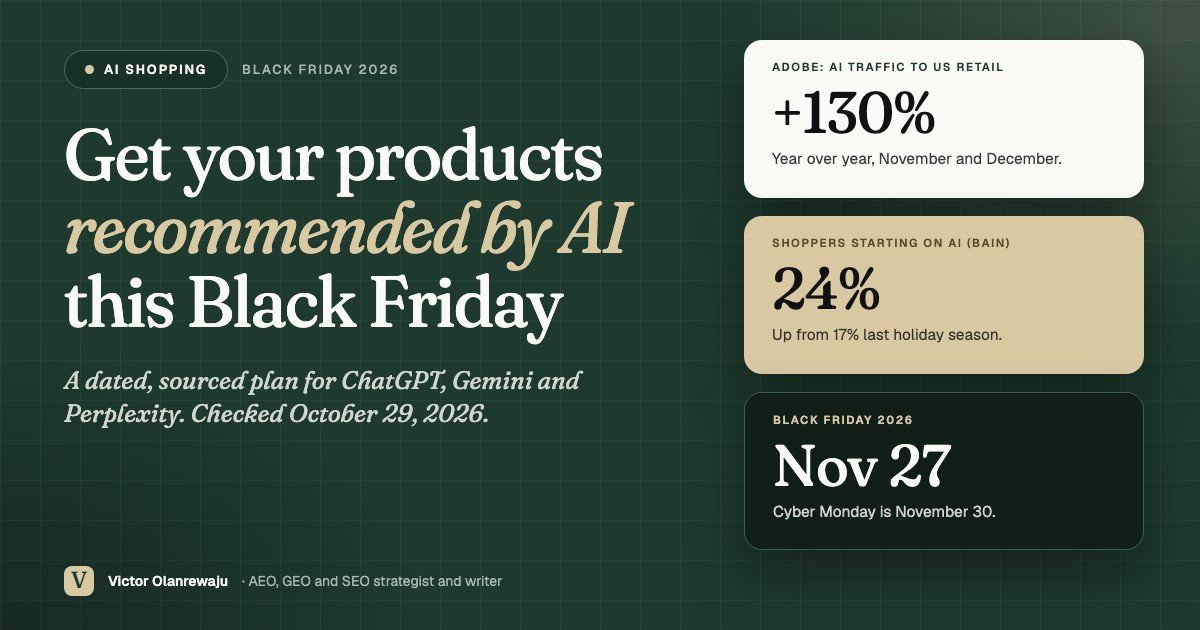
In short: To get your products recommended by ChatGPT, Gemini and Perplexity this Black Friday, make them easy to find, verify and buy. First, publish a complete product feed with accurate price, availability and identifiers. Next, match that data in Product schema on every product page. Then collect real reviews, let AI crawlers in and earn a few mentions beyond your own site. No one can guarantee a placement, and OpenAI says its product results are not ads. But the rules are public. OpenAI says ChatGPT ranks merchants on availability, price, quality and whether you make or mainly sell the item. Black Friday is Friday, November 27, 2026, which is 29 days from October 29. This guide gives you the numbers, the platform rules, a day-by-day plan, the exact fields to fix and a test to run. If you have no store or stock yet, skip to the section for people starting from zero.
+130%
Adobe’s forecast of year-over-year growth in AI traffic to US retail sites this holiday season
24%
of shoppers Bain surveyed plan to start holiday shopping on AI platforms, up from 17% in 2025
31%
better conversion for AI referrals than other traffic in Adobe’s 2025 holiday data
29
days from October 29 to Black Friday, November 27, 2026
Picture a shopper on a Tuesday in November. She types, “Best waterproof hiking boots under $150 for wide feet.” She does not scroll ten blue links. Instead, she reads one answer with four products, and she clicks the one that looks right. If your boots are not in that answer, she never sees them.
That shift is now measurable. Bain’s 2026 holiday survey of 1,105 US consumers, taken in August, found that 24% plan to start their holiday shopping on gen AI platforms such as ChatGPT, Claude and Gemini. That was 17% a year earlier. Meanwhile, Adobe forecasts that AI traffic to US retail sites will rise 130% year over year this holiday season. Both numbers matter. However, neither means AI is your main channel yet. Adobe itself says AI traffic is still modest next to other big channels. The reason to act is quality, not volume. In Adobe’s 2025 holiday data, visits from AI referrals converted 31% better than other traffic.
So what is the short answer? AI engines recommend products they can read, trust and sell. They read your product data, they check it against your page, and they weigh price, stock, quality and reviews. You control all of those inputs, and you can fix most of them this month.
One 2026 change makes this more urgent. OpenAI retired Instant Checkout in March, so ChatGPT now sends shoppers to merchant sites to buy. Walmart told WIRED that purchases inside ChatGPT converted three times worse than click-outs to its own site. As a result, your product page and your feed now do the selling. Here is what you will learn:
- The facts: what Adobe, Bain and OpenAI actually say, with their limits.
- The rules: how ChatGPT, Gemini and Perplexity each pick products.
- The plan: a dated, 29-day schedule to Black Friday.
- The fix list: feed fields, schema, reviews and crawler access.
- The test: a 12-prompt check you can run in one afternoon.
I also answer the questions store owners ask me most. Can I pay to be included? Is 29 days enough? Do I need Shopify? What if I sell on Amazon, eBay or Etsy? Keep reading, because the biggest mistake on this list costs sellers more than any missing tag, and it sits near the end.
What the data says about AI shopping this Black Friday
Start with the numbers, because the headlines blur three different measures: traffic growth, shopper intent and conversion. Here is each one, with its source and its limit.
| Finding | Source and date | What it measures | The limit to remember |
|---|---|---|---|
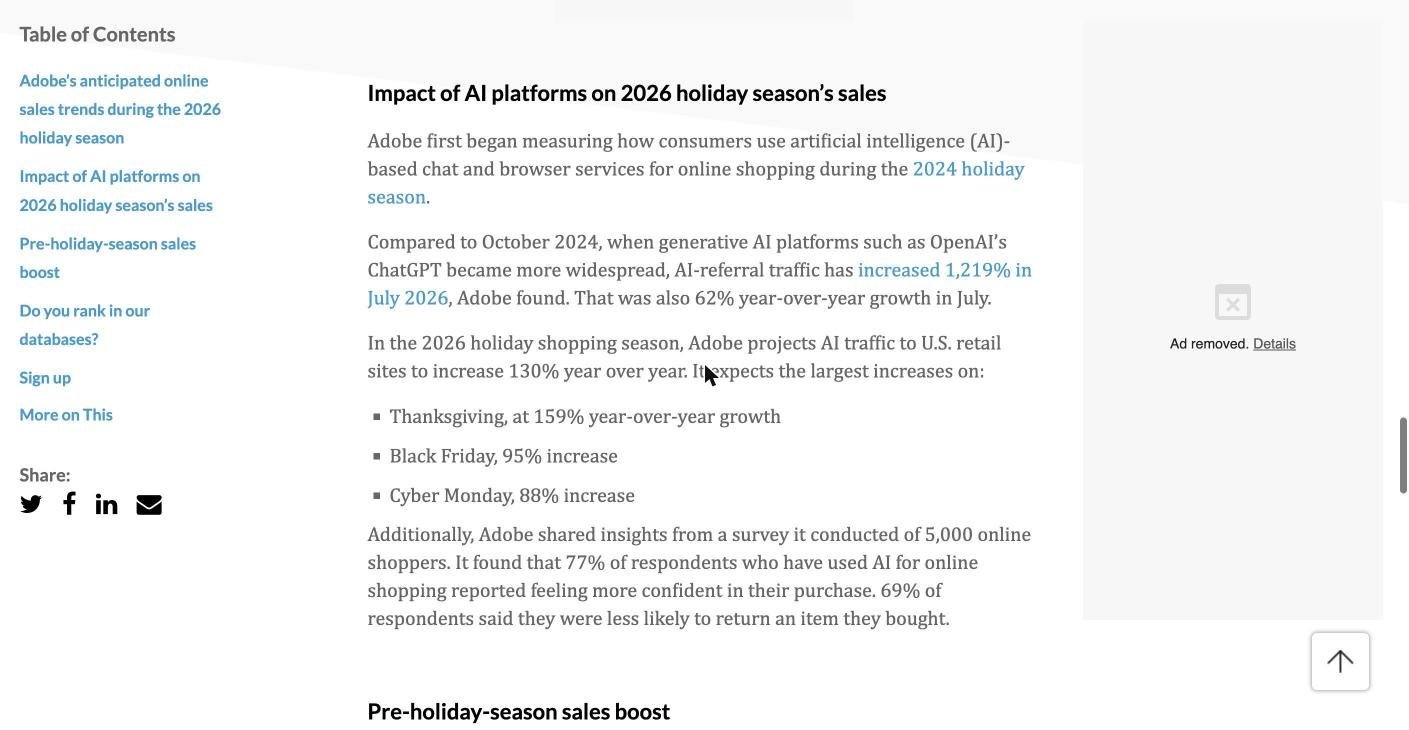
| AI traffic to US retail sites to rise 130% year over year | Adobe forecast, September 29, 2026 | Growth in AI-referred visits, November 1 to December 31 | Growth rate, not share of traffic. Adobe calls AI volume modest. |
| AI traffic up 159% on Thanksgiving, 95% on Black Friday and 88% on Cyber Monday | Same Adobe forecast | Growth on the three biggest days | Forecast, not result. Adobe expects $12.9 billion in Black Friday online sales and $15.1 billion on Cyber Monday. |
| AI-referral traffic up 1,219% in July 2026 versus October 2024, and up 62% year over year | Adobe data, as reported by Digital Commerce 360 | Measured growth in visits that came from AI tools | A steep climb from a small base. It shows direction, not share of sales. |
| 24% plan to start holiday shopping on AI platforms, up from 17% | Bain Consumer Lab, surveyed August 2026, n=1,105 | Where shoppers plan to start | Stated intent from one survey, not observed behavior. |
| 60% plan to start on retailer or brand websites, up from 51% | Same Bain survey | Where shoppers plan to start | Your own site still matters most. |
| AI referrals converted 31% better than other traffic | Adobe, 2025 holiday season | Conversion of visits that arrived from AI tools | Last year’s data, from a much smaller base. |
| 77% of shoppers who used AI felt more confident, and 69% were less likely to return an item | Adobe survey of 5,000 online shoppers, 2026 | Self-reported experience | Survey opinion, not purchase data. |
Adobe’s forecast: year-over-year growth in AI traffic to US retail sites, holiday 2026 (%)
Look at the tallest bar. Adobe expects the biggest jump on Thanksgiving Day, November 26, the day before Black Friday. So treat November 25 as your real feed deadline, not November 27. Adobe also expects $12.9 billion in US online sales on Black Friday and $15.1 billion on Cyber Monday, so the sales are real even if AI’s share is still small.
Read these together. Shoppers are moving toward AI for discovery, and the traffic converts well. At the same time, most of them still finish on a retailer’s own site. That is why Bain’s 13% of shoppers who plan to use a retailer’s own AI agent also matters. It tells you the buying step is staying close to the merchant. For wider context, see my AI search statistics for 2026.
How an AI shopping answer is built, according to OpenAI’s own help page
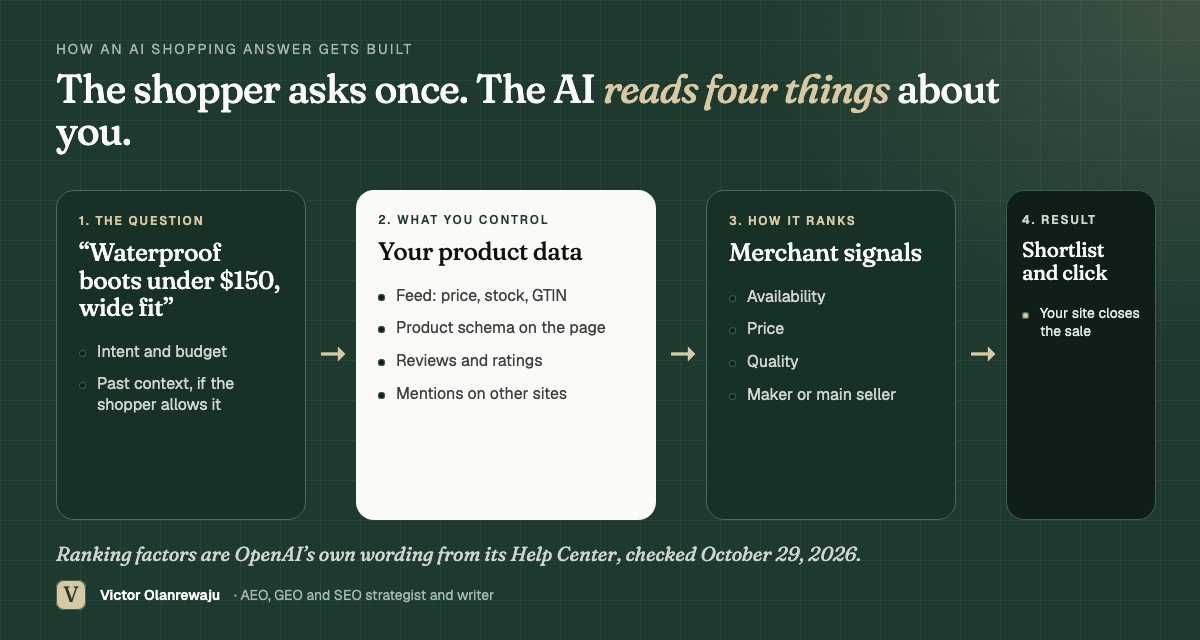
Most guides guess at this part. So I read OpenAI’s Help Center page on shopping in ChatGPT on October 29, 2026. It is the closest thing to a public rulebook. Below, each rule sits next to what it means for your store.
| What OpenAI says | What it means for your store |
|---|---|
| Product results are selected independently by ChatGPT. They are not ads, and OpenAI’s partnerships do not shape them. Ads are shown separately. | You cannot pay your way into the product carousel. Spend the effort on data and proof instead. |
| ChatGPT looks at structured data from first-party and third-party providers, such as price and description, plus other third-party content. | Your feed and your page both count. So do mentions on other sites. |
| It also reads the shopper’s question and context, including Memory and Custom instructions. | Two shoppers can get different shortlists. Cover several use cases on each product page. |
| Which factors matter changes with the question. If a shopper names a $30 budget, price counts for more. | Make price easy to read for budget searches. Make quality proof easy to find for everything else. |
| Labels such as “Budget-friendly” or “Most popular” are written by ChatGPT. They are not verified claims, and they may draw on third-party data. | Review text that mentions value, fit and durability may feed these labels. So ask buyers to say why they like the product. |
| Review summaries are built from reviews on public websites. OpenAI does not verify the reviews. | Keep the reviews you want counted on public pages. Collect them where a crawler can read them. |
| The price in the first answer usually comes from the first merchant listed. A “Best price” label can appear when several merchants sell the item. Updates can lag. | A stale price costs you the click. Update your feed the moment a price changes. |
| Merchants are ranked on availability, price, quality and whether they make the item or are its primary seller. OpenAI expects this to change and become more personal. | Show stock honestly. Price sharply. Say plainly if you make the product. Then re-test often. |
| For Shopify merchants, product data already reaches ChatGPT through Shopify Catalog, and no extra work is required. Other merchants can read the feed documentation and apply for direct feed access. | On Shopify, you are in by default. Everywhere else, you need a feed or a platform that supplies one. |
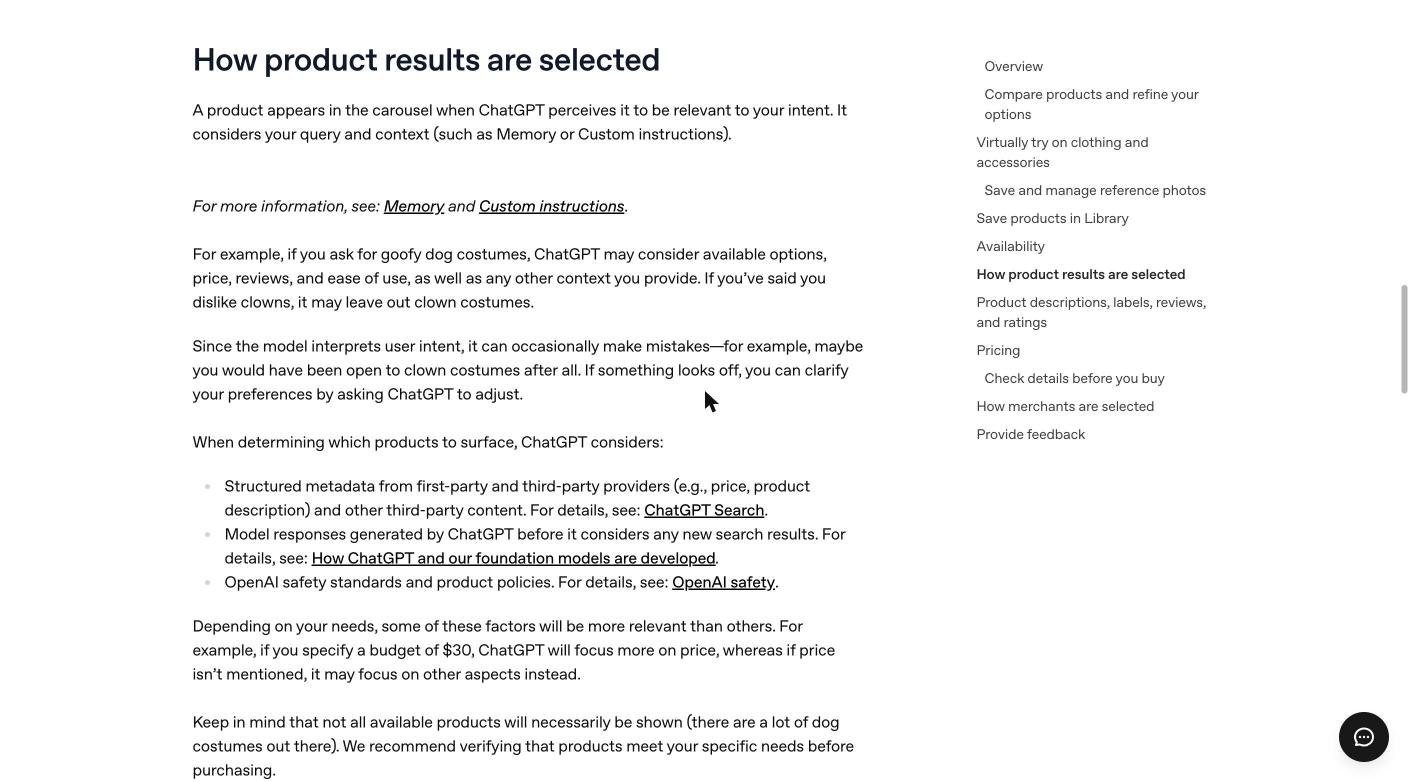
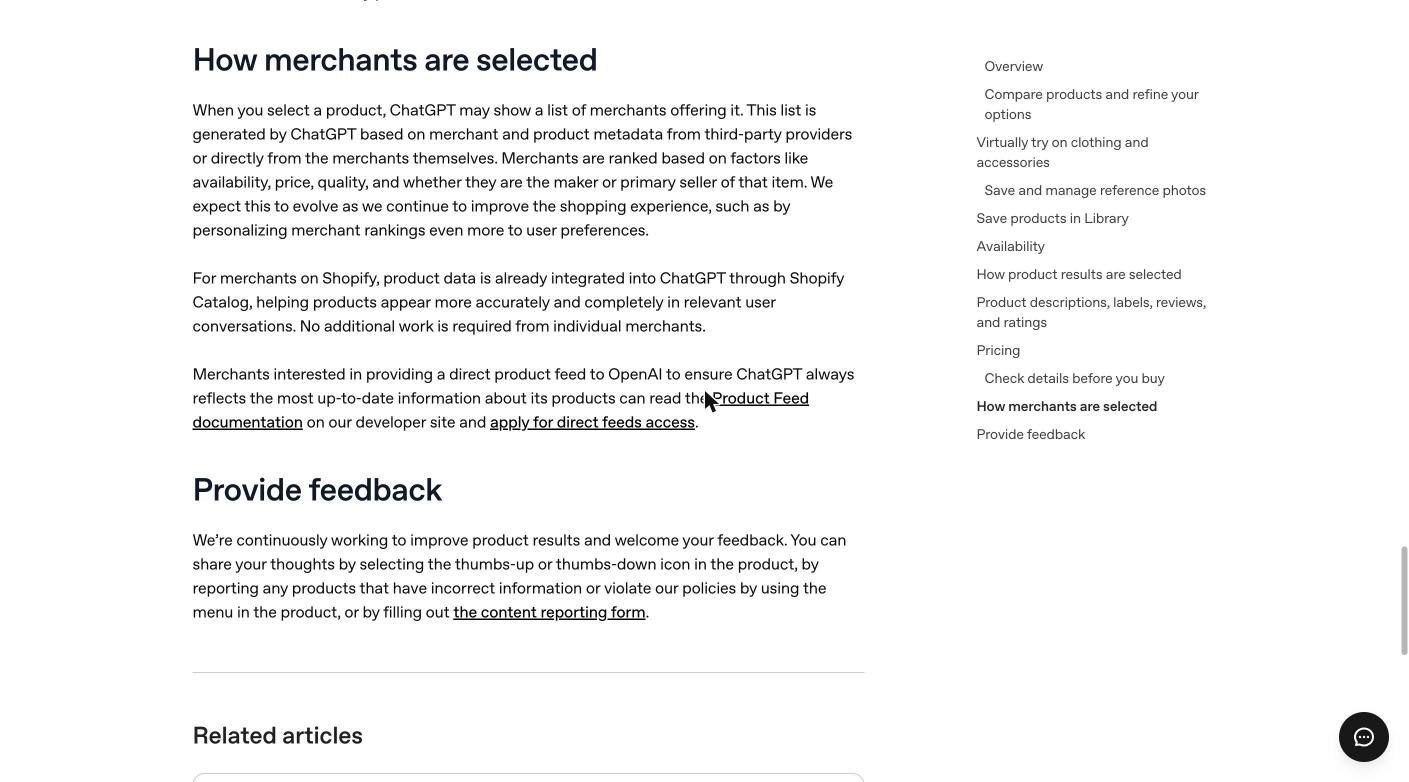
Notice what is missing. The page names no secret tag, no trick and no paid slot. It names data. That is good news, because data is the part you control.
How ChatGPT, Gemini and Perplexity choose products
Each engine has a different front door. Learn all three, then start with the one your customers use most.
| Engine | Where its product data comes from | What it says it weighs | How you get in |
|---|---|---|---|
| ChatGPT | Merchant feeds and third-party data providers, plus pages it can read | OpenAI’s help center says merchants are ranked on availability, price, quality and whether they make or mainly sell the item | Submit a product feed under OpenAI’s Agentic Commerce Protocol, or sell on a platform that supplies one. Shopify says eligible US stores can appear in ChatGPT. |
| Gemini and Google AI Mode | Google’s Shopping Graph, which Google says holds more than 50 billion listings, with 2 billion refreshed every hour | Fresh, complete product data and merchant trust signals | Merchant Center feeds and Product structured data. Google’s Universal Commerce Protocol adds checkout for approved merchants. |
| Perplexity | Merchant program data, Shopify and PayPal integrations, and web pages | No published ranking rules; no sponsored slots at launch in 2025 | Apply to its merchant program, or use PayPal or Shopify. Third-party guides disagree on whether approval is required. |
ChatGPT: feeds drive discovery, your site closes the sale
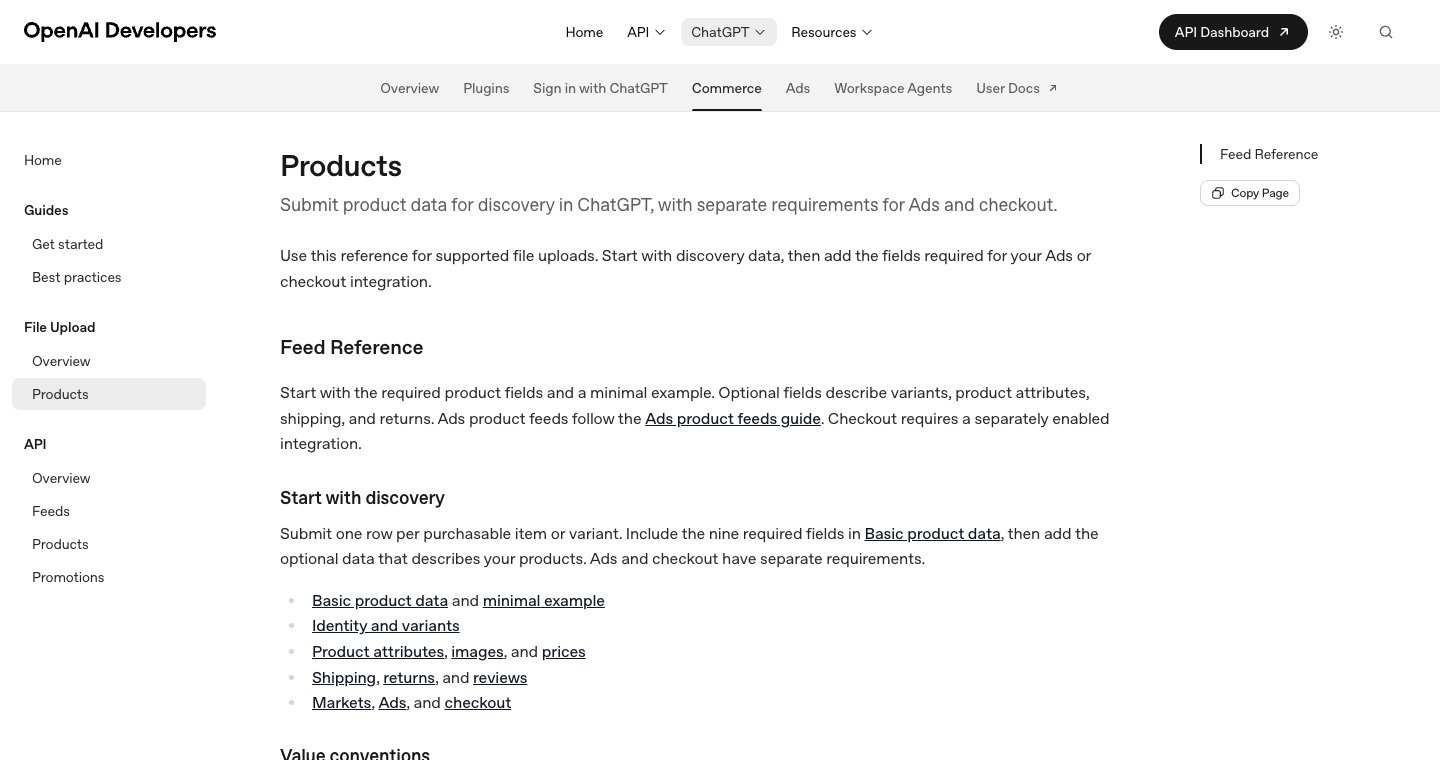
OpenAI’s product feed reference lists nine required fields. They are an item ID, title, description, product URL, brand, seller name, image URL, availability and price. Optional fields include GTIN, MPN, sale price, shipping, return policy, star rating and review count. The feed currently targets the US. Also, OpenAI states that eligibility does not guarantee display.
The Instant Checkout story matters here. OpenAI launched in-chat buying in September 2025 and pulled back in March 2026. It said it would let merchants use their own checkout while it focused on product discovery. Walmart’s data shows the problem. It offered about 200,000 products in the feature, and its executive Daniel Danker told WIRED that in-chat purchases converted at roughly one-third the rate of click-outs. So treat ChatGPT as a discovery channel. Your job is to be in the shortlist and to win the click.
Gemini and AI Mode: your Merchant Center feed is the base
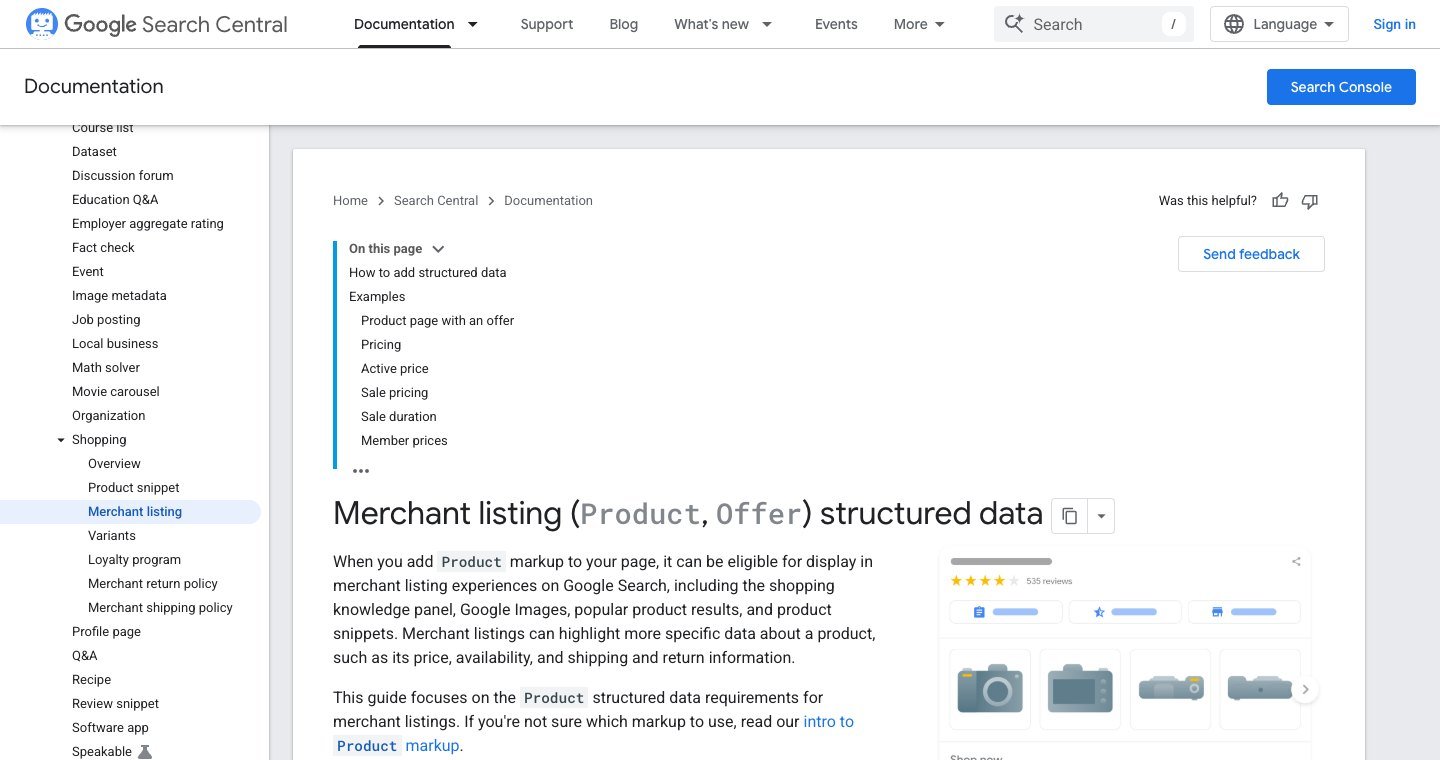
Google’s own developer page for its Universal Commerce Protocol tells merchants they can “use your existing Merchant Center account shopping feeds” to reach high-intent shoppers, and it says you remain the merchant of record. Checkout inside AI Mode and Gemini is still limited, so do not plan around it. Instead, make sure your Merchant Center feed and your Product markup are complete and agree with each other. Google’s documentation requires a name, an image and an offer with a price above zero and a currency. It recommends availability, GTIN, brand, reviews, shipping details and a return policy.
Perplexity: join the program, then earn the answer
Perplexity’s shopping runs on merchant data and on integrations such as Shopify and PayPal. Its merchant program works like a catalog submission, with details such as pricing, reviews, specs and images. Sources disagree on approval, so apply early and check Perplexity’s current sign-up page. In all three engines, one rule holds: complete, accurate, fresh data beats clever copy.
Shopify stores: what is automatic, and what is still yours
Shopify says its Agentic Storefronts feature puts eligible stores’ products into ChatGPT, Gemini and other AI chats, and that it is switched on automatically for eligible stores. It also says Shopify Catalog structures your product data so AI can read it, that AI orders land in your Shopify admin, and that you can see which sales came from AI. OpenAI’s help page backs up the ChatGPT part: no extra work is required from Shopify merchants.
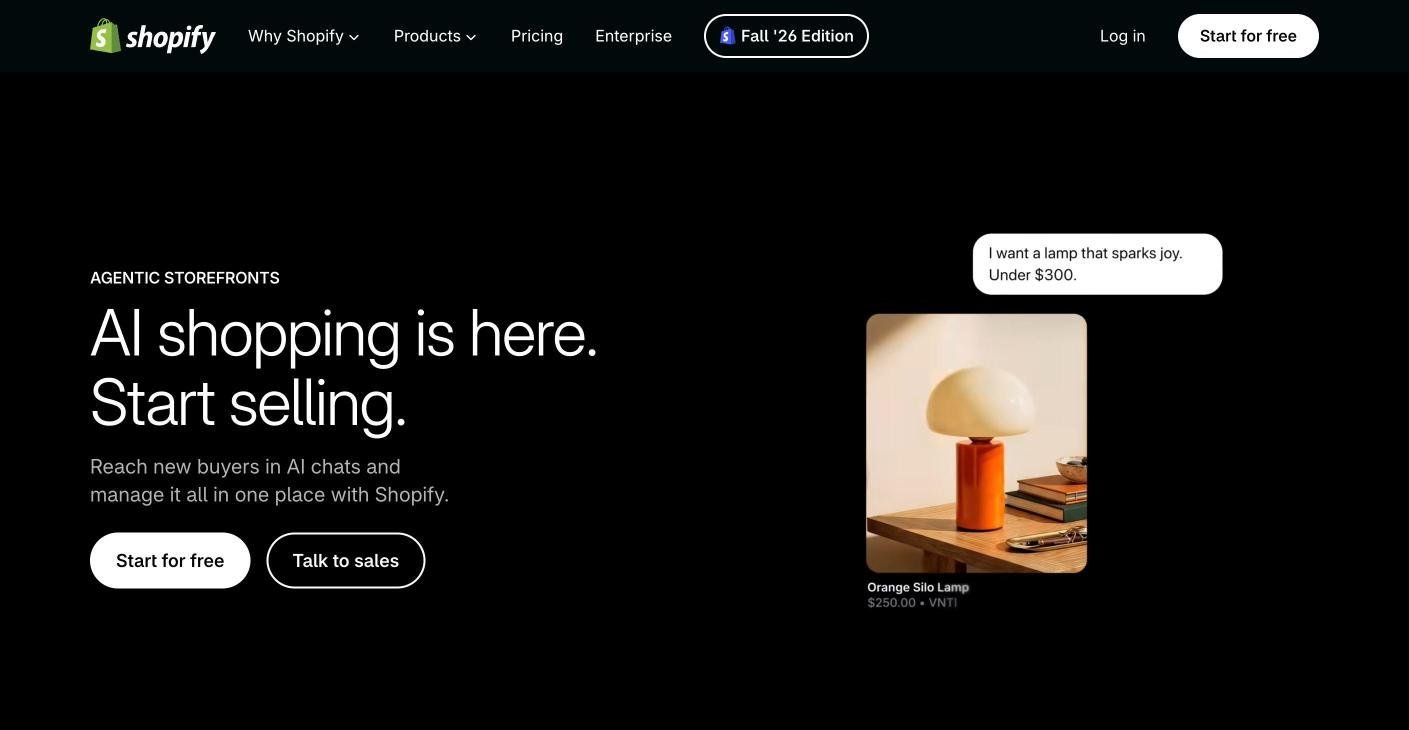
Two cautions apply. First, “automatic” does not mean “complete.” A catalog can only structure what you give it, so fill in brand, GTIN, specs, shipping and returns. That is my advice, not a Shopify rule. Second, Shopify’s page promises buying inside the chat, while OpenAI retired Instant Checkout in March. Check which AI channels and checkout options your own admin shows before you plan around either.
Other assistants sell too. Retail TouchPoints reported on January 9, 2026 that Etsy and Shopify are among the early partners for Microsoft’s Copilot Checkout. An opinion piece in The Drum argues that Amazon’s Rufus is already racking up sales. I could not open either report in full, so I give no figures for them.
A 29-day plan from October 29 to Black Friday
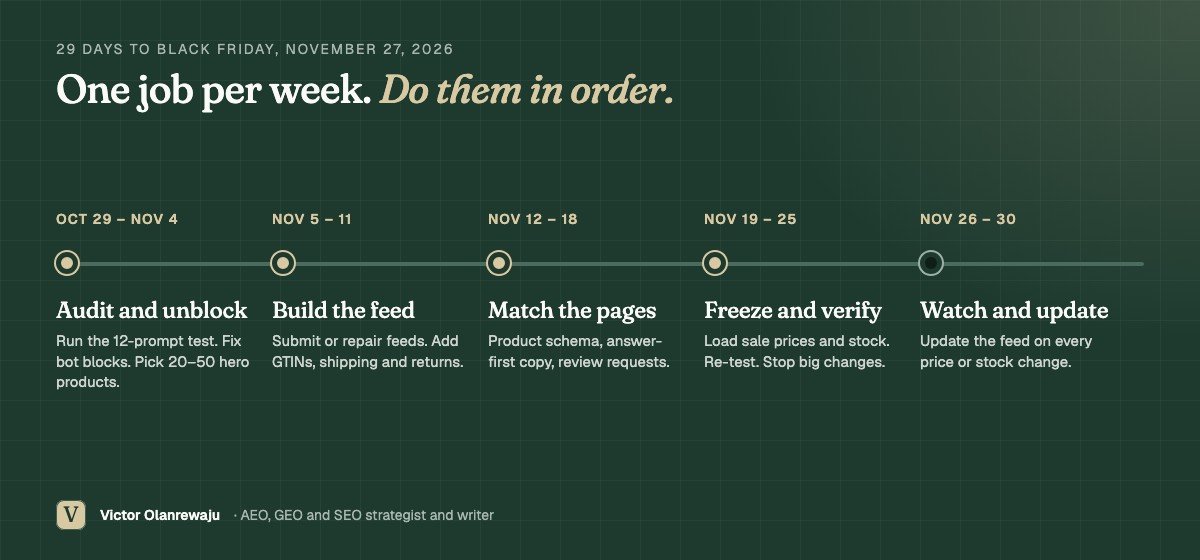
Time is short, so each week has one job. Do the tasks in order, because later steps depend on earlier ones. Note that OpenAI says merchant updates can lag, so earlier is better.
| Dates | Job | What to do |
|---|---|---|
| Oct 29 to Nov 4 | Audit and unblock | Run the 12-prompt test below to see where you stand. Score yourself on the checklist. Fix crawler blocks and any broken product pages. Choose your 20 to 50 hero products. |
| Nov 5 to Nov 11 | Build the feed | Submit or repair your ChatGPT feed and your Merchant Center feed. Add GTINs, brand, shipping and returns. Apply to Perplexity’s merchant program. |
| Nov 12 to Nov 18 | Match the pages | Add Product schema that matches the feed. Rewrite hero product pages answer-first. Send review requests for recent orders. |
| Nov 19 to Nov 25 | Freeze and verify | Load Black Friday prices and stock. Re-run the test. Check that feed, page and schema show the same price and availability. Stop big site changes. |
| Nov 26 to Nov 30 | Watch and update | Thanksgiving is November 26, Black Friday is November 27 and Cyber Monday is November 30. Update the feed the moment a price or stock level changes. Log AI referrals daily. |
The fix list, in order of impact
1. Make the product feed complete and true
Start with the nine required fields, then add the optional ones that help a model compare you. Put the right value in each field, and keep it matched to your page.
| Field | Why it matters | Common mistake |
|---|---|---|
| title (up to 150 characters) | It is the first thing a model reads about the product | Stuffing keywords instead of brand, type, model, size and color |
| description (up to 5,000) | It supplies facts for comparisons | Marketing copy with no specs |
| price (format “79.99 USD”) | Price is one of OpenAI’s stated ranking factors | A feed price that differs from the page |
| availability | Availability is another stated factor | Leaving sold-out items marked in_stock |
| gtin and mpn | They match your product to the same item sold elsewhere | Leaving them blank or using invalid check digits |
| sale_price | Shows your Black Friday deal | OpenAI says sale dates do not schedule changes, so you must update the feed when a sale starts and ends |
| shipping, accepts_returns, return_deadline_in_days | Removes buyer doubt | Policies in the footer only, not in the data |
| star_rating and review_count | Signals quality | Mixing review sources, since both fields should describe the same review population |
2. Mirror the feed in Product schema
Product markup lets Google and other crawlers read the same facts from the page. Google requires a name, an image and an offer with a price above zero and a three-letter currency. It recommends availability, GTIN, brand, review ratings, shipping details and a return policy. Below is a minimal example. Replace every value with your own, and keep it identical to the visible page.
<script type="application/ld+json">
{
  "@context": "https://schema.org",
  "@type": "Product",
  "name": "Trailhead Waterproof Hiking Boot, Wide Fit",
  "image": "https://example.com/images/trailhead-wide.jpg",
  "brand": { "@type": "Brand", "name": "Trailhead" },
  "gtin13": "0123456789012",
  "offers": {
    "@type": "Offer",
    "price": "129.00",
    "priceCurrency": "USD",
    "availability": "https://schema.org/InStock",
    "url": "https://example.com/products/trailhead-wide"
  }
}
</script>
Schema helps machines read your page. It does not guarantee a recommendation, and Google says no special markup is needed for its AI features. For the full picture, read my guide to schema markup for AEO and GEO.
3. Write product pages that an AI can quote
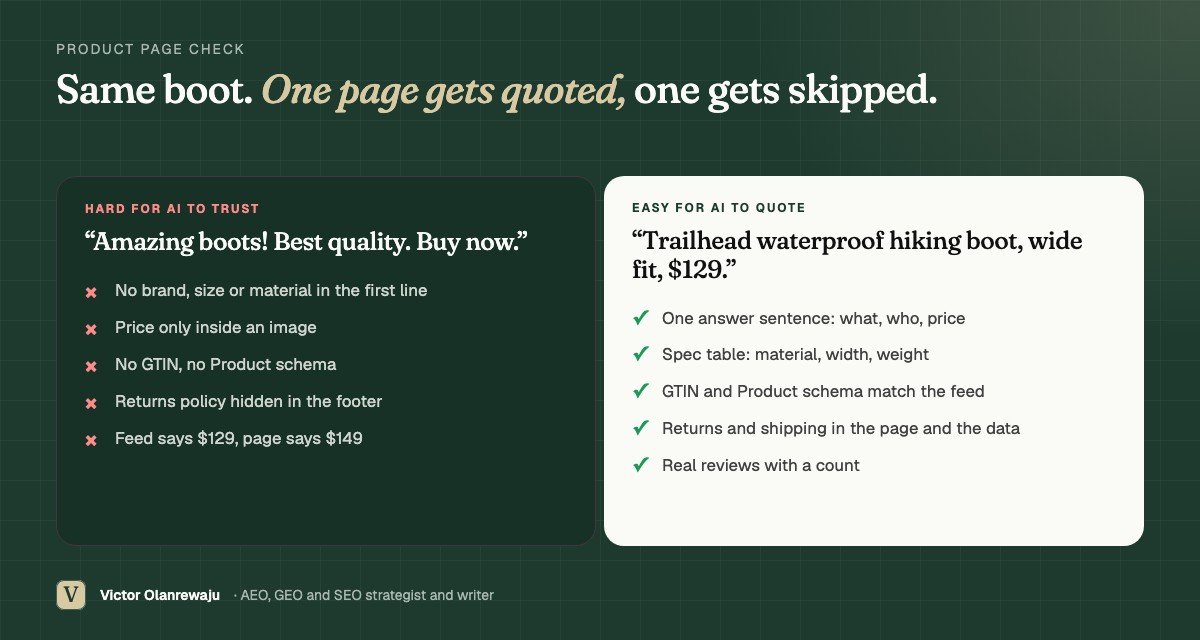
Models lift short, specific passages. So write them. Open with one sentence that says what the product is, who it suits and its price. Next, add a spec table, then a short “who it is not for” line. After that, answer five real buyer questions, such as sizing, materials and returns. Finally, keep the price in the page HTML, not only in a script. My guide to how to get cited by ChatGPT shows the pattern in detail.
4. Build proof you can show
“Quality” is one of OpenAI’s stated ranking factors, and reviews are the easiest proof to supply. Ask every recent buyer for a review, and make it simple. Never buy or invent reviews. They break platform rules and can get your feed removed. Beyond reviews, earn a few honest mentions in places buyers read, such as gift guides, comparison articles and community threads. I explain why third-party mentions matter in why Google rankings do not match ChatGPT mentions.
5. Let the right bots in
Blocking the wrong crawler can remove you from AI answers. OpenAI documents three bots with separate jobs. OAI-SearchBot surfaces sites in ChatGPT search, and sites that opt out will not appear in ChatGPT search answers. GPTBot is for training and can be blocked without affecting search. ChatGPT-User fetches pages when a person asks. Perplexity separates PerplexityBot for search from Perplexity-User for user requests. Check your robots.txt, then check your firewall and bot-protection settings, because many stores block these crawlers by accident. My AI crawlers and robots.txt guide has the full list.
6. Get your Black Friday offer data right
Black Friday breaks feeds. Prices change, stock sells out and codes expire. So prepare three things now. First, load your sale prices into the feed with a clear sale_price that is lower than price. Second, plan who updates stock during Thanksgiving week. Third, keep your page price, feed price and schema price identical. A mismatch can cost you the recommendation.
Your AI shopping readiness scorecard
Score each line 0 (no), 1 (partly) or 2 (yes). Be honest, because the lowest scores are your first tasks.
| Check | Your score (0 to 2) |
|---|---|
| Every hero product has a feed row with all nine required fields | __ |
| GTIN or MPN filled in wherever they exist | __ |
| Feed price and availability match the live page | __ |
| Product schema on every product page, matching the feed | __ |
| Shipping and return details visible on the page and in the data | __ |
| At least 10 real reviews on each hero product | __ |
| OAI-SearchBot, Googlebot and PerplexityBot are not blocked | __ |
| Product pages open with a quotable one-sentence answer | __ |
| Sale prices loaded, with an owner for stock updates | __ |
| You have run the 12-prompt test at least once | __ |
If you score 0 to 8, fix the feed and crawler access first. If you score 9 to 15, you are close, so focus on reviews and page copy. If you score 16 to 20, spend your time on testing and Black Friday updates.
Short on time? What can realistically be done before November 27
I do this work for clients, so I will be direct about timing. The table uses the prices and delivery times on my pricing page, checked October 29, 2026. Some options will not fit before Black Friday, and I say so.
| Option | Price | What it covers | Timing |
|---|---|---|---|
| Free AI visibility audit | Free | A score out of 100 for your site, the top fixes, and a manual check of what ChatGPT, Gemini and Perplexity say about you | Plain-English report by email within one business day |
| Manual AI visibility report | $120 | 25 prompts tested across ChatGPT, Gemini, Perplexity, Claude and Google AI Overviews, with a written summary | Single item. Ask for a date when you order. |
| Schema markup pack | $220 | Schema for up to 10 page templates | Single item. Ask for a date when you order. |
| Review request system | $160 | Request templates, a QR code, a WhatsApp flow and a reply guide | Single item. Ask for a date when you order. |
| Foundation build: Essentials | $390 | Up to 10 pages, crawl and indexation fixes, schema for key pages and an FAQ, plus sitemap, robots.txt and llms.txt | About 2 weeks. It fits if you start in the first half of November. |
| Foundation build: Standard | $850 | Up to 30 pages, an internal linking plan, 5 answer-first pages written for you and review request set-up | About 3 to 4 weeks. It only fits if you start this week. |
| Foundation build: Plus | $1,590 | Up to 80 pages or several locations, product and service schema at scale and 10 answer-first pages | About 5 to 6 weeks. It will not finish before Black Friday, so start it now for the next sales season. |
None of these buys a placement, and I cannot promise one. They fix the inputs the engines say they read. If you are unsure where to start, run the free audit first. It costs nothing and shows which row above you actually need.
Not sure where you stand? The free audit scores your site out of 100, lists the top fixes and checks what ChatGPT, Gemini and Perplexity say about you. No payment details are needed.
If you’re starting from zero: no store, no stock, no sales yet
Everything above assumes you already sell something. AI can only recommend what exists. It needs a product, a price, stock and proof. So if you have none of those yet, do not wait for the perfect store. Start small and sell your first items now.
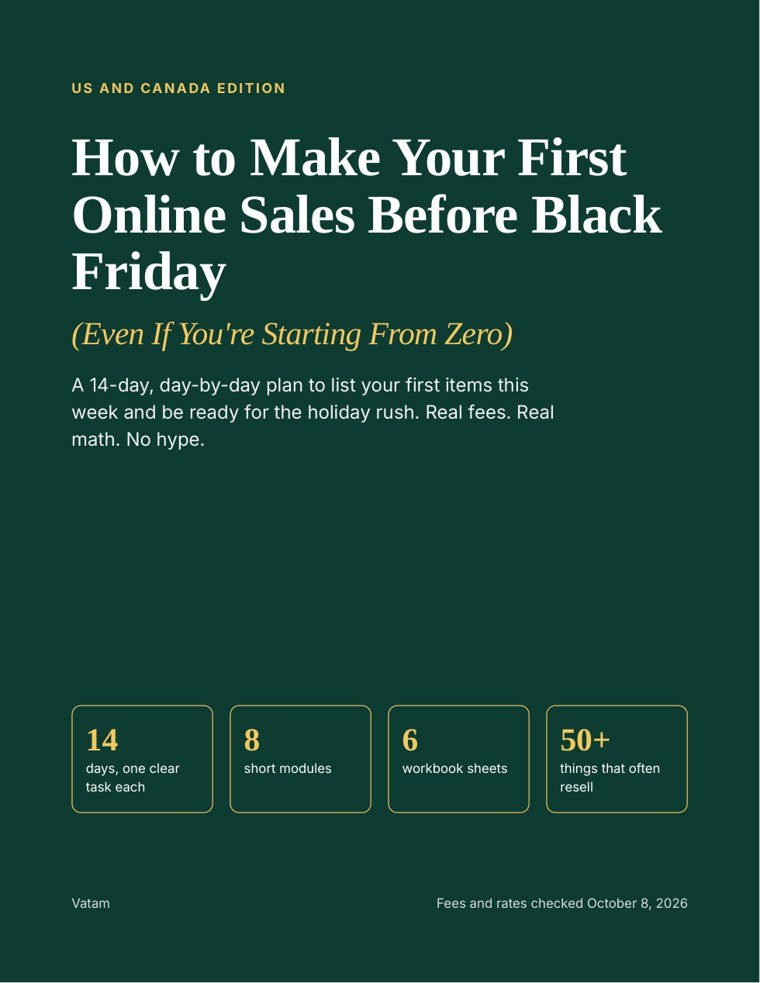
That is the gap my own guide fills. It is called How to Make Your First Online Sales Before Black Friday (Even If You’re Starting From Zero). It is a 14-day plan, with one clear task per day, for people in the US and Canada who want their first listings live this week. It is a product I made, and I sell it on Gumroad.
What you get:
- A 14-day, day-by-day plan. Each day names one task and the module to read.
- Eight short modules. They cover what to sell, sourcing, pricing and margins, an AI listing toolkit, where to sell, photos and shipping, side-income and tax basics, and scaling to the holidays.
- Ten copy-and-paste AI prompts for listings. They write titles, descriptions, honest condition notes, price checks, buyer replies and review requests, with rules to check every fact yourself.
- A six-sheet workbook. It includes a margin calculator, a sales log, a purchase log, a shipping chart, an eight-week dashboard and a fees sheet.
- A bonus toolkit. You get listing templates, buyer scripts, a list of 50+ things that often resell, a First 10 Sales checklist and a records checklist.
Fees and rates were checked on October 8, 2026, and every figure is dated. The guide teaches a method and does not promise income. It cites 2026 surveys that found about half of side hustlers earn $500 or less a month.
It also ties into this article. Module 4 teaches the same habit AI shopping rewards: clear titles, honest descriptions and facts you have checked. Marketplaces work like search engines, and so do AI assistants. Complete, accurate listings help in both.
What if you sell on Amazon, eBay, Etsy or Walmart?
Marketplace sellers control less of the data. However, you still control the parts models read. Write exact titles with brand, type, model, size and color. Fill every attribute field. Use sharp photos, keep stock accurate and ask for reviews. Also, if you have your own site, build it in parallel, because Bain found 60% of shoppers plan to start on retailer or brand websites. I could not verify which marketplaces feed which AI engines today, so do not assume. Test your own listings with the prompts below.
The 12-prompt test: see where AI puts you today
You can measure this yourself. Choose four product searches that a buyer would type, then run three styles of each on ChatGPT, Gemini and Perplexity.
| Style | Example prompt | What to record |
|---|---|---|
| Best-of | “Best [product type] under $[price] in 2026” | Are you listed? Which brands are named and cited? |
| Use case | “What [product] should I buy for [person or need]?” | Does the answer use your specs? Which page is the link? |
| Comparison | “[Your brand] vs [competitor] for [need]” | Is your price correct? Are the facts accurate? |
Run each prompt three times, because AI answers change. SparkToro and Gumshoe.ai found the same brand list in under 1% of repeated runs, so count how often you appear. Then check what you see against your feed. If a price or fact is wrong, fix the source. My guide to checking what ChatGPT says about your business gives the full method, and the comparison of AI visibility tools helps if you want it automated.
Next, track the visits. In Google Analytics 4, look at sessions by source for referrers such as chatgpt.com, perplexity.ai and gemini.google.com. Compare their conversion rate with your other traffic. That is how you will know whether this work paid off.
7 mistakes that keep products off AI shortlists
- Price and stock mismatches. The feed says one thing, the page says another.
- Blocked crawlers. A firewall or robots.txt rule hides you from search bots.
- Thin product data. No GTIN, no brand, no specs and a weak description.
- Fake or seeded reviews. They risk removal and damage trust.
- Waiting for in-chat checkout. It was retired. Build for click-through instead.
- Launching late. OpenAI notes updates can lag, so a Thanksgiving-week change may miss the rush.
- Treating AI as a trick. The engines publish their rules, and the rules reward real data. The biggest mistake is not a missing tag. It is leaving product data to chance until the week of the sale.
What to do next
Do the first two tasks today. Run the 12-prompt test, then fix your crawler access. Those two steps cost nothing and show you where you stand. If you want a second pair of eyes, I run this check as part of a free AI visibility audit. See the pricing page, my pages on AEO and GEO, or tell me what you want to be found for. For e-commerce proof, read how Lens & Co reached first place in ChatGPT answers and how LAGE Lightings moved from seventh to first.
And if you are still at the starting line, the 14-day plan is here: How to Make Your First Online Sales Before Black Friday.
How I checked, and the limits
I read the primary sources where they were public: Bain’s holiday outlook page, OpenAI’s product feed reference and bot documentation, Google’s structured data and UCP pages, and Perplexity’s bot documentation. Adobe’s forecast is cited through Digital Commerce 360, and Adobe’s 2025 figures through Adobe’s own blog. I read OpenAI’s Help Center page on shopping in ChatGPT, the Digital Commerce 360 report on Adobe’s forecast and Shopify’s Agentic Storefronts page in a normal browser session on October 29, 2026, and captured the screenshots myself. Bain’s page now serves a bot check, which I did not bypass, so I could not capture it. I also could not open Forbes, WIRED, Perplexity’s merchant page or the full reports on Copilot Checkout and Rufus, so those details come from reports and are marked as such. Surveys measure intent, forecasts can miss, and platform rules change often. Nobody can promise an AI recommendation, so treat this as a plan to improve your odds.
Related reading: SEO, AEO and GEO explained and AI citation versus AI recommendation.
Frequently asked questions
How do I get my products recommended by ChatGPT?
Give ChatGPT clean product data and a page it can trust. Submit a feed with the nine required fields (ID, title, description, URL, brand, seller, image, availability and price), keep price and stock accurate, add reviews, and let OAI-SearchBot crawl your site. OpenAI says it ranks merchants on availability, price, quality and whether you make or mainly sell the item.
Can I pay to appear in ChatGPT shopping results?
No. OpenAI says product results in ChatGPT are selected independently, are not ads and are not shaped by its partnerships. Ads are shown separately. Eligibility for a feed also does not guarantee display, so focus on complete, accurate product data and real reviews.
Is ChatGPT Instant Checkout still available?
No. OpenAI retired Instant Checkout in March 2026 and now focuses on product discovery, with merchants using their own checkout. Walmart reported that in-chat purchases converted about three times worse than click-outs to its site.
Is 29 days enough to get ready for Black Friday?
Yes for the basics, but start now. You can fix feed accuracy, schema, crawler access and review requests in four weeks. OpenAI notes that merchant updates can lag, so late changes may miss the first rush. Aim to freeze major changes by November 19.
Do I need Shopify to appear in ChatGPT, Gemini or Perplexity?
No. On Shopify, product data reaches ChatGPT through Shopify Catalog with no extra work, and Shopify says Agentic Storefronts is switched on automatically for eligible stores. But any merchant can submit a feed to OpenAI, use Merchant Center for Google, and apply to Perplexity’s merchant program. If you are on Shopify, still complete your product data.
How do I get my products into Google Gemini and AI Mode?
Use Google Merchant Center. Google tells merchants to use their existing Merchant Center shopping feeds, and it requires a name, an image and an offer with a price and currency in Product markup. Checkout through the Universal Commerce Protocol is limited to approved merchants.
How does Perplexity choose which products to show?
Perplexity has not published ranking rules. Its shopping uses merchant data and integrations such as Shopify and PayPal. Apply to its merchant program, keep data complete and accurate, and test your own queries.
How much of Black Friday traffic will come from AI?
Adobe forecasts AI traffic to US retail sites will rise 130% year over year this holiday season, but it describes the volume as modest compared with other channels. Treat AI as a small, high-converting channel to build now.
Do reviews affect AI product recommendations?
Probably, through the quality signal. OpenAI lists quality among its merchant ranking factors. It also says its review summaries come from reviews on public websites, and that it does not verify them. Its feed accepts star rating and review count too. Use real reviews only, keep them on public pages, and make sure both feed fields describe the same review population.
What if I sell on Amazon, eBay or Etsy?
Control what you can: exact titles, complete attributes, sharp photos, accurate stock and reviews. I could not verify which marketplaces feed which AI engines today, so test your own listings and also build your own site.
I have no store or products yet. Where do I start?
Start with one category and list your first items now. My 14-day guide, How to Make Your First Online Sales Before Black Friday, gives a day-by-day plan, a margin calculator and ten AI listing prompts for the US and Canada. It does not promise income.
Can you get my store ready for Black Friday?
Partly, depending on the time left. A free AI visibility audit takes one business day. Small single fixes, such as a schema markup pack ($220) or a review request system ($160), are quick jobs. Foundation builds take about 2 to 6 weeks, so only the smaller ones fit before November 27. No one can promise a placement. See the pricing page for the details.
How do I measure results from AI shopping?
Run a 12-prompt test across ChatGPT, Gemini and Perplexity three times each. Record whether you appear and whether the facts are right. Then track sessions from chatgpt.com, perplexity.ai and gemini.google.com in Google Analytics 4 and compare their conversion rate.