In this article
- So who can write content that gets cited by AI?
- Which kind of buyer are you? Start here
- What does the research say a citable page needs?
- What skills does an AEO and GEO writer need? A 7-point scorecard
- Can a writer do this alone?
- What should you give a writer, and what should a good writer ask you?
- What should the work include? Deliverables by project type
- Can AI tools write content that gets cited on their own?
- What kinds of people can write this content, and what does each cost?
- How much should you budget, and what drives the price?
- Who are the writers who can do it? 8 names with public evidence
- How do you hire one? 10 questions and a paid test
- How do you judge a writing sample? An annotated example and a 10-point audit
- What should a brief for a citable page contain?
- What should go into the contract or statement of work?
- What changes if you work in finance, crypto, health or law?
- What are the red flags when hiring for AEO and GEO?
- How do you measure whether it worked?
- How long until you see results, and what should you expect?
- What do these studies not tell you?
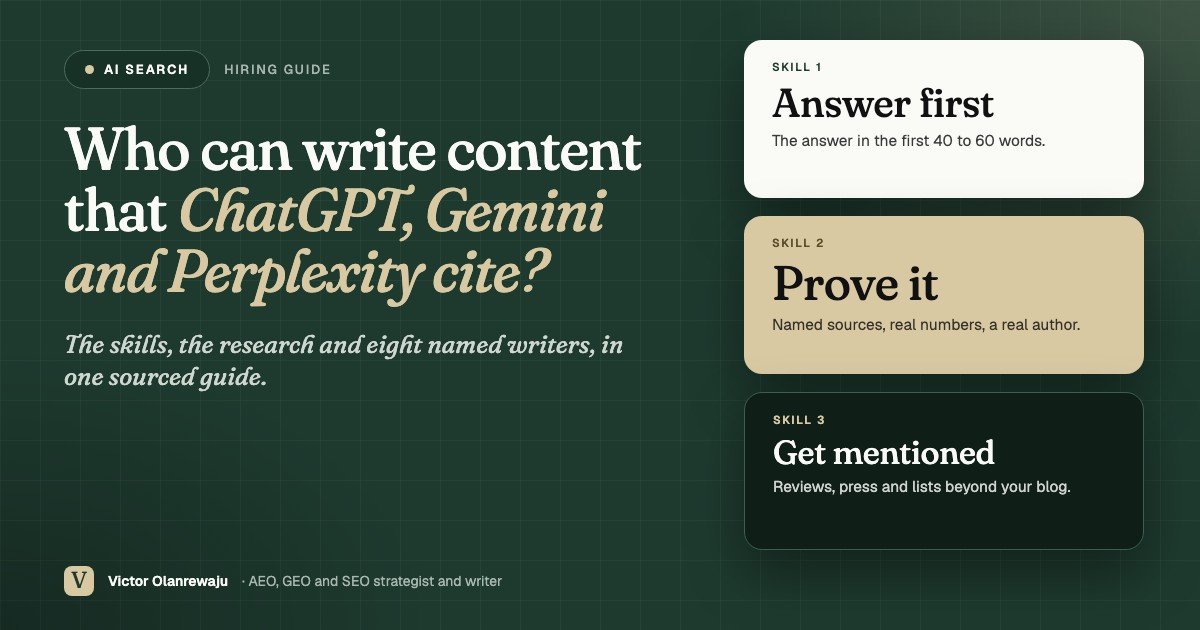
In short: Content that gets cited by ChatGPT, Gemini and Perplexity is written by someone who can do seven things: put the answer first, prove every claim with a named source, match the page type to the question, write as a real and checkable expert, understand how assistants retrieve pages, plan for mentions beyond your own blog, and measure honestly. That is a rare mix. It is not a generic content writer, and it is not an AI tool left alone. It is usually a writer-strategist working with a subject expert and an editor. This guide explains what the research says, gives you a scorecard and hiring tests, and names eight writers with public evidence of this skill, including me, plus one researcher to follow. For buyers it also adds a decision table by situation, a checklist of what to give a writer, deliverables by project type, a budgeting guide, a ten-point sample audit, a copy-and-paste brief, contract points, safeguards for regulated topics and a 90-day measurement plan.
+41%
visibility gain from adding quotations, the best tactic in Princeton’s GEO study
44.3%
of ChatGPT citations came from the first 30% of a page (Indig, 1.2 million results)
25.7%
fresher: how much newer AI-cited URLs were than organic ones (Ahrefs)
82%
of AI citations were earned media in Muck Rack’s January 2026 report
Almost every business asking this question has already tried the obvious answer. They hired a writer, published good articles and watched them rank, and ChatGPT still named a competitor. The reason is that writing for a search engine and writing for an assistant overlap, but they are not the same craft. A search engine ranks pages. An assistant reads several, picks passages it can quote and decides which businesses to name. That means the person writing your content needs skills that most job descriptions do not mention. I have written this for founders, marketing leads and SEO managers who need to hire, brief or evaluate that person. Figures are as of October 2026, and each study is labeled with its sample and limits. For the mechanics, see my guides to how to get cited by ChatGPT and AI citation versus AI recommendation.
So who can write content that gets cited by AI?
A writer who treats a page as a set of quotable answers backed by evidence, not as a keyword container. In practice that person has five traits you can check before you hire:
- They lead with the answer. Their published pages state the answer in the first lines, in plain sentences.
- They show their sources. Numbers have a named origin and a date, and they can tell a primary study from a recycled statistic.
- They have a real, findable identity. A named author with a bio, a track record and published work you can read.
- They understand where the page fits. They know which type of page answers which type of question, and that a page is one input among several that an assistant reads.
- They test. They have checked what ChatGPT, Gemini and Perplexity actually say, more than once, and they do not promise a position.
Everything else in this guide is detail on those five traits, with the evidence behind them. Before the research, one clarification on terms: AEO (answer engine optimization) is about making a page easy to quote as an answer, and GEO (generative engine optimization) is about getting an AI to name and recommend your brand. A good AEO and GEO writer does both. I explain the difference in SEO, AEO and GEO explained.
Which kind of buyer are you? Start here
The right person depends on your situation more than on any ranking of writers. Find the row that fits you, then use the rest of this guide to check the person you are considering.
| Your situation | Who to look for | A good first deliverable | What to watch |
|---|---|---|---|
| I have little content and need pages that can win from scratch | A writer-strategist who plans questions and page types, not only prose | A map of about 20 buyer questions, then two anchor pages | A writer who starts drafting before asking about your buyers |
| I rank on Google but AI assistants do not name us | Someone with retrieval literacy who can diagnose why a ranking page goes unnamed | A diagnosis of the pages that rank but are not named, then rewrites | Being sold new content when rewrites would do |
| I sell software and need comparison and alternatives pages | A SaaS-trained comparison writer who sources claims and is fair to rivals | One comparison page against your closest rival | Thin advertising dressed as a comparison, or unfair claims about competitors |
| I run an ecommerce or local business | A writer who turns real buyer questions into specific pages with prices, delivery and trust facts | Five question pages and one consistent facts sheet | Generic category copy with no specifics |
| I work in finance, crypto, health or law | A writer with domain literacy, plus a qualified reviewer in the loop | One fact-checked page with dated claims, primary sources and compliance sign-off | Unreviewed claims and no named expert |
| I have experts but no time to write | A ghostwriter-editor who interviews experts and verifies what they say | One recorded expert interview turned into an answer-first article | A piece that loses the expert’s real opinions, or invents quotes |
| I lead a content team and need standards | A fractional strategist or editor | An evidence and style standard, plus an audit of your top 20 pages | A framework with no sample you can read |
What does the research say a citable page needs?
Four independent datasets point the same way. None is perfect, and each has limits I note, but together they describe what a writer should be doing differently.
Do quotations, statistics and sources really help?
Yes, according to the most-cited academic study. Researchers at Princeton, Georgia Tech, the Allen Institute for AI and IIT Delhi tested nine content tactics on a benchmark of 10,000 queries across 25 domains, and published the work at KDD 2024. Adding quotations from credible sources lifted visibility by 41%, adding statistics by 33% and citing sources by 30%, while keyword stuffing performed worse than doing nothing. The authors reported that lower-ranked sites benefited most: a fifth-ranked site gained 115% from citing sources, while the top-ranked site lost 30%. That finding matters for smaller brands, because it suggests a writer’s skill with evidence can narrow the gap with bigger domains. See the GEO paper on arXiv.
Relative visibility gain from each GEO tactic in Princeton’s study (%)
The limits are real. The tests used a GPT-3.5-based engine, with Perplexity.ai as a real-world check, and assistants have changed a lot since. I treat the ranking of tactics as more reliable than the percentages. The direction is also what you would expect from first principles: an assistant needs something it can attribute.
Does it matter where the answer sits on the page?
Probably a lot. Kevin Indig analyzed 1.2 million ChatGPT results and 18,012 citations and found that 44.3% came from the first 30% of the page’s text, 31.1% from the middle and 24.7% from the final third. A separate analysis by Daniel Shashko of 42,971 citations across 520 queries on six platforms found that sentences of 6 to 20 words made up 92.4% of citations in Google’s AI Mode and Gemini, and that cited passages were complete sentences. Both are reported in Practical Ecommerce’s summary. For a writer, the implication is simple: lead with the answer, keep the key sentences short and complete, and do not bury the best fact.
Where in the page ChatGPT’s citations came from (%)
Which page type should the writer choose?
It depends on the question. Wix Studio’s AI Search Lab analyzed 75,000 AI answers and 1,056,727 citations from ChatGPT, Google AI Mode and Perplexity across five industries. Overall, listicles made up 21.9% of citations, articles 16.7% and product pages 13.7%, but the winner changed with intent: articles led for informational searches, listicles led for commercial ones, and product pages led for transactional and local ones. In SaaS, listicles were 35.37% of citations, and Perplexity cited discussion threads at more than double the average rate. Wix’s conclusion is that query intent predicted the cited content type better than industry or model. A good writer therefore starts from the buyer’s question, not from a template. See Wix’s research.
The content type cited most for each kind of search intent (% of citations)
Does freshness matter?
A little, and more for some assistants. Ahrefs analyzed 16.975 million cited URLs and found AI assistants cited content 25.7% fresher than organic Google results, with ChatGPT citing the newest content. But cited pages were still 2.9 years old on average, and Ahrefs says quality matters more than update frequency. A writer should keep key facts dated and current, not rewrite pages for the sake of it. See Ahrefs’ freshness study.
Average age of the URLs each source cites (days, lower is fresher)
Does the page matter more than what others say about you?
No, and this is the part a writer who only works on your blog cannot fix. Muck Rack’s Generative Pulse research, which tracks the sources AI systems cite for consumer prompts, reports that earned media drives AI responses. Its January 2026 summit recap put non-paid sources at 94% of citations and earned media at 82%, with journalism at 20% to 30%. See the Muck Rack recap and its Generative Pulse report. Ahrefs’ study of 75,000 brands found that YouTube mentions and branded web mentions tracked AI visibility far more closely than backlinks, though correlation is not causation. And G2 found software review sites were the top trust signal raising buyers’ confidence in chatbot answers. The skill a writer needs here is not just writing. It is knowing which third-party sources your category’s answers lean on and planning content that earns a place there. I cover this in why Google rankings do not match ChatGPT mentions.
What skills does an AEO and GEO writer need? A 7-point scorecard
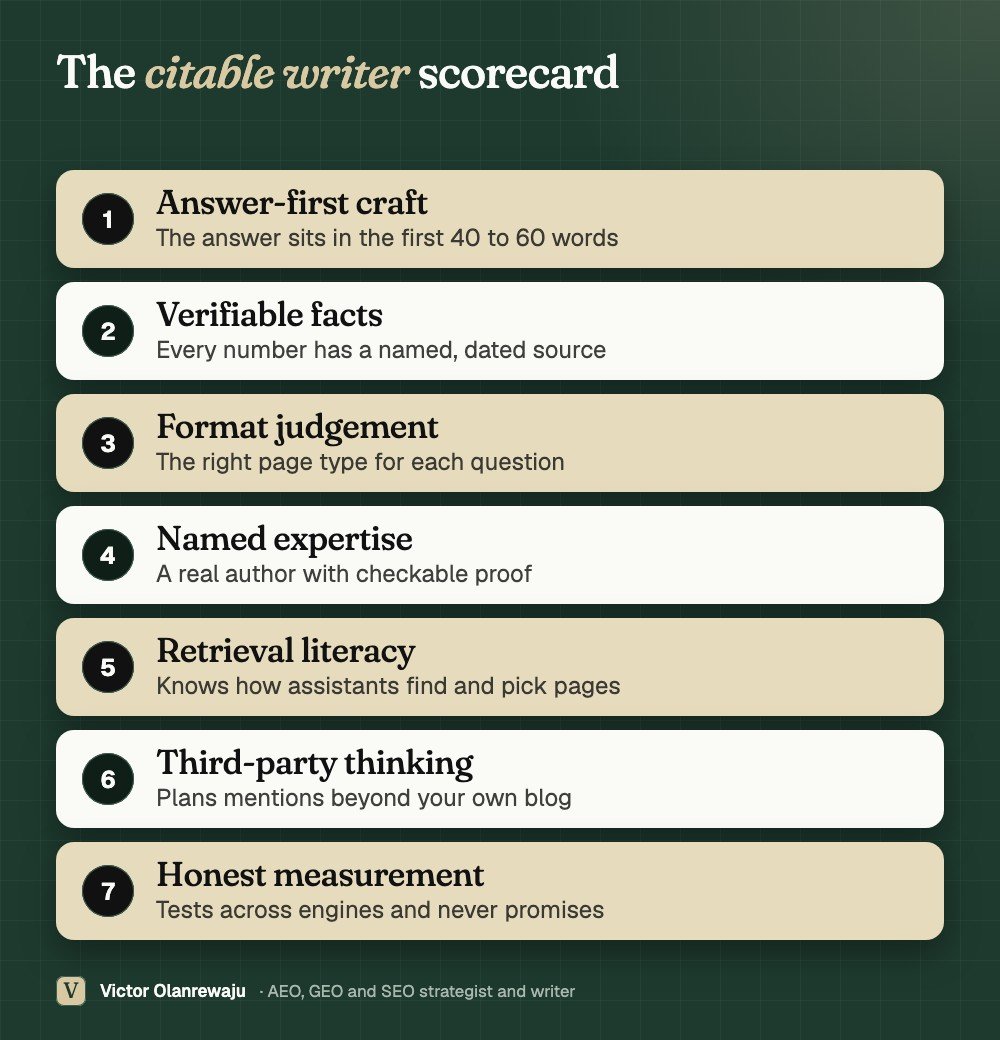
This is the scorecard I use to evaluate a writer, including myself. It is my working model, not an industry standard. Score each skill from 0 to 2 against the evidence in their portfolio, and treat anything below 10 out of 14 as a risk.
| Skill | What proof looks like | A test you can run in an interview |
|---|---|---|
| 1. Answer-first craft | Published pages open with a direct answer in the first 40 to 60 words, then explain | Give them a buyer question and ask for the first two sentences of the page, live |
| 2. Verifiable facts | Figures carry a named source and date, and limits are stated | Ask where each number in their best sample came from and how they checked it |
| 3. Format judgment | Their portfolio has comparison pages, guides and category copy, each for a clear intent | Ask which page type they would write for “best [your product] for a small team” and why |
| 4. Named expertise | A real author page, a bio with checkable history and bylines you can open | Ask them to show three live pieces under their own name |
| 5. Retrieval literacy | They can explain crawler access, query fan-out and why a ranking page may go unnamed | Ask what they would check first if you rank on Google but ChatGPT never names you |
| 6. Third-party thinking | Plans include reviews, press, lists and communities, not only owned content | Ask which three sources assistants cite in your category and how they would earn a place |
| 7. Honest measurement | They run the same prompts more than once, record the date and never promise a position | Ask how they would measure success in 60 days, and listen for “repeat runs” and “no guarantees” |
For the measurement method I use, see how to check what ChatGPT says about your business. SparkToro’s study of 2,961 responses found the same question rarely returns the same brand list twice, so a writer who judges success from one screenshot has not understood the medium.
Can a writer do this alone?
Rarely, and the best results I have seen come from a small set of roles working together. A writer can be all of them on a small project, but you should know which role is covered.
| Role | What they contribute | What goes wrong without them |
|---|---|---|
| Writer-strategist | Chooses questions and page types, writes answer-first, plans evidence and mentions | Pages that read well but answer the wrong questions |
| Subject-matter expert | Supplies first-hand experience, real numbers and defensible opinions | Generic pages with nothing original for an assistant to quote |
| Editor or fact-checker | Verifies every claim, date and source, and removes unsupported statements | Wrong figures that assistants repeat with confidence |
| Technical SEO or developer | Keeps pages crawlable, indexable and consistent, and handles robots.txt and markup | Great content that crawlers cannot read or are blocked from |
| PR or partnerships lead | Earns reviews, press and listings that assistants lean on | A strong site with few independent mentions to back it up |
My guides to AI crawlers and robots.txt and schema markup for AEO and GEO cover the technical role. The editing role is covered in how I used AI to improve a newsroom’s output without losing quality control.
What should you give a writer, and what should a good writer ask you?
Most weak results trace back to thin inputs. A writer cannot invent first-hand experience, real prices or customer proof, and an assistant will not quote a page that has none. Prepare these before the project starts.
| Input | Why it matters for citations | What it looks like |
|---|---|---|
| A buyer question list | Each page should answer one real question in the buyer’s words | 20 to 30 questions from sales calls, support tickets and search data |
| A facts sheet | Assistants quote specifics, and conflicting facts make them guess | Prices, plans, limits, delivery times, locations, licenses, with the date each was checked |
| Access to an expert | Quotations and first-hand detail were the strongest tactics in Princeton’s study | A 30-minute interview per topic, recorded, with permission to quote |
| Customer proof | Named evidence builds trust for readers and for assistants | Approved case studies, review links and results you can source |
| Competitor list | Comparison pages need accurate, fair facts about rivals | Your three closest rivals and the points where you differ |
| Claims you cannot make | Prevents compliance problems and unsupported statements | A short list of banned claims and required disclaimers |
| An approval path | Slow or unclear sign-off breaks freshness | One named approver and a turnaround time |
What does a good writer ask you before they start?
A writer who only asks for a keyword and a deadline is a risk. A good AEO and GEO writer interviews you. Expect questions like these, and be suspicious if none arrive:
- Who exactly is the buyer, and what do they ask just before choosing?
- Which three competitors do buyers compare you with, and where do you lose?
- What facts about your business change often, and who owns them?
- What can you prove with numbers, and where is the source?
- Which claims are you not allowed to make?
- Who is the expert I can interview, and how much time do they have?
- Which sites do buyers trust in your category, such as review platforms, publications or forums?
- What do ChatGPT, Gemini and Perplexity say about you today?
- How will we decide whether this worked, and over what period?
- Who approves the final version and how fast?
What should the work include? Deliverables by project type
Buyers often agree a vague scope and then argue about it. Name the deliverable and what “done” means. The ranges below are my planning guides from my own projects, not quotes, and vary with research depth and approval speed.
| Deliverable | What it should contain | Typical effort | How you judge it |
|---|---|---|---|
| Answer-first page | A question heading, a 40 to 60 word answer, specific facts, sourced figures, a short FAQ, a named author and a review date | A few business days including checking | Can you lift the first paragraph into an answer unchanged, and is every claim sourced? |
| Comparison or alternatives page | The same criteria for each option, fair claims about rivals, dated pricing, a clear recommendation by use case | About a week with research | Would a rival’s buyer find it fair? |
| Case study | A named customer, the situation, what changed, sourced numbers and honest limits | One to two weeks, mostly waiting for approvals | Could a skeptic check each number? |
| Pillar guide | A long guide on one topic with data, examples, tables and links to supporting pages | Two to four weeks | Does it contain something not found on competing pages? |
| Refresh of an existing page | Updated facts, dated claims, a restructured opening and fixed sources | Hours to a few days per page | Are the facts now current and the answer in the first lines? |
| Content and AI search audit | The question map, a prompt-panel baseline, the Rank–Mention matrix and a prioritized fix list | One to two weeks | Does it tell you what to fix first, with evidence? |
| Retainer | A monthly mix of the above, with a re-test of the same prompts each month | Ongoing | Is the share of questions where you are named rising across repeat runs? |
Can AI tools write content that gets cited on their own?
They can produce text that is cited, but I would not hand the whole job to a tool, and the data supports a cautious view. Ahrefs analyzed the 1.9 million URLs cited across 1 million Google AI Overviews and classified them with its AI-content detector: 3.6% were pure AI, 8.6% pure human and 87.8% a mix of the two. The correlation between the share of AI content and citation order was effectively zero (0.017), so Google was not rewarding AI text, nor penalizing it. See Ahrefs’ study. Two readings follow. First, AI assistance is normal and not a barrier to being cited. Second, the common ingredient in citable pages is not who typed the words but whether they carry facts, evidence and a clear answer, which is exactly what an unsupervised tool tends to skip. Google also warns against producing content at scale mainly to manipulate rankings, which its spam policies call scaled content abuse, and asks who wrote the content and why. See Google’s people-first content guidance and spam policies. In short: a human who is accountable for the facts should be in the loop.
What kinds of people can write this content, and what does each cost?
| Option | Best for | Watch out for |
|---|---|---|
| In-house writer | Ongoing publishing with deep product knowledge | Rarely has time for testing across assistants or earning outside mentions |
| Freelance AEO and GEO writer | Specific high-intent pages, refreshes and case studies | Needs access to your experts and a clear brief, or the output turns generic |
| Fractional strategist who also writes | Teams that need a plan, standards and writing together | Check that strategy comes with samples you can read, not just frameworks |
| Your own expert with a ghostwriter or editor | Thought leadership and original data | Needs a disciplined process so the expert’s voice and facts survive editing |
| Content mill or generic agency | Volume on low-stakes topics | Typically weak on first-hand facts, sources and named authorship |
On cost, published numbers help. Among the nine writers below, Manal Ghamir publishes starting prices on her homepage: an SEO article from $275, a comparison page from $375, a content mini-audit from $150 and retainers from $900. Vatam, my consultancy, publishes foundation builds from $390 one-time, growth retainers from $290 a month and single items such as an answer-first article at $80, with every scope agreed in writing first. These are starting prices as published in October 2026, and complex projects cost more. The price of the writing is usually smaller than the cost of publishing the wrong facts.
How much should you budget, and what drives the price?
I cannot give you a market rate, and I would distrust anyone who claims one. What I can give you are published starting prices and the factors that move them. The published figures are in the previous section: Manal Ghamir lists SEO articles from $275, comparison pages from $375, content mini-audits from $150 and retainers from $900, and Vatam lists answer-first articles from $80, foundation builds from $390 one-time and growth retainers from $290 a month. Treat these as starting points as of October 2026, not quotes.
| Factor | Why it raises or lowers the cost |
|---|---|
| Research depth | Original data, interviews and fact-checking take more time than summarizing existing sources |
| Expert access | Fast, recorded access to an expert cuts the writer’s time and improves quality |
| Regulation | Finance, health and legal topics need review and more careful sourcing |
| Page type | Comparison pages and case studies need more verification than a short answer page |
| Volume and speed | More pages and faster turnaround raise cost, and can lower quality if checking is skipped |
| Measurement | Repeated prompt testing and reporting is real work, so confirm whether it is included |
A simple way to think about value is the cost per question you move. Suppose, purely as an illustration with invented numbers, you spend $1,500 on a rewrite of five pages and, over the next 90 days, you go from being named in 2 of your 10 test questions to 5 of 10 across repeat runs. That is three more questions where buyers hear your name, at about $500 each. Compare that with the cost of a single lost deal and with what you pay for other channels. The point is to decide the metric before you spend, not to accept the writer’s.
Who are the writers who can do it? 8 names with public evidence
This list comes from my roundup of SaaS content writers who understand AI search, which I built from public pages read on October 11, 2026. The bar was a checkable sign that the writer understands how content is found and cited by AI assistants, such as a service called AEO or GEO, a published experiment, or a case study that mentions AI citations. It is alphabetical by surname, not a ranking, and I am on it. I have summarized each person briefly here. Details can change, so check each site and ask for live examples.
| Writer | Best for | Public AI search evidence |
|---|---|---|
| Rosanna Campbell | Expert-led thought leadership, research reports, interview-based newsletters for B2B SaaS | Lists “SEO/GEO optimized blogs” as a service. Ask to see how pieces are structured for extraction |
| Manal Ghamir | Comparison pages, SEO articles, content mini-audits, with published starting prices | Titled an AI visibility strategist, with an AI visibility teardown in her portfolio |
| Ayomide Joseph | Case-study-led SaaS content and comparison pages, including security and martech | Published AI citation research and a 270-query fan-out experiment on how ChatGPT, Gemini and Perplexity recommend B2B alternatives |
| Kaleigh Moore | AEO strategy, fractional content leadership and editorial systems for SaaS | Offers an AI search audit and has written on what makes content citation-worthy to AI |
| Oliver Munro | Fractional SEO and content operations for small teams, including fintech | Blogs on AEO and AI search visibility tracking, and positions work around Google and AI search |
| Nathan Ojaokomo | Bottom-funnel comparisons and alternatives pages, and SaaS-trained writing for crypto and fintech brands | Described as an SEO, product-led content and AI search specialist, with bylines at HubSpot, G2 and Blockchain-Ads |
| Victor Olanrewaju (me) | AI citation strategy with writing included, especially crypto, fintech and e-commerce, plus SaaS teams that want citations measured | Two published ChatGPT case studies with numbers, covered below |
| Pawel Tatarek | High-volume SEO and GEO articles, refreshes and case studies at SaaS scale | Reports more than 700 posts and shows AI Overview citations on his site, with Perplexity on his client list |
One more name belongs in the conversation, though he is not for hire. Ryan Law, Director of Content Marketing at Ahrefs, authored several of the studies cited in this guide, including the freshness study and the 75,000-brand study. His author page is the best place to follow the data any citation writer should know.
Why am I on the list, and how should you weigh it?
You should weigh it carefully, because I sell this work. Here is the evidence you can check yourself, and the limits. I have published nearly 10,000 articles over six years across crypto and finance outlets, and at Ventrix Media I ranked first on Google for “XRP price prediction” in 2021, which helped partner crypto brokers see thousands of quality leads. In 2026 I founded Vatam. The AI citation evidence is two case studies with dated screenshots: LAGE Lightings moved from seventh to first in ChatGPT in about three months, and Lens & Co by Tiara was listed first in 5 of 6 ChatGPT answers about two weeks after its content went live. My recent published work includes an opinion piece on how AI engines advise on stablecoins, on AI Story Front, and market analysis on Investing.com. The honest limits: two cases are evidence of a method, not a guarantee, my strongest proof is in crypto, fintech and e-commerce rather than a long SaaS client list, and I am a one-person consultancy, so you work with me directly and there is no team to hand work to. Compare me against the other eight on exactly those points. If you want to talk, see my page on content strategy and writing, or tell me what you want to be found for.
Which of the 8 fits which need?
This is my matching guide from the public evidence in the roundup. It is a starting point for your shortlist, not a recommendation to skip your own checks.
| If you need | Start your shortlist with | Why |
|---|---|---|
| Fair, sourced comparison and alternatives pages for SaaS | Manal Ghamir, Nathan Ojaokomo, Ayomide Joseph | Comparison pages are central to their published work |
| Thought leadership and research reports from your experts | Rosanna Campbell | Expert-led long-form and interview-based work is her focus |
| A writer who has run published AI citation experiments | Ayomide Joseph | He published AI citation research and a 270-query experiment |
| AEO strategy, an audit and editorial standards | Kaleigh Moore, Oliver Munro | Both sell strategy and content operations alongside writing |
| Volume, refreshes and steady monthly output | Pawel Tatarek | He reports more than 700 SaaS posts and a refresh offer |
| AI citation strategy with writing included, measured, for crypto, fintech or e-commerce | Victor Olanrewaju (me) | Two ChatGPT case studies in those areas, and a measurement method I publish |
How do you hire one? 10 questions and a paid test
Do not hire from a portfolio alone. Use these questions, then run a small paid test before a retainer.
| Ask this | A good answer sounds like | A red flag |
|---|---|---|
| Show me a page of yours that an AI assistant cites. | Gives a live URL, the prompt, the date and the engine | “I cannot share clients” with nothing else checkable |
| How do you decide the page type? | Starts from the buyer’s question and intent | Uses the same template for every query |
| How do you source figures? | Primary studies, dated, with limits stated | Statistics from roundups with no original link |
| Where do the experts’ words come from? | Interviews, quotes and first-hand experience from your team | Invented or generic “expert” statements |
| What do you do if we rank but are not named? | Checks crawler access, answer position, fact consistency and third-party mentions | “Write more content” |
| How do you use AI tools? | For research and drafts, with a human verifying every claim | Unreviewed AI output published at scale |
| How will you measure it? | A fixed prompt set run repeatedly, with dates and no guarantees | Promises of a first-place result |
| Who is the author on the page? | A real, named person with a bio and proof | No byline, or a made-up persona |
| What will you not do? | No fake reviews, bought placement presented as editorial, or invented data | Cannot name anything they refuse to do |
| What do you need from us? | Access to experts, product facts and approval on claims | “Nothing, just give us the keyword” |
What does a good paid test look like?
- Pick five real buyer questions from sales calls and support tickets, and record what ChatGPT, Gemini and Perplexity say about them today. Run each three times on different days.
- Commission two pages, for example one comparison page and one answer-first guide, with a named author and sourced figures.
- Check the work before publishing: every claim has a source, the answer is in the first 60 words, and the facts match your site and profiles.
- Publish and wait two to four weeks, then re-run the same prompts three times on different days.
- Judge the process, not just the result. One test cannot prove a citation effect, but it shows whether the writer’s craft, sourcing and honesty are good.
For interpreting what you see, use the Rank–Mention matrix in the rankings versus mentions guide, and for a SaaS-specific plan and 12-prompt panel, see SEO vs AEO vs GEO for B2B SaaS.
How do you judge a writing sample? An annotated example and a 10-point audit
A sample tells you more than a pitch, if you read it the way an assistant would. Here is a short illustration with placeholders, then the checklist I use.
| Weak opening | Strong opening |
|---|---|
| “In today’s fast-moving world, businesses are constantly looking for the best way to improve efficiency. [Product] is a leading solution that helps teams achieve more with less, and our award-winning platform is trusted by many.” | “[Product] is [what it is] for [who it suits]. It costs from [price] a month for [what that includes], and most teams are set up within [time]. It is a weaker fit if you need [limit]. Details and sources are below, last checked [date].” |
The weak version contains no fact an assistant could quote or verify, and its claims (“leading,” “award-winning,” “many”) have no source. The strong version states what, for whom, how much, how long, a limit and a date. Now score any sample against these ten points, one point each:
- The first 60 words answer the question in plain sentences.
- The page states a price, time, place or condition an assistant could quote.
- Every statistic has a named source and a date.
- Sources are primary where possible, with links.
- There is at least one real quotation or first-hand detail.
- Limits and trade-offs are stated honestly.
- The page type matches the question it answers.
- A named author, a role and a review date appear on the page.
- The facts match your site and public profiles.
- The text reads as written by a person who knows the subject, not as filler.
Eight or more is a strong sample. Fewer than six means you are looking at generic content, however polished it reads.
What should a brief for a citable page contain?
A good brief is the cheapest way to improve output. Copy this structure and fill it in for each page.
| Brief field | What to write |
|---|---|
| The question | The exact buyer question, in the buyer’s words |
| The reader | Who asks it and what they already know |
| Page type | Guide, comparison, category page, case study or FAQ, with the reason |
| The answer | The answer in 40 to 60 words, approved by an expert |
| Facts that must appear | Prices, limits, dates and policies, each with a source |
| Evidence to include | Studies, customer proof and quotations, with links |
| Expert to quote | Name, role and interview slot |
| What to compare | Rival names and the criteria to use |
| Follow-up questions | Five to eight questions for the FAQ |
| Links | Internal pages to link, and outside sources to cite |
| Author and date | The named author, and the date the facts were last checked |
| Success measure | The prompts you will re-run, and when |
What should go into the contract or statement of work?
I am not a lawyer, and you should have yours check this. These are the points I would want written down in any engagement, because they protect both sides and protect the quality of what gets published.
- Named author and credit. Who is named on the page, and whether ghostwriting is allowed.
- Sources log. A list of every figure and its source, delivered with each page.
- AI-use disclosure. Whether AI tools are used, for what, and that a human verifies every claim.
- Fact-check responsibility. Who checks product facts, and who signs off regulated claims.
- Revisions and timing. The number of review rounds, and the turnaround on both sides.
- Intellectual property. Who owns the final text and any original data.
- No guarantee clause. That rankings, citations and recommendations are not promised.
- Measurement plan. The prompt set, how often it runs, and what will be reported.
- Update window. Whether the writer refreshes facts after publication, and for how long.
- Conduct. No fake reviews, no invented quotations or data, and no paid placement presented as editorial.
What changes if you work in finance, crypto, health or law?
Everything gets stricter. Google’s guidance treats content that could affect a person’s health, financial stability or safety with extra care, which it calls Your Money or Your Life topics, and asks whether a page shows real expertise and trust. See Google’s people-first content guidance. In these areas the writer is not enough on their own. You need a qualified reviewer, dated claims, primary sources for every regulatory or safety statement, and a clear note on which jurisdiction a statement applies to. The risk of wrong AI answers is real: in my own test of five AI engines on stablecoin safety, the answers changed with geography and several relied on outdated facts, which I describe in my AI Story Front op-ed. If your page states a license, an audit or a reserve position, date it and link the primary document, because an assistant will otherwise fill the gap with whatever it finds.
What are the red flags when hiring for AEO and GEO?
- A guaranteed position. OpenAI publishes no ranking formula, and answers vary run to run, so nobody can promise one.
- “We write for AI” with no human accountability. If nobody is responsible for each fact, you are buying risk.
- Keyword stuffing dressed up as GEO. Princeton’s study found keyword stuffing performed worse than no optimization.
- Fake or purchased mentions. Paid placement presented as editorial, or invented reviews, can backfire and is dishonest. Muck Rack found non-paid sources made up 94% of AI citations.
- No named author. Google asks who wrote the content, and so should you.
- Pages that all look the same. If every page has the same structure regardless of the question, format judgment is missing.
- Only owned-content plans. A plan that ignores reviews, press and community leaves most of the evidence unaddressed.
How do you measure whether it worked?
Agree the measures before the first page is written. These are the five I would use, in order of how much I trust them.
| Measure | How to do it | What to be careful about |
|---|---|---|
| Prompt-panel mention rate | Run the same 10 to 12 buyer questions in ChatGPT, Gemini, Claude and Perplexity, three times on different days, before and after. Record whether you are named, where and with which sources | Answers vary, so judge the pattern across runs, not one screenshot |
| Accuracy of what is said | Check prices, plans, locations and claims in the answers against your facts sheet | Fixing wrong facts is often the fastest win |
| Self-reported source | Add “How did you hear about us?” to forms, with ChatGPT, Gemini, Claude and Perplexity as options | Small numbers, but they reveal influence that analytics miss |
| AI-assistant sessions | Look for an AI assistant channel in your analytics traffic acquisition report | A buyer may read an answer and search for you later, which appears as branded or direct traffic |
| Pipeline and demos | Compare demo requests and deal sources over a quarter | Slow and multi-factor, so use it to sanity-check, not to prove cause |
The method for the panel is in how to check what ChatGPT says about your business, and the ranking-versus-mention diagnosis is in the rankings versus mentions guide.
What does a 30-60-90 day engagement with a writer look like?
| Window | What the writer does | What you do | What you should have by the end |
|---|---|---|---|
| Days 1 to 30 | Interviews you, builds the question map, runs the baseline panel and diagnoses your existing pages | Supply the facts sheet, expert time and approvals | A prioritized list of pages to write or fix, and a baseline you can compare with |
| Days 31 to 60 | Delivers the first rewritten and new pages with a sources log | Review quickly, correct facts and publish | Two to five live pages, each with a named author, dated facts and sources |
| Days 61 to 90 | Adds comparison or case-study pages, works on third-party mentions and re-runs the panel | Approve outreach, collect reviews and customer proof | A re-test against the baseline and a decision on the next quarter |
How long until you see results, and what should you expect?
It varies, and nobody can guarantee it. In my own cases, Lens & Co’s first ChatGPT captures came about two weeks after content began going live, and LAGE Lightings moved from seventh to first over about three months. Those are two examples, not forecasts. A realistic plan is a 90-day cycle: baseline, rewrite the pages that rank but go unnamed, build proof and mentions, then re-test. The B2B SaaS playbook sets out that plan in detail, and the AI search statistics for 2026 page explains what traffic to expect and what not to.
What do these studies not tell you?
- They are snapshots. Assistants and their sources change often. Princeton’s tests used an older model, and the citation studies describe specific months.
- Some are single analysts or vendor research. Indig’s and Shashko’s findings are individual analyses, and Wix, Ahrefs and Muck Rack all sell into this market.
- Correlation is not causation. Pages with quotations and sources may simply be better pages.
- My list is not a ranking. I read public pages on October 11, 2026, many claims are self-reported, and I am on it. Ask every writer, including me, for live examples.
If you want to know what AI assistants say about your business today before you hire anyone, I run this check as part of a free AI visibility audit. See the pricing page for what happens after, my pages on AEO and GEO, or tell me what you want to be found for.
Keep reading: For software buyers, I ran ten “best software” questions through ChatGPT in how SaaS products get named in ChatGPT’s best-software answers. For a security buyer’s version of this, I tested ten vendor questions in how AI recommends cybersecurity vendors.
Frequently asked questions
Who can write content that gets cited by ChatGPT, Gemini and Perplexity?
A writer who puts the answer first, proves claims with named and dated sources, writes as a real and checkable expert, understands how assistants retrieve pages, plans for mentions beyond the owner’s blog and measures honestly. Usually that is a writer-strategist working with a subject expert and an editor. Eight named writers with public evidence are listed in this guide, including me.
What is the difference between an SEO writer and an AEO or GEO writer?
An SEO writer optimizes pages to rank. An AEO writer makes a page easy to quote as an answer, and a GEO writer works on getting an AI to name and recommend the brand. In practice a good writer does all three, because a page can rank and still go unnamed.
What makes content more likely to be cited by AI?
Answer-first structure, specific facts with named sources, quotations and statistics, and a clear match between page type and question. In Princeton’s GEO study, adding quotations lifted visibility by 41%, statistics by 33% and cited sources by 30%, while keyword stuffing performed worse than baseline.
Does it matter where the answer appears on the page?
Probably. Kevin Indig’s analysis of 1.2 million ChatGPT results and 18,012 citations found 44.3% came from the first 30% of the text, so put the answer and the key facts early. It is one analyst’s study, so treat it as a strong hint.
Which content format do AI assistants cite most?
It depends on intent. In Wix Studio’s analysis of 1,056,727 citations, articles led for informational searches (45.48%), listicles for commercial ones (40.86%) and product pages for transactional (24.88%) and local searches (21.95%). Overall, listicles were 21.9% of citations.
Can AI-generated content get cited?
Yes. Ahrefs found that 87.8% of the pages cited in Google AI Overviews mixed AI and human writing, 8.6% were pure human and 3.6% pure AI, with no meaningful link between the share of AI content and citation order. What matters is facts, evidence and a clear answer, and a human should be accountable for each claim.
Is a freelance writer enough, or do I need a team?
A freelance writer can cover a small project if they also handle sourcing and editing, and you give them access to a subject expert. Larger programs usually need an editor, technical SEO support and someone to earn reviews and press, because AI answers lean heavily on third-party sources.
How do I test a writer before hiring?
Ask for live pages that assistants cite, with the prompt, engine and date. Then run a paid test: five real buyer questions, two pages with named authors and sourced figures, and the same prompts run three times on different days before and after publishing.
What are the red flags?
Guaranteed positions, no named author, unreviewed AI output at scale, keyword stuffing presented as GEO, bought or fake mentions, identical templates for every question, and plans that ignore reviews, press and community presence.
How much does AEO and GEO writing cost?
It varies. Published starting prices in October 2026 include Manal Ghamir’s SEO articles from $275 and comparison pages from $375, and Vatam’s answer-first articles from $80, foundation builds from $390 one-time and retainers from $290 a month. Complex projects cost more, and every scope should be agreed in writing.
How long does it take for content to be cited?
It varies and cannot be guaranteed. A Lagos eyewear store was listed first by ChatGPT in 5 of 6 answers about two weeks after its content went live, and a Lagos lighting brand moved from seventh to first over about three months. Treat those as examples, not forecasts.
Which kind of writer should I hire first?
It depends on your situation. If you rank but are not named, hire someone who can diagnose the gap and rewrite pages. If you need comparison pages, hire a comparison specialist. If you work in finance, crypto or health, hire a writer with domain literacy and add a qualified reviewer. The decision table in this guide matches seven common situations to the right kind of hire.
What should I prepare before hiring an AEO or GEO writer?
A list of real buyer questions, a facts sheet with dated prices and policies, access to an expert, approved customer proof, your closest competitors, claims you cannot make and a named approver. Thin inputs are the main reason results disappoint.
What should a good writer ask me?
Who your buyer is and what they ask before choosing, which competitors they compare you with, which facts change often, what you can prove with numbers, which claims are off limits, who the expert is, which sites buyers trust, what AI says about you today, how success will be measured and who approves the work.
What should be in a contract with a content writer for AI search?
A named author, a sources log for every figure, an AI-use disclosure, who checks facts, revision rounds and timing, ownership of the text and any data, a no-guarantee clause, a measurement plan, an update window and a conduct clause against fake reviews and invented data. Have a lawyer check it.
How do I judge a writing sample?
Score it against ten points: the answer in the first 60 words, a quotable specific fact, a named and dated source for every statistic, primary sources, a real quotation or first-hand detail, honest limits, the right page type, a named author and date, facts that match your profiles, and text that reads as written by someone who knows the subject. Eight or more is strong.
How do I measure whether the content worked?
Run the same 10 to 12 buyer questions in ChatGPT, Gemini, Claude and Perplexity three times on different days before and after publishing, check the accuracy of what is said, add a self-reported source field to your forms, look for AI-assistant sessions in analytics, and compare demos over a quarter.
Does ghostwriting hurt my chances of being cited?
Not by itself. What matters is whether the page carries real expertise, sourced facts and an accountable named author. A ghostwriter who interviews your expert and verifies claims can produce strong pages, as long as the credited expert stands behind the content.
Is AI-written content risky in regulated industries?
Yes, unless a qualified human verifies it. Google’s guidance holds topics that affect health, finances or safety to a higher standard of trust, so date every claim, link primary documents, state the jurisdiction and have a qualified reviewer sign off.
Why are you on your own list?
Because I do this work and the evidence is checkable, but I have a commercial interest. I disclosed it, listed the writers alphabetically so nobody ranks first, and described my limits: two case studies, strongest proof in crypto, fintech and e-commerce, and a one-person consultancy with no team behind me.