In this article
- What was the starting point?
- What was the problem to solve?
- What did we build?
- What changed, and when?
- What does ChatGPT say about LAGE Lightings now?
- Is ChatGPT sending visitors to LAGE Lightings?
- What does Google show for “where to buy droplights in lagos”?
- How should you read “7th to 1st”?
- What did it do for the business?
- Why might this have worked?
- What could another premium retailer take from it?
- How far should you trust these numbers?
- How does AI visibility fit a high-value, considered purchase?
- What would I measure going forward?
- How does this compare with Lens & Co?
- What risks and caveats should a premium brand consider?
- How should you brief a provider?
- What does a standard 90-day approach look like?
- What should a founder ask after reading this?
- How do you protect a first place?
- What objections do founders raise about a result like this?
- Sources
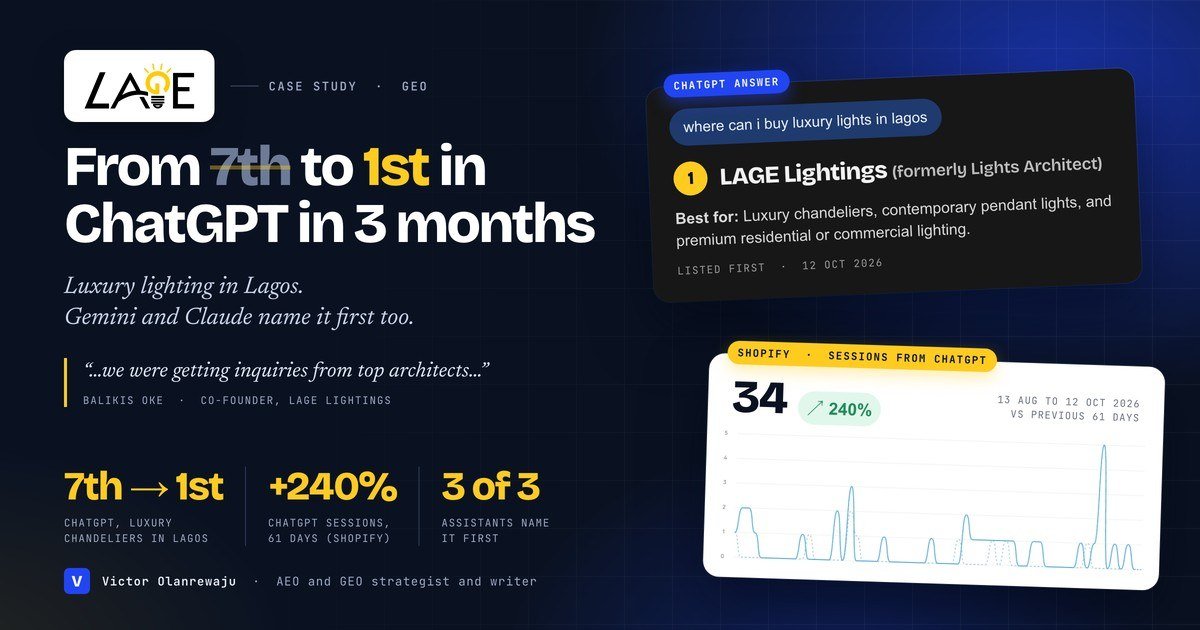
In short: In July 2026 ChatGPT listed LAGE Lightings, a Lagos luxury lighting brand formerly called Lights Architect, seventh for luxury chandeliers in Lagos. By October it was the first of five picks, Gemini had named it first in September and Claude in October, and on 12 October ChatGPT also listed it first for the broader question “where can i buy luxury lights in lagos”. The store’s Shopify data now shows 34 sessions from ChatGPT in the 61 days to 12 October, up 240% on the 61 days before, while total sessions are up 233% year on year. The co-founder reports inquiries from top architects and 4-star hotels that led to some of the biggest deals the business has closed. The business has done nine figures in naira revenue as a total, and that figure cannot be attributed to any one channel.
7th to 1st
ChatGPT position for luxury chandeliers in Lagos, July to October 2026
34
sessions from ChatGPT in 61 days to 12 Oct, up 240% (Shopify)
3 of 3
assistants naming it first: ChatGPT, Gemini and Claude
+233%
total sessions, year on year (Shopify, Sept 2026 against Sept 2025)
What was the starting point?
LAGE Lightings sells luxury lighting and home décor to buyers in Nigeria through an online store. Its co-founder, Balikis Oke, describes the situation plainly: “I was surprised we could beat our competitors since we had tried for years to do it.” In July 2026, when I asked ChatGPT about luxury chandeliers in Lagos, the brand appeared seventh. For a business selling high-value items to architects, developers and hotels, seventh on a list means the first calls go elsewhere.
This kind of purchase is considered and often involves a professional intermediary. A homeowner may ask an assistant, but an architect or a hotel developer is also asking: who supplies this, who can deliver at this scale, who has done it before. Assistants are now part of that research. DataReportal’s Digital 2026 analysis found that 77 percent of online adults in Nigeria say they are “excited” by AI, and that well over a billion people use standalone AI tools each month, so asking an assistant is no longer unusual. See AI search statistics for 2026.
What was the problem to solve?
- Low visibility in assistant answers. Seventh place in ChatGPT for a core product query.
- Competition that had been entrenched for years. The co-founder says the team had tried for years to beat competitors.
- A high-value, considered pipeline. Fewer but larger deals, where being on the shortlist early matters most.
What did we build?
Through my consultancy Vatam, I built city-level collection pages and buyer-intent articles. The collection pages were designed to give assistants a clear, specific page for each place a buyer might name. The articles answered the questions buyers ask before they choose a supplier. The principle is the one I set out in how to get cited by ChatGPT: a specific page for each specific question, with facts an assistant can verify.
What city-level collection pages are
For a retailer, a collection page groups products. A city-level version frames that collection around where a buyer is: luxury chandeliers in Lagos, for instance, with the availability, delivery and showroom details that matter to someone in that place. It serves two readers at once: a buyer who wants products, and an assistant that needs a specific page to cite for a location-based question.
What buyer-intent articles are
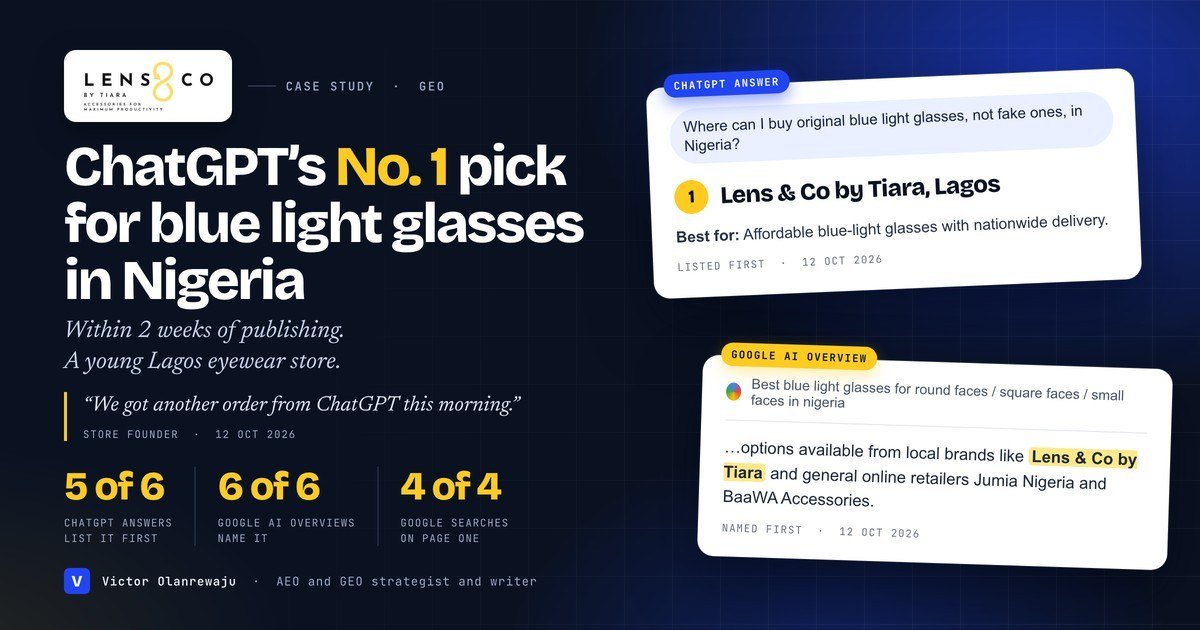
These answer the questions that come before a purchase: how to choose a chandelier for a high ceiling, how lighting affects a hotel lobby, what a supplier needs to know before a quote. Each is written for one question, with plain facts, and links to the relevant collection. This is the same one-page-per-question structure that took Lens & Co by Tiara to page one and ChatGPT’s first place in a different category.
What changed, and when?
| When | What the assistants showed |
|---|---|
| July 2026 | ChatGPT listed LAGE Lightings 7th for luxury chandeliers in Lagos |
| September 2026 | Gemini named LAGE Lightings first for luxury lighting in Nigeria |
| October 2026 | ChatGPT listed it first of five picks, and Claude named it first |
| 12 October 2026 | ChatGPT also listed it first for “where can i buy luxury lights in lagos”, and Shopify showed 34 ChatGPT sessions in 61 days, up 240% |
Alongside the assistants, the store’s own data moved. Total sessions rose 233% year on year (Shopify, September 2026 against September 2025), sessions from ChatGPT reached 34 in the 61 days to 12 October (below), and the site earned 29,400 search impressions between 20 March and 10 September 2026 (Search Console).
What does ChatGPT say about LAGE Lightings now?
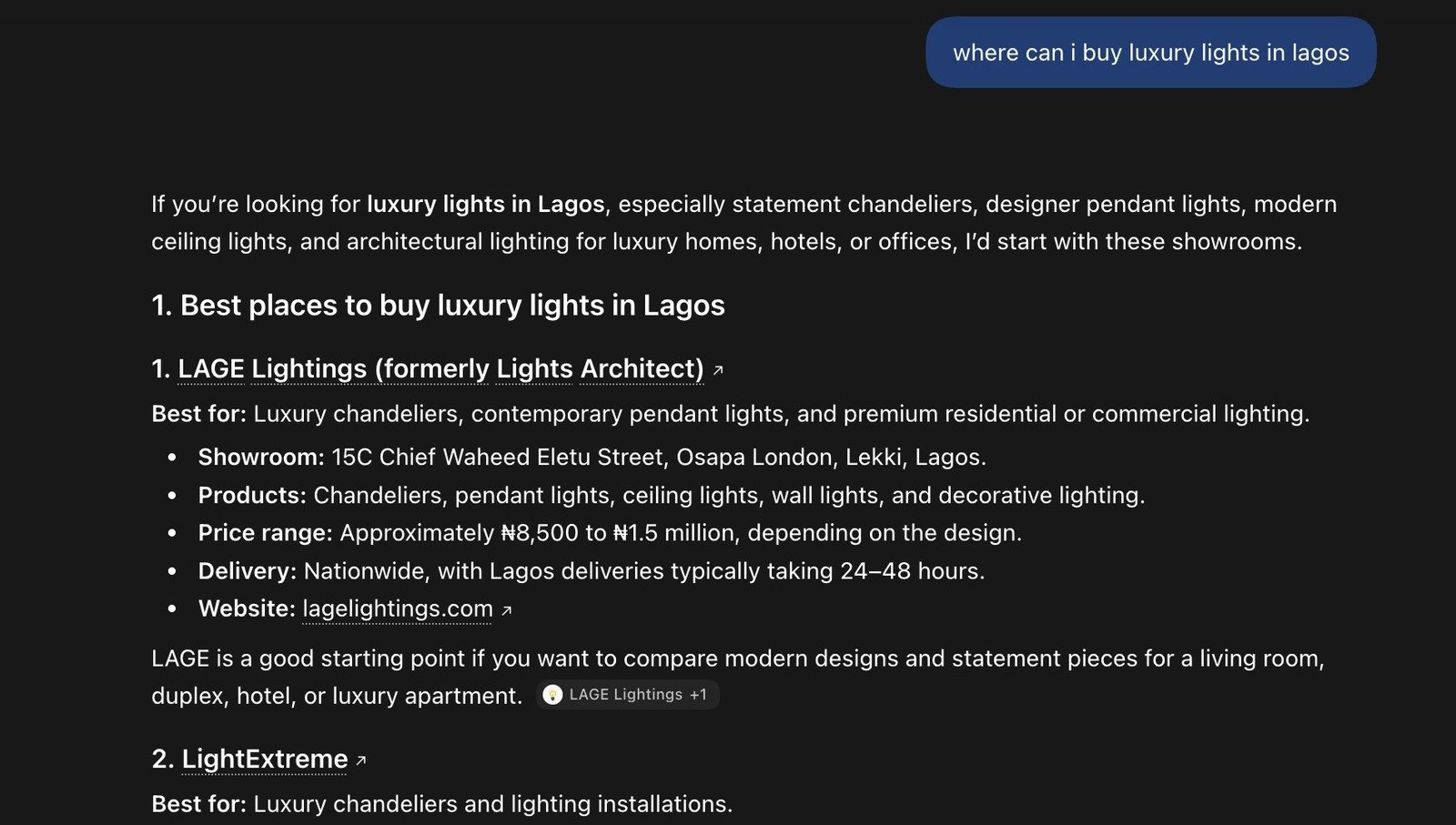
The July and October checks used one prompt, luxury chandeliers in Lagos. On 12 October the question was wider and plainer: the words a homeowner or a hotel buyer might type before they know what they want. ChatGPT listed LAGE Lightings first, under its own heading “Best places to buy luxury lights in Lagos”, and gave the buyer what a shortlist needs:
- What it is best for: luxury chandeliers, contemporary pendant lights, and premium residential or commercial lighting.
- Where it is: a showroom at 15C Chief Waheed Eletu Street, Osapa London, Lekki, Lagos.
- What it sells and for how much: chandeliers, pendant, ceiling, wall and decorative lighting, at roughly ₦8,500 to ₦1.5 million depending on the design.
- How it arrives: nationwide delivery, with Lagos deliveries typically taking 24 to 48 hours.
- Who it is for: a living room, a duplex, a hotel or a luxury apartment.
Two details are worth noticing. ChatGPT wrote “formerly Lights Architect”, so it knows the brand changed its name and links the old name to the new one. And the answer is built from facts a buyer can act on: an address, a price range and a delivery time. Those are the plain, checkable statements the city-level pages were written to carry. I have not audited each figure against the live store for this study, so treat the prices and delivery times as ChatGPT’s wording of the store’s information, not as the store’s own published terms. The showroom address does match the address on the page Google ranks first, shown below.
Is ChatGPT sending visitors to LAGE Lightings?
An assistant can name a business without sending anyone to it. The store’s Shopify analytics suggest that, for LAGE Lightings, the names are turning into visits. Across the 61 days from 13 August to 12 October 2026, Shopify recorded 34 sessions from ChatGPT, up 240% on the 61 days before (13 June to 12 August), which implies about 10 sessions in the earlier period. The two periods are the same length, so the comparison is like for like.
34
sessions from ChatGPT, 13 Aug to 12 Oct 2026
~10
sessions in the previous 61 days, implied by the 240% rise
+240%
change between the two 61-day periods
5
sessions on the busiest single day, in early October
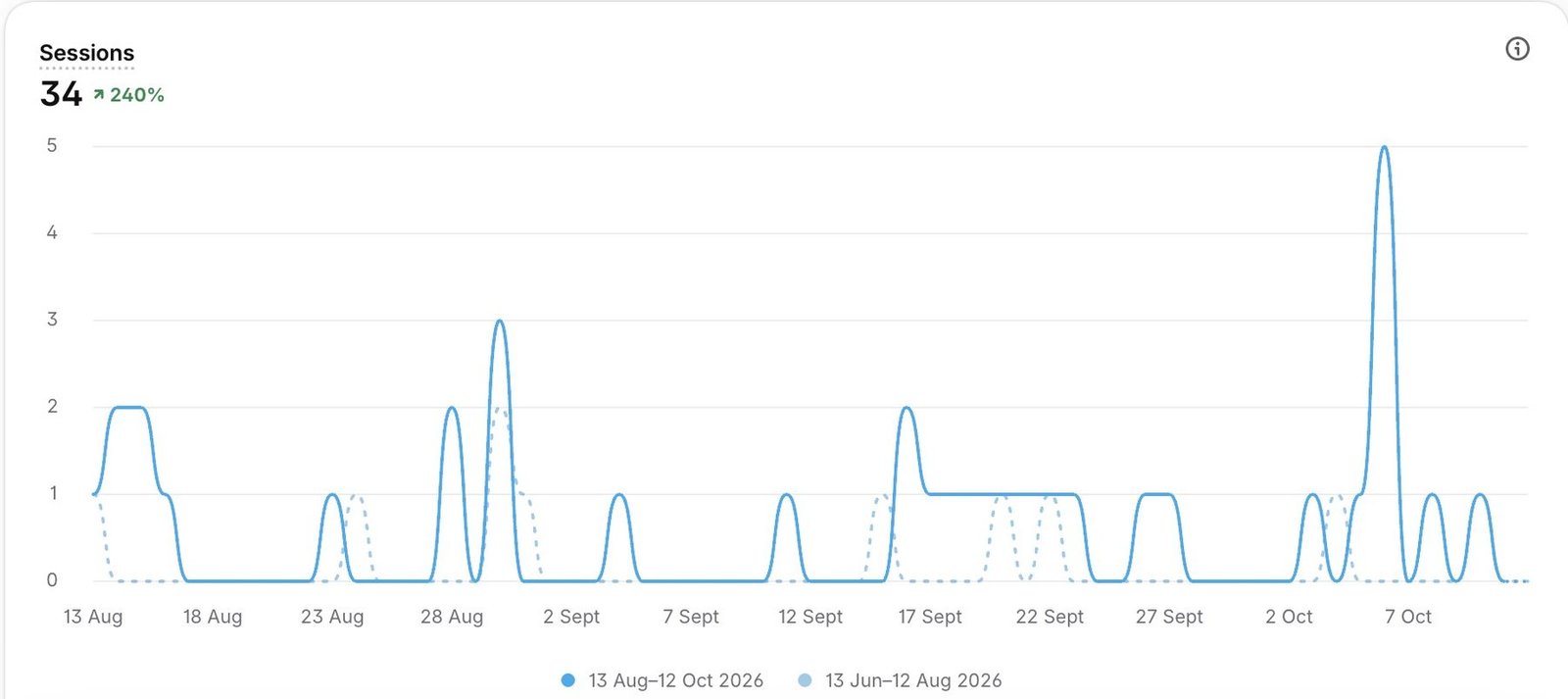
Read this carefully, because the numbers are small. Thirty-four sessions is a trickle, and a base of about ten makes any percentage look large. What matters is the pattern and the path. Sessions from ChatGPT appeared in a business that sells high-value items to considered buyers, they rose when ChatGPT began naming the brand first, and a single visit from the right architect or hotel buyer can be worth more than hundreds of casual ones. This is a different measure from the 233% year-on-year growth in total sessions, which counts every source. It is a signal to keep tracking, not a revenue figure.
What does Google show for “where to buy droplights in lagos”?
Different engines answer the same need differently, and this Google result is a useful counterweight to the ChatGPT answer. Google’s AI Overview for the search lists physical markets and showrooms, starting with sellers in Alaba International Market. What sits behind its “Show more” button is not visible in the screenshot, so the capture cannot say whether LAGE Lightings is named further down. Directly below the overview, the first organic result is the store’s own droplights page.
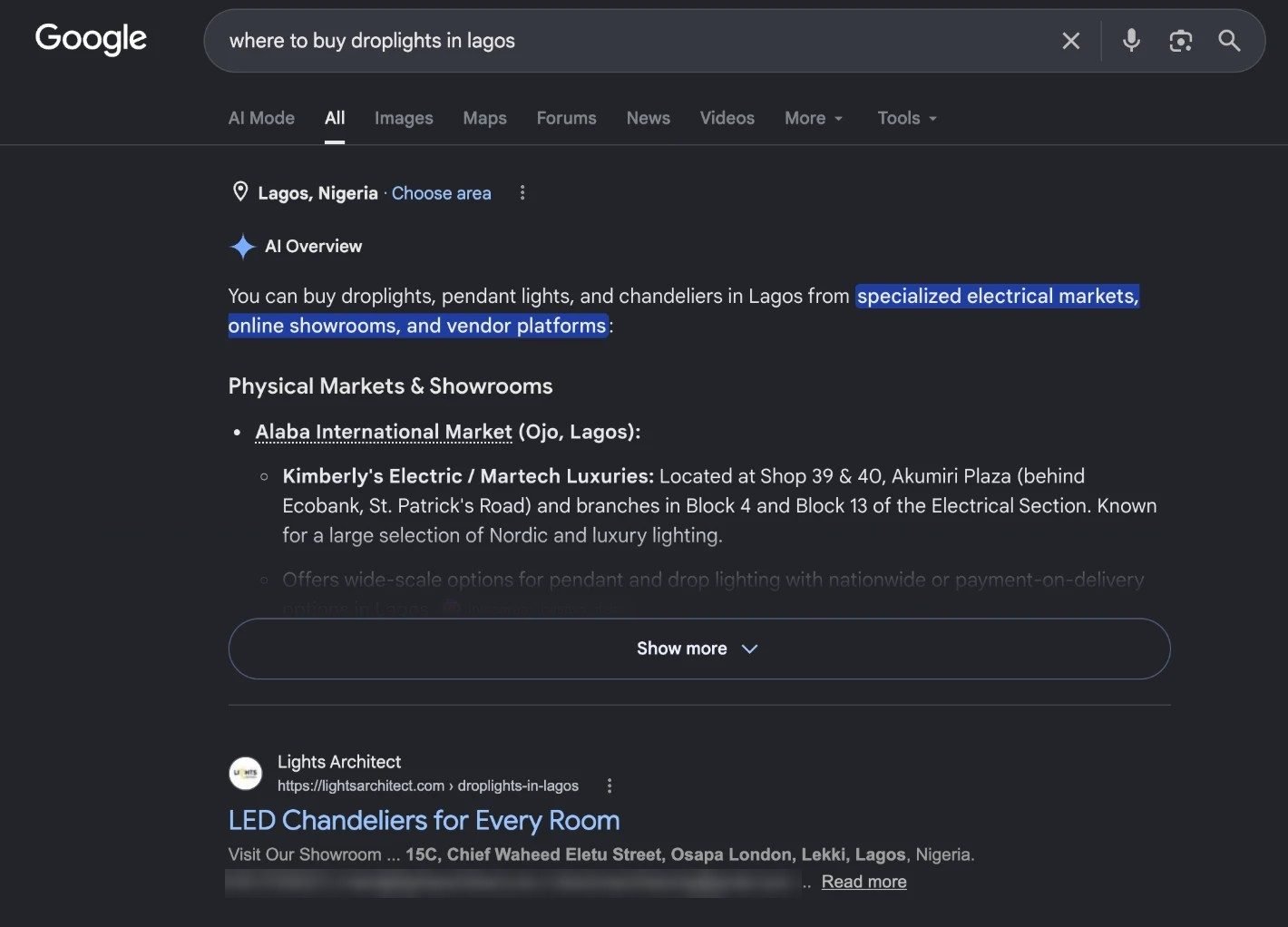
Three observations follow:
- The page follows the one-page-per-product-per-place pattern. A page about droplights in Lagos, with the showroom address in its snippet, is the kind of specific page this case study describes. It is also the first organic result for the search.
- The old brand still shows. Google lists the result under “Lights Architect” on the lightsarchitect.com domain, while ChatGPT names “LAGE Lightings (formerly Lights Architect)” and links to lagelightings.com. It is worth checking that the old domain redirects to the new one and that the new name is used on every page, so every engine resolves a single business.
- Winning one engine does not win them all. ChatGPT lists LAGE first for a broad question while Google’s overview, in the part that is visible, leads with market traders. That is why this case study tracks several assistants and Google, not one.
How should you read “7th to 1st”?
Position in an assistant’s list is not the same as a Google ranking, and it helps to be precise about what the number means:
- It is a position in one answer to one prompt. ChatGPT answers vary between runs and users, so I record the date and repeat checks.
- “First of five” is a list. In October the answer listed five picks and LAGE Lightings was first.
- It covers a defined query. Luxury chandeliers in Lagos, not every lighting search.
- The 12 October answer is a different prompt. “Where can i buy luxury lights in lagos” is broader than the luxury chandeliers question behind “7th to 1st”. It supports the direction of travel, but it is not a before-and-after for the same wording. The capture also does not show whether the account was signed in, so personalisation cannot be ruled out.
- It is consistent with other assistants. Gemini and Claude also name the brand first for luxury lighting in Nigeria, which makes it less likely to be a one-off.
What did it do for the business?
LAGE Lightings has done nine figures in naira revenue as a business. That is the total for the business, not revenue I can attribute to one channel, and I would not claim otherwise. What its co-founder reports is a change in who was getting in touch: “Victor came in, and within weeks, we were getting inquiries from top architects, 4-star hotels real developers, eventually leading to some of the biggest deals we’ve ever closed.”
That is the pipeline effect worth paying attention to. Being first in an assistant’s answer does not only add visits. It changes the quality of the shortlist a buyer builds before contacting anyone. For a supplier whose customers are architects, hotels and developers, getting named early in a decision process can matter more than raw traffic. I explain the mechanism in AI citation versus AI recommendation.
Why might this have worked?
This is my analysis, not a measured result. I build every page with three qualities, and they are the most likely reasons it worked:
- Specific. Each page answers one question or serves one place, so an assistant has a precise page to cite.
- Plain facts. Products, locations and details are written as short, checkable statements.
- Consistent. The same facts appear across the site, so an assistant finds the same answer wherever it looks.
Google’s documentation on helpful, reliable, people-first content asks for the same qualities of accuracy, completeness and originality, which is why I do not treat AI visibility as separate from good SEO. Its guidance on AI features says the SEO fundamentals remain relevant and no special optimization is needed. The three disciplines are compared in SEO, AEO and GEO explained.
What could another premium retailer take from it?
- Map your buyers’ questions, including the ones professionals ask, such as architects or procurement teams.
- Build one page per place and per question rather than one generic category page.
- State facts plainly: lead times, delivery areas, showrooms, ranges, minimum orders where relevant.
- Be consistent on every page and in your profiles.
- Test monthly across assistants, with a baseline recorded before you start. The method is in how to check what ChatGPT says about your business.
- Ask enquirers how they found you and track the quality of leads, not only their number.
How far should you trust these numbers?
- AI answers change between runs, users and models. Each result here is a dated snapshot, and I look for direction over months.
- This is one brand in one market. Another business with different competitors may see a different result.
- The nine-figure revenue is a business total, and the 233% is year-on-year sessions on Shopify. Neither isolates the effect of any one activity.
- The ChatGPT sessions figure is small, 34 in 61 days against about 10 in the previous 61, and its ChatGPT label comes from the store’s Shopify analytics, not from a filter visible in the screenshot. Treat it as an early signal.
- The Google capture was made while signed in with the location set to Lagos, and the AI Overview in it is truncated.
- The inquiry quality is reported by the client, which makes it a testimonial, not an independent measurement.
- No ranking or AI placement can be guaranteed.
What the case does show is that a focused set of specific pages can move a business up an assistant’s shortlist within a quarter. To test it for your own business, start with this 30-minute check. For a second example, read the Lens & Co by Tiara case study, and see the original case study on Vatam. My service is described on the GEO strategist page.
How does AI visibility fit a high-value, considered purchase?
For a retailer of everyday items, the buying path is short: ask, click, buy. For premium lighting supplied to architects, hotels and developers, the path is longer and has more people in it. A simple model of where assistants can matter:
| Stage | What the buyer does | Where AI visibility acts |
|---|---|---|
| Awareness | Asks who supplies luxury lighting in Lagos | Being named on the shortlist at all |
| Consideration | Compares suppliers, ranges and track records | Specific pages an assistant can cite for each comparison |
| Enquiry | Contacts two or three suppliers | Being among them, and arriving credible |
| Decision | Selects a supplier after meetings and samples | Little direct effect: sales process and product decide |
The honest conclusion is that AI visibility acts mainly at the top of this funnel, deciding who gets considered. What happens after that depends on the business. That fits the co-founder’s description of a change in the quality of inquiries, followed by deals that came through the normal sales process.
What would I measure going forward?
- Position and coverage in assistants for a fixed panel of buyer questions, including professional ones such as “lighting suppliers for hotel projects in Lagos”.
- Enquiry quality: the type of buyer, the project size and the source, recorded when an enquiry arrives.
- Source of closed deals: asking buyers how they first heard of the business.
- AI referral visits and branded search to catch influence that does not click.
- Revenue by source, with the caveat that attribution for considered purchases is imperfect.
How does this compare with Lens & Co?
| LAGE Lightings | Lens & Co by Tiara | |
|---|---|---|
| Category | Luxury lighting and home décor | Blue light and photochromic glasses |
| Buyer | Homeowners and professionals such as architects and hotels | Individual consumers |
| Purchase | High value, considered | Lower value, quicker |
| Timeline | July to October 2026 | Content published from 27 September to 8 October 2026, checks on 10 and 12 October |
| Main AI result | 7th to first of five in ChatGPT; first in Gemini and Claude | First in 5 of 6 ChatGPT answers; named in all 6 Google AI Overviews; cited by Claude in 8 of 38 checks |
| Business signal | Sessions +233%; inquiries from top architects and 4-star hotels | Orders attributed to ChatGPT; AI-assistant visitors engaging at 50%; more visits and walk-in clients |
| Measured ChatGPT traffic | 34 sessions in 61 days, up 240% (Shopify) | 26 AI-assistant sessions in 28 days (Google Analytics 4) |
Different categories, buyers and timescales, the same underlying method: specific pages for specific questions, plain facts, consistency and monthly measurement. Read the full Lens & Co case study to compare.
What risks and caveats should a premium brand consider?
- Dependency. Assistants change. A position held today can move, so keep investing and keep measuring.
- Accuracy. An assistant can describe your range or lead times wrongly. Check what it says and fix the sources.
- Attribution. Considered purchases involve many touches. Do not claim a single cause.
- Brand fit. Premium positioning requires premium pages, not thin location pages. Google’s spam policy on scaled content abuse is a reminder that pages generated at scale without value are a risk.
- Competitors respond. A first place invites imitation, so publish genuinely useful pages that are hard to copy.
How should you brief a provider?
- Share your target buyers and the questions each asks, including professional intermediaries.
- Agree the panel of questions and a baseline before work starts.
- Agree what will be reported monthly and how enquiries will be attributed.
- Set expectations: results vary, rankings and AI answers cannot be guaranteed and answers change between runs.
- Ask to see a comparable result with its sources and limits.
What does a standard 90-day approach look like?
This is my standard method for a considered-purchase brand, described as a method and not as a record of what happened month by month in this engagement.
Month 1: baseline and foundations
- Run the assistant panel and record where the brand and its competitors appear.
- Audit crawl access, indexing, titles, descriptions and structured data.
- List the buyer questions, including those asked by professionals.
- Map each question to a page, and identify the gaps.
Month 2: build and structure
- Publish city-level collection pages and the first buyer-intent articles, with plain facts and named authorship.
- Link the pages together and to the product collections.
- Make the business identity consistent across the site and its profiles.
Month 3: measure, fix and extend
- Re-run the panel and compare with the baseline.
- Fix the gaps the test exposes, such as missing facts or unclear pages.
- Extend to the next set of questions, and begin tracking enquiry quality and source.
What should a founder ask after reading this?
- Where do we appear today? Run the 30-minute test and record it.
- Who are the intermediaries in our market, and what do they ask an assistant before they contact suppliers?
- Do we have a specific page for each of those questions?
- Are our facts identical everywhere?
- How will we know a result is real, and what will we measure besides traffic?
How do you protect a first place?
A position in an assistant’s list is not owned. To defend it:
- Keep content fresh. Update pages when ranges, lead times or prices change, and show the updated date.
- Keep measuring monthly, and investigate any drop quickly.
- Keep earning real mentions and reviews, because reputation signals support recommendations.
- Keep expanding into the next questions buyers ask, so you are not dependent on a single query.
- Keep the foundations healthy: crawler access, speed, indexing and structured data.
What objections do founders raise about a result like this?
- “Isn’t one assistant’s list just luck?” It could be for a single check, which is why I record dates, repeat questions and compare across assistants. Here Gemini and Claude also named the brand first, which makes a fluke less likely.
- “Did the ranking cause the big deals?” I cannot prove that. The co-founder reports a change in who was contacting the business and describes the deals that followed. That is a credible account, and it is a testimonial, not a controlled test.
- “Will it last?” Not automatically. Assistants change, and so do competitors. That is why measurement and fresh content continue after the first result.
- “Is 233% growth a lot?” It is year-on-year sessions on Shopify, from a base that I do not publish. Percentages from a small base can mislead, so read it alongside the other signals.
- “Can we do this ourselves?” Yes, in principle. The steps are documented in how to get cited by ChatGPT. What most teams lack is time and a measurement discipline, which is what a specialist adds.
Sources
Frequently asked questions
How did LAGE Lightings go from seventh to first in ChatGPT?
I built city-level collection pages and buyer-intent articles through Vatam. ChatGPT listed LAGE Lightings seventh for luxury chandeliers in Lagos in July 2026 and as the first of five picks in October 2026. Gemini named it first in September and Claude in October.
Does ChatGPT recommend LAGE Lightings for broader luxury lighting questions?
On 12 October 2026, asked where to buy luxury lights in Lagos, ChatGPT listed LAGE Lightings (formerly Lights Architect) first, ahead of LightExtreme, with its Lekki showroom, products, a price range of about ₦8,500 to ₦1.5 million and nationwide delivery. It is one answer to one prompt, so it can change.
Is ChatGPT sending visitors to LAGE Lightings?
Yes, in small numbers so far. The store’s Shopify analytics show 34 sessions from ChatGPT in the 61 days from 13 August to 12 October 2026, up 240% on the previous 61 days, which implies about 10 sessions before. The base is small, and the ChatGPT label comes from the store’s analytics rather than a filter shown in the screenshot.
How much did LAGE Lightings sessions grow?
Total sessions rose 233% year on year, comparing September 2026 with September 2025 on Shopify. Separately, sessions from ChatGPT reached 34 in the 61 days to 12 October 2026, up 240% on the previous 61 days. The site also earned 29,400 search impressions between 20 March and 10 September 2026.
Does LAGE Lightings rank on Google for droplights in Lagos?
On 12 October 2026, in a signed-in search with the location set to Lagos, the first organic result for where to buy droplights in Lagos was the store’s droplights page, shown under its old name Lights Architect. Google’s AI Overview above it led with markets in Alaba, and the rest of the overview was hidden behind Show more.
Did the AI visibility work make LAGE Lightings nine figures in revenue?
No claim of that kind is made. LAGE Lightings has done nine figures in naira revenue as a business, but that is the total for the business and cannot be attributed to one channel. Its co-founder reports inquiries from top architects and 4-star hotels that led to some of the biggest deals it has closed.
Can a luxury or high-value business get recommended by ChatGPT?
This case suggests so. A Lagos luxury lighting brand moved from seventh to first in ChatGPT in about three months, and Gemini and Claude also name it first. For considered purchases, assistants mainly decide who gets on the shortlist, and the sale still depends on the sales process and the product.
How long does it take to get recommended by ChatGPT?
For LAGE Lightings the move from seventh to first took about three months, from July to October 2026. A different business, market or competitor set can take more or less time, and nobody can guarantee a position.
How much does it cost to do this for my business?
Vatam starts with a free AI visibility audit. Its published prices, in US dollars, are foundation builds from $390 one-time, growth retainers from $290 a month and single items such as an answer-first article at $80. Each scope is agreed in writing before work starts.
Can ChatGPT rankings be guaranteed?
No. ChatGPT answers vary between runs, users and models. Treat each result as a dated snapshot and look for direction over months.