In this article
- Do AI engines really not cite CoinGecko?
- 3 popular explanations my check ruled out
- Why AI engines skip CoinGecko: 4 reasons that fit the data
- Which crypto sites do AI engines cite instead?
- What CoinGecko does instead: it serves AI agents directly
- What this means for crypto projects, exchanges and publishers
- If you run a data site: how to become citable
- Should you still list on CoinGecko and CoinMarketCap?
- How to test your own crypto brand in 1 afternoon
- How I checked, and where the evidence is weak
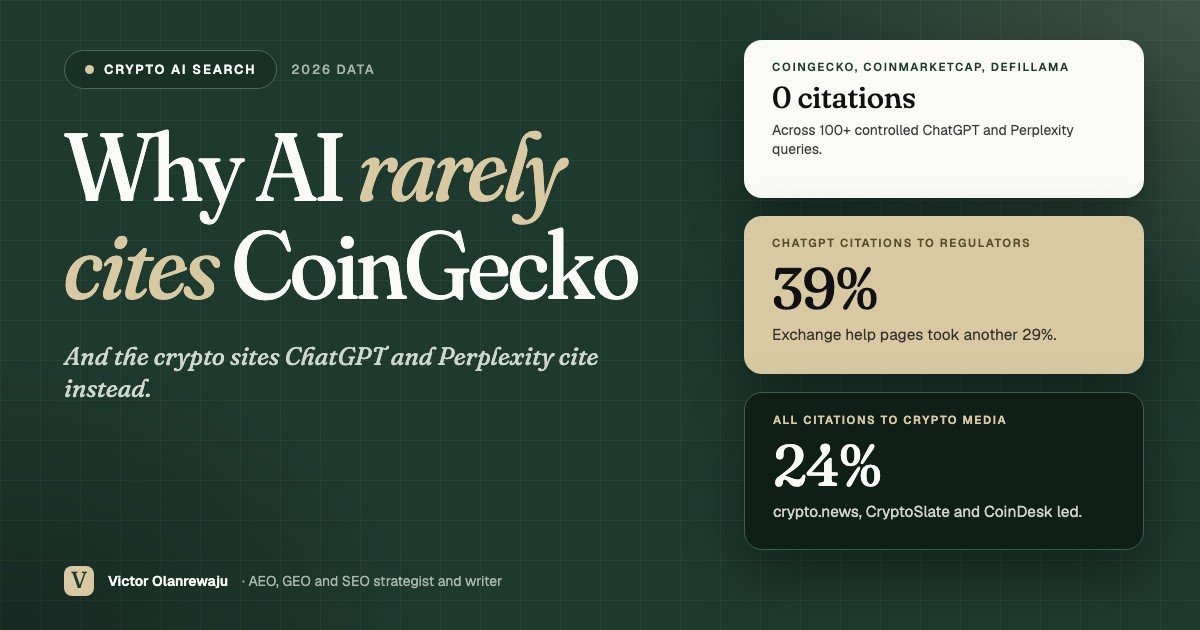
In short: In the best controlled test I found, ChatGPT and Perplexity cited CoinGecko, CoinMarketCap and DeFiLlama zero times across more than 100 query runs. That result covers the questions buyers ask most: best-of lists, breaking news, safety checks and community questions. It does not prove that AI ignores these sites for live price lookups, because nobody has tested that well. My own check also shows the cause is not what most crypto marketers say. CoinGecko allows search and AI answers in its robots.txt, and its Bitcoin page holds about 6,500 words of server-rendered text. The real cause is a mismatch between page type and question type. AI engines cite regulators, exchange help pages, roundups and trade press that answer the question as asked. So if you run a crypto brand, build those formats, earn mentions in the outlets AI actually cites and test your own queries before you pay for another listing.
0
citations for CoinGecko, CoinMarketCap and DeFiLlama in 100+ ChatGPT and Perplexity query runs (ICODA with Semrush, 2026)
39%
of ChatGPT’s citations went to regulators in ICODA’s four-engine study, with exchange help pages taking 29%
24%
of all 1,137 citations went to crypto media outlets, spread across 49 outlets
6,566
words in CoinGecko’s Bitcoin page HTML, so the page is not thin (my check, October 24, 2026)
A founder lists a token on CoinGecko. Next, they check CoinMarketCap. Then they relax. These are the biggest names in crypto data, so AI must trust them. Soon after, a buyer asks ChatGPT, “What is the best crypto exchange?” Neither site appears. Neither does the founder’s project.
That gap costs real money. The buyer picks a name from the answer, and your brand is not in it. This guide shows what the data says, where the evidence is weak and what to do about it. First, it tests the claim. Then it rules out three popular explanations with first-hand data. After that, it shows which crypto sites AI cites instead and what to build.
The reason is not the one most crypto marketers give. I checked. If you want the wider playbook first, read my guides to how to get cited by ChatGPT and crypto SEO.
Do AI engines really not cite CoinGecko?
For most buyer questions, yes. However, the evidence is thin, and one study disagrees. Here is what each source found and how much weight I give it.
| Study | Method | What it found | My weight |
|---|---|---|---|
| ICODA with Semrush (published August 10, 2026, updated October 12) | 100+ controlled query runs on ChatGPT and Perplexity, in clean sessions, across four question types | CoinGecko, CoinMarketCap and DeFiLlama “never appeared” | Highest. It is observed, not modeled. But the sample is small and an agency ran it. |
| ICODA media study (October 12, 2026) | 36 queries on ChatGPT, Perplexity, Claude and Gemini, giving 144 answers and 1,137 citations | Counted crypto media only, so it says little about data sites | Medium. It was not built to measure aggregators. |
| Everything PR citation share study (June 1, 2026) | “Directional modeling” of 28 brands, five engines and 62 prompts | Says CoinGecko and CoinMarketCap together supply “roughly a quarter” of crypto AI source citations | Low. The figures are modeled estimates, and the raw citations are not published. |
| Parse.gl AI visibility index (October 22, 2026) | 12,029 responses from ChatGPT Search and Google AI Mode in the “crypto analytics subscriptions” category | CoinGecko appeared in 1% of answers and ranked 34th in that category | Low to medium. The category is narrow, and it measures mentions, not citations. |
| 5W Retrieval Index, crypto (June 15, 2026) | Five engines across on-chain, price, regulatory, founder and news queries | Lists CoinGecko and CoinMarketCap among “other major sources” and gives Etherscan its top score | Low. These are index scores, not citation counts. |
The studies disagree because they measure different things. ICODA and Semrush tested four question types: “best X in 2026” roundups, breaking news, safety and legitimacy, and community-framed prompts. Those are the questions buyers ask before they choose a brand. They did not test live price lookups such as “Bitcoin price today.” That gap matters. For price and on-chain questions, engines may use data feeds or widgets instead of linking to a page, and no study I found measures that well.
Citations and mentions also differ. Semrush’s AI Visibility Index analyzed 126 million U.S. prompts between January and April 2026 and found that, on Gemini, the overlap between mentioned brands and cited domains can fall as low as 30%. On Google AI Overviews it was 64%. So a brand can shape an answer without earning a link, and the reverse is also true. For more on this, see AI citation versus AI recommendation.
3 popular explanations my check ruled out
Crypto marketers usually give three reasons. First, they say CoinGecko blocks AI crawlers. Second, they say its pages are too thin. Third, they say it lacks the right schema. I tested each one on October 24, 2026.
Is CoinGecko blocking AI crawlers? No.
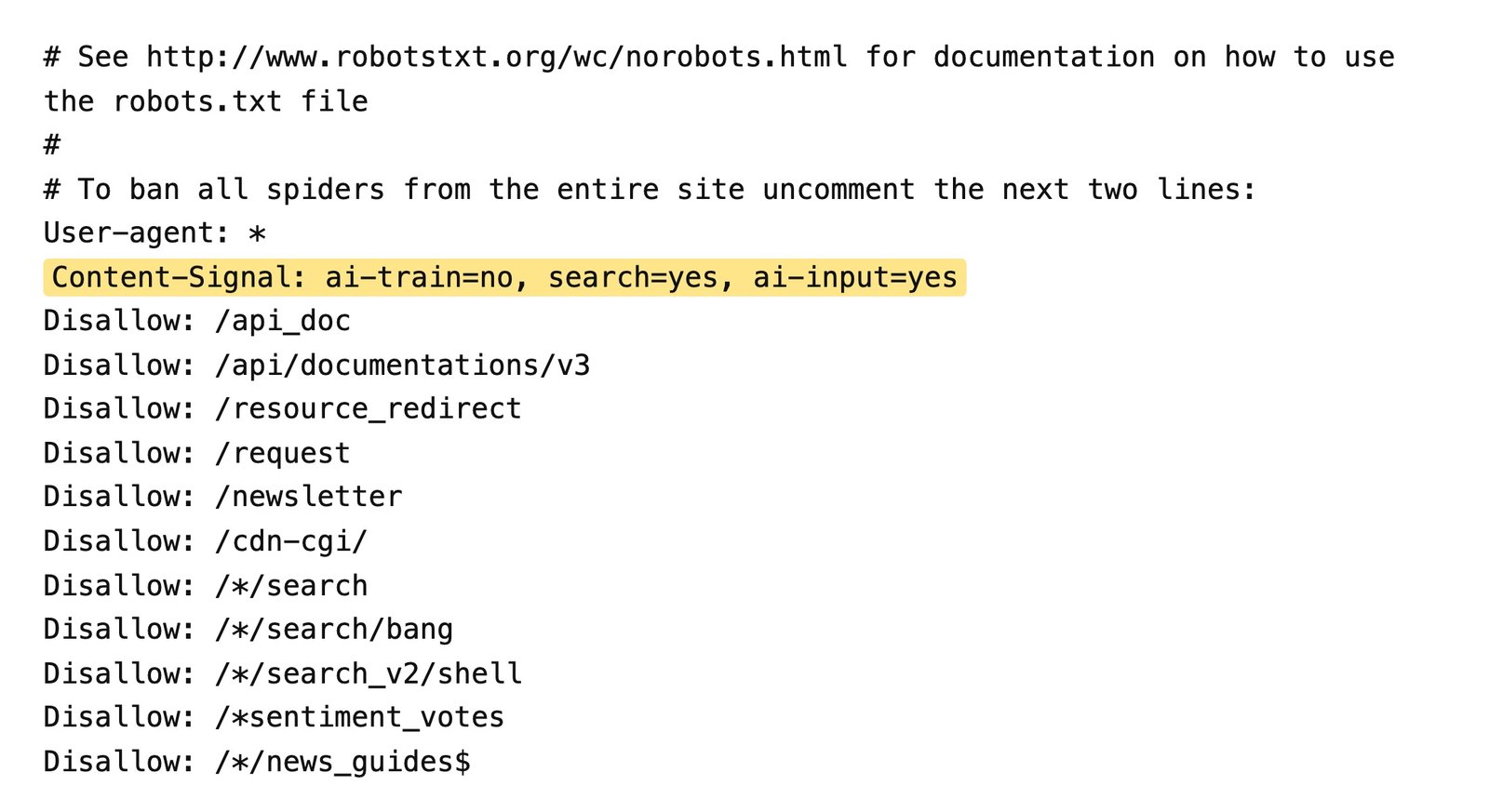
I read the robots.txt files of 12 crypto and finance sites, and seven appear in the table below. CoinGecko names no AI crawler at all. Instead, it publishes a Content-Signal line that reads ai-train=no, search=yes, ai-input=yes. Cloudflare created these signals. It defines search as building a search index, ai-input as using content to ground AI answers, and ai-train as training models. In plain terms, CoinGecko says no to training and yes to search and AI answers. CoinMarketCap publishes the same line.
Meanwhile, the sites that AI cites often block more. CoinDesk blocks GPTBot, ClaudeBot, PerplexityBot and nine other AI crawlers, yet it was the only outlet besides crypto.news that all four engines cited. This works because crawlers have different jobs. OpenAI states that each setting is independent: a site can allow OAI-SearchBot to appear in ChatGPT search while it disallows GPTBot for training. Also, Perplexity says its Perplexity-User fetcher generally ignores robots.txt. So robots.txt is a signal of preference, not a wall.
| Site | AI crawler rules in robots.txt (Oct 24, 2026) | Content signals | Citation evidence |
|---|---|---|---|
| CoinGecko | No AI crawler named; general rules only | ai-train=no, search=yes, ai-input=yes | Zero in ICODA with Semrush |
| CoinMarketCap | No AI crawler named; general rules only | ai-train=no, search=yes, ai-input=yes | Zero in ICODA with Semrush |
| DeFiLlama | Open; no AI crawler rules | None | Zero in ICODA with Semrush |
| CoinDesk | Blocks GPTBot, ClaudeBot, anthropic-ai, PerplexityBot, Google-Extended and seven more | None | Cited by all four engines, third overall (11.8) |
| Cointelegraph | No AI crawler named | None | Fifth overall (8.3) |
| The Block | Names eight AI crawlers with limited rules | search=yes, ai-input=yes, ai-train=yes | Sixth overall (6.9) |
| Investopedia | Blocks Claude and Perplexity crawlers; ChatGPT crawlers only barred from image thumbnails | None | Named among financial media cited |
Is the page too thin? No.
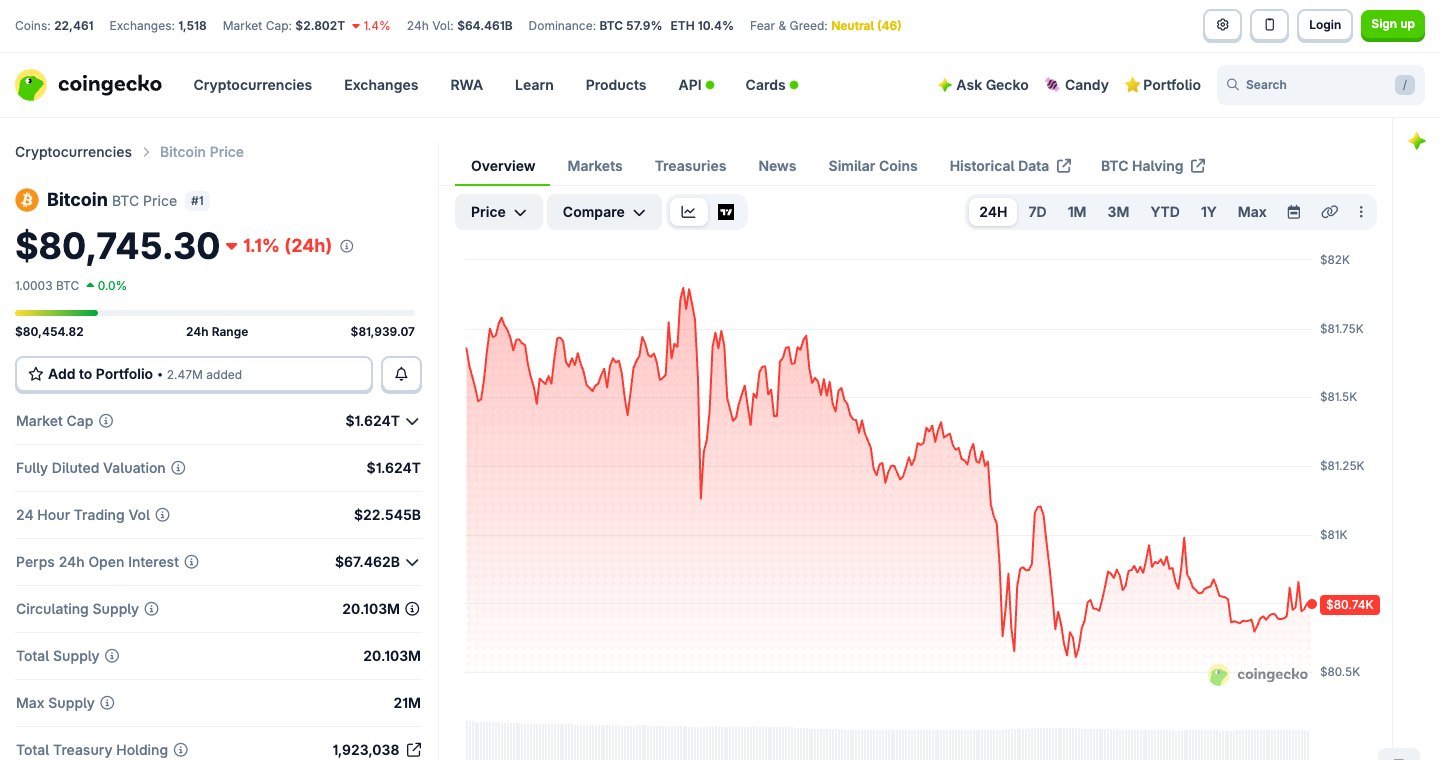
Next, I loaded eight pages in a real browser and counted what a crawler receives before any JavaScript runs. CoinGecko’s Bitcoin page delivers 6,566 words in its raw HTML. That is more than Investopedia’s Bitcoin explainer (3,343) and Coinbase’s (3,424). It has 18 H2 headings and 13 headings phrased as questions, and it includes a long “About Bitcoin” section in plain prose. So thin content does not explain the gap.
| Page | Words in raw HTML | H2 headings | Question headings | Named author | Schema types |
|---|---|---|---|---|---|
| CoinGecko, Bitcoin price | 6,566 | 18 | 13 | No | Product, ExchangeRateSpecification, BreadcrumbList |
| CoinMarketCap, Bitcoin price | 3,927 | 8 | 13 | No | FAQPage, BreadcrumbList |
| DeFiLlama, Aave protocol | 3,577 | 11 | 1 | No | Dataset, FAQPage |
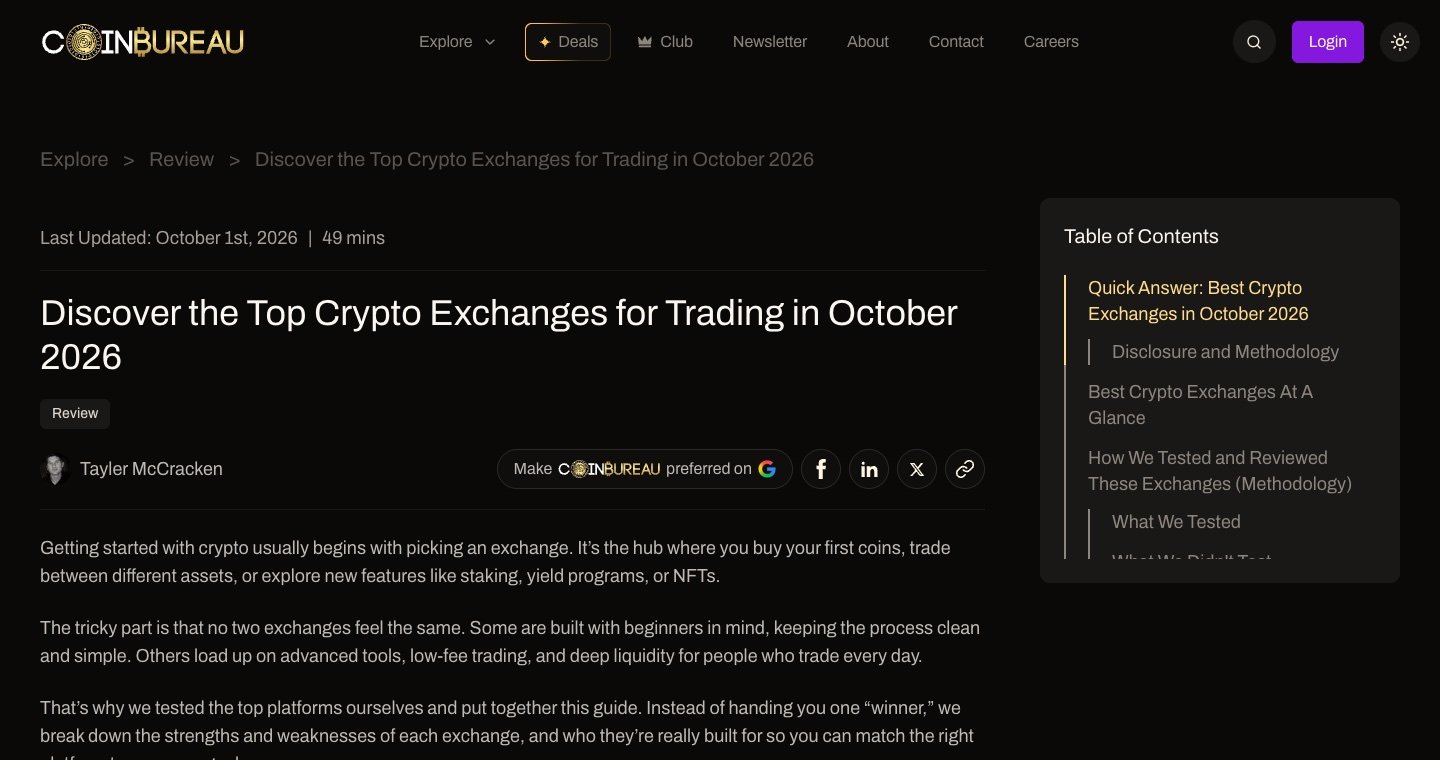
| Coin Bureau, best exchanges | 7,954 | 20 | 1 | Yes | Article, FAQPage, WebSite, Organization |
| Investopedia, What is Bitcoin | 3,343 | 14 | 5 | Yes | Article |
| Coinbase Learn, What is Bitcoin | 3,424 | 12 | 4 | No | Article, Organization |
| Binance Academy, What is Bitcoin | Challenge page only (2,105 bytes); 2,449 after JavaScript | 13 | 9 | No | Article, WebPage, Organization |
| Wikipedia, Bitcoin | 12,569 | 9 | 0 | Not applicable | Article |
One caution applies. Binance Academy returned a short challenge page to my browser, and the article text appeared only after JavaScript ran. That is one request from one machine, and real AI crawlers may be treated differently. Still, it shows why you should check what a non-rendering crawler sees. My guide to AI crawlers and robots.txt explains how.
Is the schema missing? No.
CoinMarketCap’s Bitcoin page carries FAQPage schema, and the ICODA test still found no citations for the site. CoinGecko has no FAQPage markup, but it does have 13 question-style headings. In other words, schema did not decide the outcome. Google says the same. Its documentation states that there is no special schema.org structured data to add for AI Overviews or AI Mode. Schema still helps machines read a page, as I explain in schema markup for AEO and GEO. It just does not buy a citation.
Why AI engines skip CoinGecko: 4 reasons that fit the data
With the three myths out of the way, four reasons remain. The first comes straight from ICODA and Semrush, who conclude that engines match content structure to query intent. I label the other three as my reading of the evidence.
- The page answers a different question. CoinGecko’s title reads “Bitcoin Price: BTC/USD Live Price Chart, Market Cap & News Today.” That fits a price search. It does not fit “best exchange,” “is it safe” or “latest news.” In contrast, Coin Bureau’s exchange page opens with a section called “Quick Answer: Best Crypto Exchanges in October 2026,” then shows a methodology, a named author and an update date.
- Live numbers do not make quotable answers. A price changes every second, so a quoted figure goes stale at once. An AI answer needs a claim that stays true. (My reading.)
- Data pages carry no verdict. A roundup says “Best for beginners: Coinbase.” That sentence is ready to quote. A table of market data leaves the engine to reason it out. (My reading.)
- Query fan-out lands on roundups. Google says AI Overviews and AI Mode may issue multiple related searches across subtopics. When the searches read “best crypto exchanges 2026,” the results are roundups, not price pages. (My reading, built on Google’s description.)
Brand strength does not fix this. A 2026 roundup of citation datasets by 5W reports that brand search volume is the strongest known predictor of AI citation, with a 0.334 correlation. Yet CoinGecko, one of the best-known names in crypto, earned no citations in the controlled test. A prediction across thousands of brands can still miss a single page type. For more on why ranking and citation diverge, see why Google rankings do not match ChatGPT mentions.
Which crypto sites do AI engines cite instead?
Seven source types keep appearing. Which one wins depends on the question, and on the engine.
| Source type | Examples | Evidence | Wins on |
|---|---|---|---|
| Regulators and primary documents | SEC, ESMA, investor.gov; issuer pages from Circle and Tether | 39% of ChatGPT’s citations in ICODA’s media study; primary sources on stablecoin safety queries | Safety and regulation |
| Exchange help and learn pages | Coinbase, Robinhood | 29% of ChatGPT’s citations | How-to and safety |
| Roundup and review publishers | Coin Bureau, Strategy Arena, Datawallet | Cited by ChatGPT and Perplexity on “best X” queries | Recommendations |
| Crypto trade press | crypto.news, CryptoSlate, CoinDesk, Cointelegraph, The Block | 24% of all citations across 49 outlets | News and explainers |
| Mainstream finance and reference | Investopedia, Reuters, Yahoo Finance, Wikipedia, NerdWallet | Investopedia, Reuters and Yahoo Finance were cited in ICODA and Semrush’s test; Wikipedia holds 47.9% of ChatGPT’s top-10 source share and NerdWallet is a finance leader (5W) | Definitions and comparisons |
| Communities and video | Reddit, YouTube | Reddit cited when a prompt names it (ICODA); YouTube leads finance citations at about 23% (5W) | Community and how-to |
| On-chain explorers | Etherscan | Top score (90) in 5W’s crypto index, which is an index grade, not a citation count | On-chain data |
Crypto media outlets AI engines cited most, by ICODA’s citation score (%)
Three details stand out. First, the outlets differ by engine. Crypto media made up 34% of Claude’s citations, 24% of Perplexity’s and 23% of Gemini’s, but only 11% of ChatGPT’s. Second, size does not guarantee citations. Decrypt, Blockworks and BeInCrypto earned none in 144 answers. Third, page type matters. Of 158 URLs from the top 15 outlets, news and analysis articles made up 37%, homepages and section pages 22%, best-of and review pages 20%, press-release pages 4% and learn or guide pages only 2%.
Share of each engine’s citations that went to crypto media outlets (%)
The engines also disagree with each other. 5W’s 2026 roundup of 680 million citations estimates that only 11% of domains are cited by both ChatGPT and Perplexity. Semrush found that ChatGPT averages 15.4 sources per response, while Gemini averages 3.3. As a result, one engine’s result tells you little about another’s. Ahrefs’ earlier study of 76.7 million AI Overviews and about 957,000 ChatGPT prompts showed the same split: Wikipedia led ChatGPT at 16.3%, while YouTube led Perplexity at 16.1%.
What CoinGecko does instead: it serves AI agents directly
CoinGecko is not ignoring AI. It is taking a different route. Its documentation offers an MCP server that gives agents live prices, market data and onchain analytics. A keyless free endpoint exists, and the docs list support for Claude, Cursor and Windsurf. In addition, docs.coingecko.com publishes an llms.txt file. By contrast, coingecko.com itself returns a 404 for /llms.txt, while CoinMarketCap, CoinDesk and The Block each publish one.
My reading is that CoinGecko may gain more by being the data an agent calls than by being a page an answer cites. That is a hypothesis, not a finding. Also, do not copy the llms.txt move and expect citations. Google states you do not need new machine-readable files or AI text files to appear in its AI features, and I found no evidence that llms.txt lifts citations. My llms.txt guide covers the honest view.
What this means for crypto projects, exchanges and publishers
The lesson is simple. Match each question type with the format that wins it. Then earn mentions where AI already looks.
| If buyers ask… | Build or earn this | Why |
|---|---|---|
| “Best crypto [exchange, wallet, token] in 2026” | A place in roundups from Coin Bureau-style publishers, plus your own comparison with a methodology and a named author | Roundups were the sources cited on the recommendation queries ICODA showed |
| “Is [project] safe or legit?” | A primary-source page with audits, licenses, proof of reserves and regulator filings, kept current | ChatGPT cited Circle and Tether directly on stablecoin safety questions |
| “Latest news about [project]” | Coverage in the outlets each engine favors, not only the biggest ones | Citations on news queries had zero overlap between engines |
| “What is [project] and how does it work?” | Answer-first explainers on your own domain and help-center pages | Exchange help pages took 29% of ChatGPT’s citations |
| “[Token] price today” | Keep your listings and feed data through APIs | No study shows page citations decide price answers |
Then follow seven steps. Keep each one short and measurable.
- Map 20 buyer questions. Sort them into recommendation, news, safety and community types.
- Test who gets cited today. Run each question at least three times on two engines. Record every cited domain.
- Fix your own pages first. Lead with the answer. Add a named author, an update date and a method. My crypto SEO guide shows how Google’s finance standards shape this.
- Earn mentions where AI looks. Pitch the outlets that appear in your test results. A press release alone rarely works: sponsored and release pages were only 4% of cited URLs.
- Keep facts consistent. Match your name, category and key facts across your site, docs, GitHub and listings.
- Set crawler rules by bot. Allow search crawlers. Decide on training bots separately, using the robots.txt guide.
- Re-test every month. Answers change fast. SparkToro and Gumshoe.ai found the same brand list in under 1% of repeated runs, so track how often you appear, not your position. See how to check what ChatGPT says about your business.
Measured results come from this kind of work. For example, LAGE Lightings moved from seventh to first in ChatGPT in about three months, and Lens & Co was listed first in 5 of 6 ChatGPT answers about two weeks after its content went live. Those are not crypto cases, and two cases are not a forecast. Still, they show the method works when you fix the right pages.
If you run a data site: how to become citable
Data sites are not stuck. They can add what AI engines reward without losing what makes them useful. Start with five changes.
- Add a verdict layer. Publish short, dated summaries above the numbers, such as “Bitcoin fell 1.1% in 24 hours as trading volume reached $22.5 billion.” Keep them factual.
- Show who stands behind the page. Add a named editor, a method note and an update date to data pages.
- Turn your own data into roundups. For example, publish “Top exchanges by verified volume” with a clear method. You hold the data, so you can win “best X” queries on proof.
- Publish original research. Studies with numbers and dates give engines something to quote. See my B2B playbook for the pattern.
- Keep the API and MCP route. Agents will still call your data directly, so do not trade that for citations.
This list is my recommendation, not a proven result. No study I found has tested it on a data site, so treat it as a test to run and measure.
Should you still list on CoinGecko and CoinMarketCap?
Yes. Listings still drive discovery, data distribution and trust with traders. However, do not treat a listing as an AI visibility plan. In the controlled test, the aggregators earned nothing, and the sources that won were pages built for the question. Think of your listing as a data profile and your content as the citation asset.
How to test your own crypto brand in 1 afternoon
You can run a small version of the ICODA test yourself. Use the four question types and repeat each run.
| Question type | Prompt to run | What to record |
|---|---|---|
| Recommendation | “Best [category] in [country] in 2026” | Is your brand named? Which domains are cited? |
| News | “Latest news about [your project]” | Which outlets appear, and are they current? |
| Safety | “Is [your project] safe?” | Are the facts right, and do cited sources include your own? |
| Community | “What do people on Reddit say about [your project]?” | Is the tone accurate, and which threads are cited? |
Run each prompt three times on ChatGPT and Perplexity, then compare the lists. Count your appearances and the share of citations you win. If you would rather have me run it, I include this check in a free AI visibility audit. See the pricing page or tell me what you want to be found for. To see the method on another market, read my Kigali AI answers research.
How I checked, and where the evidence is weak
I ran two checks myself on October 24, 2026. First, I fetched the robots.txt files of 13 sites, read the 12 that loaded and noted the named crawler rules and content signals. Second, I loaded eight pages in headless Chrome and counted raw-HTML words, headings, question-style headings, author markup and JSON-LD types. The author check is a rough test for author markup or a byline. I also checked /llms.txt and /llms-full.txt on eight domains. Everything else comes from the studies linked below, which I read in full where they were public.
Several limits apply. ICODA’s studies are small, and a marketing agency that sells related services ran them. The media study ran through an API with web search forced on, which can differ from the consumer apps. The tests cover ChatGPT and Perplexity most, with thinner coverage of Gemini, Claude and Google’s AI Overviews. Citations change by week and by session. Finally, no study I found tests live price queries. Treat the numbers as a strong signal, not a census.
Related reading on this site: AI search statistics for 2026, SEO, AEO and GEO explained and the 8 best AI visibility tools for agencies and freelancers. If you want crypto and AI search work done for you, see my pages on AEO and GEO.
Frequently asked questions
Does ChatGPT cite CoinGecko?
Rarely, and in the best controlled test I found, never. ICODA and Semrush ran more than 100 query runs on ChatGPT and Perplexity across best-of, news, safety and community questions and found no CoinGecko citations. Nobody has tested live price queries well, so the picture there is unknown.
Does Perplexity cite CoinMarketCap?
Not in the same controlled test. CoinMarketCap, like CoinGecko and DeFiLlama, never appeared across the four question types. Perplexity instead cited roundups such as Coin Bureau and Strategy Arena, plus trade press like The Block.
Which crypto sites does ChatGPT cite most?
In ICODA’s four-engine study, regulators such as the SEC, ESMA and investor.gov made up 39% of ChatGPT’s citations and exchange help pages 29%. Crypto media took only 11%. On “best X” queries it cited roundups such as Coin Bureau.
Which crypto news sites do AI engines cite most?
ICODA’s October 2026 study ranked crypto.news (13.9), CryptoSlate (12.5) and CoinDesk (11.8) highest. Only crypto.news and CoinDesk were cited by all four engines. Decrypt, Blockworks and BeInCrypto were cited in none of 144 answers.
Do I need a CoinGecko or CoinMarketCap listing to appear in AI answers?
No evidence says you do. The controlled test found the aggregators earned no citations, while roundups, regulators and trade press did. Keep your listings for data and trust, but build answer-first pages and earn mentions where AI actually cites.
Does blocking AI crawlers stop citations?
Not always. CoinDesk blocks GPTBot, ClaudeBot and PerplexityBot in robots.txt, yet all four engines cited it. Crawlers have separate jobs, and OpenAI says each setting is independent. Robots.txt expresses a preference and is not a technical wall.
Does schema or llms.txt make AI cite my crypto site?
There is no proof. CoinMarketCap carries FAQPage schema and still earned no citations in the test. Google says no special schema or AI text file is needed for its AI features. Schema and llms.txt can help machines read a site, but they do not buy citations.
How do I get my crypto project cited by ChatGPT?
Match the format to the question. Publish a primary-source safety page, an answer-first explainer and a comparison with a method and named author. Then earn coverage in the outlets that appear in your own tests. Repeat each test three times, because answers change.
Do press releases help AI visibility?
Only a little on their own. In ICODA’s data, press-release and sponsored pages were 4% of cited URLs from the top 15 outlets, while news and analysis articles were 37%. Plan for editorial coverage and your own pages as well.
Why do ChatGPT and Perplexity cite different sites?
They retrieve and rank differently. 5W estimates only 11% of domains are cited by both. ICODA found zero overlap on breaking-news and safety queries, and Semrush found ChatGPT averages 15.4 sources per response against 3.3 for Gemini. Test each engine separately.
How reliable are these studies?
Treat them as signals. ICODA’s samples are small, an agency that sells related services ran them, and one study used an API with forced web search. The Everything PR figures are modeled estimates. I flag each limit in the article and ran my own robots.txt and page checks.
Can you test whether AI cites my crypto brand?
Yes. I run the four question types across ChatGPT and Perplexity, repeat each run, and report which domains are cited and where your brand is missing. It is part of my free AI visibility audit.