In this article
- Why is crypto SEO so competitive?
- What kinds of crypto searches exist, and what does each need?
- Why does Google treat crypto content as high-stakes?
- How should you write a price prediction responsibly?
- How do you show who wrote it and why they know?
- Why does original analysis and data beat summaries?
- How should you structure a crypto site?
- How do you keep fast-moving pages fresh?
- How do you do on-page SEO for crypto?
- How do you earn links without buying them?
- What about AI search for crypto brands?
- How do you measure leads, not just rankings?
- What mistakes do crypto sites make most often?
- A practical 90-day plan
- What does an ethics and compliance checklist look like?
- Which tools do I use?
- Sources
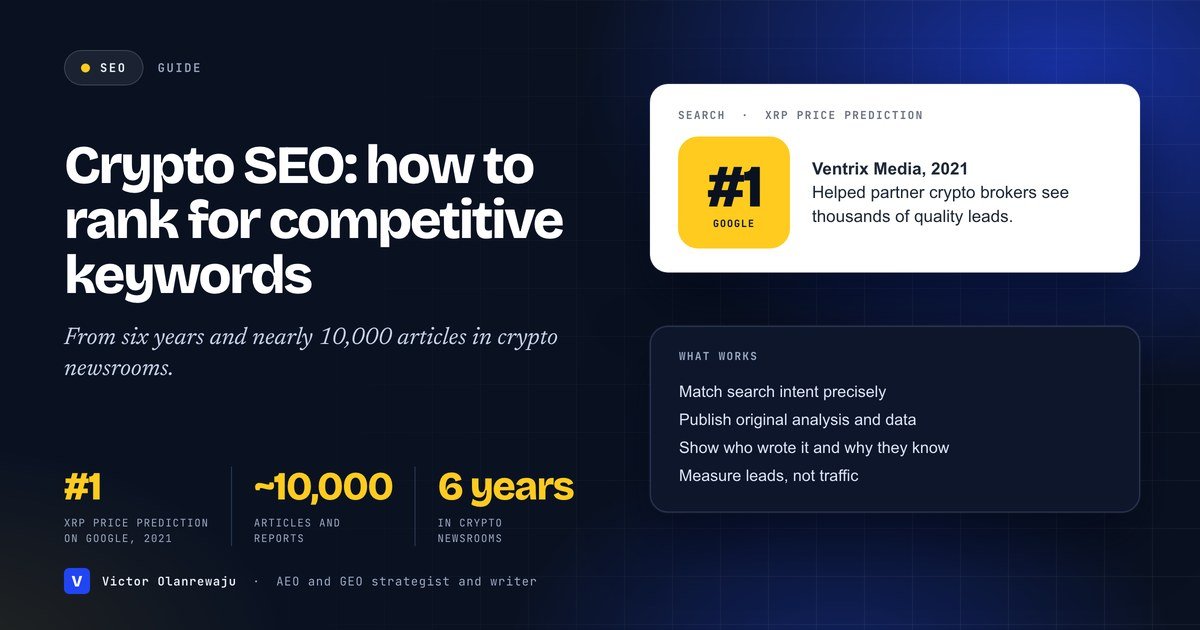
In short: Crypto SEO is hard because every publisher chases the same queries, and because Google holds finance content to a higher standard of accuracy and trust. What works is matching search intent precisely, publishing original analysis and data, showing who wrote each page and why they know, earning links through useful research, keeping fast-moving pages fresh, getting the technical basics right and measuring leads instead of traffic. I used this approach to take “XRP price prediction” to number one on Google in 2021 at Ventrix Media, where it helped partner crypto brokers see thousands of quality leads, and I have applied it across nearly 10,000 articles and reports since.
I have written for CCN, BeInCrypto, AMBCrypto, Benzinga, Coin Edition and, earlier, for Web3 brands and brokers at Ventrix Media. Along the way I published nearly 10,000 articles and reports, including 100 data-driven market and macro reports a month at CCN. This guide distils what that volume taught me into a practical approach for ranking in crypto and finance. I link Google’s own documentation wherever a point rests on what Google says, and I mark what is my experience. If you are comparing this with the AI-search side of the work, see SEO, AEO and GEO explained.
Why is crypto SEO so competitive?
A small number of queries carry enormous commercial value: price predictions, “is it a good investment”, “best exchange”, “how to buy”. They attract exchanges, media outlets, affiliates and aggregators at once. Competing on volume fails because everyone has volume. In 2021, during the bull run, “XRP price prediction” was one of the most contested searches in crypto. At Ventrix Media I took the top spot with on-page SEO, link building and content that answered the question properly, and the ranking helped partner crypto brokers see thousands of quality leads. The lesson I took from it is that in a crowded query the winner is rarely the page with the most words. It is the page that serves the intent most precisely, from a source the reader and the search engine both trust.
What kinds of crypto searches exist, and what does each need?
The same coin attracts very different searches, and a generic “coin page” tries to serve all of them and serves none. Map your queries to intent first.
| Intent | Example queries | What the page must do | Freshness need |
|---|---|---|---|
| Forecast | “XRP price prediction”, “ethereum price forecast” | Give a dated view, a stated method, scenarios and honest uncertainty | High: update on a schedule |
| News and events | “SEC XRP ruling”, “token unlock today” | Be fast, sourced and clear about what happened | Very high: decays in hours or days |
| Explainers | “what is a token unlock”, “how does staking work” | Give a complete, plain-English answer with examples | Medium: refresh when facts change |
| Comparison | “best crypto exchange for beginners” | State criteria openly and disclose commercial relationships | Medium to high |
| How-to | “how to buy bitcoin in Nigeria” | Step-by-step, accurate for the country, with risk context | Medium |
| Research | “MANTRA OM token collapse analysis” | Offer original data and interpretation nobody else has | Varies: durable if original |
Before you write, open the results for the query and ask what the top pages have in common, and what is missing. That gap is your page. This is also how I decide whether a topic deserves a new page or an update to an existing one.
Why does Google treat crypto content as high-stakes?
Google’s guidance on helpful, reliable, people-first content says its systems identify a mix of factors that can help determine which content demonstrates experience, expertise, authoritativeness and trustworthiness, which it calls E-E-A-T, and that of these aspects trust is most important. It adds that E-E-A-T itself is not a specific ranking factor, but that its systems give even more weight to content that aligns with strong E-E-A-T for topics that could significantly impact the health, financial stability or safety of people. It calls these Your Money or Your Life topics, and says that for such topics the content must be highly accurate and consistent with established expert consensus.
Crypto and finance sit in that territory whenever a reader might act on what you wrote. That has practical consequences:
- Source every figure and date every data point. “Bitcoin is up” is not a fact. “Bitcoin closed at X on this date, according to this source” is.
- Label opinion as opinion. Predictions and analysis are your reasoning, not certainty, and should say so plainly.
- Include risk context where a reader could lose money, in a form a real person will actually read.
- Correct errors visibly and keep a policy for it.
- Disclose commercial relationships where they exist, such as affiliate links or sponsorships.
Regulation of financial promotions varies by country and I am not offering legal advice, so check the rules where your audience lives.
How should you write a price prediction responsibly?
Price-prediction pages are among the most searched and most abused pages in crypto. Here is how I approach them, from experience:
- State the method. Say what the forecast rests on: technical levels, on-chain trends, supply events, macro conditions. If you cannot explain the method, you do not have a forecast.
- Show scenarios, not a single number. A base, bullish and bearish case with the conditions that would trigger each is more honest and more useful.
- Date everything and show when the page was last updated.
- Explain what would change your mind. A forecast with invalidation conditions is analysis. One without is marketing.
- Name the author and link to their background.
- Add the risk language a careful reader would expect.
How do you show who wrote it and why they know?
Google’s “Who, How and Why” framework in the same guidance asks whether it is self-evident who authored your content, whether pages carry a byline where one would be expected, and whether bylines lead to further information about the author. It strongly encourages accurate authorship information, and warns that fabricating creator profiles, such as AI-generated headshots, made-up names or false credentials, is deception that makes a page untrustworthy to users and to automated quality systems. For a crypto publisher that means real names, real bios, links to published work and, where relevant, credentials. My own profile is on my about page, and each of my articles is structured the same way.
Why does original analysis and data beat summaries?
When every outlet summarises the same news, the page with something new wins. Google’s list of content quality questions asks whether the content provides original information, reporting, research or analysis, whether it offers a substantial, complete description of the topic, whether it provides insight beyond the obvious, and, if it draws on other sources, whether it avoids simply copying or rewriting them and provides substantial additional value. It also asks whether the content provides substantial value compared with other pages in search results.
For crypto, original means data and interpretation. The sources I rely on most are on-chain analytics (Glassnode, CryptoQuant, IntoTheBlock and Santiment), market data (TradingView and CoinGecko) and macro context. The workflow is: choose a question readers are asking, pull the data that answers it, say what it means and what it does not, and show your working.
Two examples from my own work. At CCN, my coverage of the MANTRA (OM) collapse held the number one position on Google for several months and was cited by AI models, and it was built on on-chain, technical and macro research. At AMBCrypto, one market research piece on Shiba Inu reached 250,000 pageviews within five days. Both were crowded topics where the research-backed angle is what set the piece apart.
How should you structure a crypto site?
- Hub and spoke. A hub page per major asset or theme (for example, an XRP hub), with spokes for forecasts, news, explainers and research that link back to it and to each other.
- One page per intent. Do not let two pages compete for the same query. If two overlap, make one the main answer and link the other to it, the same principle behind the Lens & Co case study.
- A glossary and “how-to” layer that captures beginner queries and feeds internal links.
- Evergreen versus news. Keep news in a section that can age gracefully, and keep evergreen pages updated in place.
- Be careful with programmatic pages. Auto-generated coin pages are tempting. Google’s spam policy on scaled content abuse lists using generative AI tools to generate many pages without adding value for users, scraping feeds or search results to generate many pages, and stitching or combining content from different web pages without adding value. A programmatic page is acceptable only if each one gives a reader something they could not get elsewhere.
How do you keep fast-moving pages fresh?
A price prediction published months ago and never updated invites readers to leave and assistants to repeat stale numbers. Build a refresh routine:
- Tag every forecast and data-heavy page with a review interval, such as monthly for forecasts and quarterly for explainers.
- Update the numbers and the analysis in place, keep the URL, and change the visible “last updated” date only when the content really changed.
- Add a short “what changed” note so returning readers see the difference.
- Retire pages that no longer serve a purpose, or merge them into a stronger page with a redirect.
Daily news is different: speed and sourcing matter most, and the page’s value decays fast. Publish it, link to the evergreen explainer, and move on. At CCN I produced 100 data-driven reports a month, and that cadence only works with a disciplined process, which I describe in how I use AI without losing quality control.
How do you do on-page SEO for crypto?
- Title and H1. Put the primary query in a descriptive, non-sensational heading. Google’s guidance asks whether the main heading provides a descriptive, helpful summary and avoids exaggerating or shocking.
- Meta description. Write a unique one per page. Google’s guidance on meta descriptions says identical descriptions across a site are not helpful and that keyword strings are less likely to be shown. For articles it suggests the description can include the author and publication date.
- Answer first. Put a direct answer near the top, then the detail. It helps readers, snippets and AI summaries.
- Structure. Use clear H2s, short paragraphs and tables where data is compared.
- Internal links from related pages, with descriptive anchor text.
- Structured data for the article, author and organization, matching what is visible. See schema markup for AI search.
- Page experience. Fast, stable, readable on mobile. Many crypto readers are on phones and variable networks.
How do you earn links without buying them?
Links still matter, and the safe way to earn them is to publish things people want to reference: original research, datasets, clear explainers and expert commentary, promoted through digital PR to journalists, analysts and communities who cover the topic. Google’s spam policies define link spam as creating links to or from a site primarily for the purpose of manipulating search rankings, and list examples including buying or selling links for ranking purposes, exchanging money for links or posts that contain links, exchanging goods or services for links, and sending someone a product in exchange for writing about it and including a link. In a competitive niche a penalty is costly and slow to recover from, so the shortcut is not worth it.
What works, in my experience:
- Be the source. Publish a dataset or analysis that others cite.
- Be quotable. Give journalists specific, sourced findings.
- Build relationships with analysts and editors who cover your beat.
- Fix broken mentions. When someone cites you without a link, ask politely.
What about AI search for crypto brands?
Buyers increasingly ask assistants about exchanges, tokens and wallets. Three implications. First, being cited requires the same foundations as ranking, plus access for the AI search crawlers: see the AI crawlers guide. Second, assistants can repeat outdated numbers, so dated pages and a refresh routine matter more. Third, trust signals carry extra weight in finance: named authors, sourcing, accuracy. For the practical method, read how to get cited by ChatGPT, and check the numbers behind the shift in AI search statistics for 2026.
How do you measure leads, not just rankings?
A number one ranking is a means. What matters is the lead that comes from it. For the XRP ranking at Ventrix Media, success was measured in the quality leads partner brokers received, not in the position. Set up measurement before you publish:
- Define the conversion: sign-up, account open, enquiry, partner lead, newsletter subscription.
- Tag pages by intent and by commercial value so you can see which pages feed the pipeline.
- Use Search Console for queries, clicks and positions, and your analytics and CRM for conversions.
- Review monthly and move effort to the pages and queries that produce leads.
What mistakes do crypto sites make most often?
- Unsourced predictions and unexplained numbers.
- Thin, auto-generated coin pages at scale.
- Affiliate-heavy “best of” lists without transparent criteria or disclosure.
- Anonymous or invented authors.
- Letting forecasts go stale.
- Chasing every trending token instead of building depth on a defined beat. Google’s guidance lists writing about things simply because they seem trending, and not because you would write about them otherwise, as a warning sign.
- Measuring traffic only.
A practical 90-day plan
- Days 1 to 15: audit crawl, indexing, speed and your top 20 pages; list the ten queries that bring leads; classify each by intent.
- Days 16 to 45: rebuild the three most valuable pages around intent, add sourcing, bylines, risk context and dates.
- Days 46 to 75: publish one piece of original research and promote it for links.
- Days 76 to 90: measure leads by page, refresh what moved, and test what assistants say about you using this 30-minute check.
If you want help, see my SEO strategist page and services.
What does an ethics and compliance checklist look like?
This is a practical editorial checklist I use for finance and crypto content. It is not legal advice, and rules differ by jurisdiction.
- No promises of returns. Never imply certainty about price outcomes.
- Disclose interests. If the author or publisher holds the asset discussed, or earns from a link, say so.
- Separate news from opinion and label each.
- Keep risk language visible, near the claim it qualifies.
- Cite sources for every figure and date it.
- Publish a corrections policy and apply it.
- Check local rules for financial promotions where your audience lives.
- Label sponsored content clearly.
Which tools do I use?
The toolkit I use for crypto research and SEO work is deliberately conventional: TradingView for charts, Glassnode, CryptoQuant, IntoTheBlock and Santiment for on-chain analytics, CoinGecko for market data, Google Analytics and Search Console for performance, Ahrefs and Semrush for keyword and competitor research, WordPress for publishing, and Claude, ChatGPT and Notion AI for research and workflow support, always with human verification. The tools matter less than the process around them, which I describe in how I use AI without losing quality control.
Sources
Frequently asked questions
How do you rank for competitive crypto keywords?
Match the search intent precisely, publish original analysis and data, show who wrote each page and why they are qualified, earn links through useful research, keep fast-moving pages fresh, and get the technical basics right. Treat the topic as trust-critical, because Google applies higher standards to finance content.
Is crypto content a YMYL topic for Google?
Google says its systems give more weight to strong E-E-A-T for topics that could significantly impact health, financial stability or safety, which it calls Your Money or Your Life. Crypto and finance content that readers may act on belongs in that territory, so accuracy and trust matter.
How do you write a price prediction that ranks and is responsible?
State the method, give scenarios instead of a single number, date the page, explain what would change your view, name the author and add risk context. Update it on a schedule.
Can AI-generated content rank in crypto?
Google's spam policy on scaled content abuse targets generating many pages to manipulate rankings without helping users, however they are produced. AI can speed up research and drafts, but each page needs original value and a named human who verified the claims.
Do you guarantee a number one ranking?
No. Nobody outside Google controls rankings. I set a baseline, do the work that moves the signals and report honestly every month.