In this article
- Why are B2B software buyers moving from Google to AI assistants?
- What are SEO, AEO and GEO, and how do they differ?
- How do the 3 work together? The search visibility stack
- Layer 1, SEO: what should a B2B SaaS team audit first?
- Layer 2, AEO: how do you write pages an AI can quote?
- Layer 3, GEO: how do you earn AI recommendations?
- Layer 4, conversion trust: what happens after the recommendation?
- How does the 2026 buying journey map to the stack?
- Where does your company sit? The AI search maturity model
- How do you test what AI says about your software? A 12-prompt panel
- What should you fix first? A symptom-to-fix table
- Which KPIs should you track?
- What does a 90-day implementation plan look like?
- How does it compound? The visibility flywheel
- What do the numbers not tell you?
In short: B2B software buyers increasingly build their shortlist with an AI assistant before they visit a vendor’s site, and Google increasingly answers without sending a click. SEO gets you found, AEO makes you the answer, GEO gets you recommended, and conversion trust turns that into pipeline. They are layers, not rivals. Google says its AI features use the same index and need no special optimization, but a ranking alone does not get you named. This playbook gives you the four-layer stack, a maturity model, page templates, a 12-prompt test, a fix-by-symptom table, KPIs and a 90-day plan, with sources and limits throughout. Last reviewed October 15, 2026.
51%
of B2B software buyers start research with an AI chatbot more often than Google (G2, March 2026)
69%
chose a different vendor than they planned after chatbot advice (G2)
68.01%
of US Google searches ended without a click, Jan to Apr 2026 (SparkToro)
94%
of business buyers use AI in their purchasing process, up from 89% (Forrester)
Most B2B marketing teams still report on the same three numbers: rankings, organic traffic and click-through rate. Those numbers describe one door into your business. Your buyers are increasingly using another one, and it does not send a click when it opens. This guide is for SaaS founders, heads of marketing and SEO leads who need to decide what to do about it. It explains what SEO, AEO and GEO each do, how they fit together, where to start, what to measure and how to test what AI says about your product today. Figures are as of October 2026, and every study is labeled with its date, sample and limits. For the definitions in depth, see my guide to how SEO, AEO and GEO differ. This article is about putting them to work in B2B software.
Why are B2B software buyers moving from Google to AI assistants?
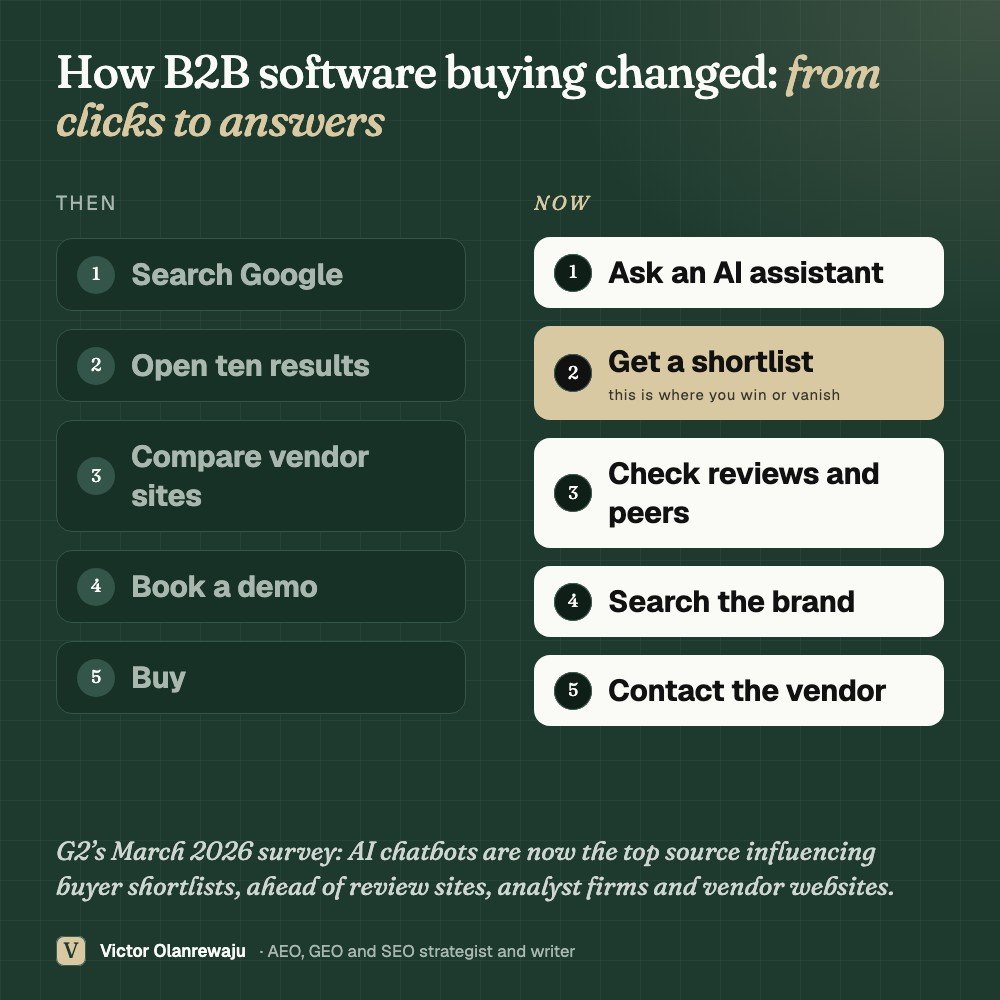
Because an assistant does the research for them. Instead of opening ten tabs, a buyer asks one question with the whole context in it: the company size, the integrations, the budget. The assistant returns a shortlist. Four independent sources show how far that has gone.
- G2, April 2026. Its survey of 1,076 software buyers (chart below) concludes that AI chatbots are now the top source influencing shortlists, ahead of review sites, analyst firms and vendor websites, and that 41% use deep research tools for structured evaluations. See G2’s research.
- Forrester, January 2026. Twice as many buyers named generative AI or conversational search as a more meaningful source than any other source, and Forrester advises vendors to move from SEO-led plans toward answer engine optimization. See Forrester.
- SparkToro, June 2026. The no-click rate was 60.45% in 2024. AI Overviews appeared on more than 20% of searches and cut click-through by nearly 60% when present. See SparkToro.
- Ahrefs, October 2026. Google AI Overviews appeared on 82.91% of US desktop searches for brand names as of September 29, 2026, up from a 61.3% monthly average in July. Buyers researching your brand often see an AI summary before your own site. See Ahrefs.
How software buyers use AI chatbots (% of buyers surveyed)
One thing to take from the chart: a buyer who “starts with AI” still validates elsewhere. G2 found software review sites were the top trust signal raising confidence in chatbot answers. AI is where the shortlist is made, and your wider reputation decides whether you stay on it.
What does HubSpot’s data add, and how far should you trust it?
HubSpot published a set of figures on September 15, 2026 that are widely quoted. They are useful, but they are vendor-reported, and HubSpot has launched its own AEO tooling, so read them as directional.
| Figure | What HubSpot reported | How to read it |
|---|---|---|
| 42% of buyers used AI search | HubSpot surveyed more than 3,000 CRM purchase decision-makers worldwide in January 2026 | CRM buyers only. Methodology beyond “surveyed” is not published |
| 36% more likely to purchase | Buyers who used AI search were 36% more likely to purchase than those who did not. HubSpot calls AI search the strongest predictor of purchase intent, ahead of demos, review sites and sales calls | A correlation. Motivated buyers may simply do more research of every kind |
| 20% more AI traffic, 170% more MQLs, 82% more deals | HubSpot customers it describes as optimizing for AI search, against comparable customers who were not | Sample size and period are not disclosed, and the comparison is not randomized, so do not forecast with it |
| Organic traffic down 27% year on year | Across nearly 300,000 HubSpot businesses, which HubSpot attributes to buyers moving to AI search | HubSpot proprietary data. It is one platform’s customer base, not the web |
What are SEO, AEO and GEO, and how do they differ?
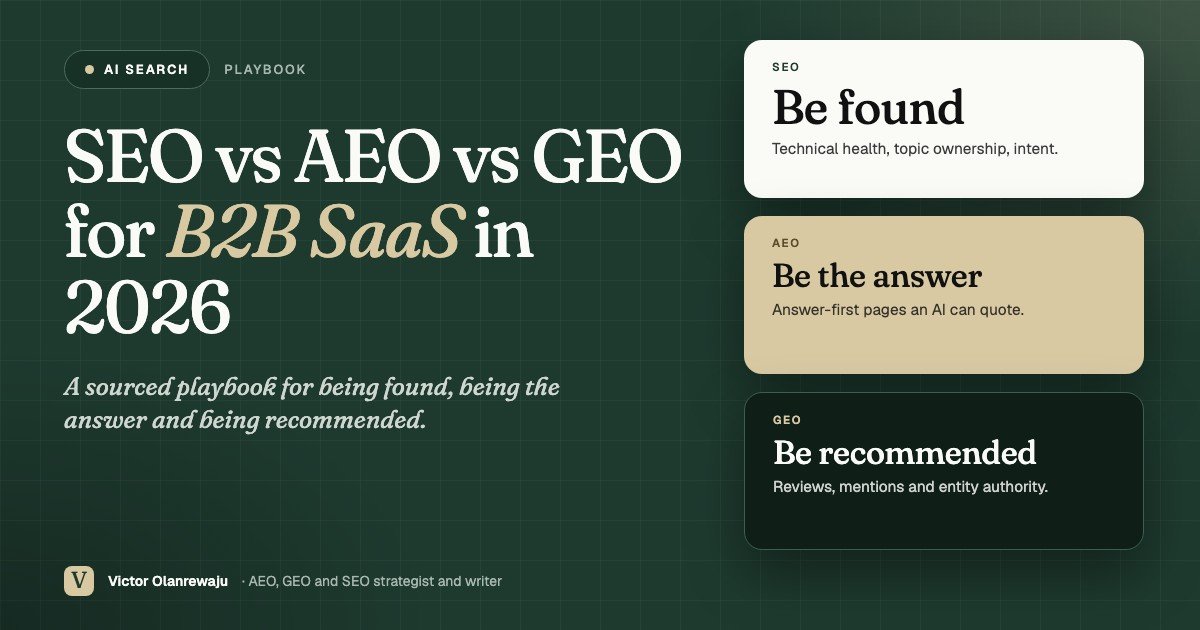
They are three layers of the same job. SEO makes your pages easy for search engines to find and rank. AEO (answer engine optimization) structures those pages so an AI can lift a clear answer from them. GEO (generative engine optimization) builds the wider authority that makes an AI name your company. The terms overlap, and people argue about the boundaries, so treat them as a useful way to organize work rather than separate disciplines.
| SEO | AEO | GEO | |
|---|---|---|---|
| Primary goal | Rank in search results and capture demand | Be the direct answer to a question | Be named and recommended by AI assistants |
| Where it shows up | Google and Bing results | AI Overviews, featured snippets, AI answers | ChatGPT, Claude, Gemini, Perplexity, Copilot |
| What you optimize | Pages and site architecture | Passages that answer one question | Your brand as an entity across the web |
| Core signals | Crawlability, relevance, intent match, links | Answer-first structure, clarity, evidence, dated facts | Third-party mentions, reviews, original research, consistent facts |
| Success looks like | Rankings, qualified organic sessions, conversions | AI Overview presence, answer visibility, question coverage | Mention rate, share of voice, recommendation frequency |
| B2B SaaS example | Your “[category] software pricing” page ranks and converts | Your comparison page opens with a 40-word verdict an AI can quote | An AI lists your product on a shortlist for “best [category] for a mid-size company” |
How do the 3 work together? The search visibility stack
The mistake I see most often is treating SEO, AEO and GEO as competing budgets. They are layers, and each depends on the one below. A fourth layer sits on top, because a recommendation that does not convert is just flattery.
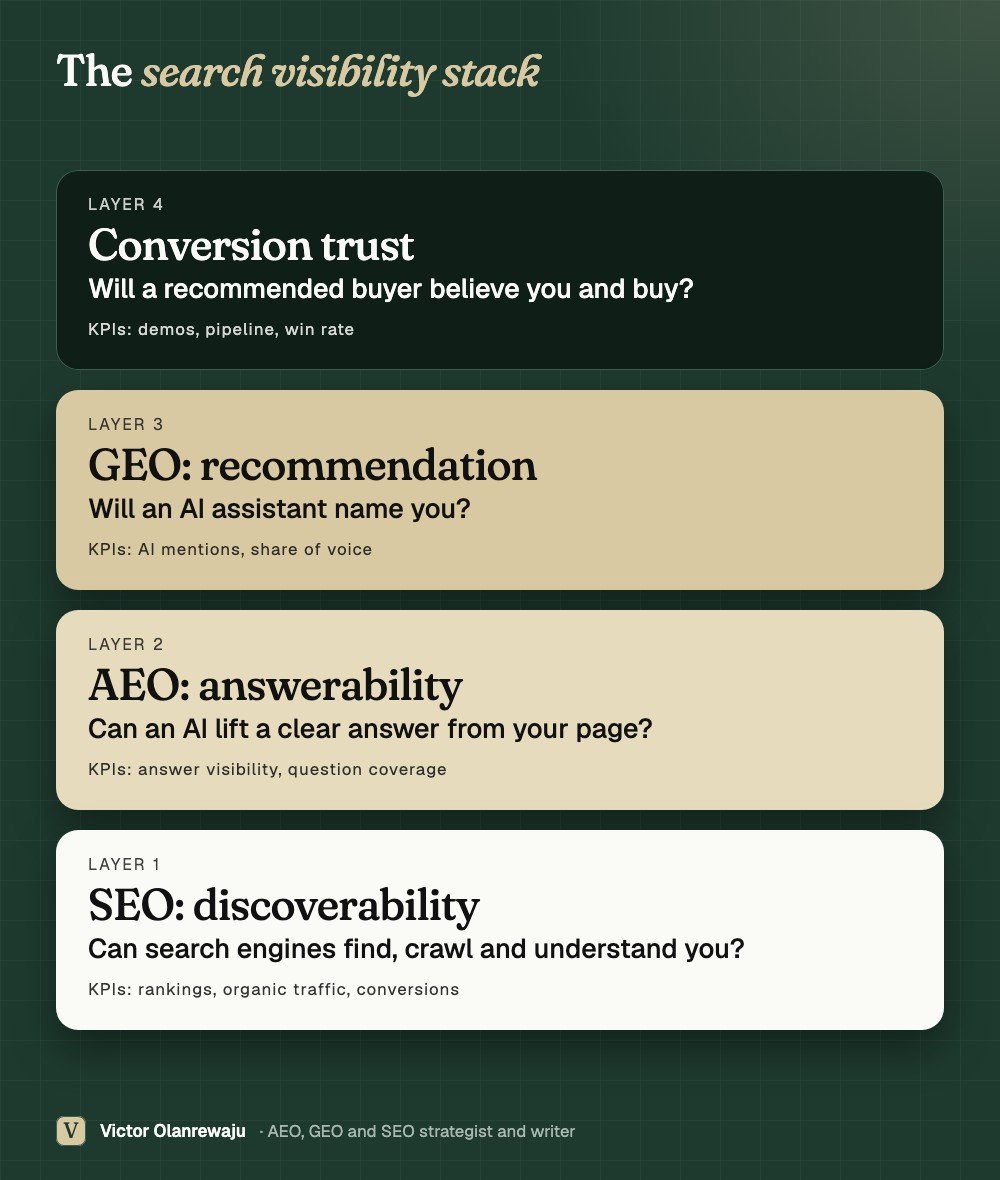
Why the layers matter: a page can rank and still not be named. In Ahrefs’ study of 15,000 prompts, only about 12% of the URLs cited by ChatGPT, Gemini and Copilot ranked in Google’s top 10 for the original prompt, and Google’s own AI Overviews now take about 38% of their citations from the top 10, down from about 76% a year earlier. I explain the data and a four-box diagnostic in why Google rankings do not match ChatGPT mentions. The short version: layer 1 does not guarantee layers 2 and 3.
Layer 1, SEO: what should a B2B SaaS team audit first?
Start here, because everything else rests on it. Google says a page must be indexed and eligible to show in Search with a snippet to appear as a supporting link in AI Overviews or AI Mode, and that there are “no additional requirements” beyond that. That is good news: your SEO work is not wasted. See Google Search Central: AI features and your website.
| Area | What to check | B2B SaaS example |
|---|---|---|
| Access and indexing | Key pages are crawlable, indexed and eligible for snippets. Robots.txt does not block search or AI crawlers you want | Your pricing, integrations and comparison pages are indexed, not hidden behind a login or a script-only render |
| Topic ownership | You cover a category with connected pages, not isolated posts | A project management tool covers workflows, agile, resource planning, integrations, migration and comparisons, all internally linked |
| Intent coverage | You have pages for learning, comparing and buying | “What is [category]” for learners and “[Your product] vs [Competitor]: pricing and fit” for buyers |
| Authority | Credible sites link to and mention you, and real experts write for you | Founder and product experts have named bylines and profiles |
| Experience | Pages load fast, work on mobile and answer the question quickly | No pop-up before the buyer reaches the pricing table |
Which bottom-of-funnel pages pay back first?
Many SaaS blogs are strong on definitions and weak on the pages that influence a purchase. Build these first, because they are also the pages an assistant uses to compare vendors:
- Comparison pages: “[Your product] vs [Competitor]: which fits [segment]?” with the same criteria for both sides.
- Alternatives pages: “[Competitor] alternatives for [use case],” written honestly.
- Pricing explainers: what each plan includes, what costs extra and who it suits.
- Integration pages: one page per important integration, stating what syncs and what does not.
- Implementation and migration guides: time, steps and prerequisites.
- Case studies: named customers, sourced numbers and honest limits.
Layer 2, AEO: how do you write pages an AI can quote?
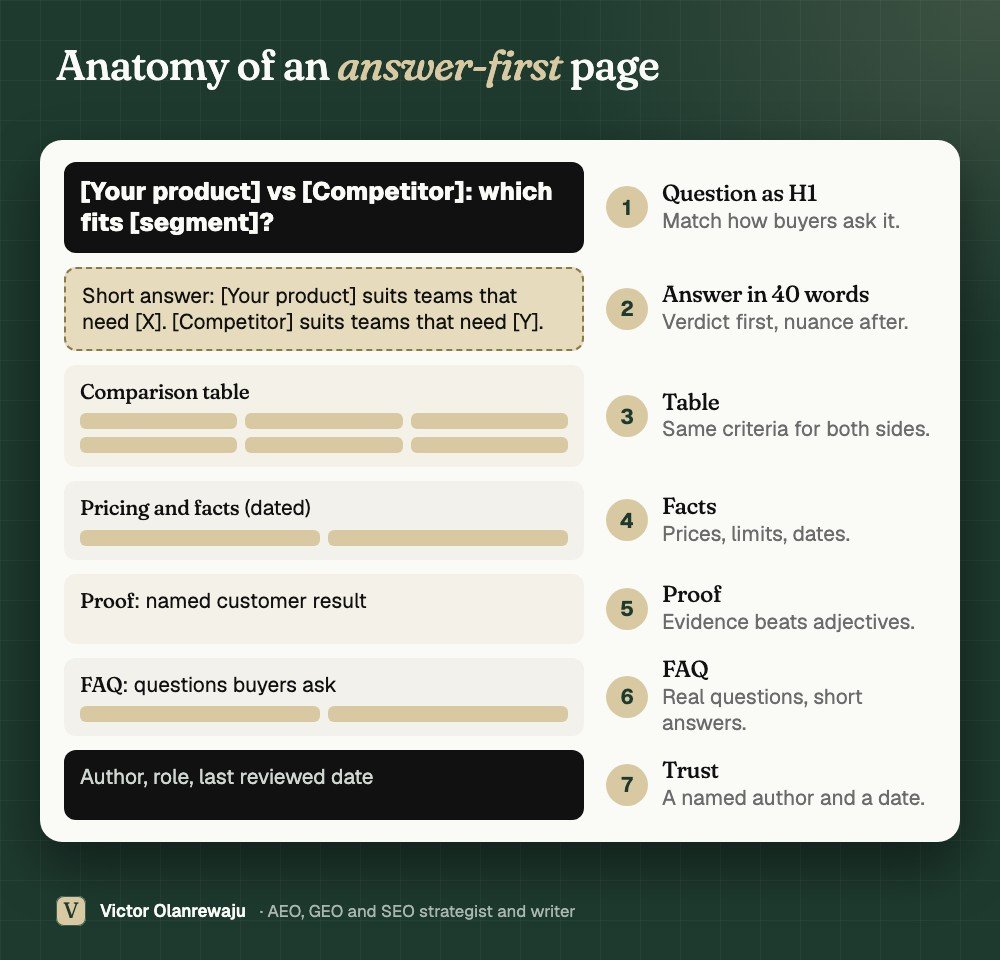
AEO asks a different question from SEO. SEO asks “how do we rank this page?” AEO asks “which passage on this page answers the buyer’s question on its own?” The fix is almost always structural: put the answer first, make it specific and back it with evidence.
What does an answer-first rewrite look like?
Here is an illustration with a generic CRM definition. It is example wording, not a client page.
| Before: an introduction | After: an answer |
|---|---|
| “Customer relationship management platforms have evolved significantly over the years as businesses seek better ways to manage customer interactions in an increasingly competitive landscape.” | “A CRM platform is software that stores customer data, tracks sales conversations and automates follow-up so a sales team can manage relationships in one place. The best fit depends on three things: team size, the integrations you need and how much reporting you require.” |
The second version defines the term in the first sentence, then states the decision factors. An assistant can lift either sentence. The first gives it nothing to lift.
Which AEO habits make the biggest difference?
- Write headings as the questions buyers ask, and answer each in the first one or two sentences.
- Define the term, then decide. A definition followed by “it depends on three factors” and the factors reads as authoritative.
- Use tables for comparisons. Same criteria, same order, for every option.
- State numbers, limits and dates. “Starts at [price] a month for [N] users, reviewed [date]” beats “affordable pricing.”
- Add a short FAQ of real questions from sales calls and support tickets, with plain answers.
- Show who wrote it and when it was reviewed. A named expert and a date build trust for readers and machines.
- Add structured data only where it is true. Google says you do not need special markup for AI features, but accurate schema helps machines read a page. See my guide to schema markup for AEO and GEO.
- Let the right crawlers in. My guide to AI crawlers and robots.txt lists which bots to allow.
For the step-by-step version aimed at ChatGPT specifically, read how to get cited by ChatGPT.
Layer 3, GEO: how do you earn AI recommendations?
This is the layer you cannot fix by publishing more articles. An assistant does not only read your site. It draws on what the rest of the web says about you, and a vendor claiming to be “the leading platform” carries less weight than a review site, a respected publication or a customer saying so. Three findings make the point.
- G2 found software review site citations were the top trust signal raising buyers’ confidence in chatbot answers.
- HubSpot describes AI recommendations as drawing on social media, reviews, third-party websites and owned content.
- Ahrefs found that for brand-name searches, AI Overviews lean heavily on third-party sources.
Third-party sources most cited in AI Overviews for branded searches (%)
In Ahrefs’ separate study of 75,000 brands, YouTube mentions and branded web mentions tracked AI visibility far more closely than backlinks, though the authors stress that correlation is not causation. I cover it in the rankings versus mentions guide.
| GEO signal | What to do | How to check it |
|---|---|---|
| Review platforms | Keep your profile on the review sites your category uses complete, current and well reviewed. Ask happy customers for honest reviews | Search your category on each platform and compare your rating, review count and recency with three competitors |
| Original research | Publish one dataset a year that your market cannot get elsewhere: a survey, a benchmark or an analysis of your own anonymised data | Search for the headline number a month later. Who cites it? |
| Named expert visibility | Give your founder and product experts bylines, speaking slots and consistent profiles | Search each expert’s name. Does the same description appear everywhere? |
| Independent mentions | Earn coverage in the publications, newsletters, podcasts and lists your buyers read. Do not buy placement and present it as editorial | Search your brand plus your category and count independent results on page one |
| Entity consistency | Use one company name, one description, one category label and one set of facts on your site, LinkedIn, review profiles and Wikipedia-style sources where they apply | Ask an assistant “What is [your company]?” and compare its answer with how you describe yourself |
| Community presence | Answer real questions in the places your buyers ask them, openly and as yourself | Search your category question and see whether your name appears in answers you did not write |
How do you find the sources that matter in your category?
Do not guess which publications and platforms to target. Let the assistants show you. This takes an afternoon and tells you where your GEO effort will count.
- Run your discovery and comparison prompts from the panel below in ChatGPT, Gemini, Claude and Perplexity, and note every domain each answer cites or draws on.
- Tally the domains. Five or six will appear again and again. These are your priority sources.
- Check your presence on each. Do they mention you, and is it accurate and recent? Do they mention your competitors instead?
- Close the biggest gaps first. A thin review profile, a missing listicle entry or an outdated comparison on a source the assistants keep citing is worth more than ten new blog posts.
| Source type (illustration) | Finding | Action |
|---|---|---|
| Review platform | Cited in 9 of 12 answers. You have 14 reviews, the leader has 600 | Start a monthly review request routine for recent customers |
| Industry listicle | Cited in 5 answers. Three rivals are listed and you are not | Pitch the author with a data point and a customer example |
| Video platform | Cited in 4 answers. Rivals have walkthroughs and you have none | Publish a product walkthrough and a comparison explainer |
| Your own site | Cited in 3 answers. Pricing quoted is two plans out of date | Update the pricing page and add a dated “last reviewed” line |
The figures in that table are invented to show the method, not real data.
I have seen the same mechanics work outside SaaS. A young Lagos store became ChatGPT’s first pick in 5 of 6 answers by publishing one specific page per buyer question, as the Lens & Co case study shows, and a lighting brand moved from seventh to first in three months in the LAGE Lightings case study. Those are ecommerce and B2B product cases, not software, so treat them as evidence of method, not a SaaS forecast.
Layer 4, conversion trust: what happens after the recommendation?
A buyer who meets you in an AI answer arrives with a shortlist and a question: can I trust this? Visibility does not close that gap. The page they land on has to. The introduction is already warmer, which is why the first impression on your own site matters so much. Semrush’s modeled estimate is that an AI search visitor is worth 4.4 times an organic visitor by conversion rate, but it states that its projections are extrapolations, so measure your own conversion before budgeting on it.
- Pricing transparency: plans, what is included, what costs extra.
- Security and compliance: a plain page that answers the buyer’s security questionnaire in advance.
- Proof: named case studies with sourced numbers.
- Comparison pages: an honest answer to “you versus the alternative.”
- A clear next step: a demo or trial path that does not need three pages of forms.
How does the 2026 buying journey map to the stack?
Each stage of the journey leans on a different layer. This table shows where buyers ask, what wins and what to measure. The example questions are illustrations of how buyers phrase things.
| Stage | Buyer question (example) | Where they ask | What wins | Layer |
|---|---|---|---|---|
| 1. Problem recognition | “How do companies reduce customer support costs?” | Google, AI assistants, LinkedIn | Clear educational pages with a quotable answer | SEO and AEO |
| 2. Discovery | “Recommend the best customer support platform for a fast-growing startup” | ChatGPT, Gemini, Perplexity, Claude | Being on the shortlist at all | GEO |
| 3. Evaluation | “Compare [Vendor A], [Vendor B] and [Vendor C] for a mid-market business” | AI assistants, review sites, your site | Honest comparison pages and strong third-party reviews | AEO and GEO |
| 4. Validation | “Is [Vendor] secure, and what do customers say?” | Review sites, LinkedIn, peers, AI assistants | Reviews, security documentation and customer proof | GEO and conversion trust |
| 5. Decision | “How much does [Vendor] cost for 50 users?” | Your site, AI assistants, sales | Transparent pricing and a smooth demo path | Conversion trust |
Where does your company sit? The AI search maturity model
An assistant cannot recommend a company that lacks authority signals, so most teams climb in four stages. This is my planning model, not a published standard.
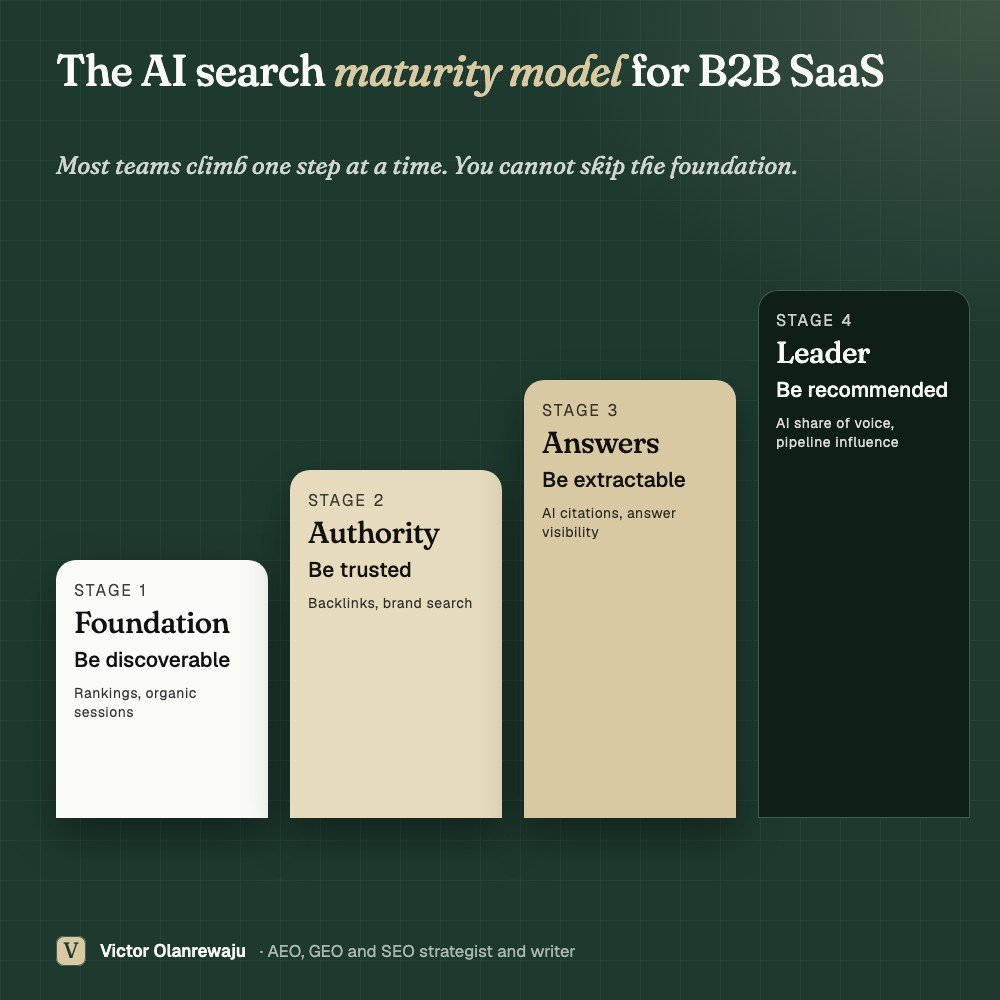
| Stage | Where you are | Focus | Metrics | Starting effort split (SEO / AEO / GEO) |
|---|---|---|---|---|
| 1. Foundation | “We need to be discoverable.” | Technical SEO, keyword and intent research, core product, pricing and comparison pages | Indexed pages, rankings, non-brand organic sessions, conversions | About 70 / 20 / 10 |
| 2. Authority | “We need to be trusted.” | Topic clusters, expert authors, case studies, first original research | Referring domains, brand search, engagement | About 55 / 25 / 20 |
| 3. Answers | “We need AI to understand us.” | Answer-first rewrites, FAQs, comparison tables, consistent facts | AI Overview presence, question coverage, AI citations | About 40 / 30 / 30 |
| 4. Leader | “We want AI to recommend us.” | Digital PR, review programs, community presence, annual research, category language | Mention rate, AI share of voice, AI-assistant sessions, pipeline influence | About 30 / 30 / 40 |
The effort split is my planning heuristic, not a research-backed ratio, and anyone quoting a fixed ratio as fact is guessing. An early-stage company has little authority for an AI to recognize, so it should build the foundation first. A larger brand usually already ranks, so its challenge is becoming the default recommendation. Move the numbers as your own data comes in.
How do you test what AI says about your software? A 12-prompt panel
Before you plan anything, find out where you stand. Write a panel of prompts that mirror the buyer journey, run each one in ChatGPT, Gemini, Claude and Perplexity, and record whether you are named, where you appear, which sources are shown and what is said about you. Replace the placeholders with your category, segment and competitors.
| Stage | Prompt to run | What you are checking |
|---|---|---|
| Discovery | “Best [category] software for a [size] [industry] company” | Are you on the shortlist? |
| Discovery | “Recommend the best [category] platform for a fast-growing startup” | Do you appear for your core segment? |
| Discovery | “Which [category] tool has the strongest [feature] for [use case]?” | Do you own a specific strength? |
| Comparison | “Compare [Your product], [Competitor A] and [Competitor B] for a mid-market business” | How are you described next to rivals? |
| Comparison | “[Competitor] alternatives for [use case]” | Do you appear as an alternative? |
| Comparison | “[Your product] vs [Competitor]: which is better for [use case]?” | Is the verdict accurate and fair? |
| Evaluation | “Is [Your product] good for [use case]? What are its downsides?” | Are its limits stated accurately? |
| Evaluation | “How much does [Your product] cost for [N] users?” | Is the pricing correct and current? |
| Evaluation | “Does [Your product] integrate with [tool]?” | Are integrations stated correctly? |
| Validation | “Is [Your product] secure? What compliance does it have?” | Are the security claims accurate? |
| Validation | “What do customers say about [Your product]?” | Which review sources are cited? |
| Entity | “What is [Your company] and who is it for?” | Does the description match how you position yourself? |
Run each prompt three times on different days, because AI answers vary: SparkToro’s study of 2,961 responses found the same question rarely returns the same brand list twice. Score the result with two numbers: the share of prompts where you are named (your mention rate) and the share of your key buyer queries where you rank in Google’s top 10. The difference tells you which layer to fix first, and the method is in how to check what ChatGPT says about your business. For interpreting the gap, use the Rank–Mention matrix in the rankings versus mentions guide. Pay particular attention to the entity prompt and the pricing prompt: wrong facts in an answer are the cheapest problems to fix.
What should you fix first? A symptom-to-fix table
Once you have run the panel, match what you see to the most likely cause. These are hypotheses to test, listed in the order I usually check them.
| What you see | Likely cause | First fix |
|---|---|---|
| You rank in the top 10 but are never named | Pages are findable but not quotable, or an AI crawler is blocked | Check robots.txt and firewall, then rewrite the page answer-first |
| Assistants name your competitors but not you | Weaker third-party presence: reviews, listicles, mentions | Run the source map above and close the biggest gap |
| The answer states the wrong price or plan | Outdated or conflicting pricing across your site and third-party pages | Update the pricing page, add a review date and correct third-party listings |
| You are placed in the wrong category | Inconsistent positioning across profiles | Use one category label and one description everywhere |
| You are named, but only on one assistant | Different engines weigh sources differently | Look at which sources that assistant cites and match them |
| You are named once but not on repeat runs | A lucky single answer, not a stable position | Build more pages and mentions, then re-test across three runs |
| You are named, but visitors do not convert | The landing page does not answer the validation questions | Add pricing, security proof and a named case study |
Which KPIs should you track?
Keep your SEO metrics, and add the layers that are missing. The aim is a dashboard that connects visibility to revenue.
| Layer | Metrics to track | How to measure |
|---|---|---|
| SEO | Non-brand organic sessions, rankings for bottom-of-funnel queries, referring domains, organic conversions | Search Console, your analytics platform and a rank tracker |
| AEO | AI Overview presence for your key queries, featured answers won, share of buyer questions with an answer-first page | Manual checks and a question-coverage spreadsheet. Google says traffic from its AI features is counted in the Web search type of Search Console’s Performance report |
| GEO | Mention rate across your 12 prompts, AI share of voice against three named competitors, source mix, accuracy of what is said | The prompt panel above, or an AI visibility tool such as Ahrefs Brand Radar or Semrush’s AI Visibility Toolkit |
| Revenue | AI-assistant sessions, demo requests by source, pipeline influence, self-reported source | Your analytics traffic acquisition report, plus a “how did you hear about us?” field that lists ChatGPT, Claude, Gemini and Perplexity as options |
Do not rely on referral traffic alone. A buyer may read an answer, remember your name and search for you later, which analytics records as branded or direct traffic. That is why a self-reported source field matters. For tools, Ahrefs Brand Radar covers Google AI Overviews, ChatGPT, Perplexity, Copilot, Gemini and Claude, and Semrush’s AI Visibility Toolkit starts from $99 a month per domain as an add-on. If your marketing site runs on WordPress, AmasoAI is a cheaper option with a free plan, which I review in my AmasoAI review (disclosure: I work in growth for AmasoAI).
What does a 90-day implementation plan look like?
| Window | Focus | Deliverables |
|---|---|---|
| Days 1 to 14 | Baseline | Run the 12-prompt panel three times. Record mention rate, accuracy and sources. Audit indexing, robots.txt and your top 20 commercial pages. Pull review profiles and compare them with three rivals |
| Days 15 to 45 | Fix what is wrong and answer-first the money pages | Correct wrong facts on your own site and profiles. Rewrite pricing, comparison, integration and category pages answer-first. Add FAQs from sales calls. Make company facts identical everywhere |
| Days 46 to 75 | Build proof and authority | Publish one comparison and one alternatives page per main rival. Launch a review request routine. Pitch two or three independent mentions. Start your first original dataset |
| Days 76 to 90 | Re-test and decide | Re-run the panel three times on different days. Compare with the baseline. Decide where to put the next quarter’s effort |
How does it compound? The visibility flywheel
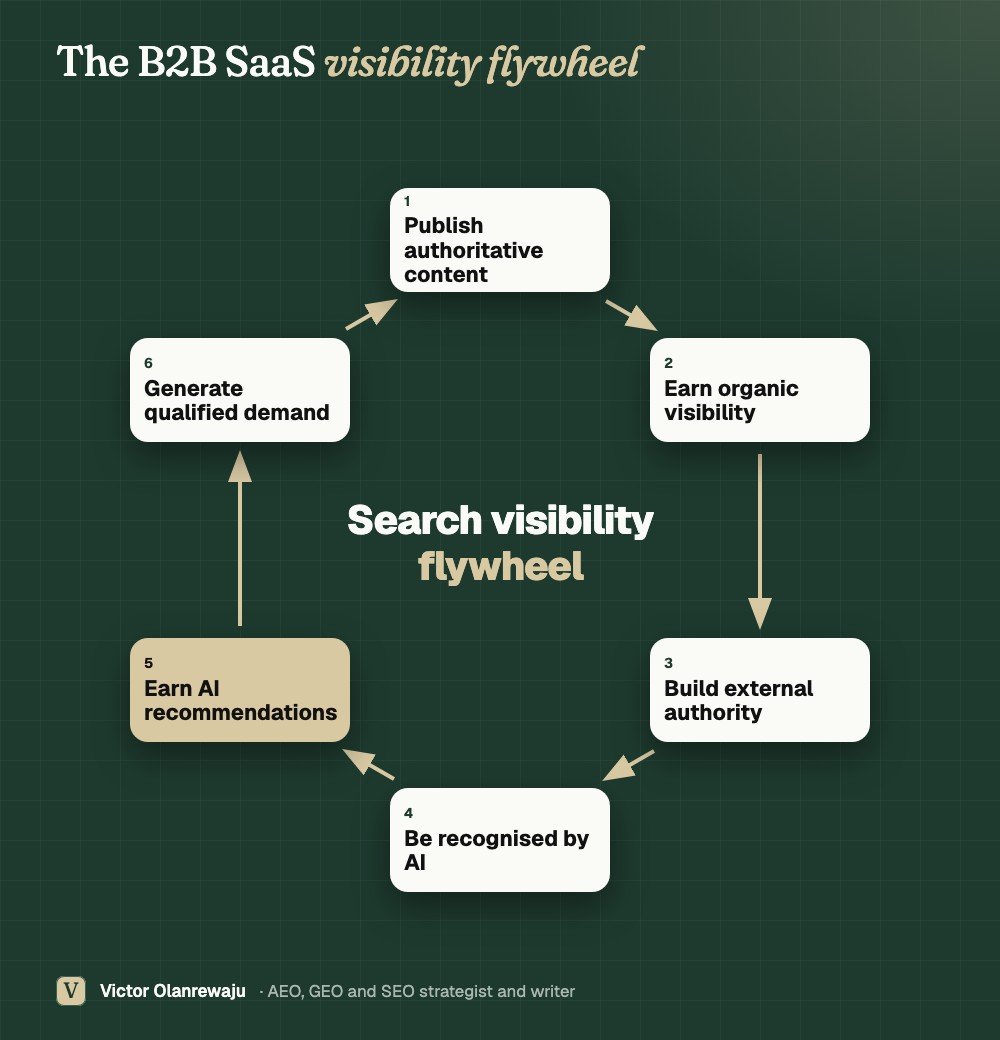
Done well, the layers feed each other, and the loop is where the compounding happens: the buyers an AI sends you become the reviews, case studies and mentions that make the next recommendation more likely.
If you are deciding who should write these pages, see who can write content that gets cited by ChatGPT, Gemini and Perplexity.
What do the numbers not tell you?
- Buyer surveys are self-reported. What people say they do is not the same as what they do.
- Vendor data is not independent. G2 and HubSpot both sell into this market.
- Correlation is not proof. Buyers who use AI search may simply research more. Companies that optimize for AI may simply be more sophisticated marketers.
- AI answers change. Every figure here is a dated snapshot.
- My own cases are not SaaS. They show the mechanism, not the size of the effect for your product.
If you would like to know what AI assistants say about your software today, I run this test as part of a free AI visibility audit. See my pages on AEO, GEO and SEO, and the pricing page: foundation builds start at $390 one-time and growth retainers at $290 a month. Or tell me what you want to be found for. For writers who understand all three, see my list of the best SaaS content writers for AI search.
Keep reading: For software buyers, I ran ten “best software” questions through ChatGPT in how SaaS products get named in ChatGPT’s best-software answers. For a security buyer’s version of this, I tested ten vendor questions in how AI recommends cybersecurity vendors.
Frequently asked questions
What is the difference between SEO, AEO and GEO?
SEO makes your pages easy for search engines to find and rank. AEO structures them so an AI can lift a clear answer. GEO builds the wider authority that makes an AI name your company. For B2B SaaS they work as layers: SEO is the foundation, AEO makes you the answer and GEO gets you recommended.
Is SEO still worth it for B2B SaaS in 2026?
Yes. Google says a page must be indexed and eligible to show with a snippet to appear as a supporting link in AI Overviews and AI Mode, and that there are no additional requirements. About 38% of AI Overview citations still come from the top 10, according to Ahrefs in March 2026. SEO is the base layer, but it does not guarantee that an AI will name you.
How many B2B software buyers use AI to research vendors?
G2’s March 2026 survey of 1,076 software buyers found 71% rely on AI chatbots at some point, and 51% start research with a chatbot more often than Google. Forrester’s Buyers’ Journey Survey 2025 found 94% of business buyers use AI in their purchasing process. Both are self-reported surveys.
Do AI assistants really change which software gets bought?
The surveys say so. In G2’s March 2026 survey, 69% of buyers chose a different vendor than they initially planned based on chatbot recommendations, and one in three bought from a vendor they had never heard of. HubSpot found CRM buyers who used AI search were 36% more likely to purchase, which is a correlation.
What is the difference between a citation and a recommendation?
A citation means an AI used your page as a source. A recommendation means it named your product as an answer, often in a short list. A page can be cited without being recommended and the reverse. I explain the difference in my guide to AI citation versus AI recommendation.
Can I rank number one on Google and still be missing from ChatGPT?
Yes. In Ahrefs’ study of 15,000 prompts, only about 12% of URLs cited by ChatGPT, Gemini and Copilot ranked in Google’s top 10 for the original prompt. Assistants run several related searches and choose which businesses to name. See my guide on why Google rankings do not match ChatGPT mentions.
What kind of content helps a SaaS company get recommended by AI?
Answer-first pages with specific facts, honest comparison and alternatives pages, original research, named expert authors, and strong third-party signals such as reviews and independent mentions. Generic content that repeats what competitors say gives an assistant no reason to quote you.
How important are review sites for AI recommendations?
Very. G2 found software review site citations were the top trust signal raising buyers’ confidence in AI chatbot answers, and HubSpot describes AI recommendations as drawing on reviews and third-party websites as well as owned content. Keep your profiles complete, current and well reviewed.
How do I measure GEO and AEO?
Run a panel of about 12 buyer prompts in ChatGPT, Gemini, Claude and Perplexity, three times on different days, and record whether you are named, where, which sources are shown and whether the facts are right. Track the mention rate and share of voice against named competitors, and add a self-reported source field to your demo form.
How long does it take to see results from GEO?
It varies and cannot be guaranteed. One Lagos store I worked with was listed first by ChatGPT in 5 of 6 answers about two weeks after its content started going live, and a lighting brand moved from seventh to first in about three months. Those are ecommerce and B2B product examples, not software forecasts.
How should I split my budget between SEO, AEO and GEO?
There is no research-backed ratio. As a planning heuristic I start early-stage companies at about 70% SEO, 20% AEO and 10% GEO, growth-stage at about 40, 30 and 30, and enterprise at about 30, 30 and 40, then adjust as data comes in.
Does schema markup guarantee AI visibility?
No. Google says you do not need special markup for its AI features. Accurate schema helps machines read a page, but the strongest signal is a clear, specific, trustworthy answer with independent support.
Can you check what AI says about my software?
Yes. Vatam starts with a free AI visibility audit that includes the prompt panel in this guide. Its published prices, in US dollars, are foundation builds from $390 one-time and growth retainers from $290 a month, with each scope agreed in writing before work starts.