In this article
- What was the problem?
- What was the 7 am agent?
- How would you design a daily briefing agent?
- What rules kept quality intact?
- How do you verify AI-assisted content?
- What does Google say about AI-assisted content?
- How do you measure efficiency honestly?
- What does a content team’s AI policy need?
- How do you build a prompt and checklist library?
- Where does this connect to AI search visibility?
- What about Oryx Studio?
- How can another content team copy this?
- A verification checklist you can copy
- Who does what?
- How do you pilot an AI workflow in 30 days?
- What commonly goes wrong?
- Which tools do I use, and for what?
- What does a good prompt look like?
- What should a team dashboard track?
- What is the lesson?
- Sources
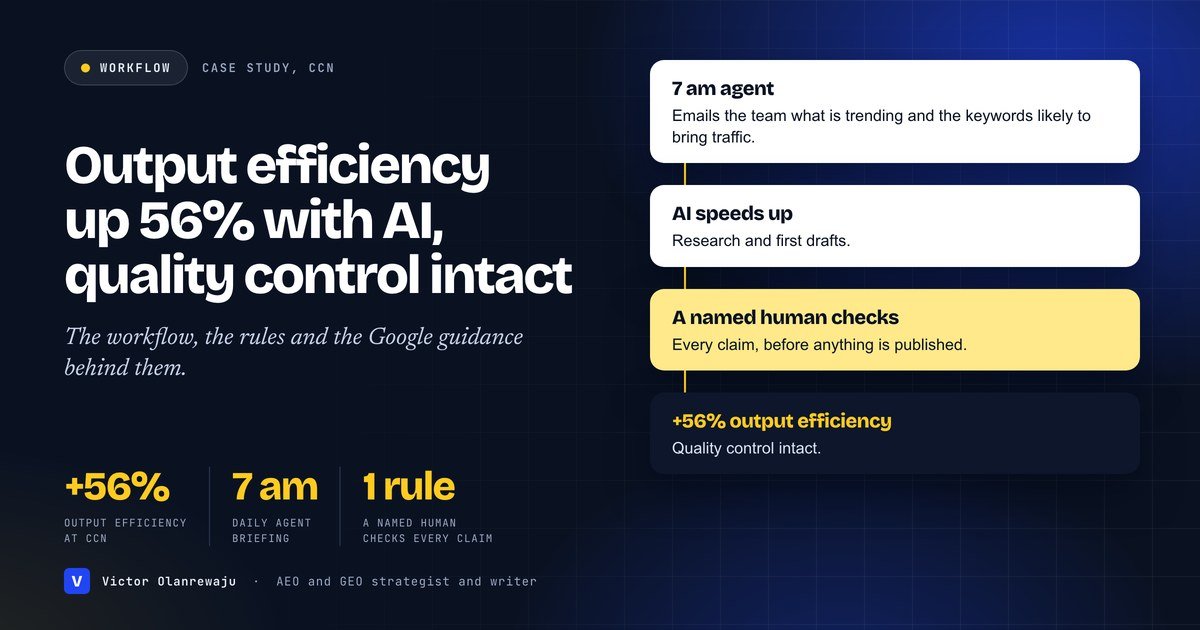
In short: At CCN I designed and implemented AI-assisted research and editorial workflows that improved output efficiency by 56%. One of them was a Notion AI agent that emailed every team member at 7 am with what was trending and the keywords most likely to bring traffic and visits. The rule never changed: AI speeds up research and first drafts, and a named human checks every claim. That rule also aligns with what Google says about AI-assisted content, which targets mass-produced pages made to manipulate rankings, not the use of AI as a tool.
Content teams are under pressure to produce more with the same people, and AI is the obvious lever. The risk is equally obvious: errors, sameness and, in the worst case, content that damages trust. In crypto and finance, where readers act on what they read, the cost of an error is higher than most. I have run this problem at volume: at CCN I published 100 data-driven market and macro reports a month, and I built workflows that improved output efficiency by 56% without lowering the quality bar. This guide explains the design, the rules, how to measure efficiency honestly and how to stay on the right side of Google’s guidance. For how the same discipline supports ranking, see my crypto SEO guide.
What was the problem?
At volume, three parts of the process consume the most time:
- Deciding what to cover. Scanning news, markets and search demand for what readers want today.
- First-pass research. Gathering data, sources and context for each piece.
- First drafts and formatting. Turning research into a structured draft that an editor can improve.
These are the parts where AI helps most, and also the parts where careless use does the most damage to accuracy. The design goal was therefore specific: automate discovery and first-pass work, keep every judgement and every published claim with a named human.
What was the 7 am agent?
I used Notion AI to build an agent that emails every member of the team at 7 am. Each email lists what is trending and the keywords that could bring the most traffic and visits. Everyone starts the day with the same picture of what readers are searching for, so writers spend their time on analysis instead of hunting for topics. It is one of several AI-assisted workflows I built across research, drafting and review, and together they improved output efficiency by 56%.
What it did not do matters as much. It did not publish anything, decide what was true or write the final copy. It produced a briefing that humans acted on. That boundary is the design principle: automate the inputs to judgement, never the judgement itself.
How would you design a daily briefing agent?
If you want to build something similar for your own team, here is the design pattern I recommend, whichever tool you use:
- Define the decision it supports. “What should we cover today, and which keywords justify it?”
- Choose inputs deliberately. Trending topics, your own search data (for example, Search Console queries and impressions), keyword research and your editorial calendar.
- Set a fixed schedule and format. A short email at a consistent time, with the same sections every day, so people learn to scan it.
- Rank, do not dump. Present the five to ten highest-value opportunities with a reason, not an endless list.
- Link to sources so a human can verify before relying on any claim.
- Review its output weekly. Check whether the topics it suggested led to good articles, and adjust the instructions.
- Keep humans in the loop. The email is a prompt for editorial judgement, not an assignment.
What rules kept quality intact?
- AI is never the last pair of eyes. It speeds up research and the first draft. A named human checks every claim before anything is published.
- Every number has a source. If a figure cannot be traced to its origin, it does not go in.
- Guidelines are written down. Style, sourcing and tone live in a checklist the whole team can use, which is also what makes AI output reviewable.
- The author is named. Readers, editors and search engines all trust content more when a real expert stands behind it.
- Measure what changed. The efficiency gain came from tracking output against the quality bar, not from publishing more for its own sake.
How do you verify AI-assisted content?
Verification is where AI workflows succeed or fail. Different kinds of claim need different checks:
| Claim type | Risk | How to verify |
|---|---|---|
| Numbers and statistics | Misquoted, outdated or invented figures | Open the primary source, confirm the figure, the date and the method, and link it |
| Quotes | Fabricated or altered wording | Find the original statement; quote it exactly or paraphrase and attribute |
| Dates and sequences | Wrong order or timing | Check against a dated source |
| Names, titles and organisations | Wrong person or role | Check the organisation’s own page |
| On-chain and market data | Stale or misread data | Re-pull from the data provider, note the timestamp |
| Legal and regulatory statements | Jurisdiction errors | Cite the regulator or a qualified source; avoid advice |
| Causal claims | Correlation presented as cause | Rephrase as association unless supported |
The practical routine: the drafter marks every factual claim, the reviewer verifies each against its source, and unverified claims are cut or flagged. This is also exactly the discipline behind the articles on this site, each of which links its sources, such as AI search statistics for 2026.
What does Google say about AI-assisted content?
Google’s guidance is consistent with these rules. Its spam policy on scaled content abuse defines it as many pages generated for the primary purpose of manipulating search rankings and not helping users, typically large amounts of unoriginal content that provides little or no value, no matter how it is created. Its examples include using generative AI tools to generate many pages without adding value for users, and scraping or stitching content together without adding value. Google’s page on generative AI content points creators to the Search Essentials and spam policies and to the quality rater guidelines on evaluating scaled content abuse.
The same helpful content guidance asks “Who, How and Why”. For “How”, it says automated, AI-generated and AI-assisted content can have a how component, and that sharing details about the processes involved can help readers understand the role automation played. It suggests asking whether the use of automation is self-evident to visitors, whether you give background on how it was used, and whether you explain why it was useful, and adds that disclosures are useful where someone might think “How was this created?”. For “Who”, it encourages bylines and warns against fabricating creator profiles, such as AI-generated headshots, made-up names or false credentials. Its list of search-engine-first warning signs includes using extensive automation to produce content on many topics and mainly summarising what others have to say without adding much value.
The practical reading is that AI is acceptable as a tool, and unreviewed mass production is a risk. A named human, a source for every claim and honesty about process keep AI-assisted content on the right side of both.
How do you measure efficiency honestly?
“Output efficiency” can mean many things, and a bare percentage tells you little. A defensible definition is output per unit of effort at a constant quality standard. To measure it:
- Choose a unit of output that matters, such as published reports per writer per month.
- Measure the effort in the same period, such as hours or headcount.
- Hold quality constant. Track an error or correction rate and editorial rework, so a speed gain that raises errors does not count.
- Record a baseline before changing the workflow, and compare like with like.
- Report the whole picture: output, effort and quality together.
The 56% improvement at CCN refers to improved output efficiency from AI-assisted workflows while quality control stayed in place. I recommend reporting any similar number with its definition, so that it can be checked.
What does a content team’s AI policy need?
- Allowed uses: research assistance, outlining, first drafts, summarising source material you supply, headline and meta description options, translation drafts, formatting.
- Restricted uses: publishing without human review, generating quotes or statistics, producing content on topics with no human expertise behind it, mass-producing pages.
- Review rules: a named reviewer for every piece, source verification for every claim, a second reviewer for high-risk topics.
- Disclosure rules: when and how to state AI assistance, following the “How” guidance above.
- Data rules: what may and may not be pasted into AI tools, especially confidential or unpublished information.
- Ownership: who maintains prompts, checklists and the policy itself.
How do you build a prompt and checklist library?
A shared library is what turns individual tricks into a team capability. Store, for each use case: the purpose, the prompt, the inputs it needs, an example of good output, the checks the reviewer must run and the known failure modes. Review it monthly. Remove prompts that produced errors, and note why. Because the guidelines are written down, new team members can follow them and a reviewer can judge AI output against a standard, not a feeling.
Where does this connect to AI search visibility?
Quality-controlled content is also what assistants cite. Google’s guidance asks for original information, a substantial and complete description of the topic, clear sourcing and a visible author, and these are the same attributes behind pages that earn citations in the case studies of Lens & Co by Tiara and LAGE Lightings. The method for earning them is in how to get cited by ChatGPT.
What about Oryx Studio?
I also helped Oryx Studio, a content marketing platform built to keep AI-assisted articles aligned to guidelines and fact-checked before publishing, with research, testing, AI-developed articles against guidelines and outlines, review and some copywriting and go-to-market support. It addresses the same problem from the product side: AI output that follows guidelines and gets reviewed before it ships.
How can another content team copy this?
- Automate the discovery, not the judgement. A daily briefing of trends and keywords, like the 7 am email, saves hours without touching what gets published.
- Write the guidelines down so a checklist, not a person’s memory, defines quality.
- Keep a human final check with a name attached.
- Track output and quality together. Efficiency without a quality measure is just speed.
- Be open about process where readers would reasonably expect it.
- Start small. Pilot one workflow for a month, measure, then expand.
If your team needs a workflow like this, see AI-assisted content operations. For how the same content discipline earns visibility, read SEO, AEO and GEO explained.
A verification checklist you can copy
Use this on every AI-assisted piece before publication:
- Every statistic has a linked primary source, a date and a note of the method where relevant.
- Every quote has been checked against the original statement.
- Every name, title and organisation has been confirmed on an official page.
- Every date and sequence of events has been checked.
- Every claim about cause is supported or rephrased.
- No claim relies only on the AI’s output.
- Opinions are labelled as opinions.
- Risk and disclosure language is present where needed.
- The author’s name is on the piece and the author page is accurate.
- A named reviewer has signed off.
Who does what?
| Role | Responsibility |
|---|---|
| Writer | Researches, drafts (with AI help), marks every factual claim, owns the piece |
| Reviewer or editor | Verifies marked claims against sources, checks against the guidelines, approves or returns the piece |
| Workflow owner | Maintains prompts, checklists and the AI policy, reviews error reports monthly |
| Team lead | Decides what is automated, what is not, and what quality bar applies |
How do you pilot an AI workflow in 30 days?
- Week 1: choose one workflow, such as the daily briefing, and define the decision it supports. Record baseline output, effort and error rates.
- Week 2: build a first version with a fixed format and schedule. Share it with a small group.
- Week 3: collect feedback, adjust the instructions, and check the outputs against what people actually used.
- Week 4: measure against the baseline, review errors, decide whether to keep, change or stop it.
What commonly goes wrong?
| Failure | Why it happens | Fix |
|---|---|---|
| Confident but wrong figures | The model generates plausible numbers | Require a linked primary source for every figure |
| Sameness across pieces | Everyone uses the same prompts and the same sources | Add original data, interviews and a named analyst’s view |
| Briefing fatigue | The daily email becomes noise | Rank, keep it short and prune what nobody acts on |
| Quality drift | Reviewers relax as the output looks polished | Sample and audit published pieces monthly |
| Confidential data leaks | Unclear data rules | Write down what may be pasted into tools |
| Speed without outcome | Output measured, impact ignored | Track traffic, leads and corrections as well as volume |
Which tools do I use, and for what?
I use Notion AI for workflow automation such as the daily briefing, and Claude and ChatGPT for research assistance, outlining and first-draft support, always followed by human verification. Analytics and keyword tools such as Search Console, Google Analytics, Ahrefs and Semrush supply the data the briefing relies on. The choice of tool is secondary: the verification checklist and the named reviewer are what protect quality.
What does a good prompt look like?
Prompts are not magic words. A reliable structure for research-assistance prompts has six parts:
- Role and purpose: what the output is for and who will read it.
- Inputs: the sources, data and notes the model must use, supplied by you.
- Constraints: what it must not do, such as inventing figures, quotes or sources.
- Format: the exact output structure, such as a table with a source column.
- Uncertainty rule: if the inputs do not contain the answer, say so instead of guessing.
- Verification note: ask it to mark every factual claim so the reviewer can check each one.
What should a team dashboard track?
| Metric | Why it matters |
|---|---|
| Output per writer per month | The efficiency numerator |
| Hours of effort or headcount | The denominator |
| Corrections and errors per hundred pieces | The quality guardrail |
| Editorial rework time | Reveals hidden cost of weak drafts |
| Search traffic and leads per piece | Whether output creates value |
| Use of the daily briefing | Whether the automation is actually used |
What is the lesson?
The efficiency gain came from being strict about where AI helps and where it does not. Automating the 7 am briefing freed writers to do the work that readers value, original analysis. Keeping a named human on every claim protected the reason readers trust the publication. If you take only one idea from this guide, take that boundary: automate the inputs to judgement, never the judgement itself.
Sources
Frequently asked questions
How did AI improve output efficiency at CCN?
I designed and implemented AI-assisted research and editorial workflows that improved output efficiency by 56%, including a Notion AI agent that emailed every team member at 7 am with what was trending and the best keywords for traffic and visits.
Is AI-generated content bad for SEO?
Google's spam policy targets scaled content abuse, meaning many pages generated primarily to manipulate rankings without helping users, no matter how they are created. AI used to speed up research and drafting, with a named human verifying the claims, is a different thing.
Should I disclose that I use AI in content?
Google's helpful content guidance says AI or automation disclosures are useful where someone might think 'How was this created?' and suggests adding them when reasonably expected.
What is the rule for using AI in editorial work?
AI speeds up research and first drafts. A named human checks every claim before anything is published.
How do I measure the efficiency gain from AI?
Measure output per unit of effort at constant quality: pick a unit of output, measure effort in the same period, track error or correction rates, record a baseline before the change and report all three together.