In this article
- What happened in the Binance hack, hour by hour
- How much was stolen? 7 numbers for 1 theft
- The test: 8 questions, 4 engines, 1 morning
- Scoreboard: who got the Binance hack right at hour 14
- What each engine said
- Why 1 engine got the same story wrong
- What the research says about AI and breaking news
- A crisis answer-readiness playbook for exchanges and fintech brands
- The 20-question panel to run on your own brand
- How I ran this, and the limits
- Snapshot 2: what changed in 3 days
- Work with me
- Update log
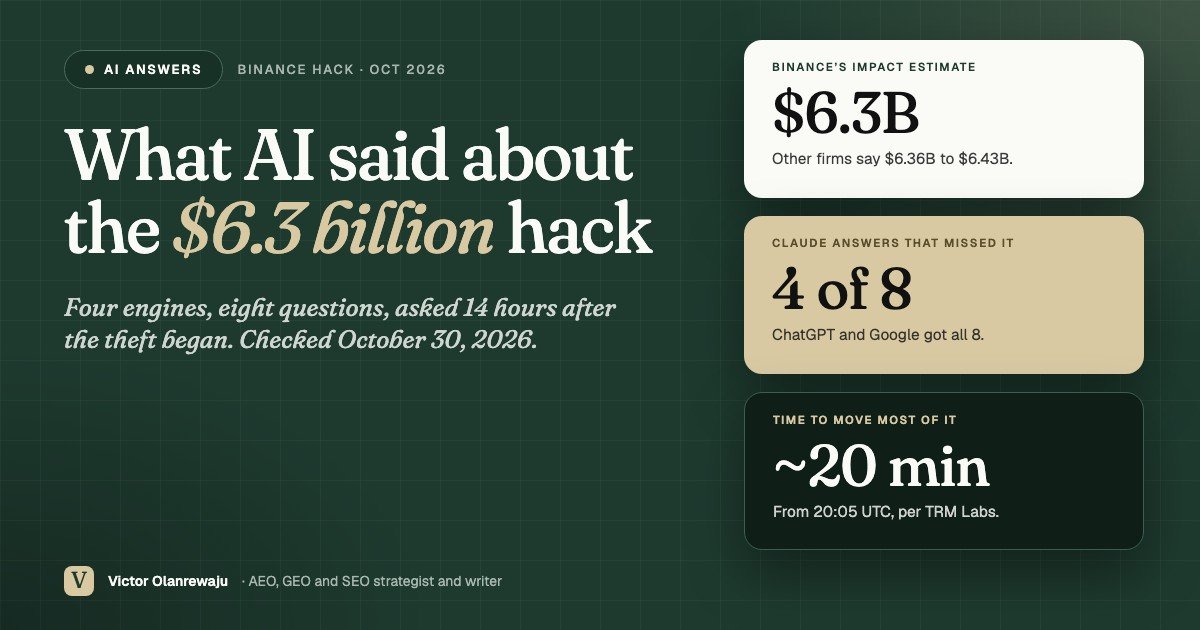
In short: About 14 and a half hours after the first transfers, I asked ChatGPT, Claude, Perplexity and Google’s AI Overviews the same questions about the Binance hack. ChatGPT and Google answered all eight correctly. Perplexity was right on the five answers I could capture, with one date slip. Claude missed the $6.3 billion theft on four of eight questions, and twice it said no hack had happened in 2026. The cause looks like phrasing, not knowledge. Claude was right on “Did Binance get hacked?” and wrong on “How much was stolen in the Binance hack?” The numbers never settled either. In about 12 hours, credible sources put the loss between $5.3 billion and $6.43 billion, and the frozen total between $1.56 billion and $3 billion. Below you get the data, the screenshots and a ten-step plan for the next crisis. This is one snapshot, and I will rerun it on November 1 and November 5.
$6.3B
Binance’s own estimate of the impact, posted October 30, 2026
~20 min
Time it took to move most of the funds, starting 20:05 UTC, per TRM Labs
4 of 8
Questions Claude answered without the 2026 theft
7
Loss estimates from credible sources in about 12 hours, from $5.3B to $6.43B
Update, November 4, 2026 (Snapshot 2): Three days later, the facts have moved. The FBI attributed the theft to North Korea’s TraderTraitor group on October 31, and North Korea denies it. Binance’s Recovery Updates show withdrawals reopening in phases from November 1. Press reports say Binance’s November 3 incident report traces the attack to a fake job interview, though I read the coverage, not the report itself. I reran the questions. ChatGPT and Google were current on all of it. Claude fixed its biggest misses and now gives the $6.3 billion, but it still says the FBI has not named a culprit and offers only the laptop theory. The details are in the section “Snapshot 2: what changed in three days.”
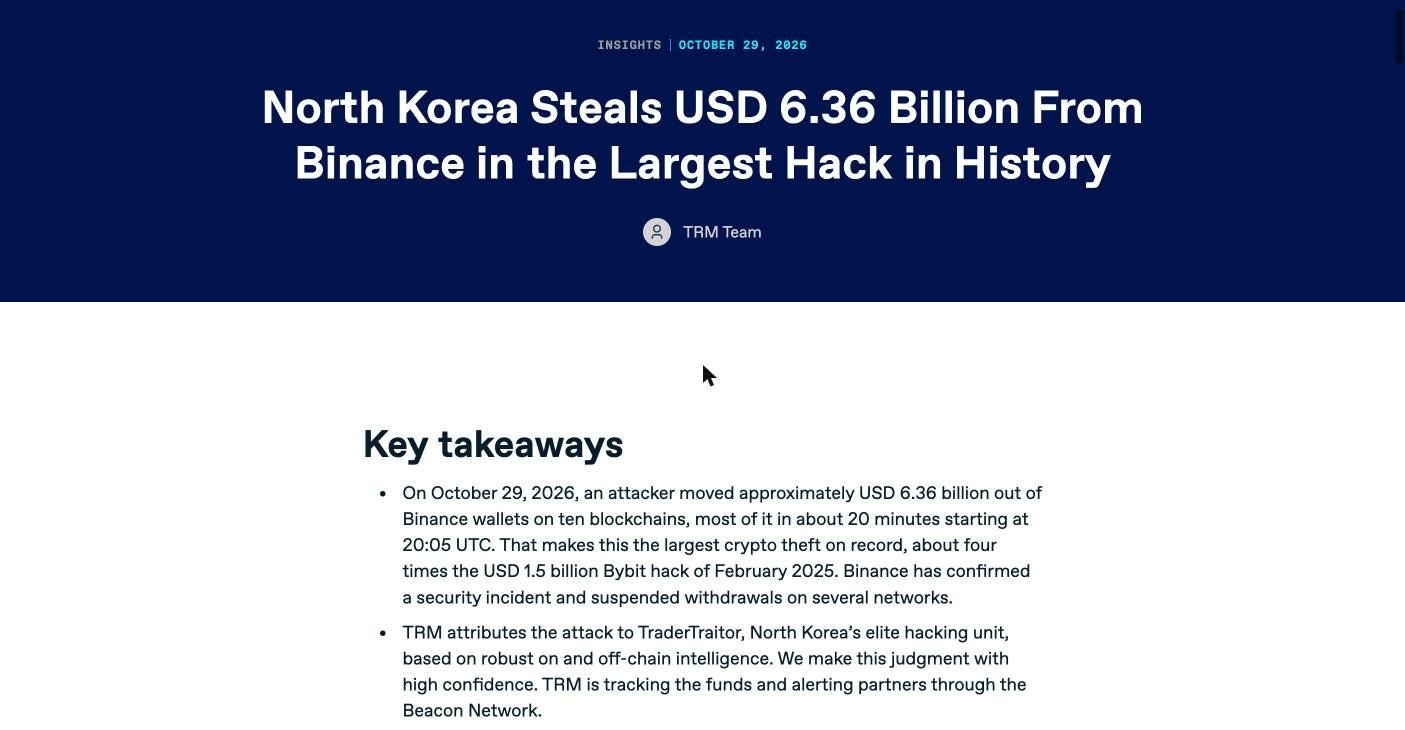
At 20:05 UTC on October 29, 2026, five Binance wallets on the XRP Ledger sent 233.46 million XRP to a single address. Within about 20 minutes, most of $6.36 billion had left Binance wallets on ten blockchains, according to TRM Labs. It is the largest crypto theft on record. Until that night, the Bybit hack of February 2025, at roughly $1.5 billion, held the title.
Then people did what they now do first. They asked an AI. I did the same. At 10:32 UTC on October 30, 14 hours and 27 minutes after the first transfer, I put eight questions to four engines: ChatGPT, Claude, Perplexity and Google’s AI Overviews.
So what did the engines say? Three of the four got the central facts right. They named the $6.3 billion estimate, the roughly $3 billion frozen, the withdrawal pause and the North Korea attribution, each with the right caveats. One did not. Claude answered four of my eight questions as if the theft never happened. On one of them it wrote, “I found no exchange-level hack” in 2026.
That gap matters more than any one engine’s score. The same engine answered “Did Binance get hacked?” correctly and “How much was stolen in the Binance hack?” wrongly. And the numbers behind the right answers did not agree with each other. In about 12 hours, credible sources reported the loss as $5.3 billion, $5.7 billion, $5.9 billion, $6.3 billion, $6.36 billion, $6.4 billion and $6.43 billion. Here is what you will get:
- The timeline: the first 14 hours, with timestamps and sources.
- The numbers: charts of every loss and freeze estimate, and why they differ.
- The test: eight questions, four engines, a scoreboard and screenshots.
- The cause: why one engine got the same story wrong, and what I can and cannot prove.
- The plan: ten steps and a 20-question panel for any brand in a crisis.
If you run communications, marketing or growth at an exchange, a fintech or a fund, jump to the plan first. It takes five minutes. Otherwise, start with what happened.
What happened in the Binance hack, hour by hour
Start with the facts, because the AI answers only make sense next to them. The timeline below comes from TRM Labs, Binance’s own announcement and Chainalysis. All times are UTC.
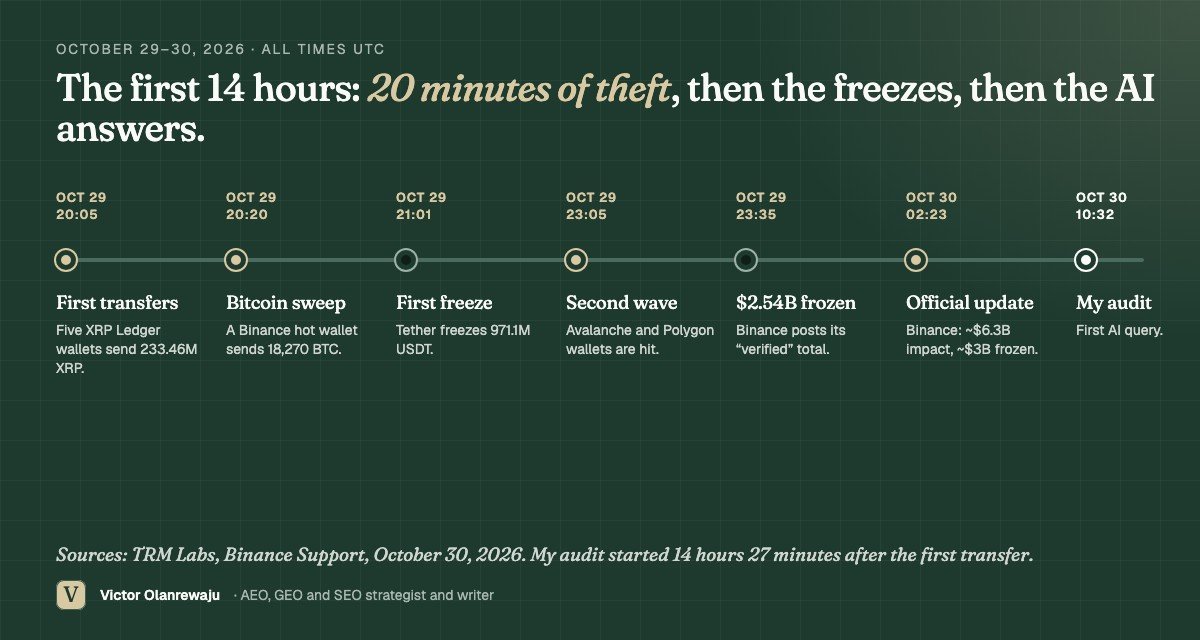
TRM says preparation began at least 36 hours before the theft, when the attacker’s operator wallet received three small Tornado Cash withdrawals. On October 29, the attacker tested its code on two wallets, rehearsed it on a third, and installed it on a Binance hot wallet about four hours later. Then the theft started. The first transfers hit the XRP Ledger. At 20:20 UTC, a Binance Bitcoin hot wallet sent 18,270 BTC to an attacker address. Within two minutes, a Tron wallet sent 612.7 million USDT and 46.4 million TRX. A second wave reached Avalanche and Polygon around 23:05 UTC.
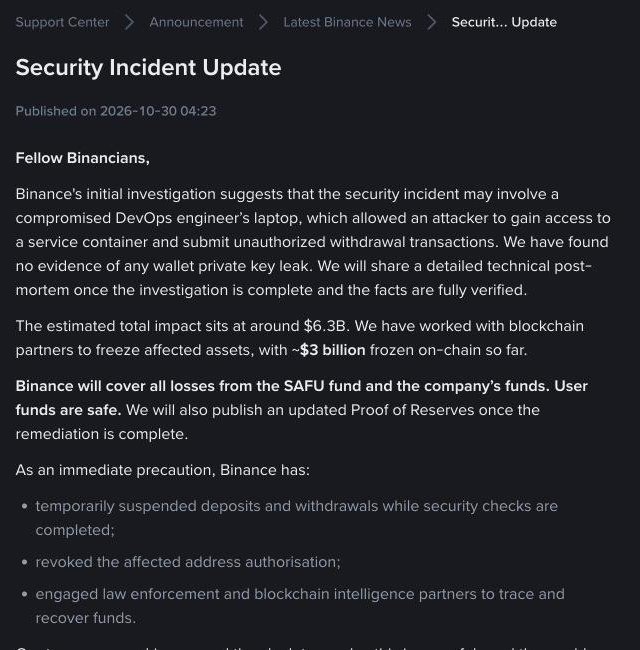
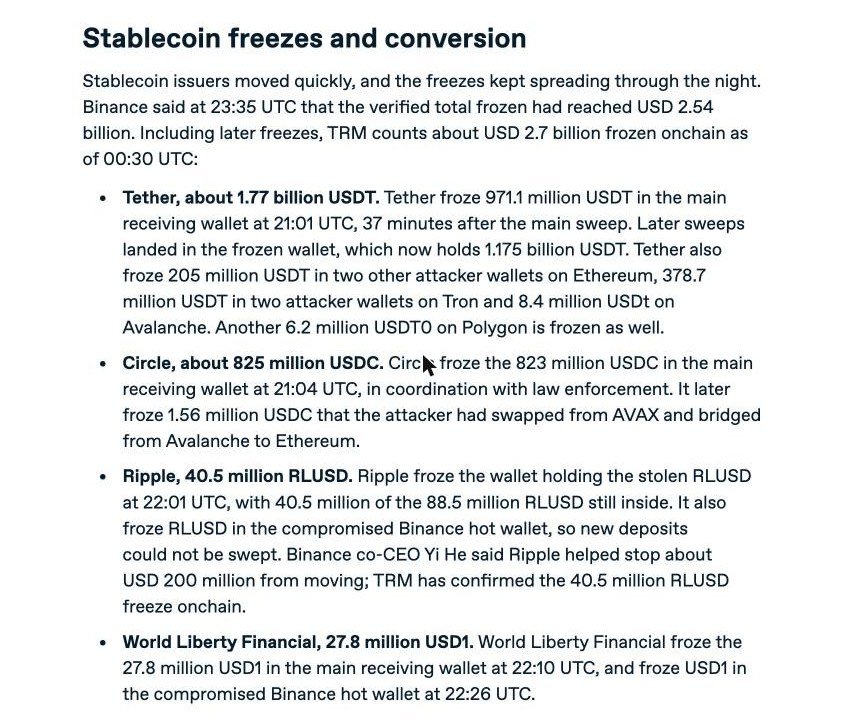
The freezes started within the hour. Tether froze 971.1 million USDT at 21:01 UTC, 37 minutes after the main sweep. Circle froze 823 million USDC at 21:04 UTC. Binance said at 23:35 UTC that its “verified” frozen total had reached $2.54 billion. At 02:23 UTC on October 30, it posted a formal Security Incident Update. Here is what that update, and everyone else, has actually established so far.
| Claim | Status | Who says so |
|---|---|---|
| About $6.3 billion in total impact | Binance’s preliminary estimate | Binance Support, October 30 |
| About $3 billion frozen on-chain | Binance statement. Frozen is not the same as recovered. | Binance Support, October 30 |
| Cause may be a compromised DevOps engineer’s laptop | Preliminary. Binance later said it found more points of breach. | Binance Support. BBC reported the later update. |
| No wallet private key leak | Binance says it found no evidence of one | Binance Support, October 30 |
| Ten blockchains drained, most of it in about 20 minutes | Onchain analysis | TRM Labs, Chainalysis, Elliptic |
| North Korea’s TraderTraitor group is responsible | At hour 14, attribution came only from analytics firms: TRM said high confidence, Elliptic said “likely.” Update: the FBI attributed the theft to North Korea on October 31. North Korea denies it. Binance has not named a culprit itself. | FBI (October 31), TRM Labs, Chainalysis, Elliptic, Al Jazeera |
| Binance will cover all losses | Binance pledge, using its SAFU fund and company funds | Binance Support, October 30 |
| Withdrawals return within about 48 hours | A target, not a guarantee | Binance, on X and Binance Square |
Notice what the official announcement leaves out. The version I read does not give the date of the incident, a breakdown by chain, or the attacker’s identity. It does promise a technical post-mortem and an updated Proof of Reserves, with no dates. Remember that gap. Whoever else is in the index fills it.
Where the money went, by chain
TRM traced every transfer from Binance-attributed wallets to attacker addresses. Ethereum took the biggest hit, followed by Bitcoin. The chart below uses TRM’s figures, valued at the price when each asset was taken.
TRM Labs: value taken from Binance wallets by chain, at theft-time prices ($ billions)
How big is it, really?
The scale is hard to hold in your head. So compare it. Elliptic puts the Bybit hack at $1.46 billion, which makes this theft more than four times larger. And TRM’s 2026 Crypto Crime Report, as cited by Al Jazeera, counted $2.87 billion stolen in nearly 150 incidents across all of 2025. This one night is more than twice that.
One night against a year: crypto theft in context ($ billions)
How much was stolen? 7 numbers for 1 theft
Here is the first reason AI answers drift. The facts themselves moved. Each estimate below is legitimate. Each is also dated, and each uses its own method.
Reported loss estimates, October 29–30, 2026 ($ billions)
Why do they differ? Four reasons stand out.
- Timing. Firms updated as they traced more wallets. TechCrunch wrote at 3:27 PM PDT that Binance may have lost “upward of $5.7 billion,” and called the numbers unconfirmed. CoinDesk later reported Chainalysis at about $5.9 billion. Chainalysis’s own blog now says about $6.4 billion.
- Valuation. TRM values each transfer at the price when it happened, which gives $6.36 billion. At later prices, the same assets are worth about $6.23 billion. Elliptic also values at the time of theft.
- Definition. Binance says “estimated total impact.” The analytics firms count assets moved out of wallets. Those are not always the same thing.
- Method. Each firm traces a different set of addresses, with different cut-offs.
The same pattern shows up in what remains in the attacker’s hands. TRM says the attacker still holds more than 420,000 ETH and 18,270 BTC, about $2.4 billion beyond issuers’ reach. Elliptic says about $3.33 billion. Both are careful firms. They counted at different moments, with different prices.
How much is frozen? A moving target
Frozen funds follow the same pattern, and they matter more to users. Only stablecoin issuers can freeze tokens. Elliptic says stablecoins make up 94% of what is frozen, and that native assets such as BTC, XRP and SOL cannot be frozen. So the frozen total climbed as each issuer acted.
Reported frozen totals, October 29–30, 2026 ($ billions)
Reference table: who said what, and when
| Source | Loss estimate | Frozen estimate | As of |
|---|---|---|---|
| TechCrunch | “At least $2 billion” drained, “upward of $5.7 billion” by some estimates, flagged as unconfirmed | Tether about $1.56 billion, Circle about $800 million | 3:27 PM PDT, Oct 29 (22:27 UTC) |
| CoinDesk | Binance about $6.3 billion. Chainalysis about $5.9 billion. Arkham: over $5.7 billion in the hacker’s wallets. | About $3 billion, including $2.3 billion in USDT and USDC | Updated 12:16 AM EDT, Oct 30 (04:16 UTC) |
| Binance (X) | Not stated | $2.54 billion “verified” | 23:35 UTC, Oct 29, as reported by TRM |
| TRM Labs | $6.36 billion at theft-time prices ($6.23 billion at later prices) | About $2.7 billion | 00:30 UTC, Oct 30 |
| Binance Support | About $6.3 billion | About $3 billion | Published 02:23 UTC, Oct 30 |
| Chainalysis | About $6.4 billion | About $2.8 billion “so far” | Blog dated Oct 30 |
| Elliptic | $6.43 billion | $2.84 billion, 94% in stablecoins | Updated 08:00 UTC, Oct 30. Freezes counted at about 07:00 UTC. |
The test: 8 questions, 4 engines, 1 morning
Now the experiment. I wrote eight questions that a worried customer, a journalist or an investor might type. I kept the wording plain and used no brand tricks. Then I asked each engine, in a fresh chat, between 10:32 and 10:50 UTC on October 30.
| # | Question | What it tests |
|---|---|---|
| 1 | Did Binance get hacked? | The basic event check |
| 2 | How much was stolen in the Binance hack? | The headline number |
| 3 | How much has Binance frozen after the hack? | The fastest-moving number |
| 4 | Is my money safe on Binance right now? | The customer worry, with a “now” cue |
| 5 | Has Binance resumed withdrawals? | Live status and dates |
| 6 | Who hacked Binance? | Attribution and caveats |
| 7 | How did the Binance hack happen? | Cause, and preliminary versus confirmed |
| 8 | Is the Binance hack the biggest crypto hack ever? | Comparison and context |
I scored each answer against the primary sources above. Correct means the answer reports the October 2026 theft, and its central facts match those sources. Slip means it is right overall but gets a detail wrong or blurs it. Missed means it leaves out the 2026 theft or says none happened.
| Engine | How I ran it | Answers captured |
|---|---|---|
| ChatGPT | Logged-in free account, web search switched on for each prompt | 8 of 8 |
| Google AI Overviews | US English search in Chrome, one query per question | 8 of 8 |
| Claude | Logged-in paid account, Opus 5.5, web search used on every run. Question 2 was run twice. | 8 of 8 |
| Perplexity | Logged out. Its free limit stopped me after five answers, and I did not sign in. | 5 of 8 (3 in full, 2 lead lines only) |
Scoreboard: who got the Binance hack right at hour 14
Here is the full grid. One result stands out at once. Claude’s misses all sit on questions that treat “the Binance hack” as a noun with no time cue.
| Question | ChatGPT | Google AI Overviews | Perplexity | Claude |
|---|---|---|---|---|
| 1. Did Binance get hacked? | Correct | Correct, but gives a $5.3–6.3 billion range | Correct | Correct |
| 2. How much was stolen? | Correct | Correct, but leans on an older $5.9 billion Chainalysis figure | Lead line correct. Rest not captured. | Missed (twice) |
| 3. How much frozen? | Correct | Correct | Lead line correct. Rest not captured. | Correct |
| 4. Is my money safe? | Correct | Correct | Not captured | Correct |
| 5. Withdrawals resumed? | Correct | Correct | Slip: says “late Sunday, October 31/early November.” October 31 is a Saturday. | Correct |
| 6. Who hacked Binance? | Correct | Correct | Correct | Missed |
| 7. How did it happen? | Correct | Correct | Not captured | Missed |
| 8. Biggest hack ever? | Correct | Slip: calls EIP-7702 a “smart contract loophole” and blends it with the laptop theory | Not captured | Missed |
Answers that reported the 2026 theft correctly, among answers captured (%)
What each engine said
Google AI Overviews: the strongest, with 1 blurred detail
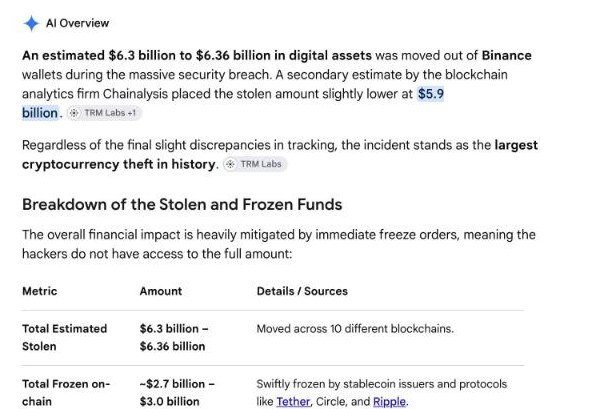
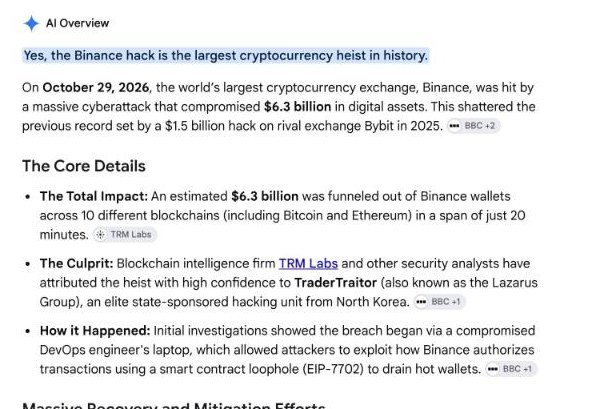
Google answered all eight questions with the 2026 theft and kept it dated. On “How much was stolen?” it gave a range of $6.3 billion to $6.36 billion and added Chainalysis at $5.9 billion. It listed the frozen total as roughly $2.7 billion to $3.0 billion. On “Is my money safe?” it said funds face “elevated risk” while Binance investigates, and it still quoted Binance’s own promise. Two details deserve a flag. The $5.9 billion Chainalysis figure was already out of date, because Chainalysis’s blog now says about $6.4 billion. And on the “biggest hack” question, Google wrote that the attacker used “a smart contract loophole (EIP-7702).” EIP-7702 is a legitimate Ethereum feature. TRM and Chainalysis describe valid signed authorizations that let a Binance hot wallet run attacker-deployed code. TRM says that points to compromised signing infrastructure, not a flaw in the feature. Google also merged that theory with Binance’s preliminary laptop explanation, as if both were settled.
ChatGPT: accurate, careful and a little long
ChatGPT, with web search on, got all eight right. It cited “Binance Support” on most answers and hedged the right claims. On question 1, it called the $6.3 billion a preliminary estimate that “should not be interpreted as a confirmed final theft total.” On question 4, it told users not to deposit more until withdrawals resume and to ignore anyone offering to “expedite” them. On question 7, it explained EIP-7702 correctly as a legitimate feature, and it called the laptop story “an initial hypothesis.” Two items looked suspicious at first, so I checked them. ChatGPT said about $3.3 billion was “not yet frozen.” No source published that number. It is the Binance estimate minus the frozen amount. But it lands close to Elliptic’s $3.33 billion that the attacker still holds beyond issuers’ reach, so I did not score it as an error. ChatGPT also listed the Ronin hack at $540 million. Some tallies price it that way, and most reports say $625 million. So that gap is valuation method, not a mistake.
Perplexity: right on what I could capture, with 1 date slip
Perplexity opened question 1 with “Yes. Binance confirmed a major security breach on October 29, 2026,” and it separated what was confirmed from what was not. On “Who hacked Binance?” it said North Korea was “a strong attribution by independent investigators, not a confirmed claim by Binance.” That is the right framing. But on question 5 it wrote that Binance’s 45-hour target “would put the target around late Sunday, October 31/early November.” October 31, 2026 is a Saturday. Sunday is November 1. It hedged, but it still got the day and date wrong. It is a small slip, and it is exactly the kind of detail a trader would act on. My free access stopped after five answers, so I cannot score its other three questions. I will add them in the next update.
Claude: right on the news, wrong on the neutral questions
Claude’s result is the reason this article exists. On “Did Binance get hacked?” it was excellent. It named the date, the $6.3 billion estimate, the $3 billion frozen and the North Korea attribution, and it added that “not every report agrees on the details yet.” It was also right on questions 3, 4 and 5. Then the framing changed.
- “How much was stolen in the Binance hack?” Claude answered with two incidents, 2019 and 2022, and never mentioned 2026. I ran it twice. It did the same both times.
- “Who hacked Binance?” Claude said “nobody has been publicly identified,” again about 2019 and 2022.
- “How did the Binance hack happen?” Claude wrote, “If you mean a recent one, nothing on Binance’s own platform has come up in 2026.”
- “Is the Binance hack the biggest crypto hack ever?” Claude answered “No,” said Bybit holds the record, and wrote, “2026: I found no exchange-level hack.”
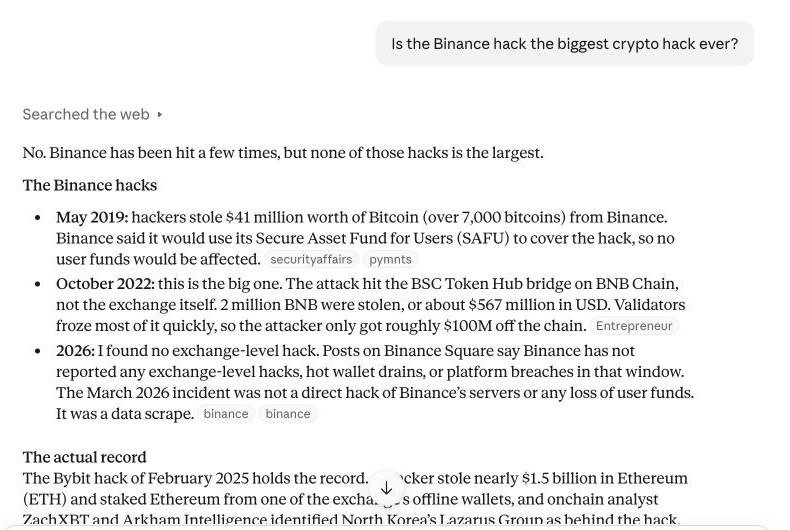
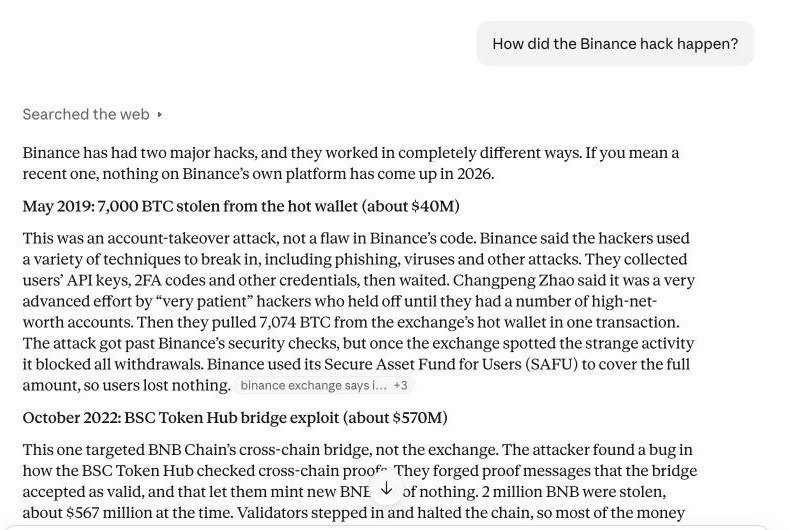
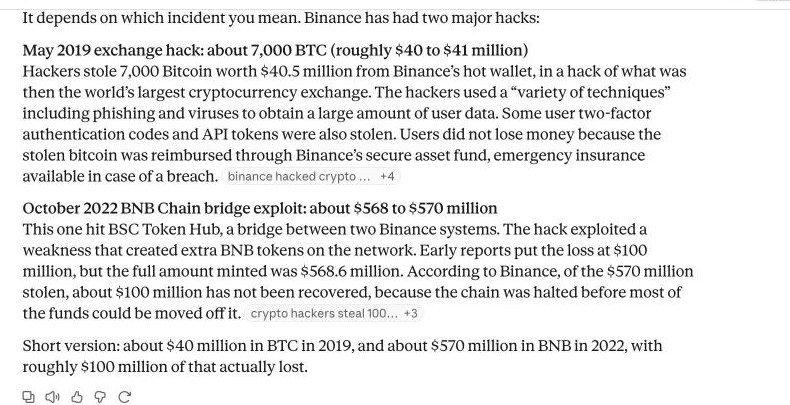
To be fair, Claude did search the web on every run. It was not guessing from memory. It found the wrong pages, and it trusted them. That is a retrieval problem, and it is the one your brand can influence.
Why 1 engine got the same story wrong
I cannot see inside Claude, so treat this section as an evidence-based reading, not a proof. Here is what the data supports.
- “The Binance hack” now has three referents. Three incidents carry the name: about $40 million in 2019, about $570 million on Binance’s BNB Chain bridge in 2022, and $6.3 billion in 2026. The first two have years of articles, links and citations behind them. The third has hours.
- The misses used no time cue. Claude’s four misses used “the Binance hack” as a noun phrase. Its four hits used cues such as “Did Binance get hacked,” “after the hack,” “right now” and “resumed.” That is a pattern across eight answers. It is not a rule.
- Old pages win on authority. Perplexity’s source list for “How much was stolen?” held at least three pages about the 2019 theft, from Bitdefender, Reuters and Mashable, next to BBC and Fortune. The engines were shown the old pages too. Some chose better.
- A stale primary page can anchor the answer. Claude cited a source labeled “Binance Square: 2026 security context” in two of its misses, and it wrote that posts there showed no exchange-level hack. I did not open that post, so I cannot say what it said or when it was written. But Claude used it to support a “no hack” reading.
- The official statement left room. Binance’s announcement has no incident date and no breakdown, and it came out hours after the news broke. Third parties filled the gap. The engines then chose among them.
Two cautions apply. AI answers vary from run to run. SparkToro and Gumshoe.ai found the same brand list in under 1% of repeated runs in an earlier study I cite in my tools comparison. And my sample is small. So read “Claude missed four of eight” as a warning about where to look, not as a verdict on the product.
What the research says about AI and breaking news
Do other studies see the same weakness? Yes, though they test news publishers, not crypto. The EBU and BBC study reviewed more than 3,000 answers from ChatGPT, Copilot, Gemini and Perplexity, checked by journalists at 22 public media organizations in 18 countries. It found at least one significant issue in 45% of answers. EBU’s own page says “almost half,” with about “a third” showing sourcing problems and “a fifth” showing accuracy issues, including “hallucinated and/or outdated information.” An earlier Tow Center study in Columbia Journalism Review tested eight AI search tools on 1,600 queries and found they answered incorrectly more than 60% of the time overall. Perplexity did best at 37% wrong, and Grok 3 did worst at 94%. ChatGPT Search signaled low confidence only 15 times in 200 responses.
These studies are older than my test, and the tools have changed. My eight questions on one event cannot confirm or refute them. But they point the same way. When a story is fresh, answers lean on whatever is already indexed, and they rarely say what they do not know. For the wider picture, see my AI search statistics and my note on AI citation versus AI recommendation.
A crisis answer-readiness playbook for exchanges and fintech brands
Most brands plan for the crisis. Few plan for what AI says about it. Based on what failed in this test, here are ten steps. They are my recommendations, not guarantees. Nobody controls what an engine says. You can control what it finds.
| Step | What to do | Why, from this test |
|---|---|---|
| 1. Publish one canonical incident page | Use one stable URL. Put a timestamp and a change log at the top. Update it in place. Never publish a new URL per update. | Binance’s update lived on a support page. Aggregators and live blogs filled the search results around it. |
| 2. Open with the answer | Start with two sentences: what happened, and what you know and do not know. Add the date of the incident. | Binance’s announcement had no incident date. Every engine took it from someone else. |
| 3. Show a numbers table with definitions | List the loss, the frozen amount, the recovered amount and the as-of time. Define each. Update the “as of” every time. | Seven loss figures and eight frozen figures circulated in 12 hours. A defined table gives engines one citable number. |
| 4. Write for the neutral questions | Add a Q&A for “How much was stolen,” “Who did it,” “How did it happen” and “Is it the biggest ever.” Use those exact words, with the year. | Claude failed on exactly these neutral phrasings. |
| 5. Link your old incidents to the new one | On each old incident page, add “See also: the October 2026 incident.” Say what changed. | Old pages with strong links pulled the answers back to 2019 and 2022. |
| 6. Keep your statements consistent | Use the same numbers and wording on your site, on X and in press notes. Correct fast, and say you corrected. | Engines quote whichever version they find first. Conflicts breed hedged, blurred answers. |
| 7. Earn third-party confirmation | Make it easy for reputable analysts, regulators and press to cite your page. Link to their reports. | The best answers cited TRM, Chainalysis, Elliptic, BBC and Reuters, not company pages alone. |
| 8. Check bot access, even in a crisis | Make sure your firewall and robots.txt do not block search bots. Crisis-mode security rules often do. | An engine cannot cite a page it cannot fetch. See my AI crawlers guide. |
| 9. Test AI answers on a schedule | Run a fixed panel at hour 1, 6, 24, 72 and day 7. Log the answer, the sources and the time. See my method for checking what ChatGPT says. | The answers I saw were correct at hour 14. They will not stay that way without checks. |
| 10. Pre-write the template before you need it | Draft the incident page, the numbers table and the Q&A now. Keep them approved and ready. | The brands in the best position have an hour’s head start in a 20-minute event. |
This is the same discipline I use in normal times. My crypto SEO guide, my piece on why AI engines rarely cite CoinGecko and my guide to getting cited by ChatGPT cover the building blocks. A crisis is the same game at ten times the speed. For the strategy behind it, read why Google rankings do not match ChatGPT mentions.
The 20-question panel to run on your own brand
You can run this in 15 minutes. Replace “Brand” with your name. Open a fresh chat for each question, and when you can, test logged out. Run each question three times, because answers change. Record the time, the answer, the sources and any error.
| Group | Questions |
|---|---|
| Facts | Did Brand get hacked? When did the Brand hack happen? How did the Brand hack happen? How much was stolen in the Brand hack? Is the Brand hack the biggest ever? |
| Money | How much has Brand frozen? Will Brand reimburse users? Is my money safe on Brand right now? Is Brand solvent? Can I still deposit on Brand? |
| Status | Has Brand resumed withdrawals? When will Brand reopen? Is Brand down right now? Is the US arm of Brand affected? |
| Blame | Who hacked Brand? Was it North Korea? Has anyone been arrested? |
| Response | What did Brand say about the hack? Should I move my crypto off Brand? |
Score each answer the way I did: correct, slip or missed. Then trace every miss to the page that caused it. If you want a tool to automate the panel, compare the options in my review of AI visibility tools.
How I ran this, and the limits
- One snapshot. All answers were captured between 10:32 and 10:50 UTC on October 30, 2026, about 14.5 hours after the first transfers. The brief for this study called for 24-hour, 72-hour and 7-day snapshots. I am running those next.
- Small sample. Eight questions per engine. AI answers vary between runs, so one run is not a rate.
- Personalized accounts. My Claude account has memory, my ChatGPT account is logged in, and Google may personalize. A neutral account could give different answers. I turned on ChatGPT’s search mode, so its default behavior may differ.
- Perplexity is incomplete. The free logged-out limit stopped me. I did not sign in to work around it.
- The story is moving. Binance has promised a post-mortem. Figures, causes and attribution may change. I scored answers against what the primary sources said at that hour.
- Attribution has moved. At hour 14, only TRM, Chainalysis and Elliptic pointed to North Korea’s TraderTraitor group. On October 31, the FBI attributed the theft to North Korea and published laundering addresses. North Korea denies it, and the FBI has not published its full forensic findings. Everything scored in Snapshot 1 was judged against the facts at that hour.
Snapshot 2: what changed in 3 days
I reran the questions on November 4, 2026, at about hour 133. Three things had happened since Snapshot 1. The FBI published an alert on October 31 attributing the theft to North Korea. Binance began reopening withdrawals in phases, on November 1 and again on November 3, according to its Recovery Updates. And Binance published an incident report on November 3. Press coverage says it describes a fake job interview and a tampered tool, but I did not read the report itself.
| Question | ChatGPT | Google AI Overviews | Claude |
|---|---|---|---|
| 2. How much was stolen? | Correct: about $6.3 to $6.4 billion | Not rerun | Correct. At Snapshot 1 this was Missed. |
| 5. Withdrawals resumed? | Correct: phased reopening from November 1 and November 3, which matches Binance’s own updates | Not rerun | Not rerun |
| 6. Who hacked Binance? | Current: cites the FBI attribution | Current: FBI, TraderTraitor and North Korea’s denial | Stale: says the FBI “hasn’t publicly named a culprit,” but it did on October 31 |
| 7. How did it happen? | Current: fake job interview and tampered tools | Current: social engineering through fake job interviews | Stale: the laptop and signing-infrastructure theory, and it says no post-mortem exists yet |
| 8. Biggest hack ever? | Correct | Not rerun | Correct. At Snapshot 1 this was Missed. |
Two readings follow, and the second is my inference. First, the freshness gap is now measurable. Google’s AI Overview cited stories that were 30 minutes to 17 hours old, and ChatGPT cited the new report and the FBI. Claude caught up on the headline number within three days, but it lagged on attribution and cause, the two details that changed most. Second, “the engine got it right” is not a stable state. The same engine can be right on one question and stale on the next, which is why a single check is never enough.
One caution. ChatGPT also quoted a frozen total of $2.85 billion and said Binance had replenished 98% of affected assets. I could not confirm either figure at a primary source, so I have not used them above. This mirrors the article’s main point: numbers keep moving, and each engine repeats whichever version it finds.
Work with me
If you lead communications, marketing or growth at an exchange, a fintech, a fund or a founder-led finance brand, you now know the weak point. AI answers are not just a ranking problem. In a crisis, they are a reputation problem, and they update by the hour.
I help brands see what ChatGPT, Gemini, Perplexity, Claude and Google actually say about them, and then fix the pages and facts those engines read. These are the options on my pricing page, checked October 30, 2026:
| Option | Price | What you get |
|---|---|---|
| Free AI visibility audit | Free | A score out of 100, the top fixes, and a manual check of what ChatGPT, Gemini and Perplexity say about you |
| Manual AI visibility report | $120 | 25 prompts tested across ChatGPT, Gemini, Perplexity, Claude and Google AI Overviews, with a written summary |
| Growth retainer | $650 per month | A 25-prompt panel across five AI engines with two competitors compared, four answer-first pages or articles, one digital PR round, and a monthly report and call |
| Scale retainer | $1,250 per month | A 50-prompt panel across five AI engines with four competitors compared, eight pages or articles, two digital PR rounds, and fortnightly calls |
Retainers report monthly. A live incident needs a faster rhythm. If that is your situation, tell me the cadence you need and the engines that matter most, and I will tell you honestly what I can do. I cannot promise what an engine will say. I can promise a clear fix list.
Start with the free audit. It takes no payment details, and you get a plain-English report by email within one business day. Prefer to talk first? Message me with your brand, your market and the question you worry about most.
Run the free AI visibility audit
Contact me, or see my pages on AEO and GEO. For e-commerce examples, read how Lens & Co reached first place in ChatGPT answers.
Update log
- October 30, 2026, 10:32–10:50 UTC: Snapshot 1 (hour 14.5). Four engines, eight questions. Published.
- November 4, 2026, about 09:12 to 09:45 UTC: Snapshot 2, at hour 133. This was about 2.5 days later than I promised (hour 72). I should have run it on November 1. It covers five questions on ChatGPT and four on Claude and Google. Perplexity is still pending, because its free limit needs a login that I do not provide.
- Planned, November 5, about 20:05 UTC: Snapshot 3 (day 7). Same questions, plus a check of whether Binance’s post-mortem changed the answers.
Related reading: SEO, AEO and GEO explained.
Frequently asked questions
Did Binance get hacked?
Yes. Binance confirmed a security incident on October 29–30, 2026 and estimated the total impact at about $6.3 billion. Analytics firms put the amount moved out of Binance wallets at $6.36 billion (TRM Labs) to $6.43 billion (Elliptic). Binance says it will cover all losses and that user funds are safe.
How much was stolen in the Binance hack?
Binance estimates about $6.3 billion. TRM Labs counts $6.36 billion at theft-time prices, Chainalysis says about $6.4 billion and Elliptic says $6.43 billion. Early reports ranged from $5.3 billion to $5.9 billion. The figures differ because of timing, valuation date and method.
How much has Binance frozen?
Binance says about $3 billion is frozen on-chain. Earlier it reported a verified $2.54 billion. TRM counted about $2.7 billion, Chainalysis about $2.8 billion and Elliptic $2.84 billion. Only stablecoin issuers can freeze tokens, and frozen funds are not the same as recovered funds.
Who hacked Binance?
The FBI attributed the theft to North Korea on October 31, 2026, and calls the group “TraderTraitor.” TRM Labs, Chainalysis and Elliptic reached the same conclusion earlier. North Korea denies it. Binance has not named a culprit itself.
How did the Binance hack happen?
Binance’s first finding was a compromised DevOps engineer’s laptop, and it later found more points of breach. Press coverage of Binance’s November 3 incident report says the attack began with a fake job interview and a malicious coding assignment. TRM and Chainalysis describe signed authorizations that let a hot wallet run attacker code. I did not read the full report.
Is my money safe on Binance?
Binance says user funds are safe and that it will cover all losses with its SAFU fund and company funds. Nobody outside Binance has verified that yet, and an updated Proof of Reserves is pending. This is not financial advice.
Has Binance resumed withdrawals?
Yes, in phases. Binance reopened a first group of networks and assets on November 1, 2026 and more on November 3, according to its Recovery Updates. Availability depends on the asset and network, so check Binance’s official status for yours.
Why do AI answers about the Binance hack differ?
The facts moved quickly, and each source dates and values them differently. Engines also retrieve different pages. In my test, one engine answered neutral questions with Binance’s 2019 and 2022 hacks and missed the 2026 theft entirely.
Which AI engine was most accurate about the Binance hack?
In my October 30 snapshot, ChatGPT with search on and Google AI Overviews answered all eight questions correctly. Perplexity was right on the five answers I captured, with one date slip. Claude was right on four of eight. One snapshot is not a verdict, and results change by the hour.
How accurate are AI Overviews for breaking news?
In my test, Google’s AI Overview was correct on eight of eight questions about the Binance hack, with one blurred detail about EIP-7702. Wider research is less kind. An EBU and BBC study found at least one significant issue in 45% of AI news answers.
How can a company control what AI says during a crisis?
You cannot control it, but you can shape what engines find. Publish one canonical, timestamped incident page. Open with the answer and the incident date. Add a defined numbers table, write for neutral questions, link old incidents to the new one, and keep every statement consistent.
How often should I test AI answers during a crisis?
Run a fixed question panel at hour 1, 6, 24, 72 and day 7. Log the answer, the sources and the time. Answers can be right at one hour and wrong at the next, so one check is not enough.
Can I hire you to check how AI describes my brand?
Yes. Start with the free AI visibility audit, or order a manual AI visibility report for $120 that tests 25 prompts across five engines. For a faster rhythm during an incident, contact me with your brand and market.