In this article
- Who owns the “best” searches in fintech: 6 queries checked
- Why this matters for AI answers: Conductor’s data on financial services
- What the winning fintechs do differently
- A 9-step playbook to win the “best” search for your fintech
- The page template: a “best of” page that ranks and gets cited
- Compliance and trust: the guardrails finance pages need
- The 12-prompt test: see where you stand today
- Where I come in
- How I checked, and the limits
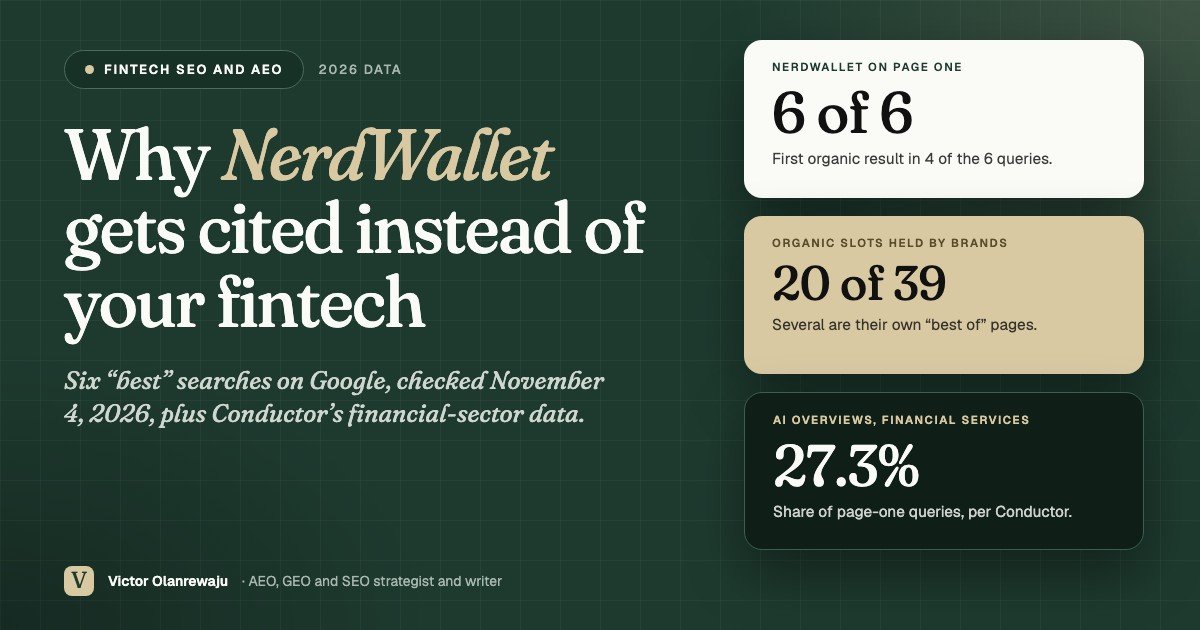
In short: NerdWallet does not win “best” searches by being better than your fintech. It wins because it answers the question the buyer asked, in a comparison format Google and AI engines can lift. I checked six US “best” searches on Google on November 4, 2026. NerdWallet was on page one for all six and the first organic result for four. But fintech brands held 20 of the 39 organic slots, and at least six were their own “best of” pages, from Mercury, Wise, Novo, Brex, Paybis and GrabrFi. So the playbook is not to outrank NerdWallet. It is to publish the honest comparison yourself, make your facts correct on the pages that list you, and show up where buyers ask. Conductor’s data adds the stakes: Google’s AI Overviews appear on 27.3% of financial services page-one queries, and NerdWallet and Bankrate lead the citations. Below you get the data, a nine-step plan, a page template and a 12-prompt test.
6 of 6
“Best” queries where NerdWallet was on page one, first organic result in 4
20 of 39
Organic slots held by fintech and bank brands, not publishers
27.3%
Financial services page-one queries with a Google AI Overview (Conductor)
10.14%
NerdWallet’s share of AI citations in financial services (Conductor)
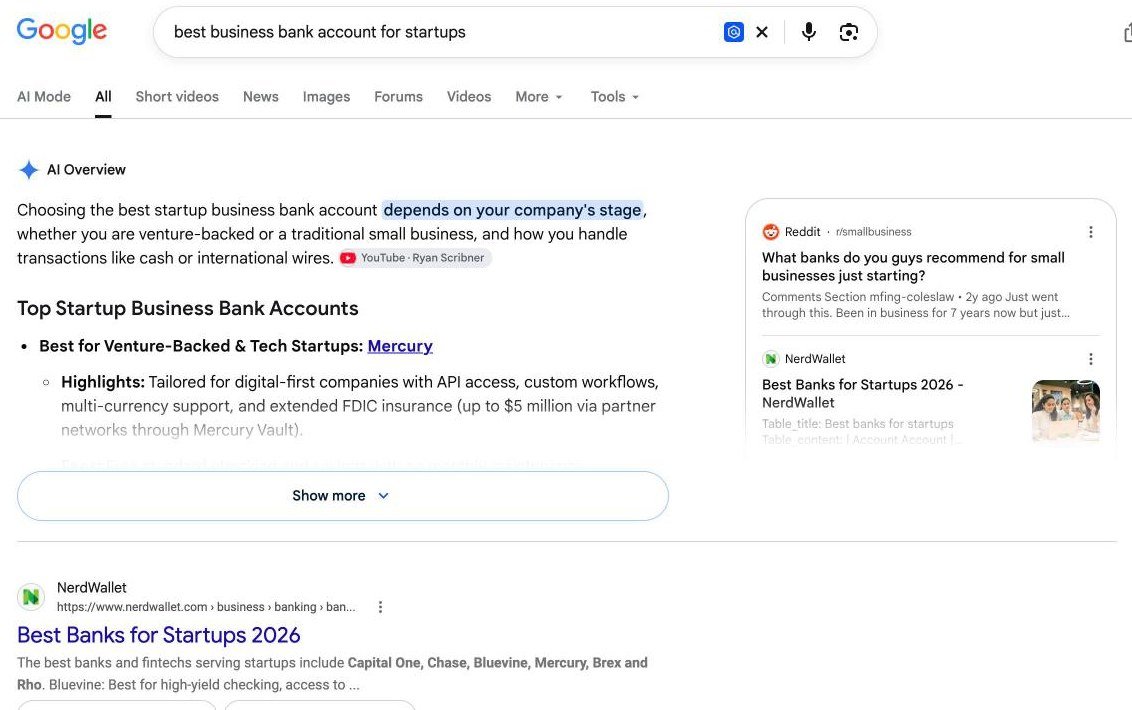
NerdWallet is not better than your fintech. It is easier to quote. That one difference explains why a comparison site keeps winning searches your product should win. Try it yourself. Search Google for “best business bank account for startups.” An AI Overview recommends Mercury. NerdWallet is the first organic result. A Reddit thread sits beside both.
The shelf is shrinking, too. Conductor found Google AI Overviews on 27.3% of financial services page-one queries. NerdWallet holds 10.14% of AI citations in the sector, and Bankrate holds 8.47%. ChatGPT drives 89.7% of AI referrals to financial sites. And Ahrefs found that when an AI Overview appears, clicks on the first organic result fall by about 58%. So ranking first matters less than it did. Being named inside the answer matters more.
There is good news. I checked six fintech searches on November 4, 2026. NerdWallet was on page one for all six, and it was the first organic result for four. Yet fintech brands still held 20 of the 39 organic slots. At least six of those were their own “best of” pages, from Mercury, Wise, Novo, Brex, Paybis and GrabrFi. Those brands did not wait to be listed. They wrote the list.
So why does NerdWallet get cited instead of your fintech? Short answer: it publishes the comparison the buyer wants, and fintechs mostly do not. The brands that do publish it, such as Mercury, Wise and Novo, show up beside NerdWallet. The rest are invisible at the exact moment of choice. Here is what you will get:
- The data: who owns page one for six fintech “best” searches, with counts.
- The stakes: how often AI Overviews appear in finance, and which sites they cite.
- The pattern: what the winning brands do differently.
- The plan: nine steps, a page template and a compliance checklist.
- The test: 12 prompts to run on your own brand this week.
If you lead growth or marketing at a fintech, a neobank, a payments company or a crypto exchange, go straight to the plan. Otherwise, start with the data.
Who owns the “best” searches in fintech: 6 queries checked
I ran six buying searches in Google with US settings and personalization off. I counted every organic web result, and set aside ads, videos and forum blocks. Then I sorted each result into three groups: brands (a bank or fintech’s own site), publishers (comparison sites, news and independent blogs) and app stores.
| Search (US) | First organic result | NerdWallet rank | Brand / publisher / app slots |
|---|---|---|---|
| best international money transfer service | Western Union (app page) | 4th of 7 | 4 / 1 / 2 |
| best business bank account for startups | NerdWallet | 1st of 7 | 5 / 2 / 0 |
| best payment processor for small business | NerdWallet | 1st of 6 | 5 / 1 / 0 |
| best neobank for freelancers | GrabrFi (blog) | 5th of 7 | 2 / 5 / 0 |
| best crypto exchange for beginners | NerdWallet | 1st of 5 | 1 / 2 / 2 |
| best online brokerage for beginners | NerdWallet | 1st of 7 | 3 / 4 / 0 |
| Total | NerdWallet first in 4 of 6 | On page one in 6 of 6 | 20 / 15 / 4 |
Who holds the 39 organic slots across six fintech “best” searches
Three findings stand out.
- NerdWallet is everywhere, but it is not alone. It was on page one for all six searches. Yet brands held more slots than publishers did, 20 against 15.
- Many brand slots are “best of” pages the brand wrote itself. Mercury ranked with “Best banks and business accounts for startups.” Wise ranked with a post on the cheapest payment processors. Novo ranked with “Best Bank for Freelance Developers.” Paybis, GrabrFi and Brex did the same. That is six of the 20. They do not wait to be listed. They write the list.
- Reddit and Quora appeared in all six searches. Buyers go to forums to check the claims, and the engines show them.
Why this matters for AI answers: Conductor’s data on financial services
Page one is only half the story. AI Overviews now sit above it. Conductor’s 2026 benchmark for the financial sector, built on US enterprise sites, quantifies how much they matter in finance and who they cite. The data covers AI traffic from May to September 2025 and AI Overviews from September 15 to October 12, 2025, so treat it as direction, not today’s exact share.
Google AI Overview prevalence on page-one queries, by sector (%)
| Finding (Conductor) | Number | What it means for a fintech |
|---|---|---|
| AI Overviews on financial services queries | 27.3% | About one in four buying queries gets an AI answer first. |
| Top AI citation share, financial services | NerdWallet 10.14%, Bankrate 8.47% | Two comparison sites take almost a fifth of citations. |
| Top AI Overview share of voice, financial services | NerdWallet 1.40%, Bankrate 1.31%, Experian 0.70% | Comparison sites hold the top two places, ahead of a credit bureau and a broker. |
| AI referral traffic share, financial services | 0.61% (financials overall 0.48%, banks 0.16%) | AI sends little traffic today, so do not expect a flood. Expect better-informed buyers. |
| Engines that drive financial AI referrals | ChatGPT 89.7%, Copilot above 5% | Test ChatGPT and Copilot, not only Google. |
Two broader numbers frame this. SE Ranking found AI referrals were 0.32% of traffic across 101,574 sites in 2026, up from 0.02% in 2024. And Ahrefs found position-one click-through is about 58% lower when an AI Overview is present. So the click you used to get from ranking first is shrinking, while the citation is becoming the new shelf space. For wider context, see my AI search statistics.
What the winning fintechs do differently
The data points to a pattern. Here it is, in the order that matters most.
- They write the “best of” page themselves. A buyer who searches “best business bank account” wants a comparison. Mercury, Wise and Novo give one, with competitors named. Google ranks it because it answers the query.
- They keep their own facts correct. Fees, limits, licensing and eligibility change. A publisher’s page can lag. A fintech that states its numbers clearly, with a date, gives engines something safe to quote.
- They are on the lists that matter, accurately. You cannot control a publisher’s ranking. You can check what each one says about you and use its corrections process when a fact is wrong.
- They show up in the forums. Reddit and Quora appeared in six of six searches. Real answers from real staff, with disclosure, carry weight there.
- They treat app stores as search results. Apple and Google Play took 4 of the 39 slots, in money transfer and crypto. The title, subtitle and description are search copy.
This follows the same logic as my study of why AI engines rarely cite CoinGecko: the engines cite pages that answer the question in the shape they need, and they lean on third parties to confirm it.
A 9-step playbook to win the “best” search for your fintech
| Step | What to do | Why | Effort |
|---|---|---|---|
| 1. List your buying queries | Write the 20 “best X for Y” and “X vs Y” searches your buyer uses. Pull them from sales calls and support tickets. | You cannot win searches you have not named. | 1 day |
| 2. Audit page one and the AI answer | For each query, record who ranks, what the AI Overview says, and which sources it cites. | It shows the gap, and the exact pages to beat or join. | 1 to 2 days |
| 3. Publish your own comparison pages | One page per query. Name competitors fairly. State criteria, fees with a date, and who each option is not for. | It is what Mercury, Wise and Novo do, and it is what ranks. | 1 week for the first five |
| 4. Lead with the answer | Open each page with a two-sentence verdict and a summary table. Put detail below. | Engines lift the first clear answer. | Included |
| 5. Make your facts quotable | Add a facts table to your product pages: fees, limits, licenses, countries, as-of date. | Wrong or missing facts get replaced by someone else’s version. | 2 to 3 days |
| 6. Check every publisher that lists you | Read what NerdWallet, Bankrate, Forbes Advisor and similar sites say about you. Use their corrections process for errors. | These pages are the most-cited sources in finance. | 1 day, then monthly |
| 7. Join the forum conversation | Answer questions on Reddit and Quora as a named employee, with disclosure. Never post fake reviews. | Forums appeared in six of six searches. | 2 hours a week |
| 8. Add schema and fix crawler access | Use Organization, FAQPage and Article schema. Check that search bots can read your pages. See my schema guide and crawler guide. | Engines cannot cite what they cannot read. | 2 days |
| 9. Test monthly | Run a fixed 20-prompt panel on ChatGPT, Gemini, Copilot, Perplexity and Google. Log mentions and sources. | Answers drift. My Binance audit showed answers change in days. | Half a day a month |
The page template: a “best of” page that ranks and gets cited
Use this outline for every comparison page. It works for Google, and it gives AI engines clean passages to quote.
| Section | What goes in it |
|---|---|
| Title and verdict | “Best [category] for [buyer] ([year])” followed by a two-sentence verdict and the date you last checked. |
| Summary table | Three to six options, with price, best for, not for, and licensing or coverage. Include competitors. |
| How we chose | Your criteria and weights, in plain words. Disclose that you make one of the products. |
| Each option | One short section: what it does well, where it falls short, the fee or limit that matters, and a source. |
| Who should pick which | Three “if you… choose…” lines. This is what AI answers reuse. |
| FAQ | Five real buyer questions, answered in two sentences, with FAQPage schema. |
| Update log | A dated list of changes. Engines and readers trust pages that show their age. |
Compliance and trust: the guardrails finance pages need
Finance is a high-trust category, so good pages show their work. Check each item with your compliance team before you publish.
- Date every fee and rate. “As of November 2026” beats an unqualified number.
- Disclose your interest on any page where you compare your own product.
- Substantiate claims. Link to the source for any “cheapest” or “fastest” statement.
- Name a reviewer. A byline and a reviewer with credentials help human readers and engines judge trust.
- Add the licensing line. State who is regulated by whom, in words a buyer can check.
- Skip guarantees. Do not promise returns, approvals or rankings.
The 12-prompt test: see where you stand today
Run each prompt on ChatGPT, Google, Gemini and Perplexity. Do it logged out if you can, and run it three times because answers vary. Record whether you are named, what the engine says, and which sources it cites.
| Type | Prompt | What to record |
|---|---|---|
| Best of | “Best [category] for [buyer] in [country]” | Are you named? Which publishers are cited? |
| Best of | “Best [category] for [use case]” | Who is first, and why does the engine say so? |
| Best of | “Cheapest [category] in [country]” | Does it quote your fees correctly? |
| Comparison | “[Your brand] vs [competitor]” | Is each fact right? What is missing? |
| Comparison | “[Competitor] alternatives” | Do you appear on the list? |
| Comparison | “Is [your brand] better than [competitor] for [need]” | What reason does it give? |
| Trust | “Is [your brand] legit” and “Is [your brand] safe” | Does it cite your license and reviews? |
| Trust | “[Your brand] fees” and “[Your brand] limits” | Are the numbers current? Which page does it cite? |
| Problem | “How do I [job your product does]” | Do you appear as a solution? |
| Problem | “[Your brand] problems” and “[Your brand] complaints” | What do the sources say? Can you respond? |
If you want it automated, compare the tools in my AI visibility tools review. For the manual method, see how to check what ChatGPT says about your business.
Where I come in
I have spent six years writing for crypto and finance outlets, and I now test what AI engines say about brands. I applied the same method to the Binance hack and to CoinGecko’s citation gap. For a fintech, crypto or payments brand, the work looks like this:
| Option | Price | What you get |
|---|---|---|
| Free AI visibility audit | Free | A score out of 100, your top fixes, and what ChatGPT, Gemini and Perplexity say about you |
| Manual AI visibility report | $120 | 25 prompts tested across five engines, with a written summary. Use the 12-prompt test above as the base. |
| Answer-first article | $80 each | 800 to 1,200 words, sourced, with an FAQ and schema |
| Standard foundation build | $850 | Up to 30 pages, an internal linking plan, five answer-first pages written for you and review request set-up, in about 3 to 4 weeks |
| Growth retainer | $650 per month | A 25-prompt panel across five engines with two competitors compared, four pages or articles and a monthly report |
I cannot promise a ranking or an AI citation. I can promise a clear fix list, sourced data and honest reporting. Prices are from my pricing page, checked November 4, 2026.
Start with the free audit. It takes no payment details, and you get a plain-English report by email within one business day. Not sure which queries matter? Tell me your product and your market, and I will tell you which ones to test first.
Run the free AI visibility audit
Contact me, or see my pages on AEO and GEO. For a crypto angle, read my crypto SEO guide.
How I checked, and the limits
- One snapshot. I ran six searches once, on November 4, 2026, in Chrome with US settings, personalization off and my account signed in. Results vary by day and location.
- Small sample. Six queries cannot describe all of fintech. Run your own twenty.
- My sorting is a judgment call. I classed Nav and Bitcoin Foundation as publishers, and Paybis and GrabrFi as brands, because they sell the products they discuss or compare. Another reviewer might split a few differently.
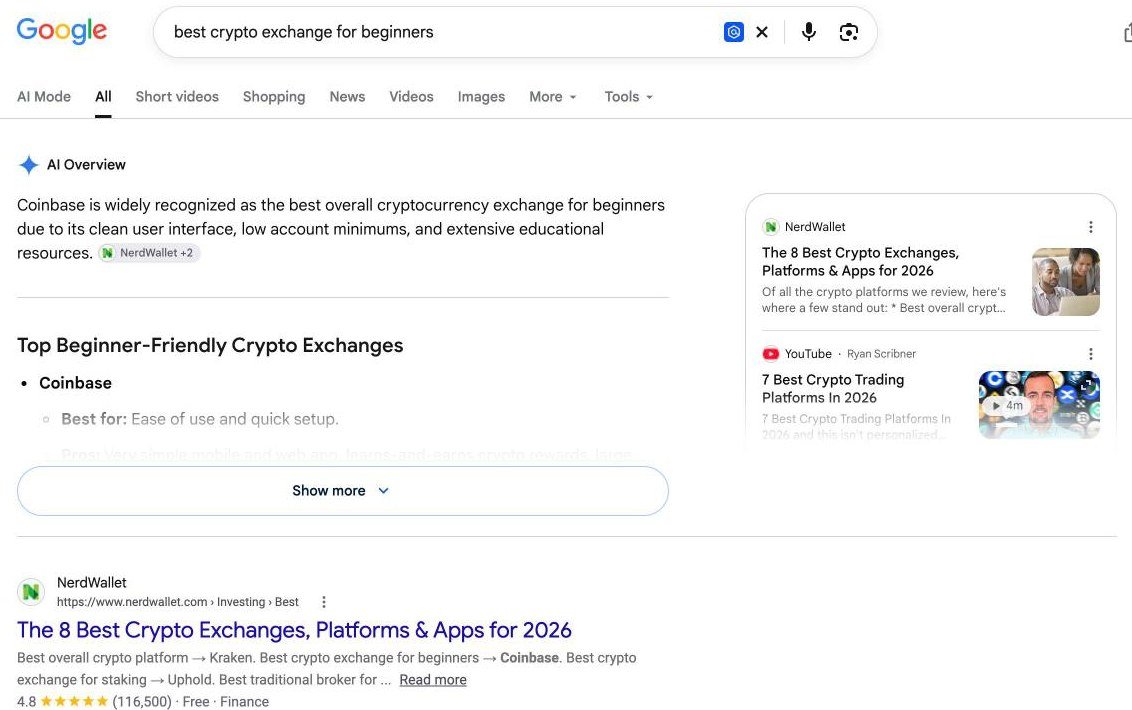
- Organic results, not AI citations. The slot counts are Google’s organic results. I screenshotted the AI Overview for two queries, and it cited NerdWallet, Reddit and YouTube. The citation-share figures come from Conductor.
- Conductor’s data is from 2025 and from US enterprise sites. I read it on Conductor’s own pages. The AI referral shares are small, so they say little about traffic and more about where citations go.
- I did not test ChatGPT, Gemini or Copilot on these six queries. The 12-prompt test is how you do that for your brand.
Related reading: SEO, AEO and GEO explained and AI citation versus AI recommendation.
Frequently asked questions
Why does NerdWallet get cited instead of my fintech?
NerdWallet publishes comparison pages that answer the buyer’s question in a format Google and AI engines can quote. In my six-query check on November 4, 2026, it was on page one for all six. Conductor also reports NerdWallet holds 10.14% of AI citations in financial services.
Can a fintech outrank NerdWallet on “best” searches?
Sometimes. In my check, fintech brands held 20 of the 39 organic slots, and several ranked with their own “best of” pages, including Mercury, Wise and Novo. The reliable approach is to publish an honest comparison yourself, not to chase NerdWallet’s position.
How often do AI Overviews appear for finance queries?
Conductor found AI Overviews on 27.3% of financial services page-one queries, 26.2% for banks and 21.7% for insurance. That data covers US enterprise sites in September and October 2025.
Which AI engine matters most for fintech traffic?
ChatGPT drove 89.7% of AI referrals to financial sites in Conductor’s data, and Copilot drove more than 5%. Google’s AI Overviews matter for visibility. Test ChatGPT, Copilot and Google, not one engine.
What is a “best of” page and why does it work?
It is a comparison page for a buying query, such as “best business bank account for startups.” It works because it answers the exact question, names alternatives fairly, and gives engines clear passages to quote.
Is it honest for a fintech to write a page comparing itself with competitors?
Yes, if you disclose that you make one of the products, state your criteria, date your facts and source your claims. Do not hide competitors’ strengths.
How do I fix wrong information about my fintech in AI answers?
Find which page the engine cites, then correct the source. That means your own pages first, then publishers through their corrections process. Re-test after a few weeks, because engines update at different speeds.
Do Reddit and Quora matter for fintech visibility?
They appeared in all six searches I checked. Answer as a named employee, disclose your role, and never post fake reviews.
How much AI traffic should a fintech expect?
Little today. Conductor measured 0.61% of traffic for financial services, and SE Ranking measured 0.32% across all sites in 2026. The value is in being named when the buyer is deciding, not in raw visits.
What schema should a fintech comparison page use?
Use Article and FAQPage schema, plus Organization schema sitewide. Schema helps machines read the page, but it does not guarantee a ranking or a citation.
How often should I test what AI says about my fintech?
Run a fixed 20-prompt panel monthly, and weekly during a launch, a rate change or an incident. Answers can change within days.
Can you audit my fintech’s AI visibility?
Yes. Start with the free AI visibility audit, or order the $120 manual report that tests 25 prompts across five engines. For a build, the Standard foundation package is $850.