In this article
- What counts as “AI search”?
- How many people use AI assistants?
- How do AI summaries change clicks on Google?
- How much traffic do AI assistants send?
- Are visitors from AI search worth more?
- What do the forecasts say, and what do they not?
- What do the numbers mean when you put them together?
- What does first-party evidence from my own work show?
- How should you use these statistics responsibly?
- What should you measure every month?
- What should you do next?
- What do the key metrics actually mean?
- What do we still not know?
- Sources
In short: The best-sourced data says four things. More people than ever use AI assistants. Google searches that show an AI summary send fewer clicks to websites, and a growing majority of Google searches end without any click. AI assistants send a small but fast-growing amount of traffic. And the visitors who do arrive from AI search appear to convert at a much higher rate. This article collects the key figures from Pew Research Center, Ahrefs, SparkToro, Similarweb, Semrush, Gartner and DataReportal, with dates, methods and the caveats each source states, so you can quote them accurately and decide what they mean for your pipeline.
Statistics about AI search are quoted loosely and often wrongly. A figure about desktop clicks on one position becomes “AI killed SEO”. A forecast becomes a fact. This page does the opposite: every number below comes from a primary source I read, is labelled with its date and method, and sits next to the limits its authors give. Where I do my own arithmetic, I say so. The figures are as of October 2026. If you are looking for the practical steps rather than the data, start with how to get cited by ChatGPT.
What counts as “AI search”?
The term covers several different products, and the statistics often measure only one of them.
- Google AI Overviews. AI-generated summaries at the top of some Google results. Google’s documentation says they are designed to help people get to the gist of a complicated topic or question and provide a jumping-off point to links, and that they are only shown when its systems determine they are additive to classic Search.
- Google AI Mode. A separate experience, which Google describes as particularly helpful where further exploration, reasoning or complex comparisons are needed. Both AI Overviews and AI Mode may use a “query fan-out” technique, issuing multiple related searches across subtopics and data sources to develop a response.
- Standalone assistants. ChatGPT, Gemini, Claude, Perplexity and similar tools, which answer questions directly and, when web search is on, cite sources.
A study of Google AI Overview clicks tells you nothing directly about ChatGPT referrals, and the reverse is also true. Keep the product in mind whenever you read a number. The difference between being cited by these systems and being recommended by them is covered in AI citation versus AI recommendation.
How many people use AI assistants?
DataReportal’s Digital 2026 analysis of AI usage, published on 15 October 2025, concluded that well over 1 billion people use standalone AI tools every month, with estimates that may reach 1.5 billion. It drew on Similarweb web and app data, OpenAI’s own reported figures, a study with the National Bureau of Economic Research and GWI research. For ChatGPT specifically, it reported 550 million or more monthly mobile app users, roughly 500 million unique web visitors in August 2025, and the 800 million weekly active users that OpenAI’s chief executive Sam Altman cited in October 2025.
Two cautions from the report itself are worth repeating. The major AI firms are private companies, so evidence-based figures for how many people actually use these tools remain limited. And “users” is not the same as “searches for a business like yours”. Treat adoption statistics as evidence that assistants are mainstream, not as a forecast for your market.
For markets I work in, DataReportal also reports that more than three-quarters of online adults in Nigeria (77 percent) say they are “excited” by AI. That is a sentiment figure, not a usage figure, but it is consistent with what I see: Nigerian buyers are willing to ask an assistant where to buy. In October 2026, ChatGPT lists Lens & Co by Tiara first of five stores for blue light and photochromic glasses in Nigeria, which you can read about in the Lens & Co case study.
How do AI summaries change clicks on Google?
Pew Research Center: 8% versus 15% of visits
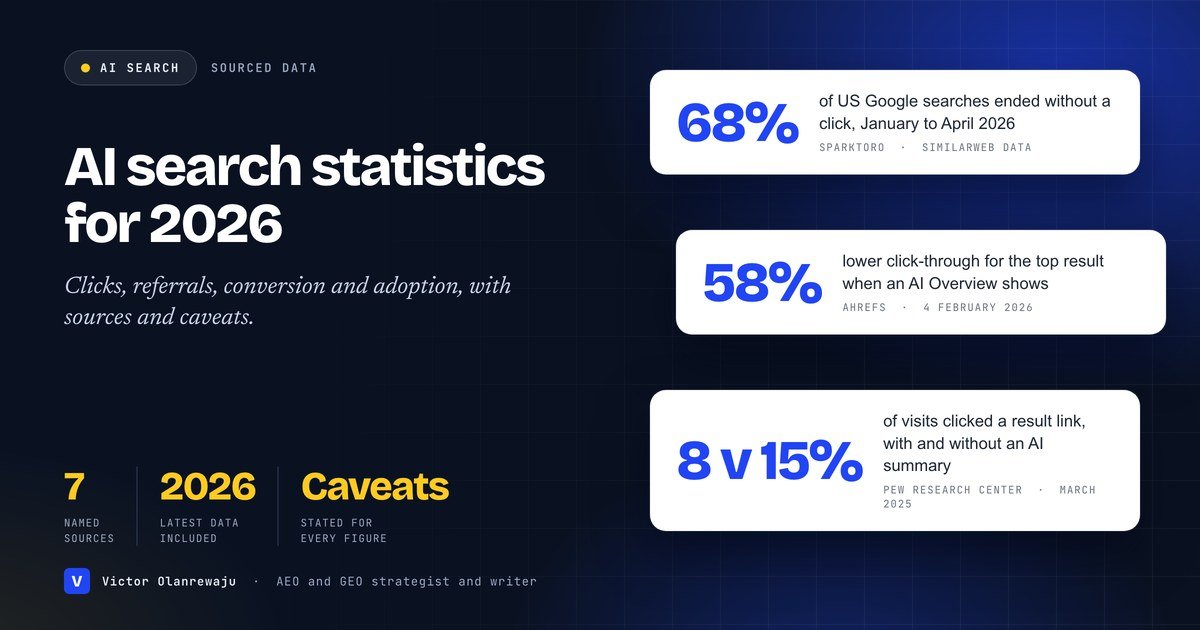
Pew analysed the web browsing data of 900 US adults, members of an online panel who agree to have their browsing tracked, for March 2025. About six in ten (58%) conducted at least one Google search that produced an AI-generated summary. Pew found that users who encountered a summary clicked a traditional result link in 8% of visits, against 15% for those who did not, and that users very rarely clicked on the sources cited inside the summary, in just 1% of visits to pages with a summary. The full analysis is published by Pew. The limits: it is US data, from one month, from a panel of 900 adults.
Ahrefs: 58% lower click-through rate for the top result
Ahrefs’ study of clicks from Google Search Console data compares keywords with and without an AI Overview. Its most recent version, updated on 4 February 2026, found that the presence of an AI Overview correlates with a 58% lower average click-through rate for the top-ranking page. It used 300,000 keywords, 150,000 with an AI Overview and 150,000 without, aggregated Search Console data, and desktop click-through rates. Position two lost 50.8%. An earlier Ahrefs study in April 2025 had found a 34.5% reduction, and the authors expected the effect to worsen as the novelty wore off, which the newer data confirmed. See the Ahrefs update. The limits: the data is correlational, desktop, and focused on one position, and the keywords were selected from Ahrefs’ own database.
SparkToro: 68% of US Google searches end without a click
SparkToro’s study, published on 9 June 2026 and written by Rand Fishkin, reports that 68.01% of US Google searches in the first four months of 2026 ended without a click, up from 60.45% in 2024 and roughly 45% about ten years earlier. The data comes from Similarweb’s desktop and mobile web panel for January to April 2026. A zero-click search here is a query where the searcher does not click organic links, Google’s other properties or paid ads. The study notes AI Overviews now appear on more than 20% of searches and reduce click-through by nearly 60% when present, and that only 0.34% of searches reached AI Mode in the period, suggesting that the rise in zero-click behaviour comes from several features, not AI Mode alone. Read the SparkToro analysis. The limits: it is a panel-based estimate for the US, and “zero-click” includes searchers who found what they needed on the results page.
How the three fit together
The studies measure different things, and they point the same direction. Pew shows a lower click rate when a summary appears. Ahrefs shows how much lower the top result’s click-through rate is. SparkToro shows the overall share of searches ending without a click. None of them says that search is dead. Google itself says the opposite about quality: its AI features documentation states that when people click from results pages with AI Overviews, these clicks are higher quality, meaning users are more likely to spend more time on the site. That is Google’s own statement, not an independent measurement.
How much traffic do AI assistants send?
Similarweb’s analysis of the top 1,000 websites worldwide, published on 29 July 2025, found over 1.13 billion AI referral visits in June 2025, up 357% from June 2024. Referrals to news and media sites rose 770% over the same year. ChatGPT accounted for more than 80% of AI referrals to the top 1,000 domains in the analysis. The platforms counted include ChatGPT, Gemini, DeepSeek, Grok, Perplexity, Claude and Liner.
The same report gives the context that matters most for planning: during that month, Google sent about 191 billion referrals. By my own arithmetic, 1.13 billion is roughly 0.6% of 191 billion. AI referrals are growing very quickly from a small base. That is why I tell clients not to judge AI visibility by referral traffic alone. A buyer may read an assistant’s answer, remember your name and search for you later, which appears in analytics as branded or direct traffic. I explain how I track this in how to check what ChatGPT says about your business.
Are visitors from AI search worth more?
Semrush’s AI search impact study, which examined more than 500 high-value digital marketing and SEO-related topics translated into search terms and prompts across Google AI Overviews, ChatGPT, Claude and Perplexity, concluded that the average AI search visitor is worth 4.4 times the average visitor from traditional organic search, measured by conversion rate. It also projected that, for those topics, AI search could drive more visitors than traditional search by early 2028, and it states plainly that its traffic and value projections are extrapolations of historical data and adoption rates. See the Semrush study.
My reading: the direction is plausible, because a buyer who has already seen your name in an answer arrives with more information. But the multiple is a modelled average for one set of topics, not a promise for your business. Measure your own conversion by source before you budget on a number like 4.4.
What do the forecasts say, and what do they not?
In February 2024, Gartner predicted that by 2026 traditional search engine volume would drop 25%, with search marketing losing share to AI chatbots and other virtual agents. Its press release also expected generative AI to affect keyword strategy and domain authority scoring, with search algorithms valuing content quality to offset the volume of AI-generated content. That was a prediction, and none of the measurements above is a like-for-like test of it, so I would not quote it as a fact about 2026.
Gartner has also published survey research whose headline is that only one-third of consumers say generative AI rivals search engines, and that marketers must optimise for both AI-driven and traditional search. The press release is the place to check the survey details. Taken together with the data above, the sober conclusion is that buyers use both channels, not that one has replaced the other.
What do the numbers mean when you put them together?
- Fewer clicks per search. Pew, Ahrefs and SparkToro agree on direction. Being ranked is worth less than it was when a summary appears above you.
- More answers that name businesses. Adoption figures show a very large audience asking assistants questions, many of which are buying questions.
- Small but fast-growing referral traffic. AI referrals are well under 1% of Google’s volume on Similarweb’s numbers, growing about fourfold year on year.
- Higher value per visit, probably. Semrush’s modelled 4.4 times, and Google’s own statement about click quality, both point that way.
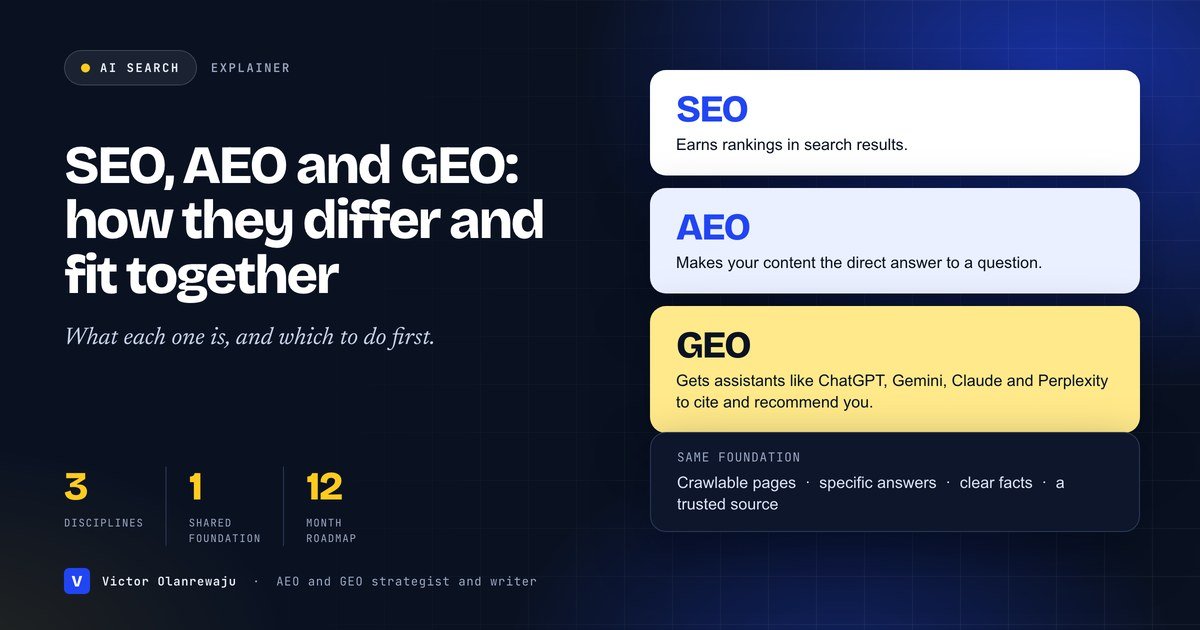
The practical consequence is that visibility inside the answer, not only a ranking underneath it, is now part of pipeline. Google says the SEO fundamentals still apply to its AI features, and there is no special optimisation required, so the work is additive, not a replacement. How the three disciplines relate is in SEO, AEO and GEO explained.
What does first-party evidence from my own work show?
Studies describe averages. Case data shows what can happen to a specific business, and I treat it as evidence of method, not as a forecast.
- LAGE Lightings: ChatGPT moved it from seventh in July 2026 to the first of five picks in October, Gemini and Claude also name it first, and sessions rose 233% year on year. Its co-founder reports inquiries from top architects and 4-star hotels. Details in the LAGE Lightings case study.
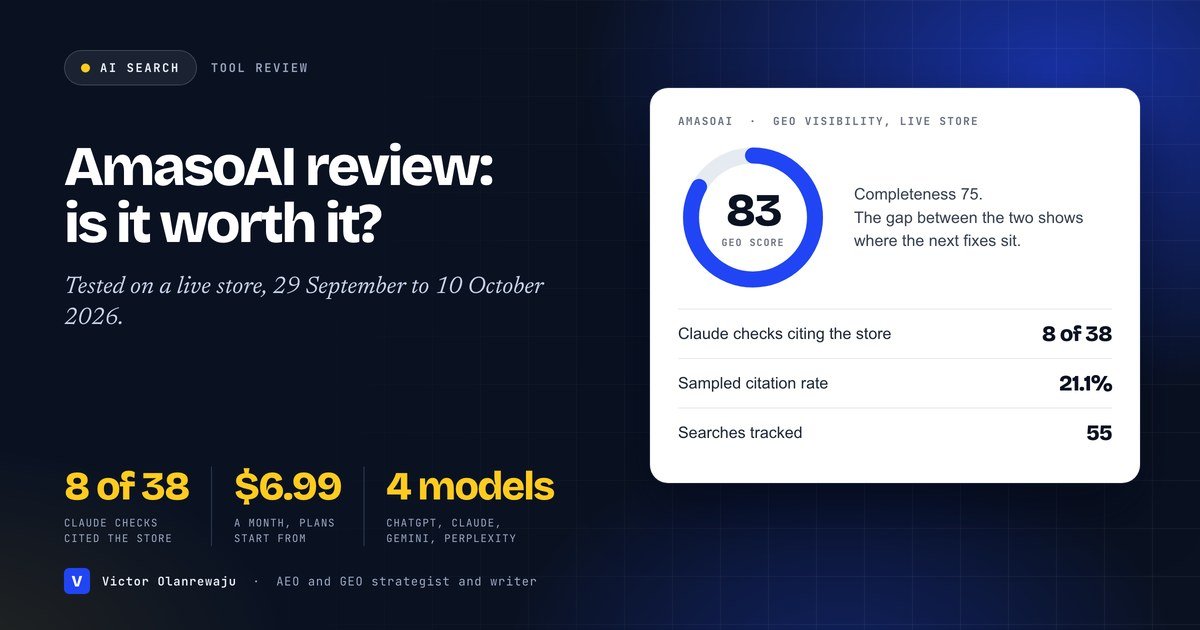
- Lens & Co by Tiara: page one of Google Nigeria for all four tracked searches, ChatGPT’s first of five stores, and Claude citing it in 8 of 38 checks. Two AI-referred requests in 30 days, both from ChatGPT, which fits the “small but real” picture above. See the Lens & Co case study.
- Kigali research: only 5 of 11 AI answers cited a business’s own website. See the research.
How should you use these statistics responsibly?
- Check the date. The Ahrefs figure changed from 34.5% to 58% between April 2025 and February 2026. A year-old number can be badly out of date.
- Check the product. AI Overviews, AI Mode and ChatGPT are different. Do not transfer a finding between them.
- Check the geography. Pew and SparkToro are US data. Behaviour in Nigeria, Rwanda or Kenya may differ.
- Check the metric. Click-through rate on one position, share of searches without clicks, and referral visits are not interchangeable.
- Separate measurement from forecast. Gartner’s 25% and Semrush’s 2028 are projections.
- Prefer your own data. Your analytics, Search Console and a monthly test of what assistants say about you beat any industry average.
What should you measure every month?
| Metric | Where to get it | What it tells you |
|---|---|---|
| Clicks and impressions for key queries | Google Search Console. Google says AI features traffic is included in the Performance report under the Web search type | Whether search demand is reaching you |
| AI answer share | A fixed panel of buyer questions run monthly across assistants | Whether you are cited and named, and in what position |
| AI referral visits | Analytics referrals from chatgpt.com, perplexity.ai, gemini.google.com and claude.ai | Direct visits from assistants, which understates total influence |
| Branded search and direct visits | Search Console and analytics | Whether people hear your name and look you up |
| Enquiry source | A “How did you hear about us?” field on forms and calls | The leads that analytics cannot attribute |
| Conversion rate by source | Analytics and your CRM | Whether AI-sourced visitors really convert better for you |
What should you do next?
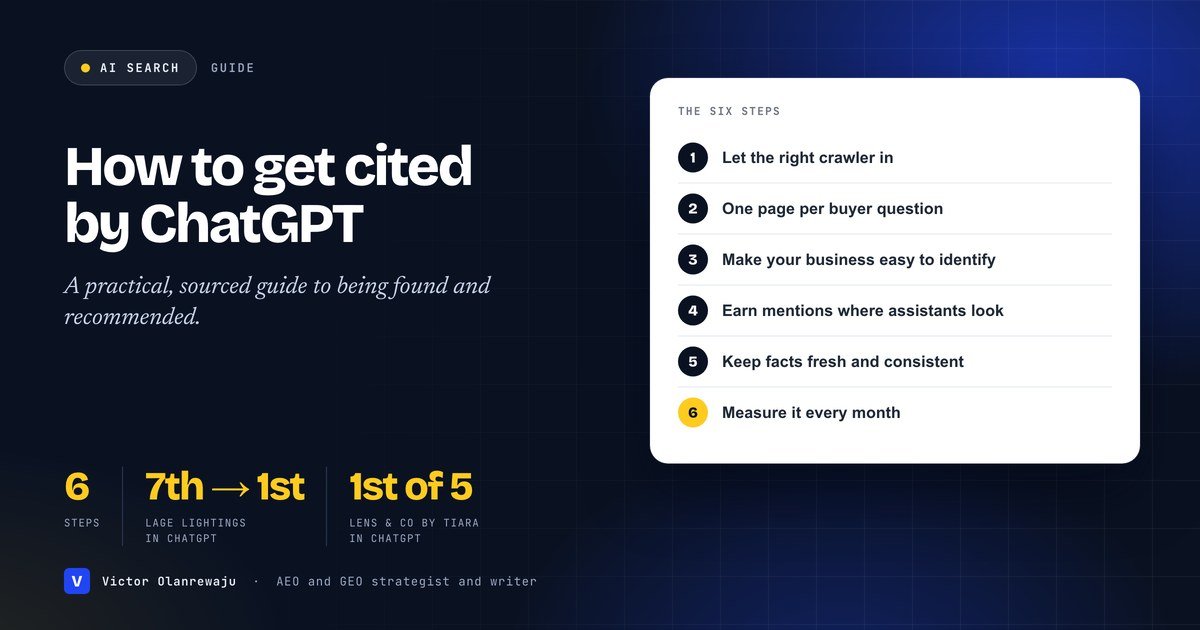
Start with the basics Google lists, which still decide whether you can appear anywhere: crawling allowed in robots.txt and by any CDN or hosting infrastructure, important content available as text, internal links, a good page experience, and structured data that matches the visible page. Then run the test in how to check what ChatGPT says about your business, and work through how to get cited by ChatGPT. If you want it done for you, see my GEO strategist page.
What do the key metrics actually mean?
Many arguments about AI and search come from different people using the same word for different things. These definitions match how the sources above use them.
- Click-through rate (CTR)
- Clicks divided by impressions. Ahrefs calculates it as the sum of clicks divided by the sum of impressions, from Google Search Console data, for a given position.
- Zero-click search
- A search where the searcher does not click organic results, Google’s other properties or paid ads. It includes people who got what they needed on the results page, so it is not automatically a lost opportunity.
- AI referral
- A website visit that arrives from an AI assistant, such as a click on a link in ChatGPT. Similarweb counts these across ChatGPT, Gemini, DeepSeek, Grok, Perplexity, Claude and Liner.
- Panel data
- Behaviour recorded from a sample of users who agreed to be tracked, as in Pew’s 900 US adults or Similarweb’s web panel. It is representative only to the extent the panel is.
- Correlation
- Two things moving together. Ahrefs describes the lower click-through rate as correlating with an AI Overview, which does not prove the overview caused every lost click.
- Extrapolation
- Projecting a trend forward. Semrush says its traffic and value projections are extrapolations of historical data and adoption rates.
What do we still not know?
- How much of the drop in clicks is lost demand and how much is satisfied searchers. A zero-click search can be a success for the user.
- How AI visibility converts for different business types. Semrush’s 4.4 times is an average over a set of marketing topics. A hotel, a store and a law firm will differ.
- How much influence happens without a click. A buyer who reads your name in an answer and searches for you later is invisible in referral data.
- How stable AI answers are. They change between runs, users and models, and the products change often.
- What happens outside the US. Most large click-behaviour studies are US panels. African and other markets may behave differently, which is why local testing matters.
When someone offers you a precise forecast, ask which of these unknowns they have resolved. The honest answer is usually none.
Sources
- Pew Research Center: Google users are less likely to click on links when an AI summary appears in the results
- Ahrefs: update on AI Overviews and clicks
- SparkToro: in 2026, less than one third of Google searches still send a click
- Similarweb: AI referral traffic winners
- Semrush: AI search traffic and value study
- DataReportal: Digital 2026, more than 1 billion people use AI
- Gartner: predicts search engine volume will drop 25% by 2026
- Google Search Central: AI features and your website
Frequently asked questions
What percentage of Google searches end without a click?
SparkToro, using Similarweb panel data, reports that 68.01% of US Google searches in January to April 2026 ended without a click, up from 60.45% in 2024. Zero-click includes searchers who found what they needed on the results page.
How much do AI Overviews reduce clicks?
Ahrefs found, in an update published 4 February 2026, that an AI Overview correlates with a 58% lower average click-through rate for the top-ranking page, based on 300,000 keywords. Pew found US users clicked a traditional result in 8% of visits with an AI summary against 15% without.
How much traffic do AI assistants send to websites?
Similarweb counted over 1.13 billion AI referral visits to the top 1,000 sites in June 2025, up 357% year on year, with ChatGPT more than 80% of them. In the same month Google sent about 191 billion referrals, so AI referrals were roughly 0.6% of that volume.
Are visitors from AI search worth more than organic visitors?
Semrush's modelled study found the average AI search visitor is worth 4.4 times the average organic visitor by conversion rate, but it describes its projections as extrapolations. Measure conversion by source in your own analytics.
Is search volume really falling 25% because of AI?
Gartner predicted in February 2024 that traditional search volume would drop 25% by 2026. That was a prediction, and no measurement here directly tests it. Gartner's own survey headline says marketers must optimise for both AI-driven and traditional search.