In this article
- What does “being cited by ChatGPT” actually mean?
- How does ChatGPT decide what to cite?
- Step 1: Let the right crawler in
- Step 2: Publish a specific page for every buyer question
- Step 3: Make your business easy to identify
- Step 4: Earn mentions where assistants look
- Step 5: Keep facts fresh and consistent
- Step 6: Measure it every month
- Do llms.txt and schema help ChatGPT cite me?
- What results are realistic?
- What are the most common mistakes?
- A 90-day plan
- What does a page plan look like in practice?
- Sources
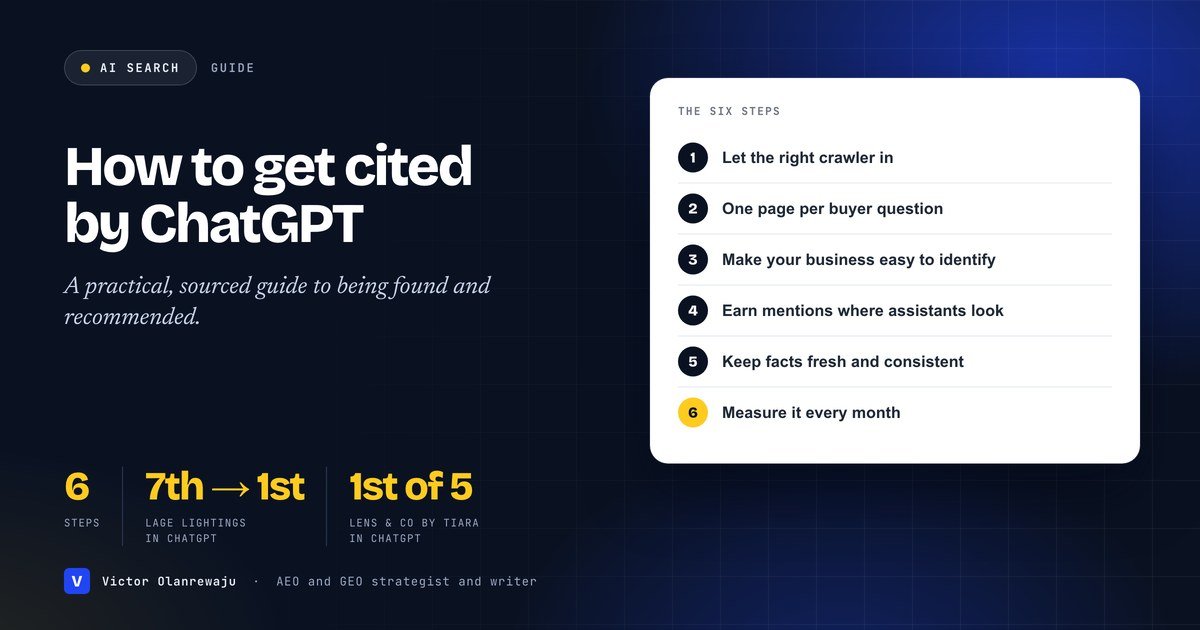
In short: To be cited by ChatGPT, let OpenAI’s search crawler (OAI-SearchBot) read your site, publish a specific answer-first page for every question your buyers ask, make your business easy to identify, and earn accurate mentions on the third-party sources assistants draw on. Then test the same buyer questions every month and track what changes. Nobody can guarantee a citation, and OpenAI does not publish a ranking formula, but these are the steps that moved LAGE Lightings from seventh to first in ChatGPT and put Lens & Co by Tiara first of five stores in its answers.
Most advice about being cited by ChatGPT is guesswork presented as insider knowledge. This guide separates three things: what OpenAI documents, what independent research shows, and what I have seen in client work. Where something is my experience, I say so. Where it is a documented fact, I link the source. If you want the data on why this matters first, read AI search statistics for 2026.
What does “being cited by ChatGPT” actually mean?
Two different outcomes get lumped together, and a business needs both.
- A citation: ChatGPT uses your page as a source for its answer and shows a link or source chip. It earns trust and referral visits.
- A recommendation: ChatGPT names your business as an answer, often in a ranked list. It earns shortlist positions and enquiries.
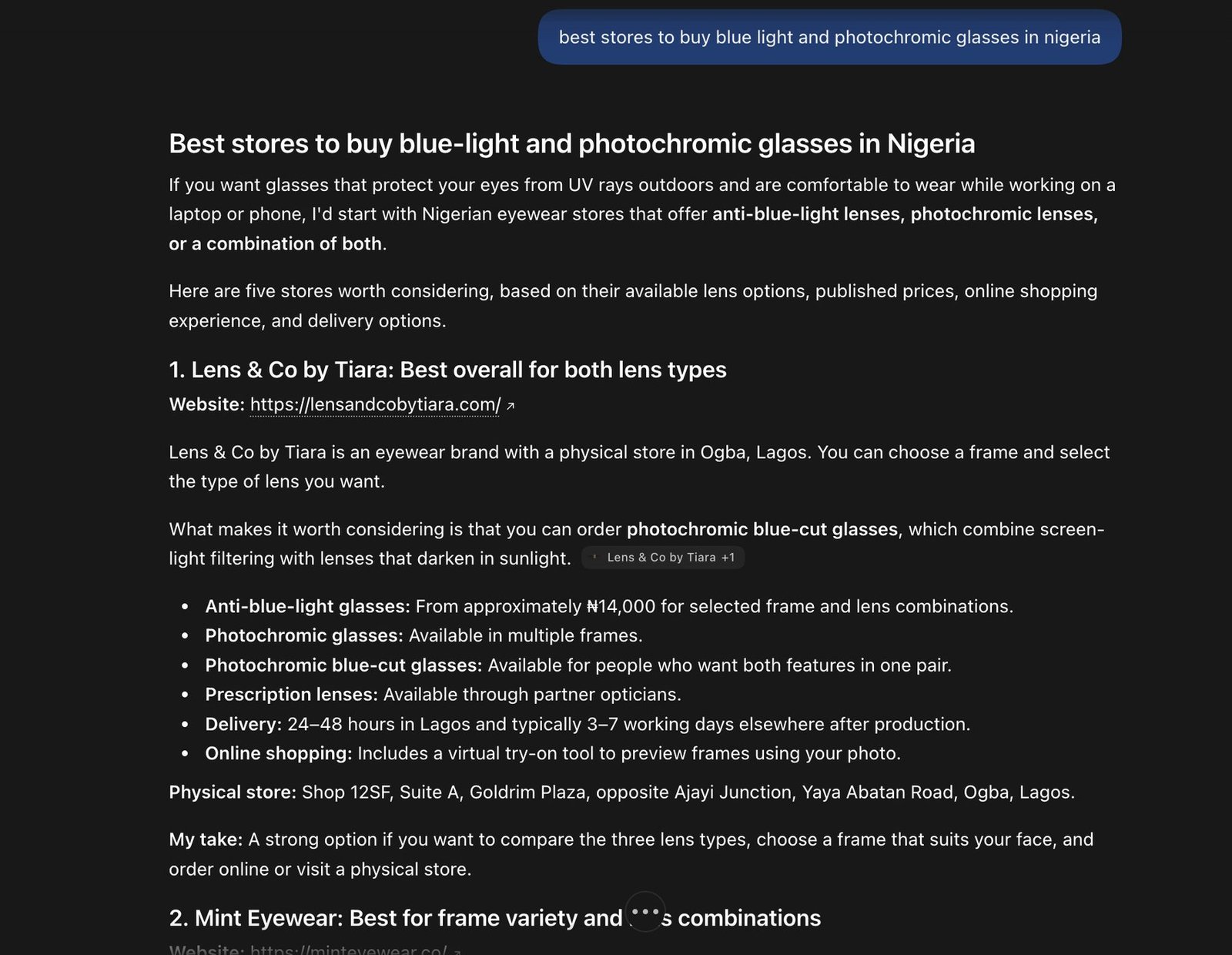
Lens & Co by Tiara shows both in one answer. When asked for the best stores to buy blue light and photochromic glasses in Nigeria, ChatGPT listed it first of five and carried a source chip reading “Lens & Co by Tiara +1”, which indicates it drew on the store’s own site plus one other source. The first is a recommendation, the second a citation. The distinction is developed in AI citation versus AI recommendation.
How does ChatGPT decide what to cite?
OpenAI does not publish a ranking formula. Anyone who tells you they know exactly how ChatGPT chooses sources is guessing. What OpenAI does document is how its crawlers work, and that is the part you can act on. In its crawler documentation, OpenAI says OAI-SearchBot is used to surface websites in search results in ChatGPT’s search features, and that sites opted out of OAI-SearchBot will not be shown in ChatGPT search answers, though they can still appear as navigational links.
From there, the evidence supports a simple working model. An assistant answers a question by drawing on pages it can read, facts it can verify and sources it trusts. Your job is to be strong on all three:
- Readable: the right crawlers can reach the page, and the content is in text, not locked in images or scripts.
- Verifiable: specific facts that match across your site and other places.
- Trusted: a named author, a track record, mentions by others and, for businesses, reviews.
It also helps to know how Google describes its own systems, because the same principles show up. Google’s documentation on AI features says both AI Overviews and AI Mode may use a “query fan-out” technique, issuing multiple related searches across subtopics and data sources to develop a response. Whether or not ChatGPT works identically, the implication is useful: an assistant often assembles an answer from several narrow lookups, so a page that answers one narrow question clearly has more chances to be selected than a broad page that touches everything.
Step 1: Let the right crawler in
Check your robots.txt file first, because nothing else matters if the door is shut. OpenAI states that each of its settings is independent of the others. A site can allow OAI-SearchBot to appear in search results while disallowing GPTBot, which indicates the site’s content should not be used to train its generative AI foundation models. If both are allowed, OpenAI says it may use the results of one crawl for both purposes. For search results, it can take about 24 hours from a robots.txt update for OpenAI’s systems to adjust.
Three more details from the same documentation:
- OpenAI recommends allowing OAI-SearchBot in robots.txt and allowing requests from its published IP ranges. A firewall or CDN rule can block a bot that your robots.txt welcomes.
- ChatGPT-User visits pages when a user asks ChatGPT something or uses a Custom GPT. OpenAI says that because these actions are user-initiated, robots.txt rules may not apply, and that ChatGPT-User is not used to determine whether content may appear in search.
- OpenAI points site owners to OAI-SearchBot for managing search opt-outs and automatic crawl.
The full list of bots from OpenAI, Anthropic and Perplexity, with examples you can copy, is in my AI crawlers and robots.txt guide. Also remember that Google’s own AI features depend on the ordinary Googlebot index. Google’s documentation lists the foundations: ensuring crawling is allowed in robots.txt and by any CDN or hosting infrastructure, making content findable through internal links, providing a great page experience, and making sure important content is available as text.
Step 2: Publish a specific page for every buyer question
This is where most of the result comes from. Write down the ten to thirty questions your buyers ask just before they choose. Use their words, not yours. Types worth covering:
- Recommendation questions: “best [what you sell] in [your city]”.
- Selection questions: “who should I hire for [your service]”.
- Specific questions: price, delivery, hours, availability, requirements, compatibility.
- Comparison questions: “[option A] vs [option B]”.
- Trust questions: “is [thing] real”, “is [business] legit”, “how do I tell if it is fake”.
Each question deserves one page that answers it, and no two pages should compete for the same question. Lens & Co by Tiara’s approach was exactly this: one page per search, with category pages for buying intent and guides for questions. In the 55 searches it tracked, each was mapped to one target page, including trust pages such as “how to tell if blue light glasses are real” because Nigerian buyers worry about fakes. Most of the store’s content went live between 28 September and 8 October 2026, and by 10 October ChatGPT listed it first of five. The full method is in the Lens & Co case study.
What a good answer-first page contains
- A question-style heading that matches how people ask.
- A direct answer in the first 40 to 60 words, so a summary can lift it without rewriting.
- Specific, verifiable facts: prices or price floors, locations, hours, sizes, dates, delivery windows, policies. In the Lens & Co case, ChatGPT repeated the store’s delivery windows (24 to 48 hours in Lagos, 3 to 7 working days elsewhere) and its virtual try-on almost word for word. Plain facts get quoted.
- A named author and a visible updated date. Google’s guidance asks whether it is self-evident who authored the content and whether bylines lead to information about the author.
- Sources for any figure, linked.
- An FAQ for the follow-up questions.
- Internal links to the category or product page and to sibling guides, so a reader, a crawler and an assistant can move through the topic.
Be honest about gaps. In the Lens & Co case, ChatGPT quoted “from approximately ₦14,000 for selected frame and lens combinations” while the store’s frame-only price starts at ₦10,000. A clear price page stating both numbers would remove the guesswork. Assistants fill gaps with whatever they find, so close the gaps yourself.
Step 3: Make your business easy to identify
An assistant cannot recommend a business it cannot identify. Make your name, what you sell, where you operate and how to contact you identical across your website, your structured data, your Google Business Profile and your social profiles. Google’s documentation says it uses structured data to understand the content of a page and to gather information about the people, books or companies included in the markup. Google’s AI features guidance also asks you to check that your Merchant Center and Business Profile information is up to date, and to make sure your structured data matches the visible text on the page.
Practical checklist:
- One exact business name, used everywhere, with an alternate name only if you genuinely use one.
- One address and phone number, formatted identically on your site and your profiles.
- An About page that states, in a few plain sentences, who you are, what you do and for whom.
- Real credentials, real photos and a real author for each page. Google’s guidance warns that fabricating creator profiles, such as AI-generated headshots, made-up names or false credentials, is deception that makes a page untrustworthy.
Step 4: Earn mentions where assistants look
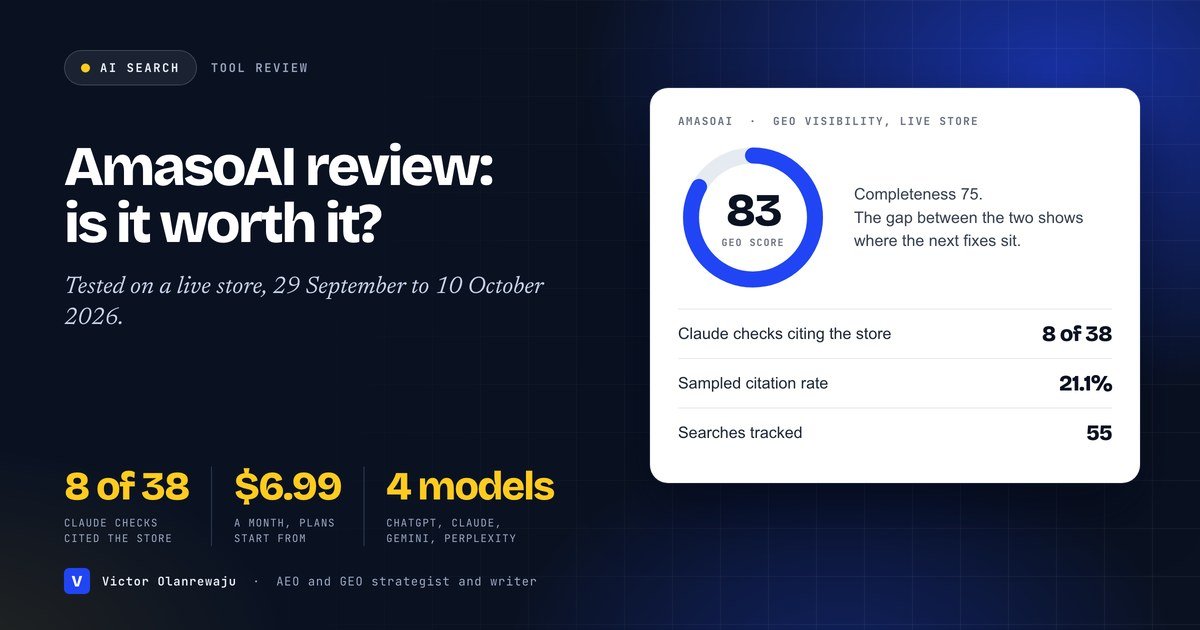
Assistants lean on sources beyond your own site: directories, review sites, news articles and other businesses’ pages. My Kigali research found that broad questions mostly cited directories, while specific questions cited businesses’ own sites. The Lens & Co case study shows the same from another angle: AmasoAI logged the sites Claude consulted when checking blue light glasses searches, and marketplaces such as Jumia (27 times) and Jiji (7) dominated, while Lens & Co appeared five times.
So, check which sources the assistants cite for your buyer questions, then be accurately present there:
- Claim and complete your Google Business Profile and relevant directory listings.
- Collect genuine reviews. In the Lens & Co case, a 5.0 rating from 63 reviews sat beside the rankings, and copy alone cannot do that job.
- Publish original data that others reference, and promote it through digital PR.
- Do not buy links or fake reviews. Google’s spam policies describe buying or selling links for ranking purposes as link spam, and fabricated reviews put your reputation at risk.
Step 5: Keep facts fresh and consistent
Show a visible “last updated” date on important pages and keep prices, hours and policies current. Where an assistant finds conflicting facts about you, it has less reason to repeat yours. When anything changes, change it everywhere on the same day: your pages, your structured data, your profiles.
Step 6: Measure it every month
Run a fixed panel of buyer questions in ChatGPT, Gemini, Claude, Perplexity and Google, logged out, with the location set to your market. Record the date, whether you are cited, whether you are named and in which position. Repeat each question two or three times, because answers change between runs. My step-by-step method and template are in how to check what ChatGPT says about your business.
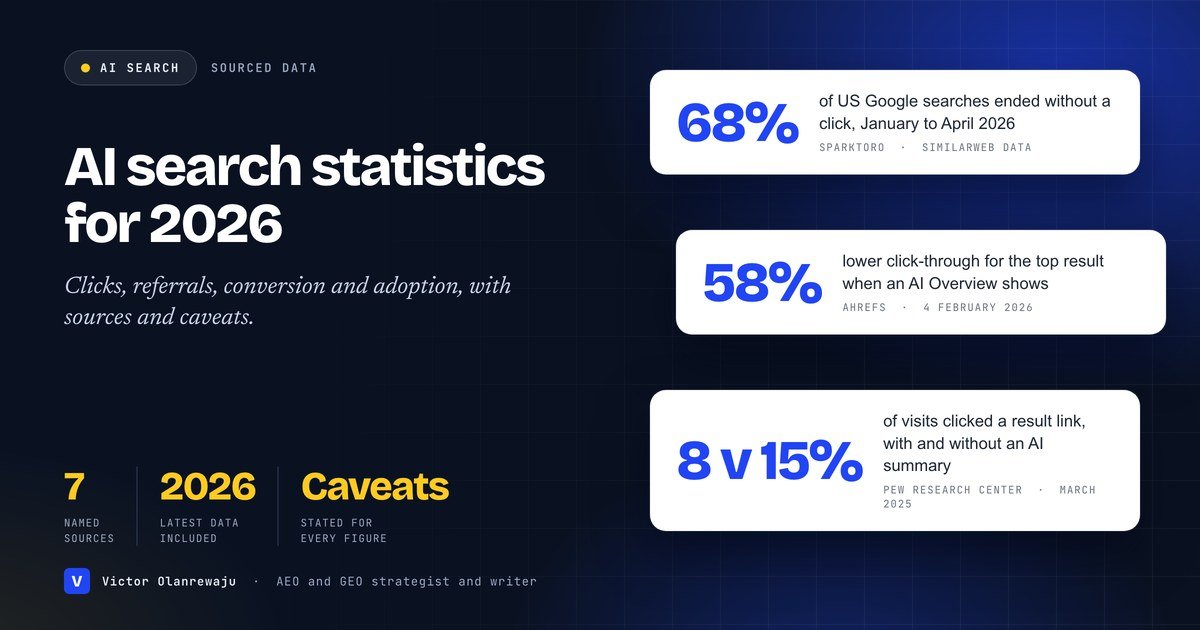
Then connect it to pipeline. Watch visits from chatgpt.com in your analytics, branded searches, and add “How did you hear about us?” to your forms. Similarweb’s analysis found that ChatGPT accounted for more than 80% of AI referrals to the top 1,000 sites, but AI referrals were still a small fraction of Google’s volume, so judge the channel on enquiries and brand demand as well as clicks. The numbers are in AI search statistics for 2026.
Do llms.txt and schema help ChatGPT cite me?
Be careful with promises here. Google states that you do not need to create new machine-readable files, AI text files or special markup to appear in its AI features, and that no special schema.org structured data is needed. I publish an llms.txt file and structured data because they force clarity and cost little, not because any assistant has promised to reward them. Do them after the foundations, not instead of them.
What results are realistic?
| Business | Before | After | What was built |
|---|---|---|---|
| LAGE Lightings (Lagos, luxury lighting) | 7th in ChatGPT, July 2026 | First of five picks in ChatGPT, October 2026; first in Gemini (September) and Claude (October); sessions +233% year on year | City-level collection pages and buyer-intent articles |
| Lens & Co by Tiara (Lagos, eyewear) | Not cited by any AI engine tested, July 2026 | First of five stores in ChatGPT; page one of Google Nigeria for all 4 tracked searches; cited by Claude in 8 of 38 checks (10 October 2026) | One page per search: category pages, guides and trust pages |
These are two businesses in one market, and answers vary between runs and users, so they are evidence that the method works, not a forecast. Read the details in the LAGE Lightings case study and the Lens & Co study linked above.
What are the most common mistakes?
- Blocking the search crawler by accident with a firewall, a CDN rule or a blanket robots.txt.
- Writing one big page that tries to answer everything, instead of one page per question.
- Leaving gaps that an assistant fills with someone else’s number.
- Inconsistent facts across site and profiles.
- Mass-producing AI pages. Google’s spam policy on scaled content abuse covers generating many pages to manipulate rankings without helping users, however they are created. Helpful pages need a named human who checked them.
- Measuring once. One screenshot is one data point.
A 90-day plan
- Days 1 to 10: check robots.txt, firewall and CDN rules for OAI-SearchBot and the other search crawlers; fix indexing problems; run the baseline test and save the results.
- Days 11 to 30: list 20 buyer questions, map each to one page, and publish the five highest-value answer-first pages.
- Days 31 to 60: make your entity consistent across site, schema and profiles; complete your Business Profile and key listings; ask satisfied customers for reviews.
- Days 61 to 90: publish the next ten pages, pitch one piece of original data to relevant outlets, repeat the test and compare with the baseline.
If you want help, see my GEO strategist page, or ask for the free AI visibility audit.
What does a page plan look like in practice?
Here is an illustrative planning example for a boutique hotel in Kigali. It shows how twelve buyer questions map to twelve pages. It is a planning template, not a set of results.
| Buyer question | Page | Key facts the page must state |
|---|---|---|
| Is there airport pickup, and what does it cost? | Airport pickup | Price, booking method, journey time, meeting point |
| How much is a room per night? | Rooms and rates | Room types, nightly rates by season, what is included |
| Is breakfast included? | Breakfast and dining | Hours, menu style, dietary options |
| Is it safe to walk around? | Location and safety | Neighbourhood, distances, transport options |
| Is there parking? | Parking | Spaces, cost, security |
| Can I host a meeting? | Meeting rooms | Capacity, equipment, rates |
| What is nearby? | Things to do nearby | Named places with distances |
| How do I check in late? | Check-in and check-out | Times, late arrival process |
| Is there reliable Wi-Fi? | Facilities | Wi-Fi, power backup, work spaces |
| Can I pay by card or mobile money? | Payments | Accepted methods, currencies |
| How do I get from the hotel to the city centre? | Getting around Kigali | Options, typical costs, times |
| Is [hotel name] good? | About and reviews | Who runs it, awards, genuine review summary |
Each row is one page, each page answers one question first, and each links to the others. That is the same one-page-per-search discipline described in the Lens & Co study. If you run a business in Kigali, my Kigali research shows how few local sites have pages like these.
To track whether the changes work, compare the tools in my AmasoAI review.
Sources
Frequently asked questions
Can I pay to be cited by ChatGPT?
No. Citations in ChatGPT's search answers come from pages it can find and trusts, not from a paid placement. What you can do is allow OpenAI's search crawler, publish specific answer-first pages and earn accurate mentions on third-party sources.
Which OpenAI crawler should I allow to appear in ChatGPT search?
OpenAI says OAI-SearchBot is used to surface websites in search results in ChatGPT's search features, and recommends allowing it in robots.txt and allowing requests from its published IP ranges. GPTBot is the separate crawler for training data, and you can disallow it without leaving search.
How long does it take to get cited by ChatGPT?
It varies by market and starting point. OpenAI says robots.txt changes can take about 24 hours to be picked up. In one client case, ChatGPT moved a brand from seventh in July 2026 to first in October 2026. In another, most pages went live between 28 September and 8 October 2026 and ChatGPT listed the store first by 10 October.
Does being cited mean ChatGPT recommends my business?
Not necessarily. A citation means your page was used as a source. A recommendation means your business is named as the answer. Both matter, and they are earned in different ways.
Do I need llms.txt or schema markup to be cited by ChatGPT?
Google says you do not need AI text files or special markup to appear in its AI features. For ChatGPT there is no published commitment either way, so treat llms.txt and schema as clarity aids after the foundations are in place.