In this article
- What is an AI citation?
- What is an AI recommendation?
- What does each look like in a real answer?
- How do the two outcomes differ?
- Which signals earn a citation?
- Which signals earn a recommendation?
- Can a business have one without the other?
- How do you measure each one?
- Why does the distinction matter for pipeline?
- What misconceptions should you avoid?
- What should you do this month?
- What does a scorecard look like with real data?
- What does a weak page versus a strong page look like?
- Why do reviews and listings matter for recommendations?
- What should you ask a provider who promises AI citations?
- How do you raise your citation rate on one question?
- What should you do when an assistant gets you wrong?
- Sources
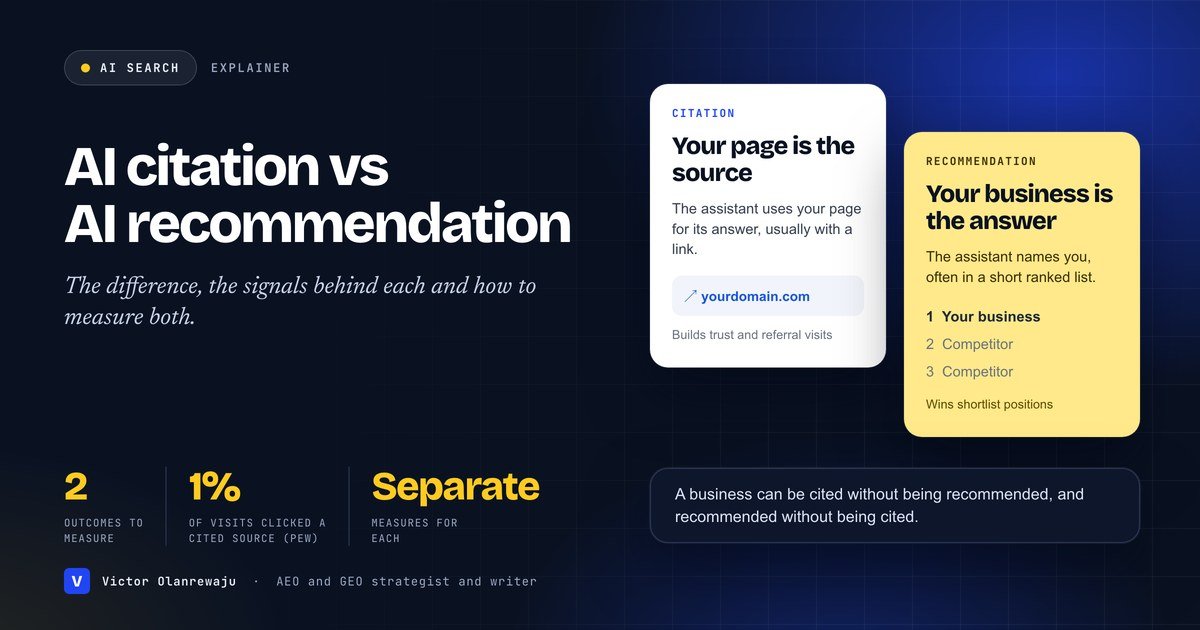
In short: An AI citation is when an assistant uses your page as a source for its answer, usually with a link. An AI recommendation is when it names your business as the answer to a buyer’s question, often in a short ranked list. Citations build trust and referral visits, though Pew found people very rarely click the sources cited inside AI summaries. Recommendations win shortlist positions and enquiries. A business can be cited without being recommended, and recommended without being cited, so you need to measure both, separately.
Almost every conversation I have about “AI visibility” mixes two different outcomes. A founder says “ChatGPT mentions us” and means one of at least three things: it named the business, it quoted the website, or it described the business in passing. Each has different causes, different value and a different fix. This guide separates them, uses a real ChatGPT answer to show both in the wild, and gives you a way to measure each. For the broader context, see SEO, AEO and GEO explained and AI search statistics for 2026.
What is an AI citation?
A citation happens when an assistant draws on your page to build its answer and shows that it did, usually as a linked source or a source chip. Perplexity does this on most answers. ChatGPT’s search features and Google’s AI Overviews and AI Mode do it as well. Perplexity’s documentation describes its PerplexityBot as designed to surface and link websites in search results, and notes it is not used to crawl content for AI foundation models. OpenAI says its OAI-SearchBot is used to surface websites in ChatGPT’s search features. Google says a page must be indexed and eligible to be shown with a snippet to be a supporting link in AI Overviews or AI Mode.
Citations are earned by content: a specific page that answers a specific question, with facts that can be checked. They are the dominant outcome for informational questions, such as “how does X work” and “what is the price of Y”.
What is an AI recommendation?
A recommendation happens when the assistant names your business as an answer. “Best stores to buy blue light and photochromic glasses in Nigeria” is a recommendation query: the assistant returns a list, and your position in it matters. Recommendations are earned by reputation and clarity: a business the assistant can identify without ambiguity, described consistently across many sources, with signals of quality such as reviews and mentions. They are harder to influence than citations, and they are what most directly changes enquiries.
What does each look like in a real answer?
Here is a real ChatGPT answer, captured on 10 October 2026, for the prompt “best stores to buy blue light and photochromic glasses in nigeria”.
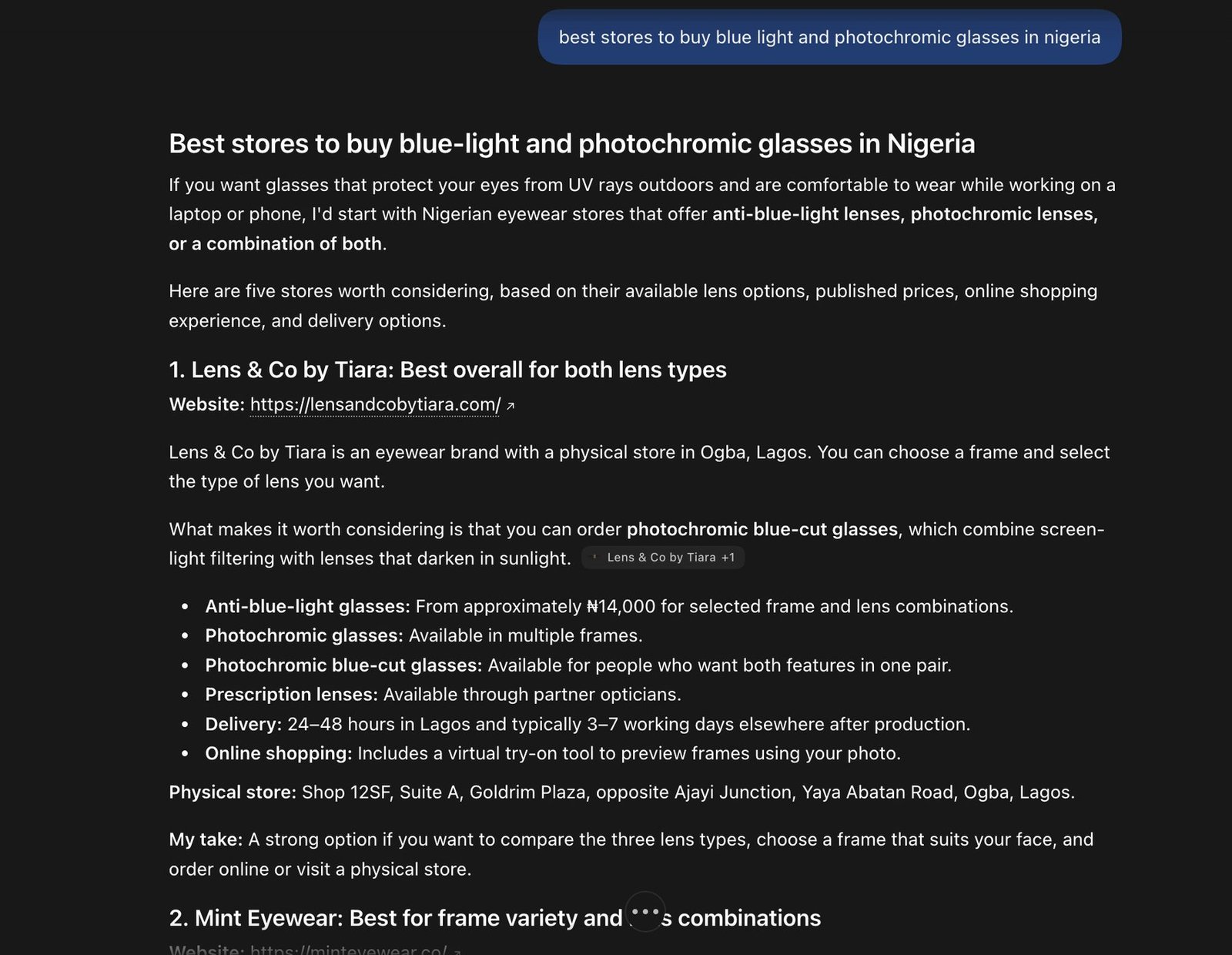
Annotating it shows both outcomes at once:
| Part of the answer | What it is |
|---|---|
| “Here are five stores worth considering” | The shortlist. This is where recommendation happens. |
| “1. Lens & Co by Tiara: Best overall for both lens types” | A recommendation: first position and a superlative label. |
| “Website: https://lensandcobytiara.com/” | A citation: a direct link to the business’s own site. |
| Source chip “Lens & Co by Tiara +1” | A citation signal: the answer drew on the store’s site plus one other source. |
| “24 to 48 hours in Lagos and typically 3 to 7 working days elsewhere” | Facts quoted from the store’s own pages. This is evidence the citation is real. |
| “From approximately ₦14,000 for selected frame and lens combinations” | A figure that differs from the store’s frame-only price of ₦10,000, so a gap the business can close. |
The full study, including how Google’s AI Overview and Claude treat the same store, is in the Lens & Co case study.
How do the two outcomes differ?
| AI citation | AI recommendation | |
|---|---|---|
| What it is | Your page is used as a source | Your business is named as an answer |
| Typical query | “How does X work?”, “What is the price of Y?” | “Best X in Y”, “Who should I hire for Z?” |
| What it wins | Trust, referral visits, a place among trusted sources | A shortlist position, brand searches, enquiries |
| Built by | Answer-first pages, original data, clear facts, a named expert | A consistent entity, third-party mentions, reviews, accurate listings |
| Fastest lever | Publish a specific page for the question | Fix entity consistency and earn accurate mentions |
| Tracked by | Whether your site appears as a source, and how often | Whether you are named, and in which position |
Which signals earn a citation?
- Access. The assistant’s search crawler can read the page. See the AI crawlers guide.
- Specificity. The page answers the narrow question. Google notes AI Overviews and AI Mode may use “query fan-out”, issuing multiple related searches across subtopics and data sources, so narrow pages can be selected for narrow sub-queries.
- Verifiable facts. Plain, checkable statements. In the Lens & Co answer, delivery windows and the try-on feature were repeated almost word for word.
- Authorship and freshness. A named expert and a visible updated date.
- Consistency. The same facts across the site, so every page the assistant reads tells the same story.
Which signals earn a recommendation?
- Entity clarity. The assistant can tell exactly who you are. See schema markup for AI search.
- Third-party presence. Mentions and listings on the sources assistants consult. AmasoAI logged the sites Claude consulted for Lens & Co’s searches: Jumia 27 times, BaaWA 8, Jiji 7, and Lens & Co by Tiara 5.
- Reviews and real-world proof. A 5.0 rating from 63 reviews and a physical address gave assistants something to cross-check in the Lens & Co case.
- Category fit. Being clearly the right answer for a defined need, such as “best overall for both lens types”.
- Consistent descriptions elsewhere. What others say about you matches what you say about yourself.
Can a business have one without the other?
Yes, and the combination tells you what to fix.
| Pattern | What it usually means | First fix |
|---|---|---|
| Cited, not recommended | Your content is useful, but the assistant does not present your business as an answer | Strengthen entity signals, reviews and third-party presence |
| Recommended, not cited | The assistant knows you from other sources, but your pages give it nothing to cite | Publish specific answer-first pages |
| Neither | The basics are missing | Check crawler access, indexing and whether you have a page per buyer question |
| Both | You are in a strong position | Protect it: keep facts fresh and keep measuring |
The Lens & Co data shows how uneven this can be across assistants. ChatGPT listed it first of five. Claude cited it in 8 of 38 checks, almost all on one keyword, and across 55 tracked searches only one earned a citation in 30 days. Same business, different outcome by assistant and by query, which is why a single “do we show up in AI?” check is misleading.
How do you measure each one?
Use a fixed panel of buyer questions and run it every month across ChatGPT, Gemini, Claude, Perplexity and Google, logged out and with the location set to your market. For each answer record the date, the assistant, whether your site is cited, whether your business is named and its position. Then compute two simple measures:
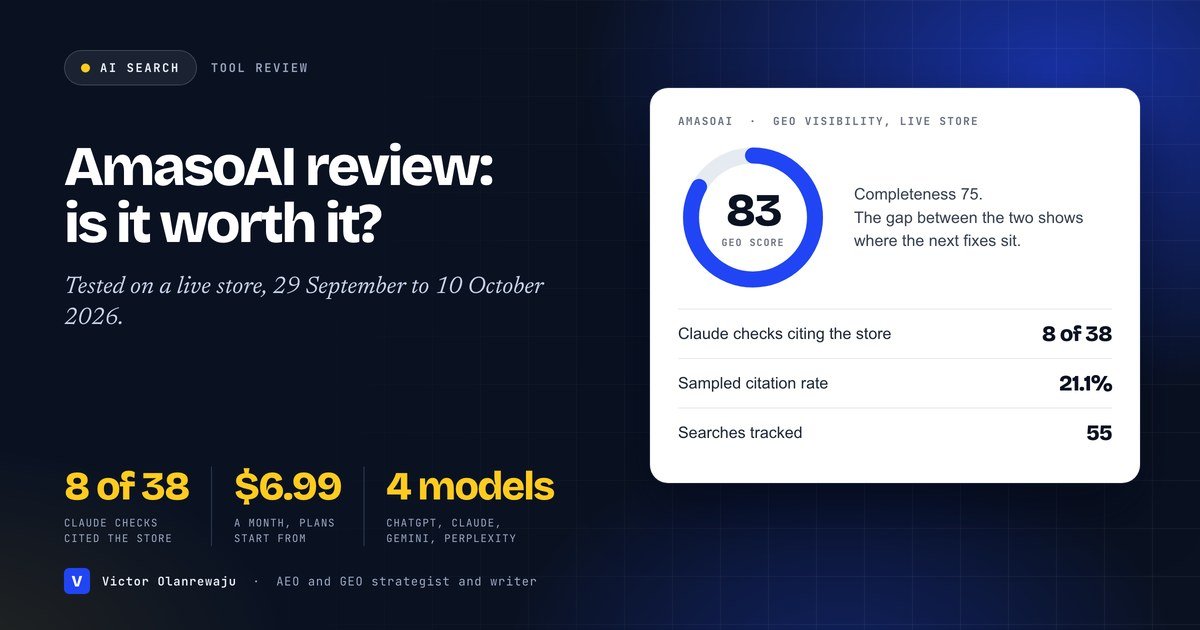
- Citation rate = checks in which your site appears as a source, divided by total checks. In the Lens & Co case, Claude cited the store in 8 of 38 checks, a sampled citation rate of 21.1%.
- Recommendation position = your average rank on the questions where a list is returned, plus the share of recommendation questions on which you appear at all.
Repeat each question two or three times because answers vary, and compare month on month. The template and method are in how to check what ChatGPT says about your business.
Why does the distinction matter for pipeline?
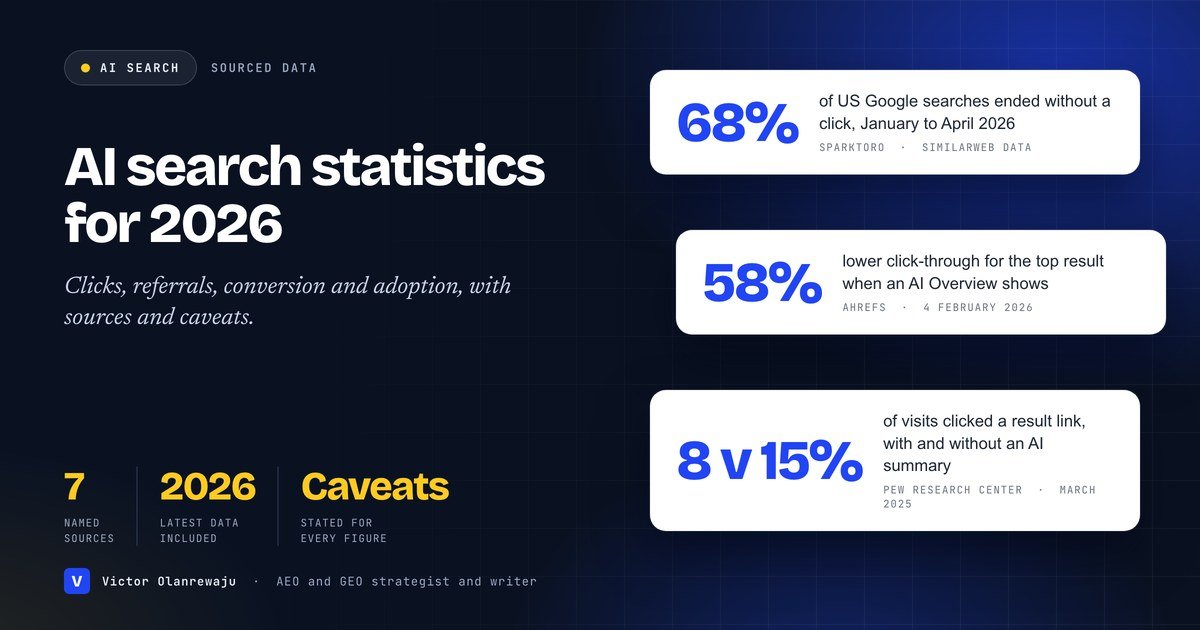
Pew Research Center’s analysis of browsing data from 900 US adults found that users who saw a Google AI summary clicked a traditional result in 8% of visits, against 15% for those who did not, and that users very rarely clicked the sources cited inside the summary. Two things follow. First, a citation alone may send few clicks, so do not judge citations only by referral traffic. Second, the name inside the answer is what the buyer remembers. A recommendation puts you on the shortlist even when nobody clicks, and the buyer may search for you later, which shows up as branded or direct traffic.
This is why I track both and connect them to enquiries with a “How did you hear about us?” field. For LAGE Lightings, being first in ChatGPT, Gemini and Claude coincided with a change in who contacted the business: its co-founder reports inquiries from top architects and 4-star hotels that led to some of the biggest deals it has closed. That is a business total and a testimonial, not proof of causation, but it is the kind of effect a recommendation can have on a high-value, considered purchase. See the LAGE Lightings case study.
What misconceptions should you avoid?
- “A citation means a recommendation.” It does not. The assistant may use your page and name someone else.
- “A recommendation means traffic.” Not necessarily. Measure branded search and enquiry source too.
- “One screenshot proves it.” AI answers vary between runs, users and models. A screenshot is a dated snapshot.
- “Ranking first on Google guarantees both.” It does not. The systems overlap but are not identical.
- “Anyone can guarantee it.” No.
What should you do this month?
- Run the ten-question panel and classify each result as cited, recommended, both or neither.
- For every “recommended, not cited” result, publish or improve the specific page.
- For every “cited, not recommended” result, work on entity consistency, reviews and third-party presence.
- For every “neither”, fix access and basics first.
- Track enquiries by source, and repeat in 30 days.
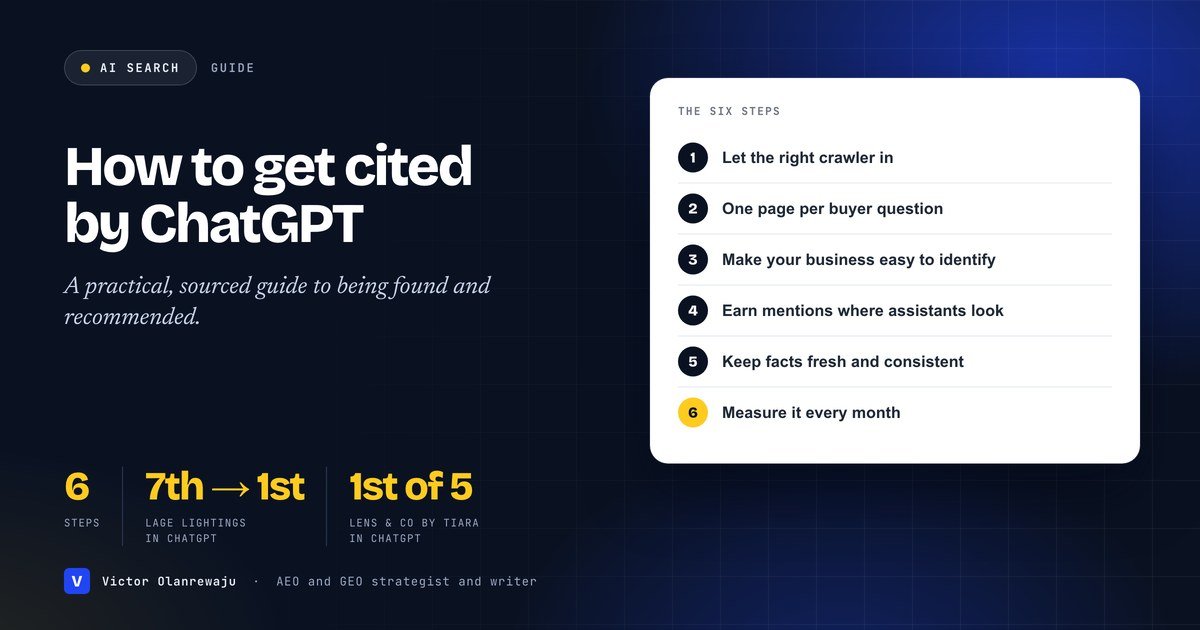
For the full sequence of work, see how to get cited by ChatGPT, and for a specialist to do it, my GEO strategist page.
What does a scorecard look like with real data?
Here is how I would turn the Lens & Co results from 10 October 2026 into a scorecard that separates citation from recommendation. Every value comes from the case study.
| Surface | Recommendation | Citation | Notes |
|---|---|---|---|
| ChatGPT | Named first of five stores | Cited: website link and “Lens & Co by Tiara +1” source chip | One answer to one prompt |
| Google AI Overview | Named second, after Mint Eyewear | Reused the store’s own delivery promise | One prompt checked |
| Claude | Not scored | Cited in 8 of 38 checks (21.1%), almost all on one keyword | Across 55 tracked searches, only 1 earned a citation in 30 days |
| Google organic | Not applicable | 5th, 4th, 5th and 4th on four tracked searches | Signed out, country set to Nigeria |
| Referral traffic | Not applicable | Two AI-referred requests in 30 days, both from ChatGPT | Small, but the first sign of AI-sent visits |
The scorecard makes the story clearer than any single number. The store is strongly recommended in two surfaces, narrowly cited in a third and only beginning to receive visits. That tells you where to invest next: widen the range of questions the store is cited for, and keep building the specific pages that earn them.
What does a weak page versus a strong page look like?
A before-and-after example makes the difference concrete. Take a hotel page that should answer “is there airport pickup in Kigali”.
Weak: a heading of “Services”, a paragraph about “a world-class guest experience”, and a line saying “transfers available on request”.
Strong:
- A heading that is the question: “Is there airport pickup at Example Hotel in Kigali?”
- A first sentence that answers it: “Yes. Example Hotel offers airport pickup from Kigali International Airport for a fixed fee, booked at least 24 hours ahead, and the drive takes about X minutes.”
- The specifics: price, how to book, what happens if the flight is delayed, how to recognise the driver.
- A short FAQ covering late arrivals, luggage and groups.
- A named author or manager, a visible updated date and links to the rooms and contact pages.
The strong version is a page an assistant can cite for that exact question, and a page a buyer is glad to land on. The weak version is neither.
Why do reviews and listings matter for recommendations?
Recommendations lean on signals outside your own site. Google’s guidance on AI features asks you to check that your Merchant Center and Business Profile information is up to date, and in the Lens & Co case a 5.0 rating from 63 reviews appeared next to the rankings. Practical steps:
- Claim and complete your Google Business Profile, with correct categories, hours, address and phone number.
- Ask satisfied customers for genuine reviews, and reply to them.
- Keep listings on the directories assistants cite consistent with your site.
- Do not buy reviews or links. They carry reputational risk and do nothing for whether an assistant trusts you.
What should you ask a provider who promises AI citations?
- Which assistants will you test, how often, and with what questions?
- How do you distinguish a citation from a recommendation in your reporting?
- What baseline will you record before work begins?
- How do you handle the fact that answers vary between runs?
- What do you guarantee? Nobody can guarantee an AI placement.
How do you raise your citation rate on one question?
Pick a question where you are not yet cited and work through this routine:
- Read the sources the assistants do cite. What do those pages contain that yours does not: a price, a table, a date, a named author?
- Check your page against the question. Does the heading match how people ask it, and does the first sentence answer it?
- Add what is missing: specifics, a source, an FAQ and a visible updated date.
- Make sure the page is crawlable and indexed, and linked from related pages.
- Re-test in two to four weeks, running the question several times, and compare with your baseline.
What should you do when an assistant gets you wrong?
Assistants sometimes describe a business inaccurately: a wrong price, an old address, a service you do not offer. Treat it as a diagnostic, not a one-off annoyance:
- Find the source of the error. Look at which pages the assistant cited or consulted, and check whether your own site, a directory or a review site contains the wrong fact.
- Fix the fact at its origin on your website, your Business Profile and any listing you control.
- Publish a clear, specific page that states the correct fact, with a date.
- Re-test after the sources update. OpenAI notes that robots.txt changes take about 24 hours to be reflected in search, and other changes can take longer.
- Use the platform’s feedback tools where they exist, but do not rely on them. Fixing your sources is the durable remedy.
Sources
Frequently asked questions
What is the difference between an AI citation and an AI mention?
A citation means the assistant used your page as a source and usually links to it. A mention or recommendation means it names your business in the answer. You can have either without the other.
Which matters more, being cited or being recommended?
For enquiries, a recommendation is usually more direct because it puts your business on the buyer's shortlist. Citations build the trust and visits that support it, and Pew found people rarely click the sources cited inside AI summaries, so I work on both.
How do I measure an AI citation rate?
Run a fixed panel of buyer questions across assistants, record whether your site appears as a source on each, and divide cited checks by total checks. In one case study, Claude cited a store in 8 of 38 checks, a 21.1% sampled rate.
How do I know if an AI assistant recommends my business?
Run buyer questions in ChatGPT, Gemini, Claude, Perplexity and Google while logged out, record whether you are named and in which position, and repeat monthly. Answers vary between runs, so look at trends.