In this article
- The test: 10 “best software” questions, asked on ChatGPT and Google
- What a ChatGPT “best software” answer is made of
- Why this matters now: what buyers and engines are doing
- Open the door first: the crawlers that decide if engines can read you
- A 10-step plan to get your SaaS named
- 3 page templates that give engines clean passages
- Where the openings are, by category
- The 12-prompt test: see where you stand today
- Where I come in
- How I checked, and the limits
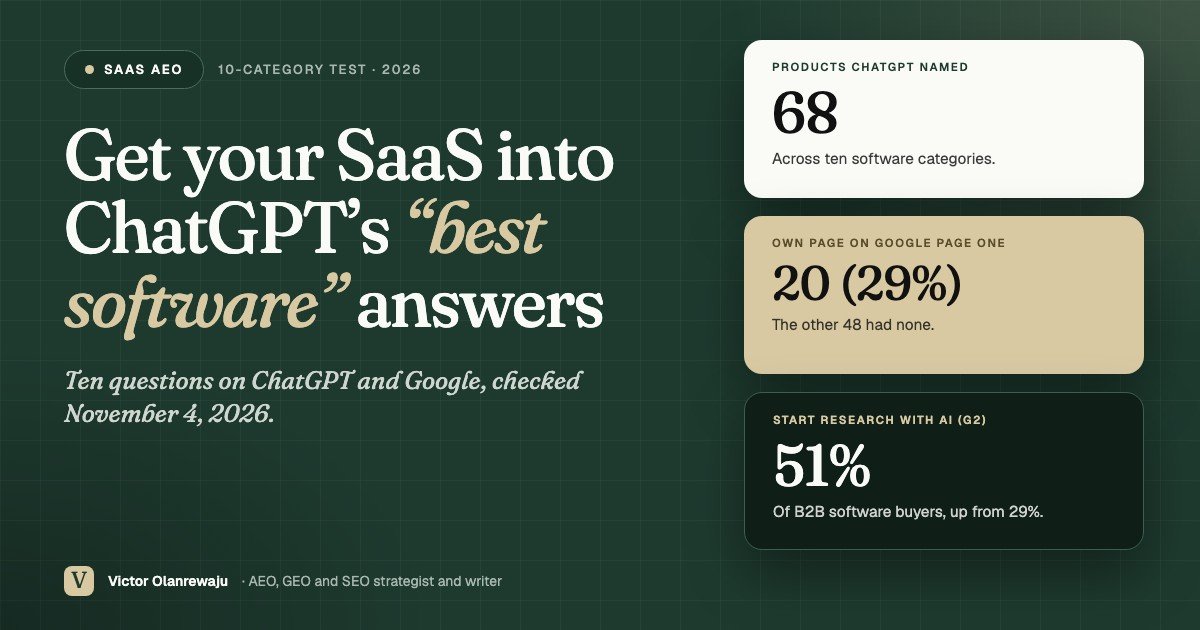
In short: Ranking on Google does not get your SaaS named by ChatGPT. I asked ChatGPT ten “best software” questions on November 4, 2026, then ran the same ten searches on Google. ChatGPT named 68 products. Only 20 of them (29%) had their own page on Google’s first page. In 6 of the 10 answers, the product ChatGPT listed first had no page there at all. Meanwhile G2 reports that 51% of B2B software buyers now start research with an AI chatbot, and 69% ended up with a different vendor than they planned. To get named, you need three things: pages that state who you are best for, at what price, against which rivals; mentions on the roundups and forums engines read; and crawlers allowed in. Below are the full data, a ten-step plan, three page templates and a 12-prompt test.
20 of 68
Brands ChatGPT named that also had their own page on Google page one
6 of 10
Answers where ChatGPT’s first pick had no page on Google page one
51%
B2B software buyers who start research with an AI chatbot (G2, March 2026)
5 of 10
ChatGPT answers that named a Zoho product
51%. That is the share of B2B software buyers who now start research with an AI chatbot, according to G2’s March 2026 survey of 1,076 buyers. A year earlier, the figure was 29%. So here is a question for you. When a buyer asks ChatGPT for the best tool in your category, does it say your name?
Probably less often than you hope, and your Google rank will not save you. I asked ChatGPT for the best project management software for small teams in the US. It named eight tools and put Asana first. Then I ran the same words on Google. Only two of the eight had their own page on page one, and Asana was not one of them.
That was one question, so I ran ten, from CRM to video conferencing. ChatGPT named 68 products. Only 20 of them (29%) had their own page on Google’s first page. In six of the ten answers, its first pick had no page there at all. Meanwhile, Zoho showed up in five. The stakes are real. Conductor found that AI sends 2.80% of technology-site traffic, the highest of ten industries, and ChatGPT drives 88.5% of it. And G2 found that 69% of buyers ended up with a different vendor than they planned. The list forms before anyone opens your website.
In other words, a top Google ranking is not a ticket into an AI answer. The two systems pull from different shelves. This article shows you what each shelf holds, with the data and the sources. Then it gives you a plan to put your product on both. Here is what you will get:
- The test: ten categories, 68 named products, and where each one shows up on Google.
- The anatomy: what a ChatGPT “best software” answer is made of.
- The stakes: G2, Conductor, SE Ranking and Ahrefs data on how buyers and engines behave.
- The access rules: which crawlers to allow so engines can read you.
- The plan: ten steps, three page templates and a gap table by category.
- The check: 12 prompts to run on your own product this week.
If you run growth or marketing at a SaaS company, jump to the plan. Otherwise, start with the test.
The test: 10 “best software” questions, asked on ChatGPT and Google
I picked ten software categories that small teams buy every day. For each one, I asked ChatGPT with web search on, adding “in the US” to stop it from answering for my location. Then I ran the same phrase on Google with US settings and personalization off. I recorded every product ChatGPT named, in order. Then I recorded which of those products had their own website among Google’s page-one organic results. Reviews, forums and videos did not count as the product’s own page.
| Category | ChatGPT listed first | Brands named | Own page on Google page one |
|---|---|---|---|
| Project management for small teams | Asana | 8 | 2: Teamwork.com, Zoho Projects |
| CRM for startups | Attio | 7 | 3: HubSpot, Salesforce, Zoho CRM |
| Email marketing for small business | MailerLite | 7 | 3: Mailchimp, Constant Contact, HubSpot |
| Customer support for startups | Intercom | 5 | 0 |
| Accounting for freelancers | QuickBooks Solopreneur | 6 | 2: QuickBooks, Wave |
| Payroll for small business | Gusto | 8 | 4: Gusto, ADP, OnPay, QuickBooks |
| Password manager for teams | 1Password Business | 6 | 2: 1Password, Bitwarden |
| Website builder for small business | Wix | 8 | 3: Wix, Squarespace, GoDaddy |
| SEO tool for small business | Semrush | 6 | 0 |
| Video conferencing for remote teams | Zoom Workplace | 7 | 1: Microsoft Teams |
| Total | 4 of 10 first picks had a page | 68 | 20 (29%) |
Share of ChatGPT’s named brands that had their own page on Google page one (%)
Five findings stand out.
- Google rank and ChatGPT’s shortlist overlap by less than a third. Only 20 of 68 named products (29%) had their own page on Google page one. The other 48 were named without one. So you can rank and not be named. You can also be named without ranking.
- ChatGPT’s first pick often had no page on page one. Asana, Attio, MailerLite, Intercom, Semrush and Zoom led their answers, yet none had a page among the Google results for that phrase. Only QuickBooks, Gusto, 1Password and Wix did both.
- Suites win by repetition. Zoho appeared in five of the ten answers: Zoho Projects, Zoho CRM, Zoho Books, Zoho Desk and Zoho Meeting. HubSpot appeared in two (CRM and email), and so did QuickBooks (accounting and payroll). A brand with a product for each need gets many chances.
- Smaller names can lead. ChatGPT put Attio first for startup CRMs, ahead of HubSpot and Salesforce, and MailerLite first for small-business email, ahead of Mailchimp. Brand size did not decide the order.
- Forums and roundups fill the gaps. Reddit was on Google page one for all ten searches. Zapier was on page one for five. Where I logged ChatGPT’s source chips, TechRadar appeared in three answers (CRM, password managers and website builders) and Zapier in one (project management).
The two systems also disagree about who belongs. Zendesk is on ChatGPT’s support list but not on Google’s page one for that search. Salesforce and Pylon are on the page but not on ChatGPT’s list. LastPass, Paychex, Paylocity, Morningscore and ZipBooks have their own pages on Google page one for their searches, yet ChatGPT did not name them. That is the opening: each engine has its own gaps, and you can fill either one.
What a ChatGPT “best software” answer is made of
Read enough of these answers and a template appears. ChatGPT builds each one from the same parts. Knowing the parts tells you what to publish. Here is what the website-builder and accounting answers contained.
| Part of the answer | Example from the test | What you publish |
|---|---|---|
| A “best for” tag | “Best overall: Wix.” “Best for tax management” for QuickBooks Solopreneur. | One plain sentence on your homepage and pricing page: “[Product] is best for [buyer] who needs [job].” |
| A starting price | “From approximately $17/month.” “$20/mo.” | A pricing page in plain HTML, with plan names, monthly and annual prices and a date. |
| Three to five feature bullets | “SEO, bookings, payments and CRM integrations.” | A short, factual feature list near the top of the product page, not buried in tabs or images. |
| A decision table | “Business requirement → best choice,” such as ecommerce → Shopify. | Your own “who should pick which” table, including who should not pick you. |
| A criteria list | “SEO, performance, integrations, scalability, ownership.” | A “how to choose” section that sets criteria you can honestly meet. |
| A freshness cue | “(2026).” “Pricing is indicative… verify checkout.” | A visible “last checked” date on every comparison and pricing page. |
| Source chips | “Sources: TechRadar +3.” | Accurate coverage on the roundups engines cite, plus your own pages. |
| A follow-up question | “Are you choosing one for a business, or…?” | Pages for each follow-up: use cases, team sizes, integrations. |
Notice what is missing. ChatGPT did not quote slogans. It quoted tags, prices, bullets and criteria. So the pages that get lifted are the ones that state those things in plain, short sentences.
Why this matters now: what buyers and engines are doing
Start with buyers. G2’s March 2026 survey of 1,076 B2B software buyers and decision-makers, published April 15, 2026, shows how fast habits are moving.
How B2B software buyers use AI chatbots (% of buyers surveyed)
Now the engines. Conductor’s 2026 benchmark for the information technology sector covers US enterprise sites and was last updated April 14, 2026. Treat it as direction, not today’s exact share.
| Finding (Conductor, IT sector) | Number | What it means for a SaaS company |
|---|---|---|
| AI referrals as a share of traffic | 2.80% for IT; 3.37% for software and services | The highest of the 10 industries Conductor studied. Software buyers use AI more than most. |
| ChatGPT’s share of AI referrals | 88.5% for IT sites; Perplexity nearly 5% | Test ChatGPT first. It sends the traffic. |
| Google AI Overviews on queries | 11.4% for IT; 10.8% for software and services | Fewer AI Overviews than in finance (27.3%), so classic rankings still carry weight. |
| Most-cited content type in AI Overviews | Blog content (over 300,000 pages cited); product pages second (just over 58,000) | Educational and comparison articles get cited more often than product pages. |
| Top AI Overview share of voice, software and services | Microsoft 1.98%, LinkedIn 1.49%, Google 1.35% | Platforms lead. A mid-size SaaS brand competes through the content around its category. |
Two broader numbers add context. SE Ranking measured AI referrals at 0.32% of traffic across 101,574 sites in 2026, up from 0.02% in 2024. And Ahrefs found position-one click-through is about 58% lower when an AI Overview is present. So AI still sends a small slice of visits, yet it shapes the shortlist before the visit happens. That is why G2’s 69% matters more than any traffic share. For more context, see my AI search statistics.
Open the door first: the crawlers that decide if engines can read you
No page can be cited if the engine cannot fetch it. The good news: Google says there is nothing special to add. On its AI features page, Google states that “there are no additional requirements to appear in AI Overviews or AI Mode,” and that no special schema.org markup is needed. A page must simply be indexed and eligible to show with a snippet.
The other engines use their own bots. Several vendors split search bots from training bots, so you can allow one and block the other. Here is what each company says.
| Engine | Bot | What it does | Your move |
|---|---|---|---|
| ChatGPT | OAI-SearchBot | Surfaces sites in ChatGPT search results | Allow it. Sites that opt out do not appear in ChatGPT search answers. |
| ChatGPT | GPTBot | Crawls content that may train OpenAI models | Your choice. Blocking it does not remove you from search. |
| ChatGPT | ChatGPT-User | Visits a page when a user asks | Do not rely on robots.txt to control it. |
| Claude | Claude-SearchBot | Indexes content to improve search results | Allow it. Blocking may reduce your visibility. |
| Claude | Claude-User | Retrieves pages when a user asks a question | Allow it for visibility in those answers. |
| Claude | ClaudeBot | Collects content that may train models | Your choice. |
| Perplexity | PerplexityBot | Surfaces and links sites in Perplexity results | Allow it, and allow its published IP ranges. |
| Googlebot | Crawls for Search, including AI features | Keep pages indexable. No extra steps. |
The pattern is simple. Allow the search bots. Decide separately about the training bots. After you edit robots.txt, OpenAI says its systems can take about 24 hours to adjust. For setup details, read my AI crawler guide. Sources for the bot facts are OpenAI, Anthropic and Perplexity.
A 10-step plan to get your SaaS named
The plan covers both ends of the funnel. Steps 1 to 4 serve mid-funnel buyers who are still comparing categories. Steps 5 to 8 serve bottom-funnel buyers who have a shortlist and want proof. Steps 9 and 10 keep you honest.
| Step | What to do | Why | Effort |
|---|---|---|---|
| 1. Write your “best for” line | One sentence: “[Product] is best for [buyer] who needs [job].” Use it word for word on your homepage, pricing page, G2 profile and LinkedIn page. | ChatGPT answers carry a “best for” tag per product. Consistent wording gives it one to copy. | 2 hours |
| 2. Publish a plain-HTML pricing page | Plan names, monthly and annual prices, limits, and a “last checked” date. No price in images or pop-ups. | The website-builder and accounting answers quoted a price for the products they listed. | 1 day |
| 3. Build “best [category] for [buyer]” pages | One honest page per buying query. Name rivals, state criteria, and say who should not pick you. Disclose that you make one of the products. | Page one for these searches is mostly roundups and forums. A vendor page that answers the question stands out. | 1 week for the first three |
| 4. Add comparison and alternatives pages | “[You] vs [Rival]” and “[Rival] alternatives.” Use a table: price, best for, not for, integrations. | Buyers with a shortlist search these exact phrases. | 2 days each |
| 5. Make facts quotable | Add a facts block to product pages: who it is for, plans, integrations, security certifications, countries, as-of date. | Missing or vague facts get filled in by someone else’s version. | 2 to 3 days |
| 6. Win the roundups that engines read | List the 10 roundups that rank for your queries (Zapier, TechRadar and similar). Check what each says about you. Send editors accurate data and a real test account. Never pay for fake reviews. | Reddit and roundup sites showed up in nearly every search I ran. | 1 day, then monthly |
| 7. Earn real reviews and forum answers | Ask customers for honest reviews on the platforms your buyers use. Answer questions on Reddit as a named employee, with disclosure. | Reddit was on page one in 10 of 10 searches. | 2 hours a week |
| 8. Add schema that matches the page | Organization sitewide, Article and FAQPage on guides, SoftwareApplication on product pages where it fits. Only mark up what readers can see. | It helps machines read the page. It does not guarantee a ranking or a citation. | 2 days |
| 9. Fix crawler access | Allow OAI-SearchBot, Claude-SearchBot and PerplexityBot. Confirm key pages are indexable and load without a login. | Engines cannot cite what they cannot fetch. | Half a day |
| 10. Test monthly | Run a fixed 20-prompt panel on ChatGPT, Gemini, Claude, Perplexity and Google. Log whether you are named, in what position, and which sources appear. | Answers drift. My Binance audit showed answers change within days. | Half a day a month |
One caution on step 8. Google’s software app structured data guide requires a name, a price in the offer, and either an aggregate rating or a review. Do not invent a rating to qualify. Fake markup breaks Google’s rules and erodes trust. My schema guide shows safe patterns.
3 page templates that give engines clean passages
Template 1: the “best for” comparison page
| Section | What goes in it |
|---|---|
| Title and verdict | “Best [category] for [buyer] ([year]).” Then a two-sentence verdict and the date you last checked. |
| Summary table | Three to six options, including rivals: starting price, best for, not for, standout feature. |
| How we chose | Your criteria in plain words, and a line saying you make one of the products. |
| Each option | One short section: strengths, limits, the price that matters, and a source link. |
| Who should pick which | Three “if you…, choose…” lines. Answers reuse this block. |
| FAQ | Five real buyer questions, two sentences each, with FAQPage schema. |
Template 2: the pricing page
| Section | What goes in it |
|---|---|
| Plan table | Plan names, monthly price, annual price, seat limits, key limits. Real text, not images. |
| Best for, per plan | One line per plan: “Best for solo founders,” “Best for teams of 10 to 50.” |
| What is not included | Add-ons, usage fees and overages. Buyers and engines trust a page that says it. |
| Last checked date | “Prices checked November 2026.” Update it when you change a price. |
| Pricing FAQ | Free trial, refunds, contract terms, discounts. Five questions with schema. |
Template 3: the “versus” page
| Section | What goes in it |
|---|---|
| Verdict | Two sentences: who should pick you, who should pick the rival. |
| Side-by-side table | Price, best for, integrations, support, limits. Cite the rival’s own pricing page. |
| Switching guide | How to migrate from the rival, with time and cost. This is bottom-funnel gold. |
| Honest limits | Where the rival is better. It makes the rest believable. |
Where the openings are, by category
The gap table below is my reading of the test data. It is an inference, not a measurement of cause, so treat it as a hypothesis to test.
| Category | What the test showed | The opening |
|---|---|---|
| Customer support | 0 of 5 named brands had their own page on Google page one. | A vendor “best for startups” page faces mostly roundups and forums. |
| SEO tools | 0 of 6 named brands on page one. Results were roundups, forums and one challenger. | An honest comparison with real test notes can stand out. |
| Video conferencing | 1 of 7 on page one. Roundups dominated. | Use-case pages: remote hiring, webinars, client calls. |
| Project management | 2 of 8 on page one. Zapier and forums filled the page. | Team-size and industry pages, plus a roundup outreach plan. |
| Payroll | 4 of 8 on page one, and six payroll vendors had pages there. | A crowded shelf. Differentiate on state coverage, price clarity and switching help. |
| CRM and email | 3 of 7 each. Large suites held the vendor slots. | Niche pages by industry, since ChatGPT also named smaller tools. |
The 12-prompt test: see where you stand today
Run each prompt on ChatGPT with web search on, then on Gemini, Claude and Perplexity. Run it three times, because answers vary. Record whether you are named, your position, what the engine says and which sources it shows.
| Type | Prompt | What to record |
|---|---|---|
| Best of | “Best [category] software for [buyer] in the US” | Are you named? In what position? |
| Best of | “Best [category] tool for [use case]” | Who is first, and what “best for” tag do they get? |
| Best of | “Cheapest [category] software” | Is your price quoted correctly? |
| Comparison | “[Your product] vs [rival]” | Is each fact right? What is missing? |
| Comparison | “[Rival] alternatives” | Do you appear on the list? |
| Comparison | “Is [your product] better than [rival] for [need]” | What reason does the engine give? |
| Trust | “Is [your product] legit” and “Is [your product] secure” | Does it cite your certifications and reviews? |
| Pricing | “[Your product] pricing” and “Does [your product] have a free plan” | Are plans and limits current? Which page does it cite? |
| Problem | “How do I [job your product does]” | Do you appear as a solution? |
| Integration | “Does [your product] integrate with [tool]” | Is the answer right? Do you have a page for it? |
| Switching | “How to switch from [rival] to [your product]” | Does your migration page appear? |
| Complaints | “[Your product] problems” and “[Your product] reviews” | What do the sources say? Can you respond? |
If you want it automated, compare the tools in my AI visibility tools review. For the manual method, read how to check what ChatGPT says about your business. For a fintech version of this study, see why NerdWallet gets cited instead of your fintech.
Where I come in
I have spent six years writing for crypto and finance outlets, and I now test what AI engines say about brands. I used the same method on the Binance hack and on CoinGecko’s citation gap. For a SaaS company, the work looks like this:
| Option | Price | What you get |
|---|---|---|
| Free AI visibility audit | Free | A score out of 100, your top fixes, and what ChatGPT, Gemini and Perplexity say about you |
| Manual AI visibility report | $120 | 25 prompts tested across five engines, with a written summary. The 12-prompt test above is the base. |
| Answer-first article | $80 each | 800 to 1,200 words, sourced, with an FAQ and schema |
| Standard foundation build | $850 | Up to 30 pages, an internal linking plan, five answer-first pages written for you and review request set-up, in about 3 to 4 weeks |
| Growth retainer | $650 per month | A 25-prompt panel across five engines with two competitors compared, four pages or articles and a monthly report |
I cannot promise a ranking or an AI citation. I can promise a clear fix list, sourced data and honest reporting. Prices come from my pricing page, checked November 4, 2026.
Start with the free audit. It takes no payment details, and you get a plain-English report by email within one business day. Not sure which searches matter? Tell me your product and your buyer, and I will tell you which ones to test first.
Run the free AI visibility audit
Contact me, or see my pages on AEO and GEO.
How I checked, and the limits
- One snapshot. I ran ten ChatGPT prompts and ten Google searches once, on November 4, 2026. ChatGPT answers vary run to run and by user. Google results vary by day and location.
- Personalization. ChatGPT was signed in to my account with web search on. I added “in the US” to each prompt, yet account memory may still have shaped some answers.
- Prompt and search wording. ChatGPT prompts ended with “in the US.” The Google searches used the same words without it, with US settings applied. The CRM, support and project-management phrases were “for startups” and “for small teams,” as shown in the table.
- Small sample. Ten categories cannot describe all of SaaS. Run your own twenty.
- “Own page” is my judgment. I counted a brand only when its own domain appeared among Google’s page-one organic results. A brand’s Reddit thread, YouTube video or review did not count. Subpages such as a Zoho or QuickBooks product page counted for the product they described.
- Source chips were not logged for every answer. I recorded them where they were visible in my notes: TechRadar for CRM, password managers and website builders, and Zapier for project management. Do not read the other answers as having had no sources.
- Order is as ChatGPT listed it. “Listed first” means first in the numbered list. ChatGPT did not always call it the winner.
- Third-party data has its own limits. Conductor’s figures cover US enterprise sites. G2 surveyed buyers who chose to respond. I read G2, Conductor, Google, OpenAI, Anthropic and Perplexity on their own pages. Check the originals before you reuse a number.
Related reading: SEO, AEO and GEO explained and AI citation versus AI recommendation.
Keep reading: If you plan to hire for this work, see my list of the best SaaS content writers for AI search.
Frequently asked questions
How do I get my SaaS recommended by ChatGPT?
Publish pages that state who you are best for, your pricing and how you compare with rivals. Get accurate coverage on the roundups and forums engines read, and allow OAI-SearchBot to crawl your site. In my November 4, 2026 test, only 20 of the 68 products ChatGPT named had their own page on Google page one, so Google rank alone does not decide it.
Does ranking on Google get my product into ChatGPT’s answers?
Not by itself. In my ten-category test, 48 of the 68 products ChatGPT named had no page of their own on Google page one, and in 6 of 10 answers its first pick had none. Rankings help, but ChatGPT also draws on roundups, forums and your own facts.
What do ChatGPT’s “best software” answers include?
In the answers I read, each product had a “best for” tag, a starting price, a few feature bullets, and the answer ended with a decision table and a follow-up question. Several answers also showed source chips, such as TechRadar. So publish those same elements in plain text.
Should I allow OAI-SearchBot in robots.txt?
Yes, if you want to appear in ChatGPT search. OpenAI says sites that opt out of OAI-SearchBot will not appear in ChatGPT search answers. GPTBot is separate and controls training use, so you can block it without leaving search.
Which Claude and Perplexity bots should I allow?
Allow Claude-SearchBot and Claude-User, because blocking them may reduce your visibility in Claude answers. For Perplexity, allow PerplexityBot and its published IP ranges. ClaudeBot collects training data, so that choice is separate.
Do I need special schema to appear in Google’s AI Overviews?
No. Google says there are no additional requirements and no special schema.org markup for AI Overviews or AI Mode. Pages need to be indexed and eligible to show with a snippet. Schema still helps machines read your page.
Does SoftwareApplication schema help SaaS products?
It can, for Google’s software app rich results. Google requires a name, an offer price, and either an aggregate rating or a review. Only add it if you have real ratings or reviews, and never invent them.
How many B2B buyers use AI chatbots to research software?
G2’s March 2026 survey of 1,076 B2B software buyers found 51% start research with an AI chatbot, up from 29% in its 2025 report, and 71% rely on chatbots at some point. 69% chose a different vendor than they planned.
How much traffic does AI actually send to software sites?
More than to most industries, though still a minority. Conductor measured AI referrals at 2.80% of IT site traffic and 3.37% for software and services. ChatGPT drove 88.5% of those AI referrals. SE Ranking measured 0.32% across all sites in 2026.
What content do AI Overviews cite most for software queries?
Conductor found blog content is by far the most cited type in IT-sector AI Overviews, with over 300,000 pages cited, ahead of product pages at just over 58,000. Educational and comparison articles matter as much as your product pages.
Is it honest to write a “best software” page that includes my own product?
Yes, when you disclose that you make one of the products, state your criteria, name rivals fairly and say who should not choose you. Pages that hide the conflict lose reader trust, and engines tend to favor pages with clear sourcing.
How often should I check what AI says about my product?
Run a fixed 20-prompt panel monthly, and weekly around launches, price changes or incidents. Answers can change within days, so track the same prompts on the same engines and log your position each time.
Why was a smaller CRM listed above HubSpot and Salesforce?
In my test ChatGPT listed Attio first for startup CRMs, ahead of HubSpot and Salesforce. I cannot say why from one run. It does show that brand size did not decide the order, so a well-positioned challenger can lead.
Can you audit my SaaS product’s AI visibility?
Yes. Start with the free AI visibility audit, or order the $120 manual report that tests 25 prompts across five engines. For a full build, the Standard foundation package is $850.