In this article
- Why does Kigali make an interesting test?
- How was the research done?
- What did the AI answers cite?
- What were the 20 websites missing?
- What does it mean?
- What should a Kigali business fix first?
- How could you replicate this research for your own market?
- What are the limits of this research?
- What should a Kigali hotel’s key pages contain?
- What should a Kigali restaurant publish?
- What should you do on Google Business Profile?
- How should a Kigali business measure progress?
- What is a realistic 30-day plan?
- What do we still not know about Kigali?
- Why do directories dominate broad questions, and what can you do about it?
- How would the Lens & Co playbook apply to a Kigali tour operator?
- What about languages?
- What does this mean for Rwanda’s wider digital economy?
- Sources
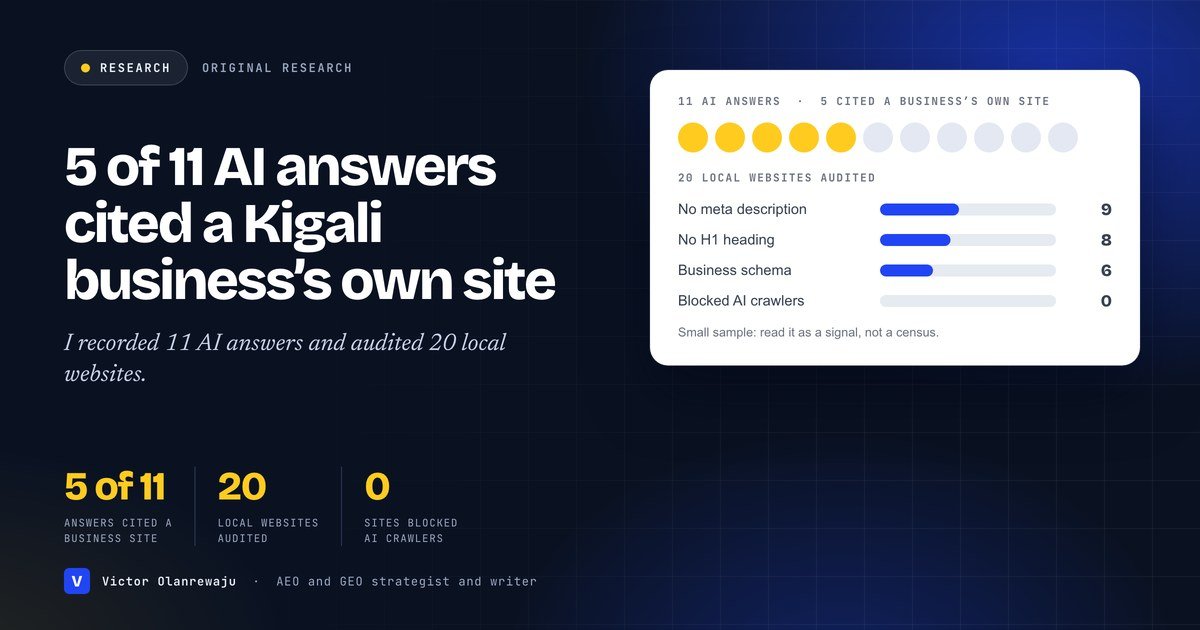
In short: I recorded 11 AI answers about Kigali restaurants and hotels and audited the raw HTML of 20 local sites. Only 5 of the 11 answers cited a business’s own website, mostly on specific questions. Broad questions mostly cited directories. Nine of the 20 sites had no meta description, eight had no H1, six had business schema, and none blocked AI crawlers. It is a small sample, so read it as a signal, not a census. The takeaway for a Kigali business is encouraging: the basics are missing on most sites and the door to AI crawlers is open, so doing them well can stand out quickly.
Most writing about AI search comes from the United States and Europe. I live and work in Kigali, serve clients across East and West Africa, and wanted to see what the assistants actually do with businesses I can walk to. This is the write-up of a small piece of original research, with its method, its limits and the practical conclusions. It is the local counterpart to the case studies of Lens & Co by Tiara and LAGE Lightings. The original version appears on Vatam: how Kigali restaurants and hotels appear in AI answers.
Why does Kigali make an interesting test?
Kigali is a city where travel and hospitality decisions are often made online, by people who do not live there. Rwanda’s tourism sector generated USD 647 million in 2024 and welcomed 1.36 million visitors, according to the Rwanda Development Board’s 2024 annual report, with meetings, incentives, conferences and exhibitions generating USD 84.8 million across 115 events and over 52,000 delegates. Those visitors and delegates choose where to stay and eat before they arrive, and increasingly they ask an assistant.
Domestic connectivity adds a second audience. DataReportal’s Digital 2026 report for Rwanda, published on 8 November 2025, counted 5.01 million internet users in October 2025, a penetration of 34.2% of the 14.7 million population, and 13.0 million active mobile connections. So the local market is mobile-first and still growing, while international visitors are a large share of hospitality demand. Both audiences form their shortlist somewhere other than a hotel’s own front door. See AI search statistics for 2026 for the wider data on how assistants are changing that behaviour.
How was the research done?
- AI answers. On 5 October 2026 I recorded 11 answers while logged out: six restaurant questions on Perplexity and five hotel and restaurant questions on ChatGPT.
- Website audit. I audited the raw HTML of 20 Kigali restaurant, café and hotel websites for the basics that search engines and assistants rely on: a meta description, an H1, business schema markup and whether AI crawlers were blocked.
- Controls. Answers were recorded logged out. Perplexity’s free logged-out allowance ran out after about six queries, which is why the sample is not larger, and I did not create accounts to get around it.
- Limits. It is 11 answers on two platforms on one day, and 20 sites. Answers change between runs, so this is a snapshot.
What did the AI answers cite?
| Finding | Result |
|---|---|
| Answers that cited a business’s own website | 5 of 11 |
| Which questions produced those citations | Mostly specific questions |
| What broad questions cited | Mostly directories |
The pattern is the one I see across markets. A specific question has a specific answer, and a business with a specific page can be that answer. A broad question has no single answer, so the assistant leans on directories that list many businesses. A hotel with a page that answers “is there airport pickup in Kigali” has something to be cited for. One with only a homepage does not.
The same mechanism appears in Nigeria. For Lens & Co by Tiara, AmasoAI logged the sites Claude consulted, and marketplaces such as Jumia (27 times) and Jiji (7) dominated, while the store itself appeared five times and ChatGPT listed it first of five. A store with one page per search got named. A directory-dependent market rewards the business that gives the assistant something specific.
What were the 20 websites missing?
| Check | Result | Why it matters |
|---|---|---|
| No meta description | 9 of 20 | Google’s guidance says unique descriptions help when individual pages appear in results, and that Google sometimes uses the description to build the snippet |
| No H1 | 8 of 20 | The page does not state its own subject in the clearest place |
| Business schema markup | 6 of 20 | Without it, a machine has to guess your name, address and category. See schema markup for AI search |
| Blocked AI crawlers | 0 of 20 | Good news: the door is open. See the AI crawlers guide |
Put another way: of the 20 sites, only 11 had a meta description, 12 had an H1 and 6 had schema. Those are the most basic page signals there are, and they cost nothing. The same sites mostly allowed AI crawlers, which means the businesses that fix their pages are not fighting a technical block. Google also tells site owners to make sure their Business Profile information is up to date, which for many hospitality businesses is the single most visible fact source of all.
What does it mean?
- Most Kigali businesses are missing easy wins. Basic page signals that cost nothing are absent on many sites.
- Nobody is blocking the crawlers, so the opportunity is open. A business that does the basics well can stand out quickly.
- Specific pages are the gap. Few of the sites had a page dedicated to a question a visitor actually asks.
- Directories are doing the work businesses are not. When your own site does not answer, an assistant cites someone who lists you.
What should a Kigali business fix first?
- Every important page gets one clear H1, a unique title and a meta description. Prioritise the home page, rooms or menu, contact and booking pages.
- Add business schema with your name, address, hours and contact details, kept identical to your Google Business Profile.
- Write a specific page for each question visitors actually ask. For a hotel: airport pickup, parking, prices by season, check-in and check-out, breakfast, safety, getting around, nearby attractions, meeting rooms. For a restaurant: menu and prices, opening hours, reservations, dietary options, location and parking.
- Keep AI crawlers allowed and consider publishing an llms.txt summary.
- Complete your listings and collect genuine reviews, since assistants lean on them.
- Test what ChatGPT, Gemini, Claude and Perplexity say about you now, then again each month with this 30-minute test.
How could you replicate this research for your own market?
- Choose a category and a place, such as hotels in your city.
- Write 10 to 20 questions a visitor would ask, from broad (“best hotels in X”) to specific (“is there airport pickup”).
- Run them in each assistant, logged out, with web search on, and record the date, the answer, the businesses named and the sources cited.
- Audit the 20 most-named businesses’ sites for the basics.
- Compare what the answers cite with what the sites offer, and publish the gaps.
I plan to repeat this research with a larger sample and a wider set of assistants, and I will publish the results here and on Vatam.
What are the limits of this research?
This is a small sample. Eleven answers on two platforms on a single day cannot describe all of Kigali or all assistants, and AI answers change between runs, users and models. The website audit looked at HTML signals, not at content quality. I publish it because specific, dated, small-sample evidence is more useful than a generic claim, and because the pattern matches what I see in client work elsewhere. If you want to see where your own business stands, ask for the free AI visibility audit, or read about my GEO work.
What should a Kigali hotel’s key pages contain?
Because specific pages are what assistants cite, the fastest improvement for most hotels is a handful of pages that answer the questions guests actually ask. Here is an outline for three of them.
Airport pickup page
- A heading phrased as the question, such as “Is there airport pickup at [hotel] in Kigali?”
- The direct answer in the first sentence, with price and booking method.
- Journey time from Kigali International Airport and where the driver meets guests.
- What happens if a flight is delayed.
- An FAQ for luggage, groups and late arrivals.
- Links to rooms, contact and getting around.
Rooms and rates page
- Each room type with size, bed configuration, facilities and photos with descriptive text.
- Nightly rates by season, what is included and any extra charges.
- Payment methods, cancellation policy and check-in and check-out times.
- A clear booking route, including WhatsApp where guests prefer it.
Getting around and nearby page
- Distances and travel times to named places: the airport, the city centre, the convention centre, major attractions.
- Transport options with typical costs.
- Practical safety and local tips written by a person who knows the area.
What should a Kigali restaurant publish?
- Menu and prices as text, not only as an image or PDF, so assistants and search engines can read them.
- Opening hours including holidays, kept identical to the Business Profile.
- Reservations: how to book, group sizes, deposit rules.
- Dietary options and allergens.
- Location, parking and nearby landmarks in plain words.
- Payment methods accepted.
- One page per question guests ask repeatedly.
What should you do on Google Business Profile?
For local hospitality, your Business Profile is often the most visible fact source. Google’s AI features guidance asks site owners to check that their Business Profile information is up to date, and the Lens & Co case shows a 5.0-star local listing from 63 reviews appearing beside its rankings. A practical checklist:
- Claim and verify the profile.
- Choose accurate primary and secondary categories.
- Keep name, address and phone number identical to your website and structured data.
- Add hours, including special hours.
- Upload real photos and keep them current.
- Answer questions guests ask, and reply to every review politely.
- Link to your specific pages, not only the home page.
How should a Kigali business measure progress?
| Measure | Tool | Cadence |
|---|---|---|
| What assistants say about you | Fixed panel of questions, logged out, in ChatGPT, Gemini, Claude, Perplexity and Google | Monthly |
| Search clicks and impressions | Google Search Console | Monthly |
| Visits from assistants | Analytics referrals from chatgpt.com, perplexity.ai and similar | Monthly |
| Bookings and enquiries by source | A “How did you hear about us?” field and your booking system | Ongoing |
| Reviews and rating | Google Business Profile | Monthly |
What is a realistic 30-day plan?
| Week | Focus | Output |
|---|---|---|
| 1 | Audit and baseline | Run the assistant panel, record results, audit H1s, titles, descriptions, schema and robots.txt |
| 2 | Fix the basics | One H1, a unique title and a meta description on every important page; add business schema; confirm AI crawlers are allowed |
| 3 | Publish specific pages | Airport pickup, rooms and rates, getting around, FAQ |
| 4 | Profiles and measurement | Complete Business Profile, request genuine reviews, set up the enquiry source field, re-run the panel |
This is a starting point. It will not move every assistant in a month, and results vary, but it fixes the gaps the research found. If you would like me to run this for your business, ask for the free AI visibility audit.
What do we still not know about Kigali?
- Whether the pattern holds across more assistants. I tested ChatGPT and Perplexity. Gemini, Claude and Google’s AI features may behave differently.
- How stable the answers are over weeks. One day’s snapshot cannot show drift.
- How much traffic and how many bookings assistants actually drive for Kigali businesses, which needs analytics from businesses willing to share them.
- How other categories behave: clinics, law firms, schools and tour operators.
Those are the questions I want to answer next. If you run a Kigali business and would like to take part, get in touch.
Why do directories dominate broad questions, and what can you do about it?
For a broad question such as “best restaurants in Kigali”, no single business’s page is the answer, so an assistant leans on sources that cover many businesses: directories, review sites and articles. A restaurant cannot change that by rewriting its home page. What it can do is:
- Be accurately present on the directories assistants cite. Claim and complete your listings, with consistent name, address, hours and photos.
- Earn real reviews where reviews are collected.
- Be mentioned in articles by local publications and bloggers who cover the city, through genuine relationships and original content.
- Win the specific questions yourself. You cannot own “best restaurants in Kigali”, but you can own “does [restaurant] take reservations for groups”.
How would the Lens & Co playbook apply to a Kigali tour operator?
Here is a worked plan, not a record of a real engagement. Lens & Co by Tiara reached page one of Google Nigeria and ChatGPT’s first place with one page per search. A Kigali tour operator could apply the same principle:
- List the searches. “Gorilla trekking permits Rwanda”, “how much is gorilla trekking”, “Kigali city tour half day”, “best time to visit Rwanda”, “airport transfer Kigali”.
- Map one page to each search, with the answer in the first sentence and the specifics: prices, durations, what is included, how to book.
- Add trust pages: licensing, safety, cancellation and refund policy, guides’ credentials, real traveller reviews.
- Link the pages together and to booking.
- Complete the Business Profile and relevant listings.
- Test monthly in ChatGPT, Gemini, Claude, Perplexity and Google with the same questions, and track enquiries by source.
The Rwanda Development Board’s 2024 figures show how much tourism spending is at stake, with USD 647 million in revenue and 1.36 million visitors. The principle is the same in every sector: the business that answers the specific question gets named.
What about languages?
Rwanda’s visitors and residents use English, French, Kinyarwanda and Swahili among other languages. I did not test multilingual questions in this research, so I cannot say how assistants treat pages or questions in other languages. If your audience asks in French or Kinyarwanda, test those questions explicitly and publish pages in those languages where it makes sense, with accurate translations reviewed by a native speaker.
What does this mean for Rwanda’s wider digital economy?
Rwanda’s internet penetration of 34.2% (DataReportal, October 2025) means most of the population is not yet online, but the people who are online include the international visitors, diaspora and business travellers who drive spending in hospitality. For those audiences, discovery happens in search and in assistants. Rwandan businesses that make their facts clear and specific now are positioned for both, and, as the Rwanda Development Board’s tourism figures suggest, the audience is large enough to matter.
Sources
Frequently asked questions
How many AI answers cited a Kigali business's own website?
Five of the 11 answers I recorded cited a business's own website, mostly in response to specific questions. Broad questions mostly cited directories.
What were Kigali business websites missing?
Of 20 sites audited, 9 had no meta description, 8 had no H1 and only 6 had business schema markup. None blocked AI crawlers.
Is this research representative of all of Kigali?
No. It is a small sample: 11 answers from Perplexity and ChatGPT recorded on one day, and 20 websites. Treat it as a signal, not a census.
What is the first thing a Kigali business should fix?
Give each important page a clear H1, a unique title and a meta description, add accurate business schema, and write specific pages for the questions visitors ask.
How big is tourism in Rwanda?
According to the Rwanda Development Board's 2024 annual report, tourism generated USD 647 million and 1.36 million visitors in 2024, and the MICE sector generated USD 84.8 million across 115 events.