In this article
- Why test what AI says about you?
- What do you need before you start?
- Step 1: design the question panel
- Step 2: control the variables
- Step 3: run each question in each assistant
- Step 4: record everything
- Step 5: score the results
- Step 6: map the sources
- Step 7: check what the assistants say about you
- Step 8: diagnose the pattern
- Step 9: connect it to pipeline
- How do you monitor the monitoring?
- How often should you repeat it?
- What should you do with the findings?
- How many repeats are enough?
- What should a monthly report contain?
- What testing mistakes distort the results?
- The whole test on one page
- Sources
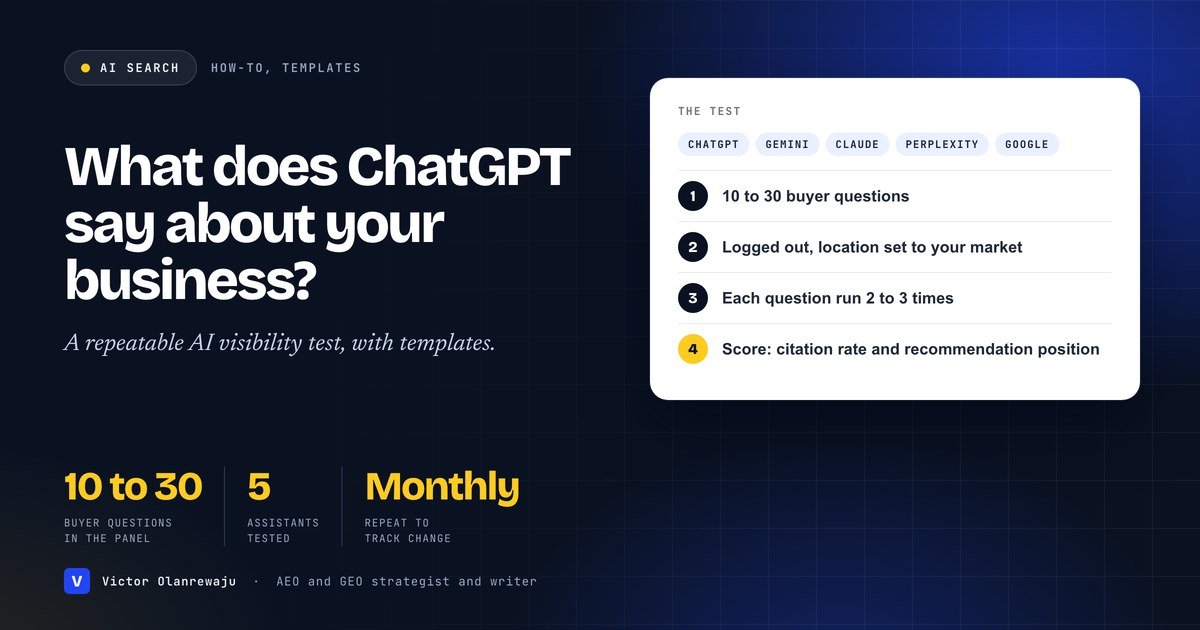
In short: Write ten to thirty questions your buyers ask, run each one in ChatGPT, Gemini, Claude, Perplexity and Google while logged out and with the location set to your market, and record whether your business is cited, whether it is named and in which position. Repeat each question two or three times, because answers change between runs. Score the results with two simple measures, citation rate and recommendation position, map the sources the assistants rely on, compare what they say with what your own site says, and repeat monthly. Do it before you change anything, so you have a baseline.
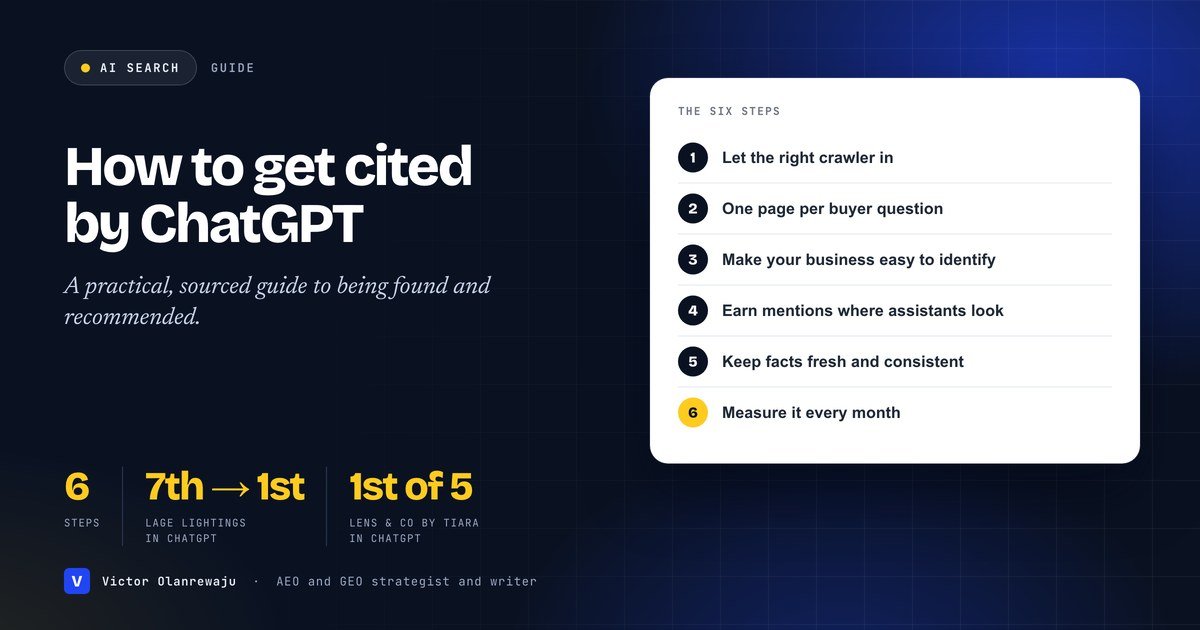
The first thing I do with any client is run this test, and the most common reaction is surprise: at who is named instead of them, at how often the assistant gets a basic fact wrong, and at which websites it trusts. You cannot improve what you have not measured, and the case studies on this site, including Lens & Co by Tiara, are clear that the biggest weakness in an otherwise strong result was the absence of a baseline recorded before the work began. This guide shows how to run the test properly, so that the numbers mean something. It supports the sequence in how to get cited by ChatGPT.
Why test what AI says about you?
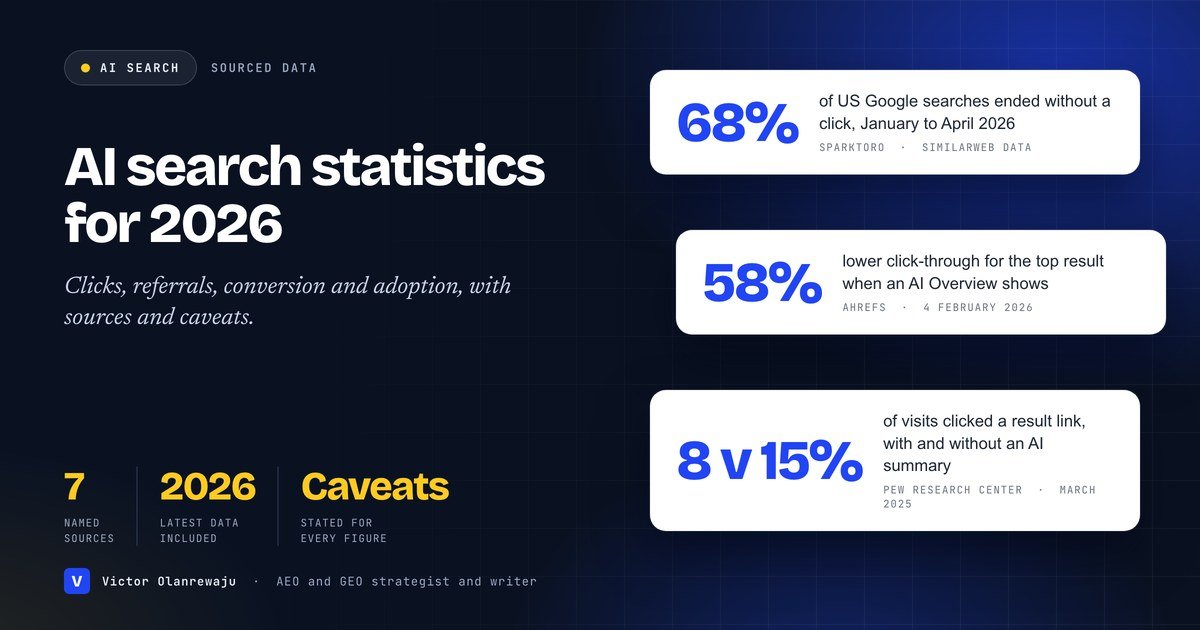
Buyers increasingly ask an assistant before they open a search result, and the assistant answers with a short list of businesses. Pew Research Center’s analysis of browsing data from 900 US adults found that users who saw a Google AI summary clicked a traditional result link in 8% of visits, against 15% for users who did not, and very rarely clicked the sources cited inside the summary. SparkToro, using Similarweb panel data, reports 68.01% of US Google searches in January to April 2026 ended without a click. The full set of figures, with their limits, is in AI search statistics for 2026. If you have never checked what the assistants say about you, you do not know whether you are on the shortlist, who is, what facts they repeat about you, or which sources they trust. This test finds out.
What do you need before you start?
- A spreadsheet with the columns shown below.
- A private or incognito browser window, signed out of every assistant, so your history and preferences do not shape the answer.
- Your location set to the market you serve. In the Lens & Co study, Google results were read from a signed-out browser with the country set to Nigeria, and the study notes that rankings move with device, location, personalisation and time. Treat each result as a dated snapshot.
- Web search switched on in each assistant that offers it, because that is how buyers use it.
- About 30 minutes for a first run of ten questions, and more as the panel grows.
Step 1: design the question panel
The panel is the heart of the test. A weak panel produces flattering or meaningless results.
Where to find real questions
- Search Console queries that already bring impressions.
- Sales calls and enquiry forms: the exact words prospects use.
- Customer support tickets and reviews.
- Google autocomplete and “People also ask” for your category.
- Competitor FAQ pages.
Four types of question
| Type | Example pattern | What it tests |
|---|---|---|
| Recommendation | “Best [what you sell] in [your city]” | Whether you are named on the shortlist |
| Selection | “Who should I hire for [your service]?” | Whether you are recommended for a decision |
| Specific question | “How much does [product] cost in [country]?”, “Is there [feature] in [place]?” | Whether your pages are cited as sources |
| Brand | “What is [your business]?”, “Is [your business] good?” | Whether assistants describe you accurately |
Include two or three questions that name your category but not your brand. They show whether you are discoverable by people who do not already know you. Use natural language, including your city or country, because that is how people ask.
A starter panel for three kinds of business
| Business | Example questions |
|---|---|
| Hotel in Kigali | “Best boutique hotels in Kigali”, “Hotels near Kigali airport with airport pickup”, “Where to stay in Kigali for a business trip”, “Is [hotel name] good?” |
| E-commerce store in Nigeria | “Best stores to buy blue light and photochromic glasses in Nigeria”, “Where to buy luxury chandeliers in Lagos”, “How to tell if blue light glasses are real” |
| B2B service | “Best SEO agency for fintech companies”, “Who can help my business get recommended by ChatGPT”, “How much does an AI visibility audit cost” |
Step 2: control the variables
AI answers vary between runs, between users and between models, and Google’s own documentation says AI Overviews are only shown when its systems determine they are additive to classic Search, so they often do not trigger. To make results comparable month to month, write down a protocol and follow it every time:
- Same browser profile type (private window), signed out.
- Same location setting and language.
- A fresh conversation for every question, so earlier answers do not carry over.
- Web search on, where available.
- The exact question wording, copied from the panel.
- The date, and the assistant and model name if shown.
Free, logged-out usage can run into limits after a handful of queries. If that happens, spread the test across several days instead of creating accounts to get around the limit.
Step 3: run each question in each assistant
Test ChatGPT, Gemini, Claude, Perplexity and a Google search that may show an AI Overview (and AI Mode where available). Run each question two or three times in separate sessions, because a single run is an anecdote. For a ten-question panel across five assistants and three repeats, that is 150 answers, which is why many teams automate part of it. Start manually: you learn more by reading the answers yourself.
Step 4: record everything
| Date | Assistant | Question | Run | Named? | Position | Cited? | Competitors named | Sources cited | Facts accurate? |
|---|---|---|---|---|---|---|---|---|---|
| 2026-10-10 | ChatGPT | Best stores to buy blue light and photochromic glasses in Nigeria | 1 | Yes | 1 of 5 | Yes | Mint Eyewear and others | Store site +1 | Mostly (price differs) |
A citation means your website appears as a source. A recommendation means your business is named. They are different outcomes, explained in AI citation versus AI recommendation, so record both separately. Save a screenshot of every answer. They are your evidence, and assistants change.
Step 5: score the results
Raw logs are hard to read. Convert them into a handful of measures:
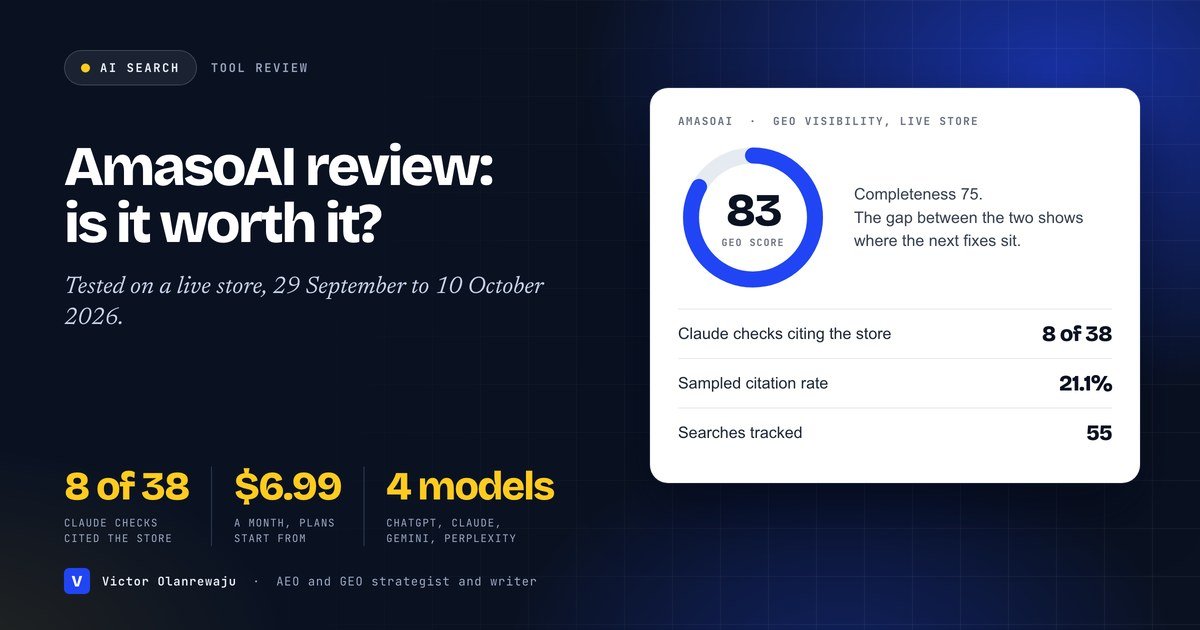
- Citation rate = checks in which your site appears as a source, divided by total checks. In the Lens & Co case, Claude cited the store in 8 of 38 checks, a 21.1% sampled citation rate. That figure was almost entirely from one keyword, so also compute it per question.
- Recommendation coverage = the share of recommendation questions on which you are named at all.
- Average position on the questions where a ranked list is returned.
- Share of voice = your mentions divided by all business mentions across the panel, which shows how you compare with competitors.
- Accuracy = the share of facts stated about you that match your own site.
Step 6: map the sources
For every answer, list which websites the assistant cited or consulted. Over a month you will see a pattern, which is a map of where to be present. In the Lens & Co study, AmasoAI logged the sites Claude consulted for its tracked searches, and the map was clear: marketplaces dominated.
| Site | Times consulted |
|---|---|
| Jumia | 27 |
| BaaWA | 8 |
| U-Buy | 8 |
| Jiji | 7 |
| Grok Brand | 6 |
| AllMart Nigeria | 5 |
| Lens & Co by Tiara | 5 |
| Mint Eyewear | 1 |
That table tells a store two things: marketplaces still dominate what Claude reads, and the next gains come from more pages that answer specific buying questions. In my Kigali research, broad questions mostly cited directories while specific questions cited businesses’ own sites, the same pattern from another market.
Step 7: check what the assistants say about you
Compare each factual claim an assistant makes about your business with your own site. This is where assistants earn their keep as an audit tool, because they show you which facts are being repeated and which are being guessed. In the Lens & Co answer, ChatGPT repeated delivery windows and the virtual try-on almost word for word, which proved the site was being read. It also quoted anti-blue light glasses “from approximately ₦14,000 for selected frame and lens combinations” while the store’s frame-only price starts at ₦10,000, a gap that a clear price page stating both numbers would close.
For each mismatch, ask where the assistant got it. Is your site unclear, is another source out of date, or is the assistant combining two facts? Fix the source, not the assistant.
Step 8: diagnose the pattern
| Pattern | What it usually means | First fix |
|---|---|---|
| Named but never cited | Assistants know you from other sources, but your pages give them nothing to cite | Publish specific answer-first pages |
| Cited but never named | Your content is useful, but your business is not presented as an answer | Strengthen entity signals, reviews and third-party presence |
| Neither | The basics are missing | Check crawler access, indexing and whether you have a page per buyer question |
| Described wrongly | Conflicting or missing facts | Fix the facts on your site, your Business Profile and your listings so they agree |
| Present in one assistant, absent in another | Different sources or crawlers | Check each assistant’s crawler and the sources it favours |
Step 9: connect it to pipeline
Visibility only matters if it brings enquiries. Add measures alongside the monthly panel:
- AI referral traffic. In your analytics, look at referrals from chatgpt.com, perplexity.ai, gemini.google.com and claude.ai. Similarweb found ChatGPT accounted for more than 80% of AI referrals to the top 1,000 sites, so expect ChatGPT to be the largest source. In the Lens & Co case, the dashboard recorded two AI-referred requests in 30 days, both from ChatGPT, which was small but the first sign that an assistant had sent visitors.
- Branded search and direct visits. Assistants often send people who then search for you by name, so a rise here is an effect you will not see in referrals. Some visits that start in an assistant arrive with no referrer and look like direct traffic.
- A “How did you hear about us?” field on forms and a standard question on calls, with “ChatGPT or another AI assistant” as an option.
- Conversion by source. Semrush’s modelled study estimates AI search visitors are worth 4.4 times organic visitors by conversion rate, with the caveat that its projections are extrapolations, so check your own numbers.
How do you monitor the monitoring?
Automation helps, but it fails quietly. In the Lens & Co study, scheduled ChatGPT checks failed because the OpenAI account ran out of credits, Gemini’s checks failed because the configured model name was out of date, and Perplexity was not configured, so only Claude, the one AI connected through MCP, produced a record. The result was a narrow data set, without history for the assistant that mattered most. Whether you test manually or with a tool:
- Confirm every scheduled check actually ran, every month.
- Keep API accounts funded and model names current.
- Run a manual spot check to compare against automated results.
- Record a baseline before any work begins.
If you run WordPress and want a tool to automate part of this, see my AmasoAI review, which covers what it recorded, what it cost and where it fell short.
How often should you repeat it?
Monthly is enough for most businesses, with a fresh check after any significant change to your site, your listings or your competitors. Keep the same panel each time so results are comparable, and add new questions as you learn what buyers ask, tagging the new ones so the original trend line stays clean. Review the results in a short monthly report: what changed, why you think it changed, and what you will do next.
What should you do with the findings?
- Fix access first. Crawlers and indexing.
- Close page gaps. A specific answer-first page for each question where you are not cited.
- Fix entity and facts. Consistent name, address, offer and prices everywhere, with matching structured data.
- Work the sources. Accurate presence on the sites the assistants cite.
- Re-test in 30 days and compare.
The full sequence is in how to get cited by ChatGPT, and where this sits among the disciplines is in SEO, AEO and GEO explained. If you would rather have it done for you, the free AI visibility audit checks ChatGPT, Gemini and Perplexity and emails you a plain-English report, or see my GEO strategist page.
How many repeats are enough?
There is no single right number, but a rule of thumb helps. With very few checks, one unusual answer can swing your numbers. The Lens & Co study ran 38 checks against Claude and still described the result as narrow, because almost all the checks used one keyword. As a practical guide, use at least three runs per question per assistant for a monthly report, and be cautious about reading small changes as trends. If your citation rate moves by a few percentage points between months with a small sample, that is likely noise. A sustained move over several months, or a large jump after a specific change, is a signal. Always report the number of checks next to the percentage.
What should a monthly report contain?
- Headline: citation rate, recommendation coverage and average position, each with last month’s figure.
- By assistant and by question type, because averages hide differences.
- Sources: the top sites cited this month and any changes.
- Accuracy: facts the assistants got wrong, and where they came from.
- Business metrics: AI referral visits, branded search, enquiries by source.
- Actions taken since last month, and what you expect them to change.
- Next month’s plan.
What testing mistakes distort the results?
- Leading questions. Putting your brand name in a question meant to test discovery guarantees you are mentioned.
- Testing while logged in. Your history and preferences shape the answer.
- Ignoring location. An assistant answering for a different country gives different businesses.
- Cherry-picking screenshots. Record every run, including the bad ones.
- Treating AI Overviews as constant. Google only shows them when its systems judge them additive, so absence in a check is data, not an error.
- Changing the panel every month. You lose the trend line.
- Forgetting the competitors. Your position only means something relative to who else is named.
The whole test on one page
- Write 10 to 30 buyer questions across four types: recommendation, selection, specific and brand.
- Set up a private window, signed out, location set to your market, web search on.
- Run every question in ChatGPT, Gemini, Claude, Perplexity and Google, three times each, in fresh sessions.
- Record date, assistant, question, run, named, position, cited, competitors, sources and accuracy; save screenshots.
- Compute citation rate, recommendation coverage, average position, share of voice and accuracy.
- Map the sources, and compare what is said with your own site.
- Diagnose the pattern and pick the next fix.
- Track AI referral visits, branded search and enquiry source alongside.
- Repeat monthly with the same panel.
Sources
- Pew Research Center: Google users are less likely to click on links when an AI summary appears
- SparkToro: in 2026, less than one third of Google searches still send a click
- Similarweb: AI referral traffic winners
- Semrush: AI search traffic and value study
- Google Search Central: AI features and your website
Frequently asked questions
How do I check if ChatGPT recommends my business?
Run a set of buyer questions in ChatGPT while logged out, with web search on and your location set to your market, and record whether your business is named, in which position and whether your site is cited. Repeat each question two or three times, because answers vary.
Why do ChatGPT answers change between runs?
AI answers vary between runs, users and models. That is why I record the date, repeat questions and look at trends over months instead of trusting a single result.
How often should I test AI visibility?
Monthly is enough for most businesses, plus a fresh check after major site changes. Keep the same questions so results are comparable.
How do I know if AI visibility is bringing me customers?
Track visits from assistant domains such as chatgpt.com, watch branded search, and add a 'How did you hear about us?' field to forms and calls. Some assistant-driven visits arrive without a referrer and appear as direct traffic.
What should I record before I start improving anything?
A baseline: the date, assistants, questions, whether you are named, your position, whether you are cited, which sources appear and which facts are wrong. Without a baseline, you cannot show change later.