Get cited and recommended by ChatGPT, Gemini, Claude and Perplexity
When your buyers ask an AI assistant who to choose, I make sure your pages are used as the source and your business is named on the shortlist. Then I track it through to enquiries and revenue.
In short
AI citation is when an assistant uses your page as a source for its answer. AI recommendation is when it names your business as the answer to a buyer’s question. Generative engine optimization (GEO) earns both. Victor Olanrewaju is a GEO strategist in Kigali, Rwanda. His consultancy Vatam moved LAGE Lightings from seventh to first in ChatGPT in three months, and ChatGPT now lists Lens & Co by Tiara as its first pick for blue light and photochromic glasses in Nigeria.
Two different things happen inside an AI answer, and a business needs both. GEO works on each one.
Cited
Your page is used as a source behind the answer, usually with a link.
What it wins
Trust, referral visits and a place among the sources assistants return to.
How it is built
Answer-first pages, original data, clear facts and a named expert behind each page.
Recommended
Your business is named in the answer, often in a short ranked list.
What it wins
A shortlist position, more brand searches and more enquiries.
How it is built
A consistent entity, third-party mentions, reviews and accurate listings.
How it improves your pipeline
Buyers now ask an assistant before they open a search result, and the assistant hands them a short list. If you are not on it, you are not in the running. If you are first, you get the first call.
Pew Research Center analysed browsing data from 900 US adults in March 2025. Users who saw a Google AI summary clicked a traditional result in 8% of visits, against 15% for users who did not. When fewer people click through, being named inside the answer carries more of the value.
1A buyer asks“Best stores to buy blue light glasses in Nigeria.”
Citation2The assistant cites sourcesYour page is used as evidence and linked.
Recommendation3The assistant names a shortlistYour business is recommended, ideally first.
4The buyer actsThey visit, call, message or walk in.
5Pipeline and revenueEnquiries become customers.
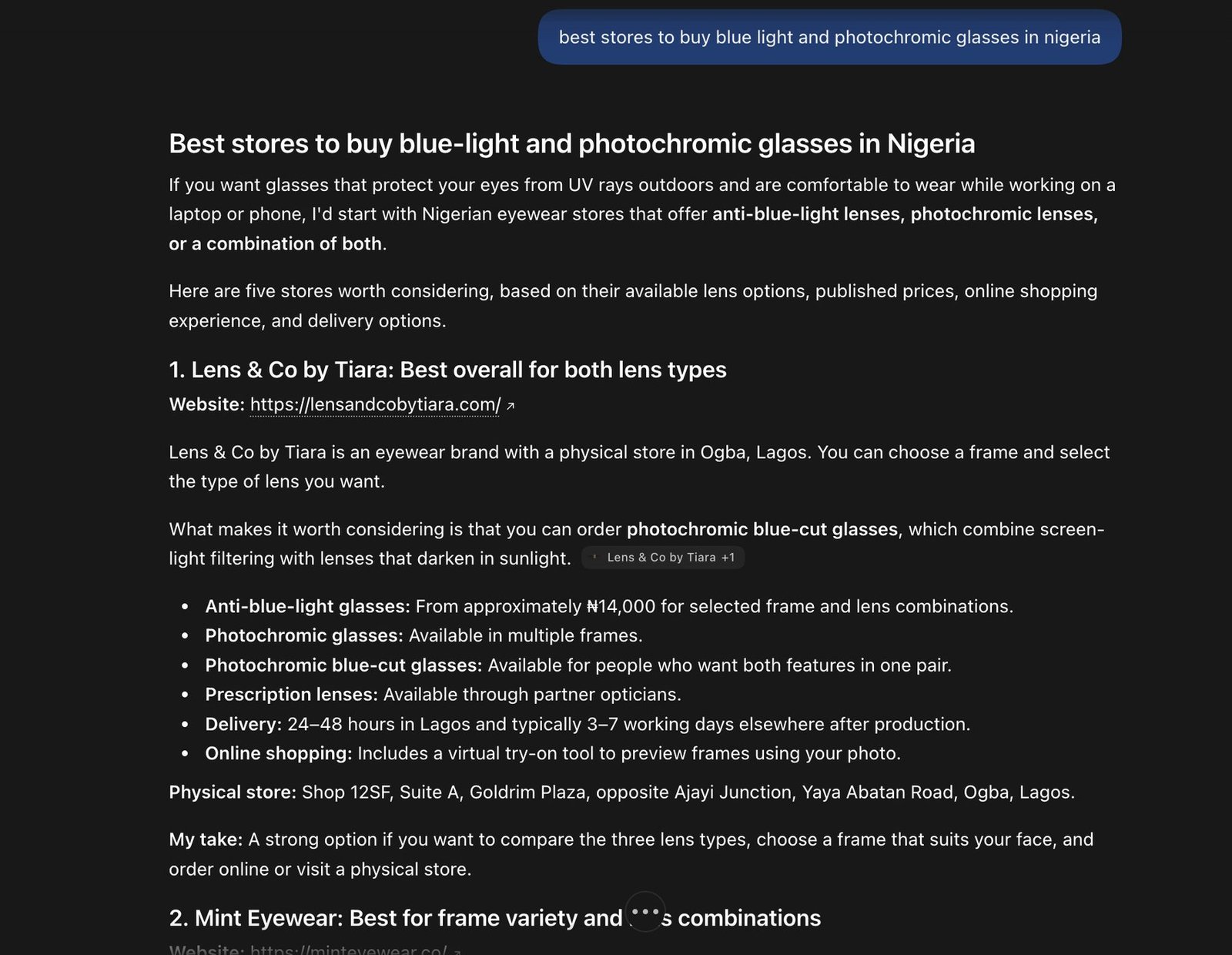
Evidence: ChatGPT recommending a client
ChatGPT’s answer to “best stores to buy blue light and photochromic glasses in nigeria”, October 2026. Lens & Co by Tiara is named first, as “best overall”, with a link to its website. In July 2026 none of the AI engines we tested cited it.
Alongside this, the store reports more website visits, more walk-in clients at its Lagos shop and a jump in revenue from organic search.
Evidence: moving up the shortlist
LAGE Lightings in ChatGPT for “luxury chandeliers in Lagos”
1
2
3
4
5
6
7
Position in the answer (1 is first)
July 2026: 7th
October 2026: 1st
By October 2026 LAGE Lightings was the first of five picks in ChatGPT. Gemini (September 2026) and Claude (October 2026) also name it first for luxury lighting in Nigeria. Sessions from ChatGPT reached 34 in 61 days to 12 October (up 240%), total sessions are up 233% year on year, and LAGE Lightings has done nine figures in naira revenue as a business.
How I earn citations and recommendations
Baseline: test a fixed panel of buyer questions across ChatGPT, Gemini, Claude, Perplexity and Google AI Overviews, and record who is cited and who is named
Entity: make who you are, what you sell and where you operate unambiguous across your site, schema and profiles
Pages: write an answer-first page for each buyer question, with facts and sources an assistant can verify
Sources: earn mentions in the places assistants cite, through digital PR, reviews and accurate listings
Access: check that AI crawlers are allowed and publish an llms.txt summary
Track: repeat the panel every month and report what changed
How I connect it to leads and revenue
Some visits that start in an assistant arrive with no referrer, so they look like direct traffic. That is why I combine analytics with the panel and with asking customers directly.
AI answer share: whether you are cited, named and in which position, tracked monthly
AI referral traffic: visits from assistants such as chatgpt.com, perplexity.ai and gemini.google.com in your analytics
Brand demand: branded searches and direct visits, which often move when assistants name you
Enquiry source: a “How did you hear about us?” question on forms and calls, so AI-influenced leads are counted
Revenue: leads and orders tied back to those sources wherever your data allows
Crawler access, in plain terms
OpenAI documents separate crawlers for different jobs: OAI-SearchBot for search results, GPTBot for training and ChatGPT-User for actions taken by a user. A site that blocks the search crawler can drop out of ChatGPT’s search answers, so I check robots.txt as part of every baseline. The research behind the term GEO, a 2023 paper by Aggarwal and colleagues, reported that optimization methods can boost visibility in generative engine responses by up to 40% in its experiments, with results varying by domain.
The honest limits
Nobody controls what an assistant says. Answers change between runs, users and models, so I test repeatedly, record the date and treat each result as a snapshot. I do not guarantee a mention. I guarantee the baseline, the work and the reporting.
Where it pays most
It pays most where one new customer is worth a lot: hotels and lodges, property, finance, premium retail and professional services. Buyers in those markets ask an assistant before they open a search result.
Proof from my work
7 to 1
LAGE Lightings in ChatGPT between July and October 2026, with Gemini and Claude also naming it first
0 to #1
Lens & Co by Tiara in ChatGPT for blue light and photochromic glasses in Nigeria, with more website visits and walk-in clients
9 figures
in naira revenue for LAGE Lightings as a business, with sessions up 233% year on year
“I was surprised we could beat our competitors since we had tried for years to do it. Victor came in, and within weeks, we were getting inquiries from top architects, 4-star hotels real developers, eventually leading to some of the biggest deals we've ever closed.”
The things people ask before they hire a copywriter or an SEO.
Which AI assistants do you optimize for?
I test and report on ChatGPT, Gemini, Claude, Perplexity and Google AI Overviews, because buyers use all of them and each draws on different sources.
What is generative engine optimization (GEO)?
GEO is the practice of making a business easy for AI assistants such as ChatGPT, Gemini, Claude and Perplexity to find, trust and recommend. It covers your pages, your facts and the third-party sources the assistants cite.
Can you guarantee ChatGPT will recommend my business?
No. Answers change between runs, users and models, and nobody outside the AI companies controls them. I guarantee a measured baseline, the work that moves the signals and monthly reporting. For one example, ChatGPT moved LAGE Lightings from seventh to first between July and October 2026.
How do you measure GEO?
I run a fixed panel of buyer questions across the main assistants every month, record who is named and which sources are cited, and compare against the baseline. Where your analytics allow, I also tie the changes to enquiries and sales.
How is GEO different from AEO?
AEO focuses on being the direct answer in search features such as snippets and AI Overviews. GEO focuses on being named and cited inside AI assistant answers. They share the same foundations, so I run them together.
What is the difference between AI citation and AI recommendation?
A citation is when an AI assistant uses your page as a source for its answer, usually with a link. A recommendation is when it names your business as the answer to a buyer’s question, often in a short list. Citations build trust and referral visits. Recommendations win shortlist positions and enquiries. GEO works on both.
How does being cited and recommended by AI improve my pipeline?
Buyers increasingly ask an assistant before they open a search result, and the assistant gives them a short list. Being on it puts you in the running, and being first earns the first enquiry. I track the effect through a monthly panel of buyer questions, AI referral traffic, branded searches, a “How did you hear about us?” question on your forms, and leads and revenue where your data allows. For example, LAGE Lightings is first in ChatGPT, Gemini and Claude and has done nine figures in naira revenue as a business, and Lens & Co by Tiara reports more website visits, more walk-in clients and a jump in organic revenue. Results vary by business and are never guaranteed.
What does a content strategist do for SEO and AI search?
A content strategist decides what a business should publish, for which buyer question and in what order, so each page can earn a Google ranking or an AI citation and lead a reader towards a purchase. In practice that means mapping buyer questions, giving each one its own answer-first page, keeping facts consistent across the site and measuring rankings, citations and enquiries every month.
Start here
Tell me what you want to be found for.
Tell me what a new customer is worth to you and the search you want to win. I read every message myself and reply within one working day. Want to see where you stand first? Ask for the free AI visibility audit.
1I read your message myself, usually the same day.
2You get a reply within one working day with my first read and an offer of the free audit.
3If it fits, the scope and price are agreed in writing before any work starts.
“Within weeks, we were getting inquiries from top architects, 4-star hotels real developers, eventually leading to some of the biggest deals we've ever closed.”